







Why has NeoCloud seen the largest gains in this round of US tech stock rebound?
Logically, capital is pricing in a type of AI infrastructure equity instrument with multiple layers of leverage: computing capacity that is already under contract and can be delivered quickly.
If AI demand revisions trend upward, NeoCloud’s revenue expectations, financing capacity, and shareholder equity value can all rise simultaneously. This gives these stocks significant upside elasticity during tech rallies, with power, data centers, financing, and valuation elasticity collectively forming this leverage.
The bottleneck in AI is shifting. Initially, GPUs were the scarcest resource, followed by HBM and high-speed networking. Now, what customers truly lack is a comprehensive, deployable capability: securing GPUs, having adequate power, completing data center construction, interconnecting networks, and delivering large-scale clusters within months. NeoCloud sits precisely at this gap.
Capital is Buying “Powered-On Compute Factories”
NeoCloud offerings typically include GPU clusters, networking, liquid cooling, data centers, power access, and operational services. Customers are purchasing large-scale compute capacity that can immediately run AI training and inference workloads. This distinction is important. GPUs can be procured, but power capacity, land, substations, data center permits, and network access cannot be replicated quickly. Major cloud providers have capital and customers, yet they are equally constrained by construction timelines; some AI companies prefer to retain flexibility and avoid concentrating all their demand with a single hyperscaler.
Consequently, NeoCloud providers with existing power and rapid deployment capabilities have become the “accelerators” for AI infrastructure investment. The market assigns them higher valuations because these resources possess two key characteristics:
· Scarcity: Available power and deliverable data center capacity are limited;
· Contractability: Customers are willing to sign multi-year capacity contracts with minimum commitments.
When scarce resources can be locked in via long-term contracts, the market reinterprets them from ordinary IT service revenue into cash-flow assets with infrastructure properties.
Earnings Changed the Market‘s View of the Business Model
Previously, the main market skepticism toward NeoCloud was straightforward: Given the massive capex required for GPUs and data centers, would these companies fall into a perpetual cycle of “continuous financing and continuous cash burn”? Recent earnings reports have provided a positive answer.
CoreWeave’s Q2 revenue reached $2.575 billion, disclosing a backlog (signed but unrecognized expected revenue) of approximately $104 billion; Nebius reported $3 billion in AI Cloud ARR (annualized recurring revenue) and disclosed several large long-term contracts. The market tracks quarterly revenue but focuses more on the complete business loop emerging behind these numbers:
AI customers sign long-term capacity contracts
→ Some customers provide prepayments or minimum payment commitments
→ Companies find it easier to obtain debt and equipment financing
→ New GPUs, data center space, and power capacity come online
→ Revenue and EBITDA (earnings before interest, taxes, depreciation, and amortization) grow
→ Financing capacity and expansion capability continue to improve
This shifts NeoCloud’s narrative from “high-capex GPU leasing companies” toward “order-backed AI infrastructure operators.” As long as orders, financing, and delivery remain seamlessly connected, growth exhibits clear flywheel characteristics.
Why Capital Didn’t Prioritize Memory and the Big Three Clouds
Capital allocation reflects discrepancies in expectations across different sectors. Memory leaders benefit from AI demand, with robust momentum in HBM, DRAM, and related products. However, the market is beginning to worry about supply ramp-ups, elevated prices, peaking profit margins, and whether previous optimistic expectations are already fully priced into stocks. Even with strong earnings, if forward guidance doesn’t include further upward revisions, stock prices can come under pressure.
The challenge for memory companies lies in their cyclical nature. The market trades on price, shipment volume, and gross margin trajectories over the coming quarters; when supply potentially catches up with demand and average selling prices may decline, strong current performance struggles to sustain valuation expansion. HBM/DRAM, NAND/SSD, and HDD represent different sub-cycles, so not all memory stock performance can be attributed to a single cause.
The big three clouds—Microsoft Azure, Amazon AWS, and Google Cloud—possess more stable cash flows, customers, and technical capabilities, and are core beneficiaries of AI investment. However, their AI businesses are diluted by massive revenue bases from advertising, enterprise software, e-commerce, and consumer operations. It also takes longer for new AI capital expenditures to translate into group-level margin improvements. For capital seeking upside elasticity, a single large NeoCloud contract often has a greater marginal impact on revenue and valuation than an equivalent-sized order would on the overall valuations of the big three clouds.
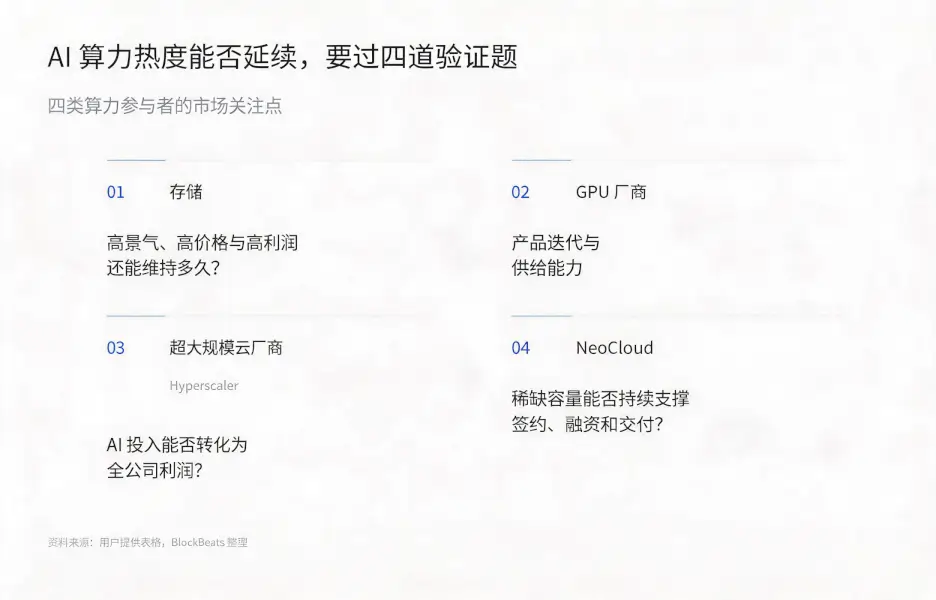
NeoCloud sits in between: lower revenue bases, pure AI exposure, rapid order growth, and every new long-term contract can directly support the next round of financing and expansion. Capital can easily view these as high-elasticity AI infrastructure plays. The current market logic can be summarized as:
NeoCloud is, Essentially, AI Infrastructure Leverage
Understanding NeoCloud’s leadership requires understanding its leverage effect. Buying shares in these companies means holding an equity asset highly sensitive to AI compute demand, deliverable capacity pricing, and financing conditions. This leverage encompasses three layers.
The first is operating leverage. Upfront investments in GPUs, data centers, power access, networking, and operations are substantial, with many costs becoming relatively fixed once capacity is online. As utilization of activated clusters rises and unit capacity pricing improves, incremental revenue converts into profit at a faster rate, resulting in significant marginal margin improvements.
The second is financing leverage. Long-term contracts, take-or-pay commitments, and customer prepayments enhance attractiveness to lenders and equipment financiers. Companies can leverage a portion of equity capital to fund larger GPU, data center, and power investments; once new capacity begins generating revenue, it supports the next round of construction.
The third is equity leverage. NeoCloud companies typically have smaller revenue bases and market capitalizations than the big three clouds, yet hold higher proportions of fixed assets and debt on their balance sheets. When a large contract simultaneously boosts revenue expectations, utilization, and financing availability, the market’s revaluation of shareholder equity can be steep. Post-earnings stock surges often stem from the combined effect of upward earnings revisions and multiple expansion.
These three layers of leverage create a positive feedback loop during upward phases:
Larger long-term contracts
→ Easier access to financing and capacity expansion
→ Higher utilization and operating profits
→ Improved equity value and financing capacity
→ More contracts and next-round expansion opportunities
The same mechanism amplifies downside risks. If customers delay, utilization declines, GPU or power delivery lags, or debt costs rise, fixed costs and financing obligations compress shareholder returns. Therefore, the market’s pricing of NeoCloud’s high elasticity also reflects its high execution requirements.
Order Visibility is the Core of This Re-rating
NeoCloud’s most attractive feature lies in revenue visibility. When customers sign take-or-pay contracts, they bear certain minimum payment obligations even if actual usage fluctuates in the short term. For operators, this revenue is more predictable; for creditors, these contracts enhance the feasibility of asset financing.
The market will therefore continuously track several metrics:
· Contract duration, binding nature, and customer creditworthiness;
· The gap between activated MW (megawatts) and contracted MW;
· Revenue per MW versus capex per MW;
· Customer prepayment ratios and payment cadence;
· Utilization rates, renewal rates, and customer concentration;
· Debt interest rates, debt maturities, and future financing capacity.
Among these, “activated capacity” is particularly critical. Contracted MW represents demand, but only MW that are powered on, installed, and generating billings contribute to revenue and cash flow.
This is Also a Revaluation of Power Assets
The most valuable insight regarding NeoCloud in the community is shifting focus from GPU counts to Power (power capacity). GPU supply expands with procurement by NVIDIA, AMD, and cloud providers; however, high-quality power capacity forms much more slowly. It involves power grids, substations, land, permits, data center construction, and regional network conditions.
Whoever secures sufficient power earlier can convert GPUs into sellable compute capacity sooner. This explains why some companies transitioning from Bitcoin mining have entered this theme: they already possess power resources, land, and infrastructure, and only need to shift assets from mining loads to AI loads. Of course, resource foundations don’t guarantee commercial success; ultimately, customer, financing, and delivery capabilities determine outcomes.
NeoCloud’s leadership in the tech rally reflects a market-wide reordering of the AI infrastructure value chain.
Currently, capital most highly values compute capacity that combines GPUs, power, data centers, and long-term customer contracts with rapid delivery capability. This capacity captures AI capital expenditure while possessing stronger contract-based characteristics than pure chips or components; it offers both high-growth elasticity and a premium for infrastructure scarcity. Going forward, whether NeoCloud continues to outperform depends on a fundamental question: can these massive orders be converted on time into powered-on clusters, recognized revenue, and cash flows that cover capital costs.
This article is sourced from the internet: Why has NeoCloud seen the largest gains in this round of US tech stock rebound?
Western Digital, the U.S. storage company, reported revenue of $3.747 billion in its latest FY2026 Q4 earnings release. On a GAAP basis, earnings per share came in at $8.21. According to the company’s announcement, the mark-to-market gain on its SanDisk stake was also recorded in the income statement. This gives Western Digital’s results two possible interpretations. The first is that the core HDD business, after the flash memory business was spun off, is selling more and making more money. The second is that the value of its retained SanDisk stake fluctuates with market prices, pushing GAAP profit to a level not suitable for directly measuring the hard drive business. This is not a one-quarter spike Let’s start with the most basic question. Did this growth happen in just one quarter?…
Related articles































 English
  繁體中文
繁體中文  简体中文
简体中文