







Author: Azuma (@azuma_eth)
On the morning of August 17, Beijing time, Bloomberg reported that payment giant Stripe has finalized its acquisition of AI infrastructure startup OpenRouter(fun fact: OpenRouter co-founder Alex Atallah previously founded OpenSea), with the deal value exceeding $7 billion, though falling short of the $10 billion figure that had been rumored in the market.
While the progress of this acquisition was hardly a secret, and the market was already familiar with the strategic alignment between the two parties, the confirmation of the deal still triggered a wave of skepticism. The core question: Is OpenRouter really worth this much money?

Odaily note: Jason, a prominent influencer and well-known investor with millions of followers, has also expressed confusion over this deal.
After all, when OpenRouter completed its $113 million Series B funding round at the end of May this year, its valuation was “only” around $1.3 billion. In just over two months, Stripe has had to pay more than five times that amount in hard cash. At the same time, OpenRouter’s current revenue scale also appears insufficient to justify such a high price. The market estimates the platform’s current annualized revenue at roughly $50 million, which means the $7 billion acquisition price corresponds to an astonishing price-to-sales ratio of 140x.
More critically, OpenRouter’s core business does not appear to possess any significant technical moat. At its essence, OpenRouter provides a unified entry point for AI models—developers can access OpenAI, Anthropic, Google, and a wide range of open-source models through a single API, with OpenRouter handling routing, failover, and price optimization across different models and inference providers. In theory, model vendors, cloud service providers, and other AI infrastructure companies could all replicate similar functionality.
As a result, the market has naturally split into two radically different assessments. One view holds that Stripe may have spent over $7 billion on a middle layer that looks attractive but isn’t particularly substantial. The opposing view, however, argues that this very “middle layer” is precisely what’s worth buying—because what truly makes OpenRouter valuable may never have been the code that forwards API requests, but rather the AI inference traffic, users, payment relationships, and the data and distribution capabilities it has already aggregated.
The Bear Case: Limited Moat, Merely a Transitional Product of Its Era
Following the deal announcement, market skepticism has centered on one question: Is model routing itself a business worth betting on for the long term?
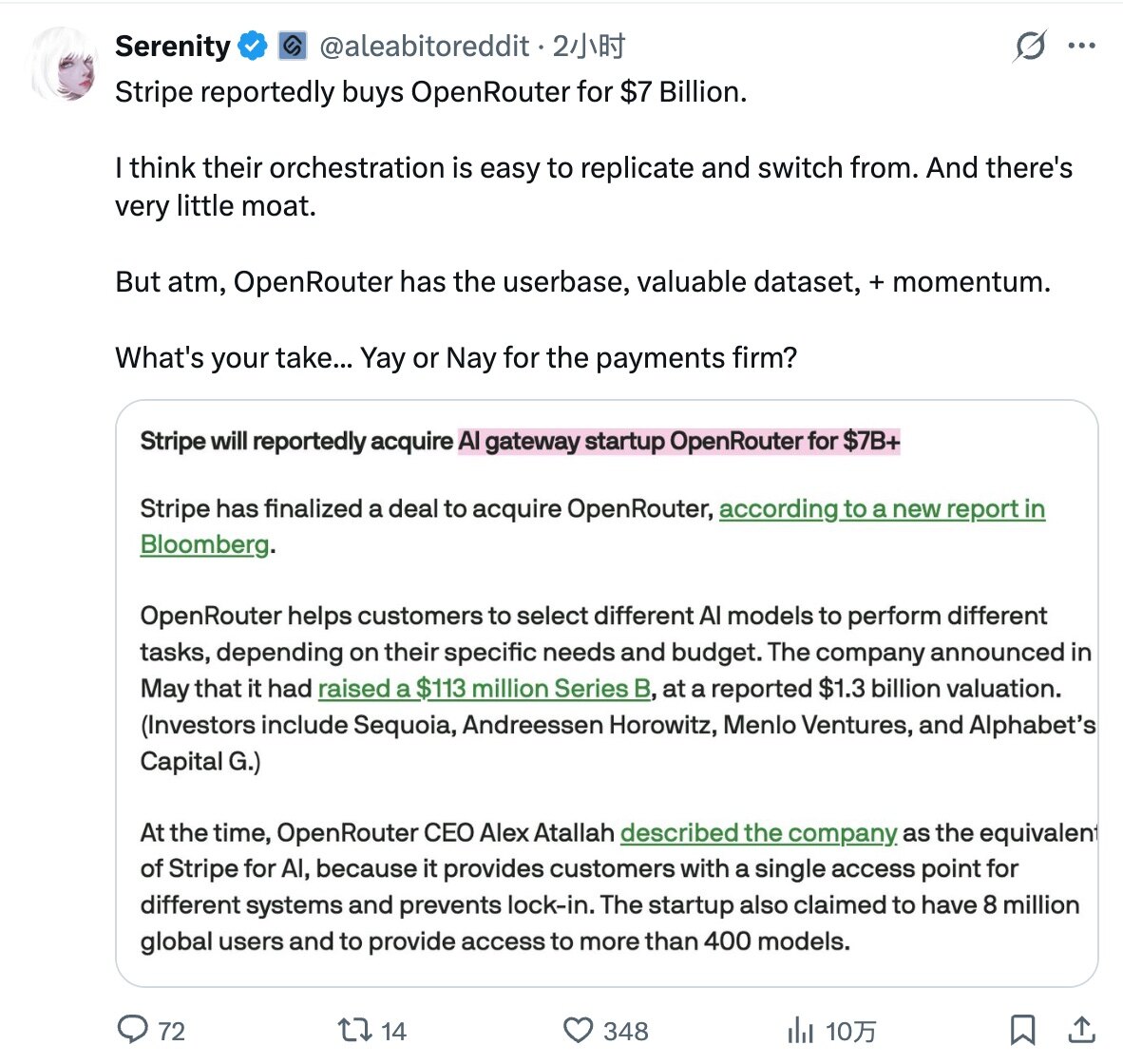
Serenity, known in the crypto community as the “white-haired stock guru,” posted on X that OpenRouter’s model orchestration and scheduling capabilities are easily replicated and replaced, leaving “virtually no moat,” while also acknowledging that, at least for now, OpenRouter boasts a massive user base, highly valuable datasets, and strong growth momentum.
This is actually the core tension within the opposition camp—no one denies that OpenRouter has some value today; the doubt lies in whether that value can persist for a decade.
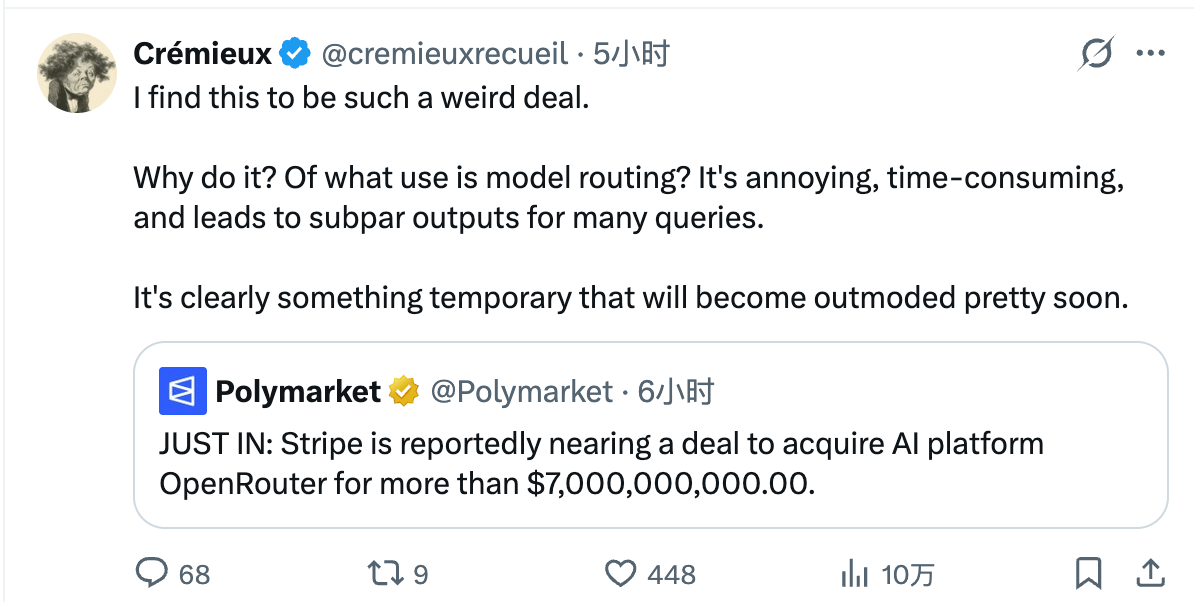
Crémieux, another tech KOL with over 300,000 followers, raised a more direct question: Given that model routing itself adds complexity to API calls and may produce suboptimal results for many requests, why is a standalone routing layer even necessary? If the number of models, pricing, and access methods gradually stabilize in the future, will this layer of intermediaries gradually become redundant?
From this perspective, the biggest risk OpenRouter faces isn’t even “competition from other relay services,” but rather: could this business simply be a transitional product that emerges at a certain stage of AI infrastructure development? After all, OpenAI, Anthropic, Google, cloud providers, and even Stripe itself all have the capability to progressively integrate multi-model calls, fallback, price optimization, and usage management directly into their own products. If every model platform eventually ships with its own built-in Router, what justification would OpenRouter have to continue charging fees as a middleman over the long term?
OpenRouter’s current business model is actually quite simple—the platform doesn’t mark up the underlying model prices but instead charges a 5.5% platform fee when users purchase Credits. Therefore, in the eyes of the opposition, OpenRouter looks more like an AI traffic intermediary with explosive growth but a questionable commercial moat.
And $7 billion seems far too expensive for an “intermediary.”
The Bull Case: Don’t Think of It as a Relay Station—Imagine a Toll Booth for the AI Era
Of course, plenty of professionals hold the exact opposite view. If you try to understand OpenRouter purely through the lens of a “model relay station,” you might be underestimating this deal from the start.
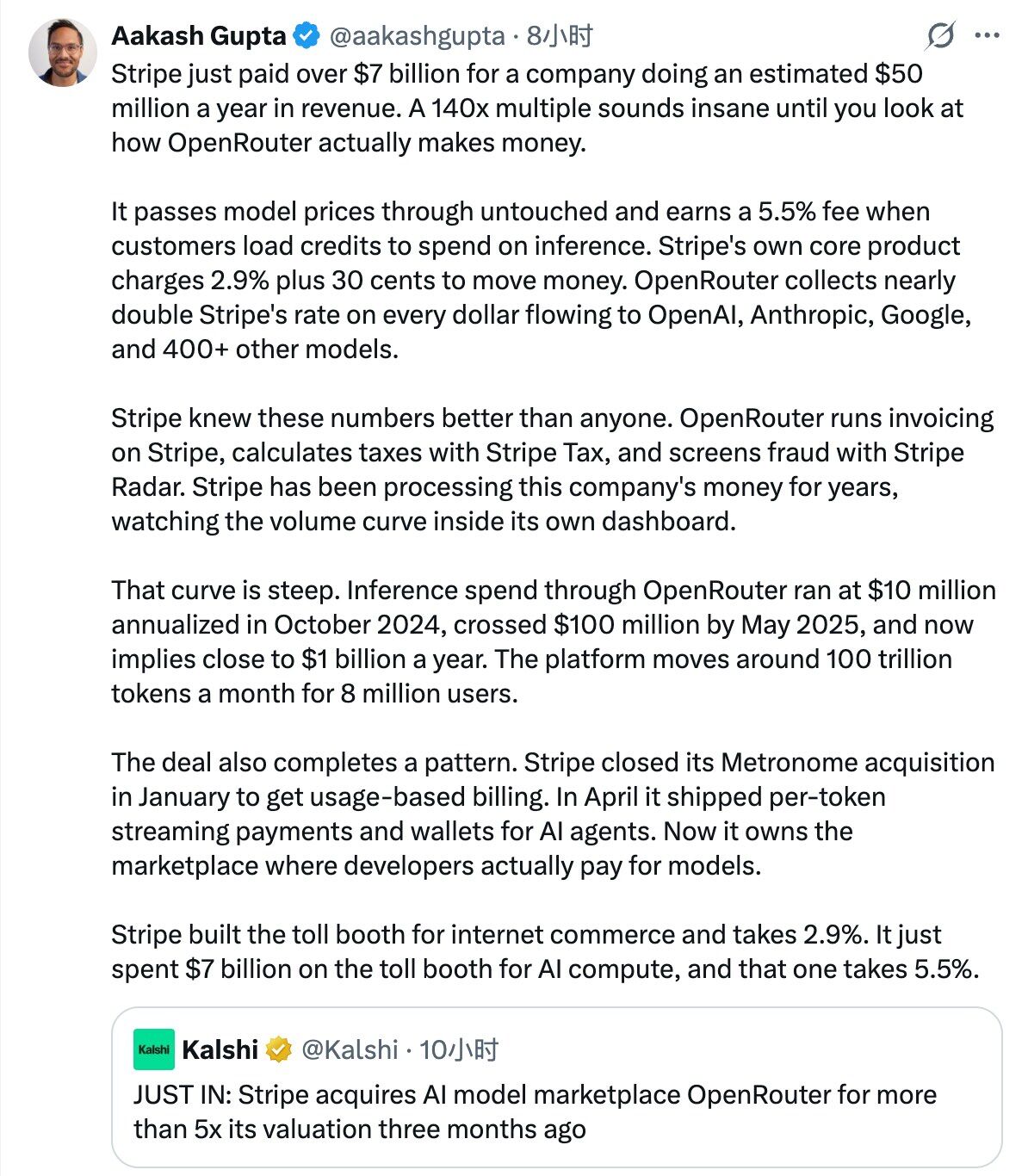
Aakash Gupta, a Silicon Valley product growth expert, offers a particularly representative perspective. In Gupta’s view, the 140x price-to-sales ratio does sound crazy, but the key point is that OpenRouter doesn’t generate revenue the way a traditional software company does—the 5.5% platform fee means that for every $1 flowing to OpenAI, Anthropic, Google, and 400+ other models, OpenRouter extracts 5.5%. By comparison, Stripe’s own core business (payment processing) charges only 2.9%—the former is nearly double the latter.
More importantly, Stripe is arguably the party best positioned to see the true picture of this business—because OpenRouter’s payment infrastructure runs on Stripe, its tax calculations use Stripe Tax, and its fraud prevention relies on Stripe Radar. Inside its own dashboard, Stripe has witnessed firsthand the rapid, steep upward trajectory of OpenRouter’s payment volume curve.
From this perspective, what Stripe is buying is not a simple API proxy but a rapidly expanding AI inference transaction channel. Routing may be easy to replicate, but what’s genuinely hard to copy is the user base, request volume, and data that have already aggregated on top of that routing layer.
Gupta closed with a brilliant analogy—Stripe built the toll booth for internet commerce, and now it’s spending $7 billion to buy the toll booth for the AI inference era. If this analogy ultimately holds, then today’s seemingly rich valuation isn’t paying for OpenRouter’s current revenue, but rather for the future scale of the AI inference market and the “tolls” OpenRouter can collect as the traffic gateway.
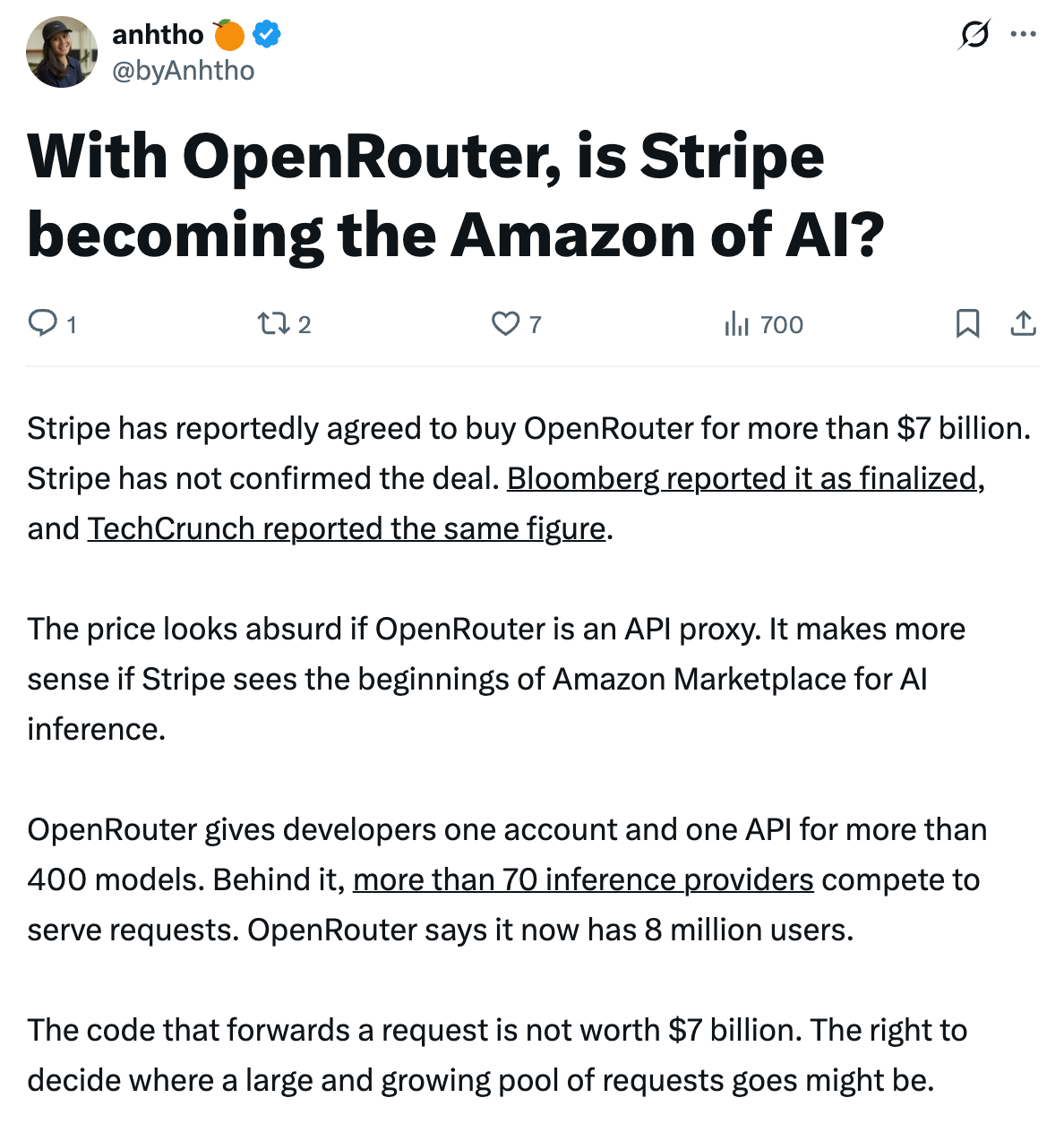
Lago co-founder byAnhtho offered a similar judgment from another angle: if you view OpenRouter merely as an API proxy tool, the price is certainly absurd. But if Stripe sees the embryonic form of an “Amazon” in the AI inference space, the logic becomes entirely different—the code that simply forwards requests may not be worth $7 billion, but the scheduling power that determines where massive and ever-growing AI requests ultimately flow might actually be worth that price.
An Unfinished Debate
When you place the two sides side by side, the essence of this debate is really a disagreement over where the value anchor lies in AI infrastructure.
If you view OpenRouter as an AI middleman with annualized revenue of just $50 million and limited technical barriers, then a 140x price-to-sales ratio is clearly hard to justify. But if you view it as a critical traffic gateway that is forming between AI applications and model/inference providers, then today’s revenue scale may not be the most important metric after all.
At the end of the day, the market isn’t really arguing about what OpenRouter is worth today, but rather how large the future AI inference market will grow, and whether OpenRouter can hold that “toll booth” position over the long term.
In the internet era, Stripe became the “toll booth” of the commercial world through payment infrastructure. Now, it’s attempting to use over $7 billion to pre-purchase another “toll booth” for the AI inference era. Whether this deal was overpriced, or whether Stripe has spotted the next ticket into AI infrastructure ahead of everyone else—only time will tell.
This article is sourced from the internet: OpenRouter worth $7 billion?
Related: SK Hynix’s Most Profitable Quarter Ever—Why Is It Still “Below Expectations”?
Original by Odaily (@OdailyChina) Author: Azuma (@azuma_eth) On July 29, Beijing time, SK Hynix released its second-quarter 2026 financial report. The financial data shows that SK Hynix recorded revenue of 79.32 trillion KRW in the second quarter, a 257% year-over-year increase and a 51% quarter-over-quarter increase; operating profit reached 60.54 trillion KRW, up 557% year-over-year and 61% quarter-over-quarter, with the operating margin further rising to 76%, hitting an all-time high. Including a one-time investment gain of 62.166 trillion KRW from the partial sale of Kioxia shares, the company’s net profit reached 93.92 trillion KRW. In any industry, this would be a report card shocking enough to shake the market. However, the initial reaction from the capital markets was quite the opposite. As both revenue (actual 79.32 trillion KRW vs. market…
Related articles
































 English
  繁體中文
繁體中文  简体中文
简体中文