







SpaceX Faces Epic Stock Unlock: $116 Billion in Shares Become Liquid on August 6
Original source: Wall Street CN
The first lockup expiration following the largest IPO in history is approaching, and the market is assessing its potential impact on the stock price.
According to SpaceX’s prospectus, a maximum of approximately 911.5 million shares held by insiders will be unlocked on August 6, representing a market value of around $116 billion. This timing coincides with just two days after the company releases its first-ever quarterly earnings report. By the end of the year, the total number of tradable shares will surge from the current ~639 million to 5.33 billion.
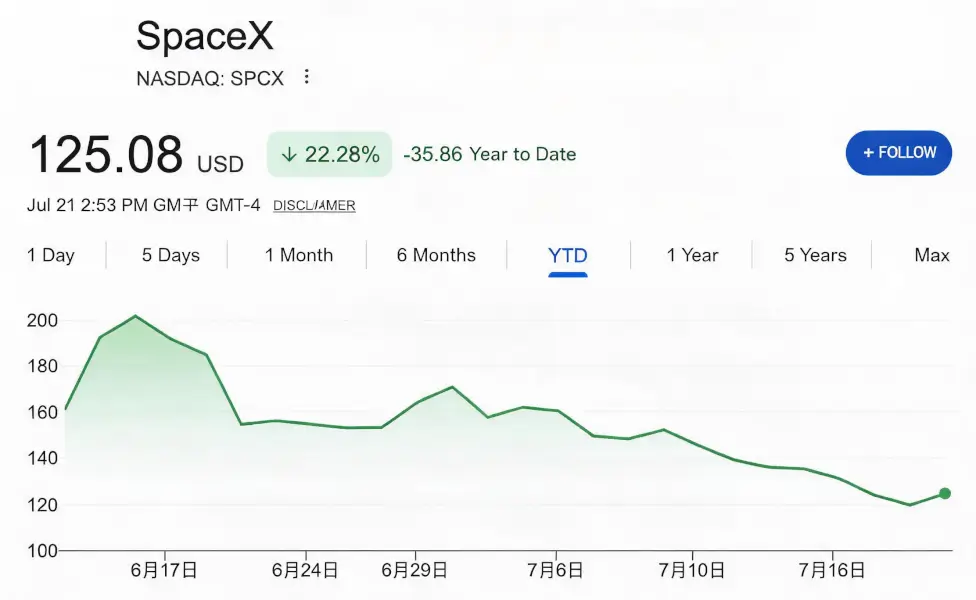
Faced with this massive unlocking scale, SpaceX’s stock price is under significant pressure. Since its closing high on June 16, the stock has fallen by 37%, erasing over $425 billion in market capitalization. As of Tuesday’s writing, it was up 3.8% in intraday trading, potentially ending a seven-day losing streak.
According to S3 Partners data, approximately 30% of the currently tradable shares are sold short, with short sellers sitting on paper profits of about $7 billion.
The uniqueness of this lockup expiration lies in the fact that SpaceX did not follow the conventional 180-day uniform unlocking period post-IPO. Instead, it designed a phased release schedule, aiming to avoid a sharp disruption to market supply-demand dynamics while expanding the public float.
Phased Unlocking: An Unusual Structural Arrangement
Compared to traditional IPO lockup expirations, SpaceX’s multi-tranche, staggered release mechanism is rare in the market. The prospectus shows that the initial unlocking of over 900 million shares on August 6 is only the first tranche. In the subsequent months, the unlocking scale will continue to expand. By early December, the total number of shares available for trading in the market will jump to 5.33 billion, an increase of more than seven times compared to the current level.
Notably, a conditional trigger mechanism exists after August 6: If SpaceX’s stock price reaches $175.50 on at least five of the ten trading days before the earnings release, an additional maximum of 455.8 million shares will be eligible for trading immediately after the results are announced.
Based on Monday’s closing price of $119.85, reaching this threshold would require the stock to rise over 46% from current levels, a feat widely considered difficult by the market.
Elon Musk holds approximately 7.8 billion shares, representing about 60% of the total shares outstanding. The prospectus indicates that the lockup period for his shares extends to more than a year after the company’s listing in June, meaning they are not expected to be a source of selling pressure in the near term.
Early Investors Face Lucrative Exit Opportunities
Despite the recent significant stock price correction, early shareholders still hold substantial unrealized gains compared to pre-IPO valuation levels. SpaceX was valued at approximately $400 billion in a private fundraising round about a year ago.
Earlier this year, SpaceX completed its acquisition of xAI. According to Bloomberg, the deal assigned SpaceX a substantial overall valuation of $1 trillion, while xAI was valued at $250 billion. This transaction generated billions of dollars in paper profits for numerous investors, whose equity stakes in the public company are now worth several times their initial investment.
The phased unlocking schedule implies that early private market investors and insiders will have exit windows opening over the coming months, allowing them the option to monetize their positions in batches at potentially different price levels.
Bearish Pressure Mounts, IPO Market Sentiment Dampened
The anticipation of the lockup expiration, combined with valuation debates, has triggered a significant influx of short sellers. According to S3 Partners data, approximately 30% of the available public float is currently shorted, with short sellers holding paper profits of around $7 billion.
Over the past 12 trading sessions, SpaceX’s stock has closed lower on 10 occasions. The triggers include not only the expectation of the lockup expiration but also the abortive launch of the Starship rocket due to an engine failure, as well as a broader market rotation of funds away from AI-related concept stocks.
SpaceX’s sharp volatility has had a spillover effect on the overall new issue market.
According to Bloomberg data, the weighted average return for companies that have gone public this year has fallen to negative 4.4%. Even excluding SpaceX and SK Hynix, the overall return for this year’s new listings is only 5.3%, significantly underperforming the S&P 500 index’s gain of 9.4% over the same period.
Finding a balance between releasing liquidity and stabilizing the stock price will be the core challenge facing SpaceX and its underwriting team in the coming months.
This article is sourced from the internet: SpaceX Faces Epic Stock Unlock: $116 Billion in Shares Become Liquid on August 6
Author: Golem (@web 3_golem) Last Friday, SpaceX closed its first trading day at $160.95, giving it a market cap of $2.1 trillion. While SpaceX still set a record for the largest IPO in U.S. stock market history, the result fell short of full expectations compared to the market sentiment built up before the listing. Some research institutions, like CFRA, even assigned a “Sell” rating to SPCX, suggesting Musk’s “Mars story” was well-received but not well-bought. (Related reading: After SpaceX’s Debut: A $2.1 Trillion Market Cap, Is It Still Worth Chasing?) Amid market concerns, SPCX surprised everyone at the U.S. stock market open on Monday. According to Gate’s U.S. stock data, SPCX rallied throughout the session, eventually closing at $192.5, a gain of 19.6%. The closing price was also the day’s…
Related articles

































 English
  繁體中文
繁體中文  简体中文
简体中文