







a16z: The U.S. needs to pass the CLARITY Act to seize standard-setting power for stablecoins and tokenization
Original Translation: Deep Tide TechFlow
Introduction: The GENIUS Act propelled a 50% surge in the stablecoin market within six months and attracted $13 billion in investment, proving that clear regulation can foster rather than stifle innovation. However, stablecoins account for only 15% of the crypto market, and the blockchain networks that support them still lack federal rules—like regulating smartphones while ignoring the cellular network. The CLARITY Act aims to fill this void, determining whether the U.S. can dominate the next generation of financial infrastructure as it did with the internet.
Each generation has an opportunity to upgrade its infrastructure.
The 1990s were about the internet. Policymakers worried it would disrupt existing industries and create new risks. But instead of forcing the technology into outdated regulatory frameworks, they established rules that allowed innovation to thrive while protecting consumers. The result was one of the greatest periods of economic growth in American history.
Today, we face a similar opportunity with blockchain networks. Stablecoins make payments faster and cheaper. Tokenization is modernizing capital markets. Both rely on blockchain infrastructure.
These technologies will advance regardless of whether Congress acts. Whether the U.S. sets the standards or cedes this territory to others is up to it.
The GENIUS Act Proves Clear Rules Work
The GENIUS Act demonstrates what well-considered policy can achieve. Stablecoins are digital dollars that move as easily as bits across the internet. Sending $200 from the U.S. to Colombia via traditional channels can cost over $12 and take days. With stablecoins, the same transfer settles in seconds for pennies.
Regulatory uncertainty has hindered stablecoin adoption for years. The GENIUS Act changed that. By establishing reserve requirements and an issuer framework, it removed all ambiguity and unleashed growth.
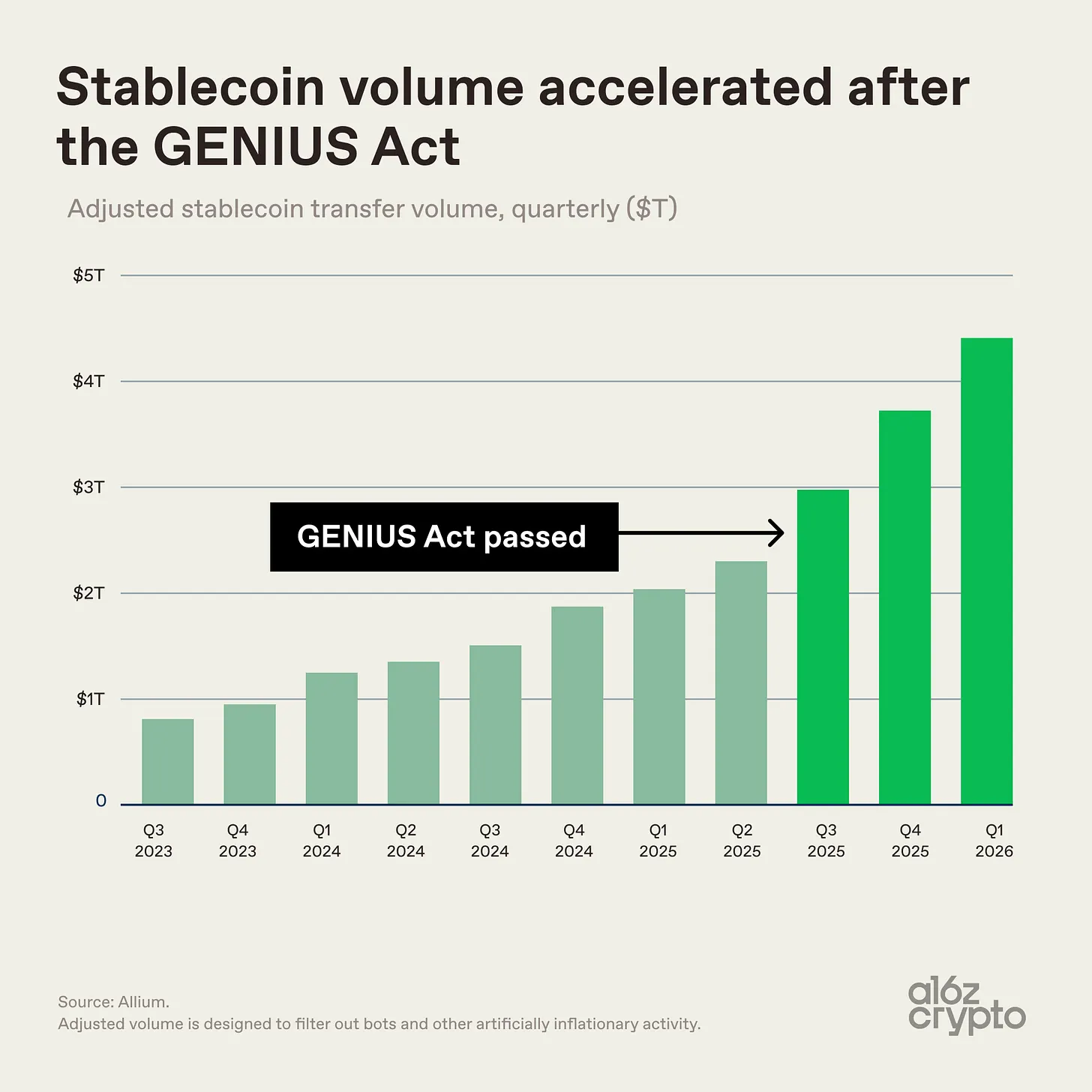
The results speak for themselves. The stablecoin market is now approximately $315 billion, up over 50% from a year ago, with dollar-backed tokens becoming one of the fastest-growing channels for U.S. currency abroad. According to Visa, stablecoins processed $100 trillion in transaction volume over the past 12 months. Major institutions—including JPMorgan, Citi, Visa, Mastercard, and BlackRock—are deepening their engagement with blockchain infrastructure.
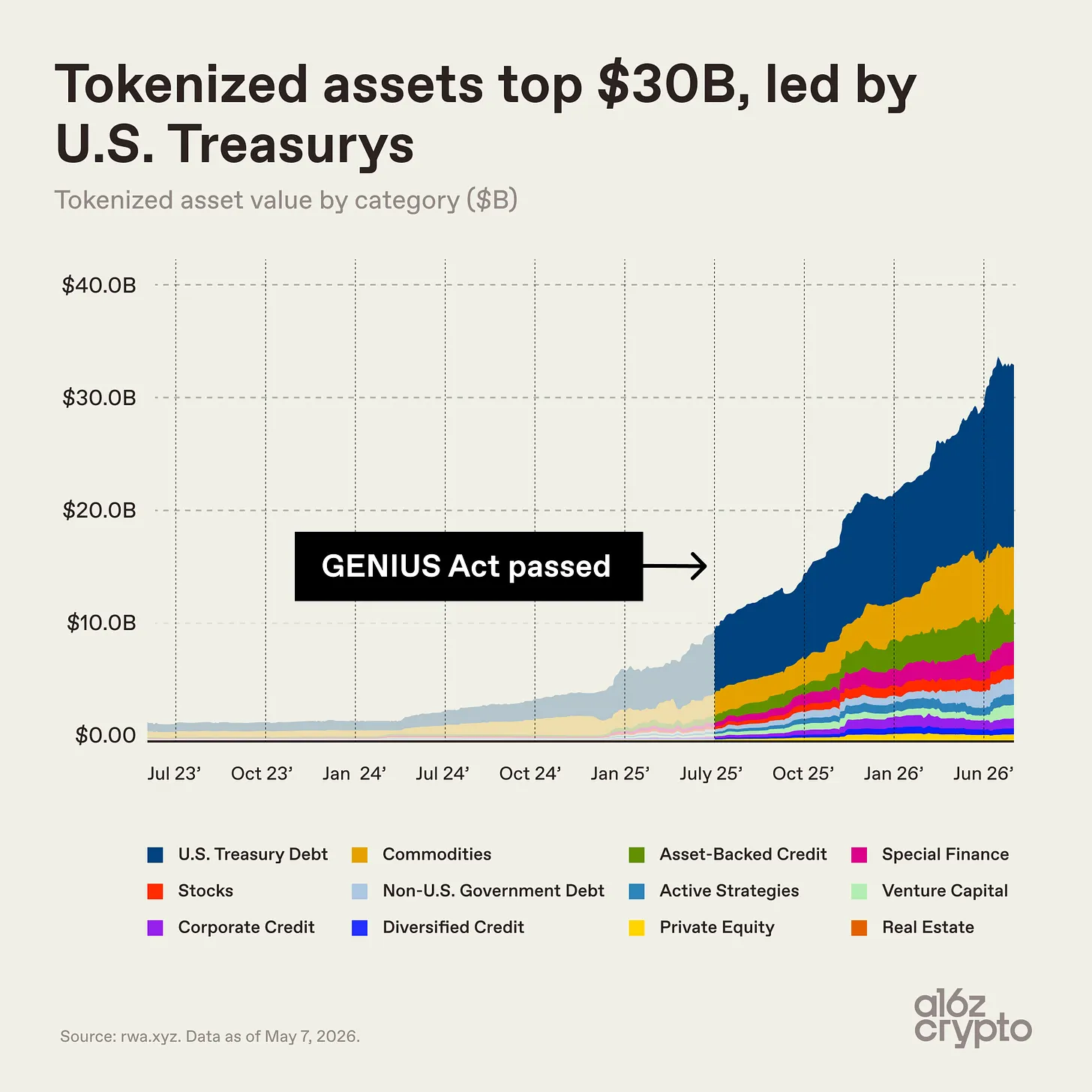
Crucially, the dollar is winning. Millions of people worldwide without convenient access to traditional dollar accounts can now hold and trade digital dollars through software wallets. Clear rules have helped anchor this new system to American standards and institutions rather than competitive alternatives.
The GENIUS Act proves that smart regulation expands markets rather than restricting them. But it only addresses part of the problem.
Blockchain Networks Still Lack Rules
Stablecoins represent less than 15% of the crypto market by market cap, but they depend on the underlying blockchain networks that make up the remaining 85%, which still lack a coherent federal framework. This is akin to regulating smartphones while ignoring the cellular network.
The CLARITY Act corrects this.
At its core, CLARITY provides clear rules for blockchain networks and defines regulatory responsibilities for digital asset markets. It incentivizes transparency, reduces risk, and promotes competition under a common set of standards. It helps prevent another FTX-style disaster by empowering regulators to oversee intermediaries using established principles of traditional finance—proper custody, segregation of client assets, and adequate disclosure. It also unlocks the next wave of institutional adoption.
Major companies are already moving. BlackRock has launched tokenized funds. JPMorgan is building blockchain-based payment systems. DTCC, which holds custody of $114 trillion in assets, is preparing to scale tokenized securities via the Canton network. CLARITY removes barriers to entry, providing a clear path for traditional finance to participate compliantly. This benefits not only the crypto industry but also consumers, investors, and the long-term competitiveness of U.S. capital markets.
The Choice Before Us
History shows that open, neutral platforms governed by clear rules create the most value. The internet succeeded because entrepreneurs knew the rules of the game. They could build, attract capital, and compete on merit rather than regulatory guesswork. Blockchain networks deserve the same opportunity.
The opposition between regulation and innovation is a false dichotomy. GENIUS has already disproven it: in the second half of 2025—after the GENIUS Act was signed into law—over $13 billion flowed into crypto startup investments, nearly double the roughly $6.9 billion invested in the first half of 2025 before GENIUS. Meanwhile, projections show the tokenized asset market could grow 100-fold in the coming years. The real choice is between certainty and uncertainty, between the U.S. asserting its leadership and building the future at home, or watching it be built elsewhere.

No law is perfect, and the CLARITY Act is no exception. The reality is that cryptocurrency currently has no consumer protections. CLARITY puts these protections in place. Like any bill, no one will get everything they want, but the version released today will move the industry forward. It reflects months of bipartisan negotiation and significant industry compromise. Whatever its imperfections, the CLARITY Act is clearly better than continuing with no safeguards at all.
The decisions Congress makes this year will determine where the next era of financial infrastructure flourishes and who sets the rules. If the CLARITY Act passes, it will put America ahead again, just as it did with the commercial internet. Inaction means innovation migrates elsewhere, operating under frameworks designed by others.
This article is sourced from the internet: a16z: The U.S. needs to pass the CLARITY Act to seize standard-setting power for stablecoins and tokenization
Related: Weekly Token Unlocks: ZRO Unlocks $23 Million Worth of Tokens
LayerZero Project Twitter: https://x.com/LayerZero_Core Project Website: https://layerzero.network/ Tokens Unlocked This Round: 25.75 million Value Unlocked This Round: Approximately $23.16 million LayerZero is an omnichain interoperability protocol designed for lightweight cross-chain message passing. LayerZero provides trustable and guaranteed message delivery with configurable trustlessness. The specific unlock schedule is as follows: Kaito Project Twitter: https://x.com/KaitoAI Project Website: https://www.kaito.ai/ Tokens Unlocked This Round: 17.6 million Value Unlocked This Round: Approximately $7.4 million Kaito is an AI-driven Web3 information platform designed to solve the problem of information fragmentation in the crypto industry. By aggregating data sources such as social media and governance forums, Kaito leverages AI technology to provide real-time search, sentiment analysis, and trend tracking. The specific unlock schedule is as follows: Starknet Project Twitter: https://twitter.com/Starknet Project Website: https://starknet.io/ Tokens Unlocked This Round:…
Related articles

































 English
  繁體中文
繁體中文  简体中文
简体中文