







USDD Officially Launches WBTC Vault, Diversifying Collateral Assets to Enhance Security and Robustness
The USDD team stated, “The launch of the WBTC Vaults is a significant step for the USDD protocol in diversifying collateral assets, improving security, and enhancing user experience. We will continue to deepen integration with the Bitcoin ecosystem, providing global users with a more secure, flexible, and yield-generating stablecoin solution.”
WBTC Vault Launch: Low Barrier to Entry and Dual-Yield Strategies
It is reported that the two newly launched WBTC Vaults are WBTC-A and WBTC-B. Details are as follows:
WBTC-A has a minimum collateralization ratio of 150%, a minimum debt of $1,000, and a debt ceiling of $10 million;
WBTC-B has a minimum collateralization ratio of 130%, a minimum debt of $2,500, and a debt ceiling of $10 million.
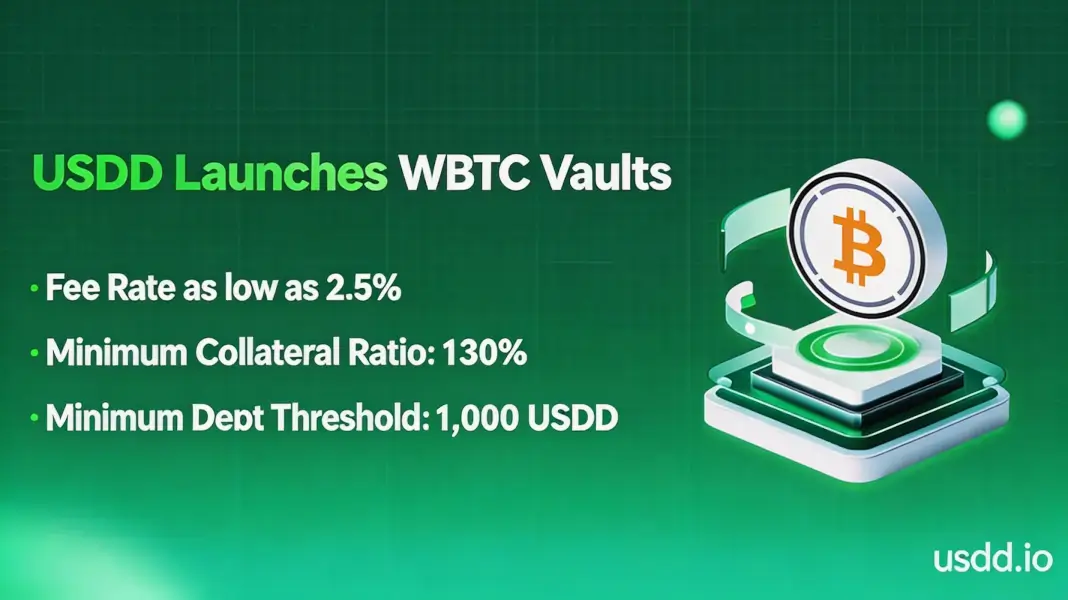
Currently, the WBTC Vaults are only supported on the TRON network, with potential expansion to other major public chains in the future. TRON network users can connect their wallets on the official website and directly deposit WBTC to obtain USDD. Cross-chain users can use the official cross-chain bridge or custodial channels to bridge their WBTC to the TRON network. Once transferred to a TRON wallet, users can proceed to mint USDD using either of the two WBTC Vaults.
Furthermore, users can employ two efficient strategies to increase their yield. The first is a leveraged long loop, where users collateralize WBTC to borrow USDD, swap the USDD for more WBTC on a DEX, and then re-collateralize it, thereby amplifying their BTC exposure without additional capital. The second is cross-platform interest rate arbitrage, where users borrow USDD and deposit it into high-yield pools to earn the net interest rate spread.
USDD Collateral Assets Become More Diversified
WBTC, as the largest and most market-recognized tokenized Bitcoin asset, custodies over 119,000 BTC with a market cap of $8.5 billion, commanding over 60% market share. The inclusion of WBTC significantly enhances the diversity and robustness of the USDD collateral pool.
USDD Vaults have long been known for their industry-low stability fees, minimal participation thresholds, and flexible exit mechanisms (e.g., PSM for 1:1 lossless redemption to USDT). The launch of the WBTC Vaults further strengthens USDD’s diversified collateral strategy, offering users a richer selection of cross-chain wealth management options.
On January 22 of this year, BitGo, the custodian of WBTC, was listed on the New York Stock Exchange, signifying its established, tight connection with traditional finance and comprehensive recognition in terms of compliance, transparency, and security. As an asset custodied by BitGo, WBTC similarly carries dual trust from both the crypto finance and traditional finance sectors.
Since the beginning of this year, another publicly listed company, TRON.INC, has also been continuously increasing its holdings of TRX. The addition of WBTC means the collateral assets within USDD Vaults are now primarily composed of top-10 crypto market assets and high-quality assets recognized by traditional financial markets. Through the transmission of collateral asset safety and stability, USDD’s advantages in transparency and stability will further elevate its position within the stablecoin sector.
USDD Protocol’s Security and Robustness Further Strengthened
Incorporating WBTC as collateral will further enhance USDD’s security and robustness, marking another milestone for the protocol and representing a comprehensive upgrade for the future development of the USDD ecosystem.
With the implementation and expansion of this strategic move, USDD is expanding its collateral assets from those primarily within the TRON ecosystem to include global core assets. This reduces dependency on a single ecosystem, making the overall collateral portfolio more stable during market volatility, lowering risk concentration, and significantly improving the system’s robustness.
Furthermore, Bitcoin, as a safe-haven asset, possesses deep global liquidity and broad market consensus. When other categories of collateral assets face significant volatility and liquidity pressure, the resilience inherent to WBTC will help USDD maintain its price peg during extreme market conditions, mitigating the impact of potential black swan events and substantially reducing the likelihood of systemic risk.
The inclusion of WBTC also signifies that USDD can attract a broader range of market capital, particularly inflows from Bitcoin holders. Introducing external high-quality assets into the USDD Vaults optimizes the composition of the collateral pool, thereby enhancing long-term security and stability.
Since completing its brand upgrade in 2025, USDD has rapidly achieved multi-chain deployment across major public chain platforms, making it an accessible decentralized stablecoin product for users. Following the joint launch of diversified and sustained yield-earning activities with major exchanges and DeFi protocols, the USDD ecosystem has expanded rapidly, continuously validating and reinforcing its positioning strategy as the “interest-bearing version of USDT.” Driven by its peg performance, stable yield strategies, and strong self-sustaining capabilities, USDD’s market penetration and share have been steadily increasing. To date, USDD’s TVL has reached $2.19 billion, with a circulating supply exceeding $1.54 billion, ranking 8th in the stablecoin market. It has become one of the most outstanding stablecoin brands since 2025. The launch of the WBTC Vault will continue to propel USDD forward on its path to becoming a top-tier stablecoin product.
This article is sourced from the internet: USDD Officially Launches WBTC Vault, Diversifying Collateral Assets to Enhance Security and Robustness
Related: OpenClaw Burns 21.5 Million Tokens in a Day? Three Optimization Strategies Drastically Reduce Costs
Original Author: MOSHIII Original Compilation: Peggy, BlockBeats Editor’s Note: With the rapid adoption of Agent applications, many teams have encountered a seemingly paradoxical phenomenon: the system runs smoothly, but token costs continue to rise unnoticed. This article, through a dissection of a real OpenClaw workload, finds that the cause of cost explosions often does not stem from user input or model output, but rather from the overlooked cached prefix replay. The model repeatedly reads massive historical context in each round of calls, resulting in enormous token consumption. The article, using specific session data, demonstrates how large intermediate outputs such as tool outputs, browser snapshots, and JSON logs are continuously written into the historical context and repeatedly read during agent loops. Through this case study, the author proposes a clear optimization…
Related articles
































 English
  繁體中文
繁體中文  简体中文
简体中文  日本語
日本語  Tiếng Việt
  العربية
  한국어
한국어  Bahasa Indonesia
  हिन्दी
  اردو
اردو  Русский