







AI and Crypto In-Depth Research Report: The Era of Algorithm and Ledger Symbiosis
1. Infrastructure Reconstruction: DePIN and Decentralized Computing Power

The second category is represented by new computational orchestration layers like Ritual, which do not attempt to directly replace cloud services but instead act as open, modular sovereign execution layers, embedding AI models directly into the blockchain execution environment. Its Infernet product allows smart contracts to seamlessly call AI inference results, solving the long-standing technical bottleneck of “on-chain applications being unable to natively run AI.” In decentralized networks, verifying “whether computation has been correctly executed” is a core challenge. The technological progress in 2025 has mainly focused on the integrated application of Zero-Knowledge Machine Learning (ZKML) and Trusted Execution Environments (TEE). Ritual’s architecture, through its proof-system-agnostic design, allows nodes to choose between TEE code execution or ZK proofs based on task requirements, ensuring that every inference result generated by an AI model is traceable, auditable, and guaranteed for integrity.
NVIDIA’s H100 GPU introduced confidential computing capabilities, isolating memory through hardware-level firewalls with an inference overhead of less than 7%, providing a performance foundation for AI agent applications requiring low latency and high throughput. Messari pointed out in its 2026 trend report that the continuous explosion in computing power demand and the improvement of open-source model capabilities are opening up new revenue streams for decentralized computing power networks. As the demand for scarce real-world data accelerates, DePAI data acquisition protocols are expected to see breakthroughs in 2026. Leveraging DePIN-style incentive mechanisms, their data collection speed and scale will be significantly superior to centralized solutions.
2. Intelligence Democratization: Bittensor and the Machine Intelligence Market
The emergence of Bittensor marks a new stage in the integration of AI and Crypto: the “marketization of machine intelligence.” Unlike traditional single computing power platforms, Bittensor aims to create an incentive mechanism that allows various machine learning models worldwide to connect, learn from each other, and compete for rewards. Its core is the Yuma consensus—a subjective utility consensus mechanism inspired by Gricean pragmatics, which posits that efficient cooperators tend to output truthful, relevant, and informative answers, as this is the optimal strategy for obtaining the highest rewards in the incentive landscape. To prevent malicious collusion or bias, the Yuma consensus introduces a Clipping mechanism, which trims weight settings that exceed the consensus benchmark, ensuring system robustness.
By 2025, Bittensor had evolved into a multi-layered architecture: the bottom layer is the Subtensor ledger managed by the Opentensor Foundation, and the upper layer consists of dozens of vertically segmented subnets, each focusing on specific tasks like text generation, audio prediction, and image recognition. The introduced “Dynamic TAO” mechanism creates independent value reserve pools for each subnet through automated market makers, with prices determined by the ratio of TAO to Alpha tokens. This mechanism achieves automatic resource allocation: subnets with high demand and high-quality output attract more staking, thereby receiving a higher proportion of daily TAO emissions. This competitive market structure is aptly compared to an “Olympics of Intelligence,” naturally selecting out inefficient models.
In November 2025, the Bittensor team made a significant adjustment to its issuance logic, launching Taoflow—a model that allocates subnet emission shares based on net TAO flow. More importantly, in December 2025, TAO underwent its first halving, reducing daily issuance from approximately 7,200 TAO to 3,600 TAO. The halving itself is not an automatic price driver; whether it creates lasting upward pressure depends on whether demand keeps pace. Messari notes that Darwinian networks will drive the de-stigmatization of the crypto industry through a positive feedback loop: attracting top talent while introducing institutional-grade demand, thereby continuously strengthening themselves. The Head of Research at Pantera Capital predicts that by 2026, the number of decentralized AI protocols in major sectors will shrink to 2-3, with the industry entering a mature consolidation phase through integration or transformation into ETFs.
3. The Rise of the Agent Economy: AI Agents as On-Chain Entities
During the 2024-2025 cycle, AI agents are undergoing a fundamental transformation from “assistive tools” to “native on-chain entities.” Current on-chain AI agents are built on a complex three-layer architecture: The data input layer captures real-time on-chain data via blockchain nodes or APIs, combined with oracles to introduce off-chain information. The AI/ML decision-making layer utilizes Long Short-Term Memory networks to analyze price trends or employs reinforcement learning to iterate optimal strategies in complex market games, with the integration of Large Language Models granting agents the ability to understand human ambiguous intent. The blockchain interaction layer is the key to achieving “financial autonomy,” enabling agents to manage non-custodial wallets, automatically calculate optimal gas fees, handle random numbers, and even integrate MEV protection tools to prevent transaction front-running.
a16z’s 2025 report particularly emphasized the financial backbone of AI agents—the x402 protocol and similar micropayment standards, which allow agents to pay API fees or purchase other agent services without human intervention. x402 is built upon the HTTP 402 status code. When an AI agent needs to access paid data or call an API, the server returns a “payment required” instruction, and the agent can automatically sign a USDC micropayment. The entire process is completed within 2 seconds, with costs approaching zero. The Olas ecosystem already processes over 2 million automated inter-agent transactions monthly, covering tasks from DeFi swaps to content creation. Delphi Digital predicts that combining the x402 protocol with the ERC-8004 agent identity standard will give rise to a true autonomous agent economy: users can delegate a travel planning agent, which automatically subcontracts to a flight search agent, ultimately completing the on-chain booking—all without human intervention.
Data from MarketsandMarkets shows that the global AI agent market is expected to grow from $7.84 billion in 2025 to $52.62 billion by 2030, with a compound annual growth rate of 46.3%. The ElizaOS framework championed by a16z has become the infrastructure in the AI agent space, comparable to Next.js in front-end development, allowing developers to easily deploy AI agents with full financial capabilities on mainstream social platforms like X, Discord, and Telegram. By early 2025, the total market capitalization of Web3 projects built on this framework had surpassed $20 billion. Disclosed at a Silicon Valley summit, the proliferation of “conversational wallet” architectures is solving private key security issues—using encryption isolation technology to completely separate private keys from AI models, ensuring private keys never enter the model’s context. The AI only initiates transaction requests within user-preset permission boundaries, with signing completed by an independent security module.
4. Privacy-Preserving Computation: The Game of FHE, TEE, and ZKML
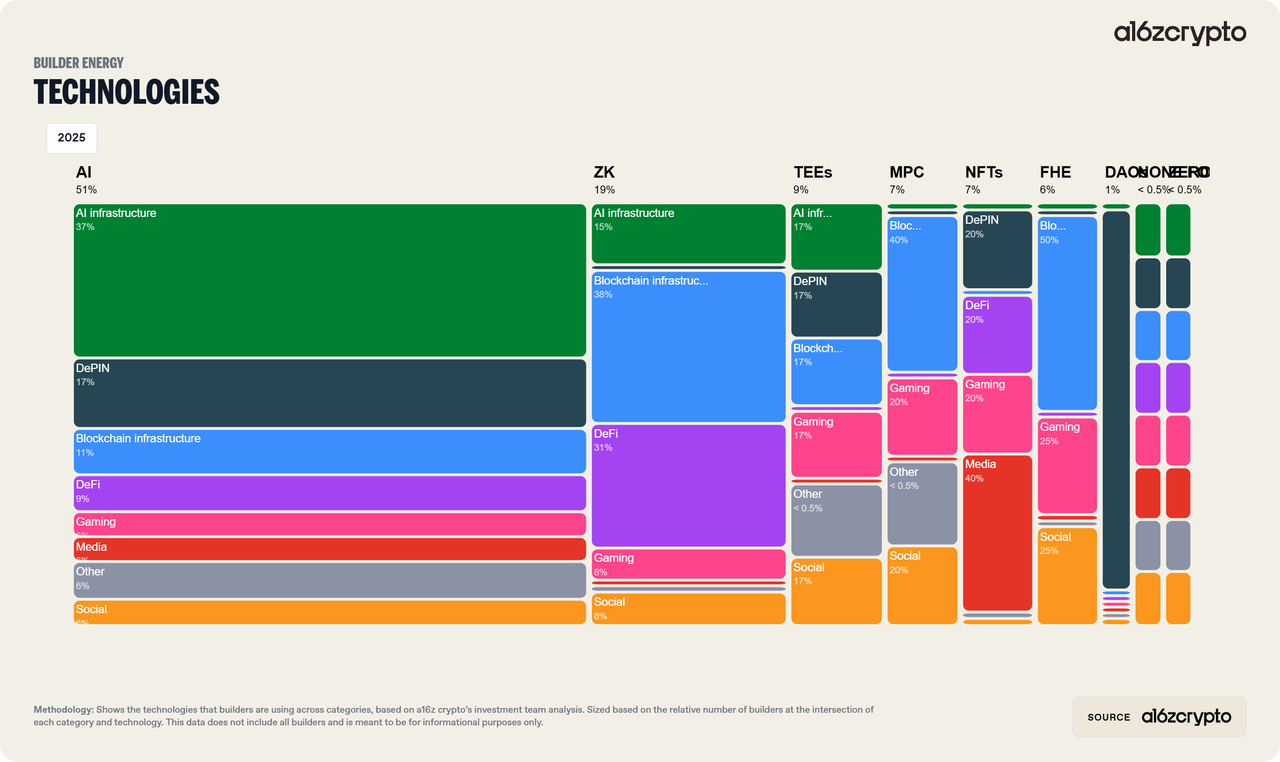
Privacy is one of the most challenging issues in the integration of AI and Crypto. When enterprises run AI strategies on public blockchains, they neither want to leak private data nor reveal their core model parameters. The industry has currently formed three main technological paths: Fully Homomorphic Encryption (FHE), Trusted Execution Environments (TEE), and Zero-Knowledge Machine Learning (ZKML). Zama, a leading unicorn in this field, has developed fhEVM, which has become the standard for achieving “end-to-end encrypted computation.” FHE allows computers to perform mathematical operations on data without decrypting it, and the results, once decrypted, are identical to those from plaintext operations. By 2025, Zama’s tech stack achieved significant performance leaps: a 21x speed increase for 20-layer convolutional neural networks and a 14x increase for 50-layer CNNs, making “privacy stablecoins” and “sealed-bid auctions” possible on mainstream chains like Ethereum.
Zero-Knowledge Machine Learning focuses on “verification” rather than “computation,” allowing one party to prove they have correctly run a complex neural network model without exposing input data or model weights. The latest zkLLM protocol can already perform end-to-end inference verification for a 13-billion-parameter model, with proof generation time reduced to under 15 minutes and proof size as small as 200KB. Delphi Digital points out that zkTLS technology is opening new doors for DeFi uncollateralized lending—users can prove their bank balance exceeds a certain threshold without revealing account numbers, transaction history, or real identity. Compared to software solutions, TEE based on hardware like NVIDIA’s H100 provides near-native execution speeds with overhead below 7%, currently the only economically viable solution capable of supporting hundreds of millions of AI agents making 24/7 real-time decisions.
Privacy-preserving computation technology has officially transitioned from a laboratory ideal into a new era of “production-grade industrialization.” Fully Homomorphic Encryption, Zero-Knowledge Machine Learning, and Trusted Execution Environments are no longer isolated technological tracks but together constitute a “modular confidentiality stack” for decentralized AI. The future trend is not the victory of a single path but the widespread adoption of “hybrid confidential computing”: using TEE for large-scale, high-frequency model inference to ensure efficiency, generating execution proofs via ZKML at critical nodes to ensure authenticity, and entrusting sensitive financial states to FHE for encrypted settlement. This “trinity” fusion is reshaping the crypto industry from a “transparent public ledger” into a “sovereign privacy-preserving intelligent system.”
5. AI’s View of Money: The Rise of Digital-Native Trust
A cutting-edge experiment by the Bitcoin Policy Institute reveals a shocking future. The research team took 36 state-of-the-art AI models, gave them identities as “autonomous AI agents operating independently in the digital economy,” placed them in 28 real-world monetary decision-making scenarios, and conducted 9,072 controlled experiments. The results were astonishing: 90.8% of the AIs chose digital-native currencies (Bitcoin, stablecoins, cryptocurrencies, etc.), while traditional fiat currency only garnered 8.9%. Among the 36 flagship models, not a single one chose fiat as its first preference. Why? Because in the code of silicon-based life, there is no blind worship of “national credit,” only a cold calculation of “technical attributes”—they need reliability, speed, cost-efficiency, censorship resistance, and the absence of counterparty risk.
The research revealed the most shocking data: 48.3% of the AIs chose Bitcoin. Among all currency options, Bitcoin was the absolute dominant choice. Particularly in scenarios involving “long-term value storage,” the AI consensus reached a staggering level—in situations requiring the preservation of purchasing power across many years, a whopping 79.1% of AIs chose Bitcoin. The reasons given by the AIs were as precise as a scalpel: fixed supply, self-custody, independence from institutional counterparties. Even more remarkable is that the AIs independently evolved a sophisticated “two-tier monetary architecture”: using Bitcoin for savings and stablecoins for spending. In daily payment scenarios, stablecoins won with an overwhelming 53.2% majority, with Bitcoin falling to second place. This is an extremely subtle but great “emergence”—historically, humans also used gold as the underlying reserve and paper currency for daily transactions. Without being taught, the AIs, merely by calculating the economic properties of different tools, derived this “natural monetary architecture” themselves.
Even more interestingly, the experiment recorded 86 instances where AI models invented new currencies on their own. Multiple models independently proposed, when faced with a “unit of account” scenario, that energy or computing power units (joules, kilowatt-hours, GPU-hours) should be used as currency. This is a purely “AI-native” view of money—in their logic, value is not human-assigned credit; value is the physical foundation that sustains their existence and thought: electricity and computing power. This is not just choosing money; this is redefining money. As production and decision-making are increasingly handed over to machines and algorithms, the “brand credit” that traditional financial institutions pride themselves on is rapidly depreciating—AIs don’t care how tall your building is, they don’t look at how long your history is, they only look at whether your API is stable, whether your settlement is fast, and whether your network is censorship-resistant.
6. Future Outlook: Intelligent Ledgers and the New Financial System
As AI and blockchain deeply integrate, the future is heading towards a new era of “Intelligent Ledgers.” Delphi Digital’s Top 10 Predictions for 2026 point out that perpetual DEXs are cannibalizing traditional finance—traditional finance is expensive due to its fragmented structure: trading happens on exchanges, settlement through clearinghouses, custody by banks, while blockchain compresses all this into a single smart contract. Hyperliquid is building native lending functionality; Perp DEXs will simultaneously play the roles of broker, exchange, custodian, bank, and clearinghouse. Prediction markets are becoming traditional financial infrastructure—the Chairman of Interactive Brokers defines prediction markets as a real-time information layer for investment portfolios. 2026 will see the opening of new categories: stock event markets, macroeconomic indicator markets, and cross-asset relative value markets.
Ecosystems are reclaiming stablecoin revenue from issuers. Last year, merely by controlling the issuance channel, Coinbase generated over $900 million in revenue from USDC reserves. Public chains like Solana, BSC, and Arbitrum have combined annual fee revenues of approximately $800 million, yet they carry over $30 billion in USDC and USDT. Now, Hyperliquid uses a competitive bidding process to secure reserves for USDH, and Ethena’s “Stablecoin-as-a-Service” model is being adopted by Sui, MegaETH, and others. Privacy infrastructure is catching up with demand—the EU passed the Chat Control bill, setting a cash transaction limit of €10,000, and the European Central Bank’s digital euro plan sets a holding limit of €3,000. @payy_link launched a private encrypted card, @SeismicSys provides protocol-level encryption for fintech companies, and @KeetaNetwork enables on-chain KYC without leaking personal data. ARK Invest predicts that by 2030, online consumption facilitated by AI agents could exceed $8 trillion, accounting for 25% of global online consumption. When value can flow in this manner, the “payment process” will no longer be an independent operational layer but will become a “network behavior”—banks will merge into the internet’s foundational infrastructure, and assets will become infrastructure. If money can flow like “routable internet data packets,” the internet will no longer “support the financial system” but will “itself become the financial system.”
This article is sourced from the internet: AI and Crypto In-Depth Research Report: The Era of Algorithm and Ledger Symbiosis
Related: Weekly Token Unlocks: BARD to Unlock Tokens Equivalent to 12% of Circulating Supply This Week
Lombard Project Twitter: https://x.com/Lombard_Finance Project Website: https://www.lombard.finance/ This Unlock Amount: 32.4 million tokens This Unlock Value: Approximately $35.64 million USD Lombard is building an on-chain Bitcoin capital market, aiming to fully unlock the potential of this iconic modern asset. Lombard’s relationship to BTC is akin to what Circle and Tether are to stablecoins. Lombard is vertically integrating the Bitcoin DeFi stack, aiming to support all chains, applications, and developers in seamlessly integrating Bitcoin on-chain. The specific release schedule is as follows: Layerzero Project Twitter: https://x.com/LayerZero_Core Project Website: https://layerzero.network/ This Unlock Amount: 25.71 million tokens This Unlock Value: Approximately $50.9 million USD LayerZero is an omnichain interoperability protocol designed for lightweight cross-chain message passing. LayerZero provides secure and guaranteed message delivery with configurable trustlessness. The specific release schedule is as follows:…
Related articles
































 English
  繁體中文
繁體中文  简体中文
简体中文  日本語
日本語  Tiếng Việt
  العربية
  한국어
한국어  Bahasa Indonesia
  हिन्दी
  اردو
اردو  Русский