







StarkWare Makes Drastic Cuts to Survive, L2’s “Technological Faith” Faces Market Reckoning
On April 13th, Eli Ben-Sasson, CEO of StarkWare, the ZK-Rollup infrastructure company behind Starknet, announced at an all-hands meeting that the company would undergo layoffs and be restructured into two independent business units, focusing on revenue generation and Starknet development. The company initially launched the StarkEx scaling engine and brought Starknet to mainnet as an Ethereum Layer 2 validity rollup in late 2021. It also developed its own Cairo programming language, Sierra intermediate representation layer, and post-quantum proof system, establishing itself as a technical benchmark in the ZK Rollup field. In 2022, the company completed multiple funding rounds totaling approximately $260 million, reaching a valuation as high as $8 billion at one point, making it one of the highest-valued ZK projects in the تشفير industry at the time.
According to DefiLlama data, Starknet’s on-chain monthly revenue peaked at nearly $6.3 million in November 2023. However, since April 2024, its monthly revenue has only been in the tens to hundreds of thousands of dollars, representing a drop of over 95%.
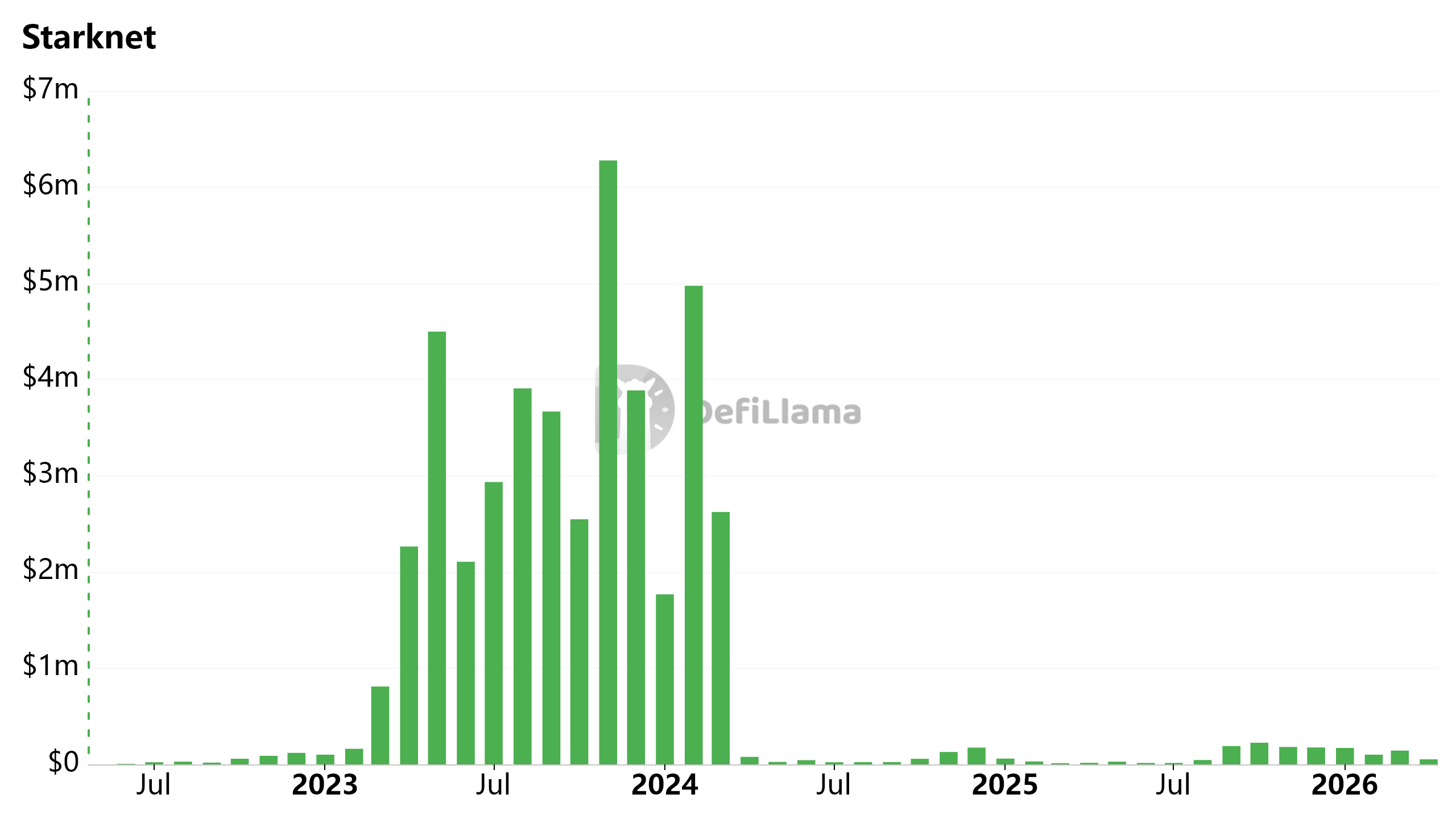
Starknet Chain Fees (Monthly)
Retreating from “Infrastructure” to “Independent Applications”
Facing a shift in identity from a “platform infrastructure company” to a “product-focused technology company,” Ben-Sasson admitted that StarkWare in the past was “too big, too inefficient.” He stated that the company must now return to a startup mode, rapidly iterating with small teams to find product-market fit (PMF).
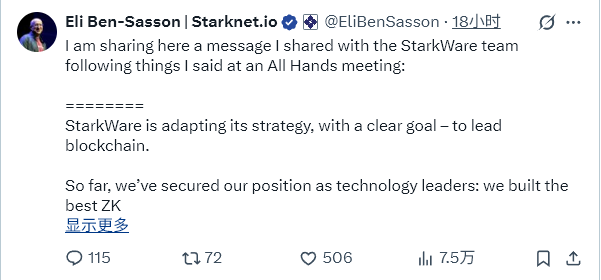
Source: Eli Ben-Sasson’s Tweet
In this wave of industry contraction, StarkWare is not alone. OP Labs (the core development team of Optimism) laid off about 20 people (approximately 20% of its staff) in March, aiming to focus on core priorities, accelerate decision-making, and reduce coordination costs. Polygon Labs conducted organizational integration after an acquisition in January, resulting in layoffs of about 60 people across multiple teams, although the company stated its net headcount remained unchanged.
Additionally, exchange Crypto.com laid off 12% of its staff, L1 Algorand Foundation laid off 25%, and other companies or projects like crypto research firm Messari also underwent a new round of workforce adjustments.
After the restructuring, Chief Financial Officer Ran Grinshtein will oversee backend functions such as finance and human resources. The front-end business will be split into two units, each equipped with its own independent BD, engineering, and go-to-market (GTM) teams.
- Starknet Development Department: Led by Head of Product Tom Brand, continuing the core protocol’s foundational work.
- Application Department: Led by Chief Product Officer Avihu Levy, bearing the critical responsibility of direct revenue generation, dedicated to building products that “can only be realized with StarkWare’s technology stack and have minimal external dependencies.”
Although the company has not officially announced specific product lines, considering Levy’s recent paper on achieving quantum-secure Bitcoin (QSB) transactions without modifying the Bitcoin protocol, and Starknet’s launch of Zcash-like privacy features, quantum security and Bitcoin-related products are highly likely to be among its first pilot directions.
The Impact of EIP-4844 and the Polarization of L2s
Starknet’s predicament essentially reflects the collective growing pains of the entire L2 sector following protocol upgrades.
In March 2024, Ethereum introduced EIP-4844, which drastically reduced the cost of Blob data, directly dismantling the business model L2s relied on: “profiting from the gas price difference between L1 and L2.”
Subsequently, Ethereum continued to expand Blob supply through multiple upgrades. The Pectra upgrade in May 2025 increased the target from 3 per block to 6 per block (maximum 9). After the Fusaka upgrade in late 2025, it was further increased to a target of 14 per block and a maximum of 21 per block.
In the future, Ethereum still plans to gradually increase Blob capacity through more BPO mechanisms and technologies like PeerDAS, which will keep L2 data availability costs at extremely low levels for the long term.
When data availability costs plummet, the moat of network value is no longer cheapness, but rather its own user density and capital accumulation capability.
Despite suffering the same EIP-4844 impact, the performance of the L2 market has been highly divergent.
According to DefiLlama data, Base, leveraging Coinbase’s powerful user funnel and fiat on-ramp channels, generated $75.4 million in revenue in 2025 (accounting for 62% of total L2 revenue) and processed over 60% of the total network transaction volume. Arbitrum, relying on a composable financial stack formed by leading protocols like GMX and Pendle, has maintained its TVL stably at the $2 billion level.
Optimism once relied on the OP Stack and the Superchain ecosystem. However, the Superchain’s TVL is now highly dependent on Base (over 80%), with OP Mainnet itself accounting for only a single-digit percentage. Its TVL and on-chain fee revenue also declined significantly in 2025-2026. Making matters worse, Base announced in February 2026 that it would depart from the OP Stack and move towards its own unified technology stack, which will further weaken Optimism’s hub status within the L2 ecosystem.
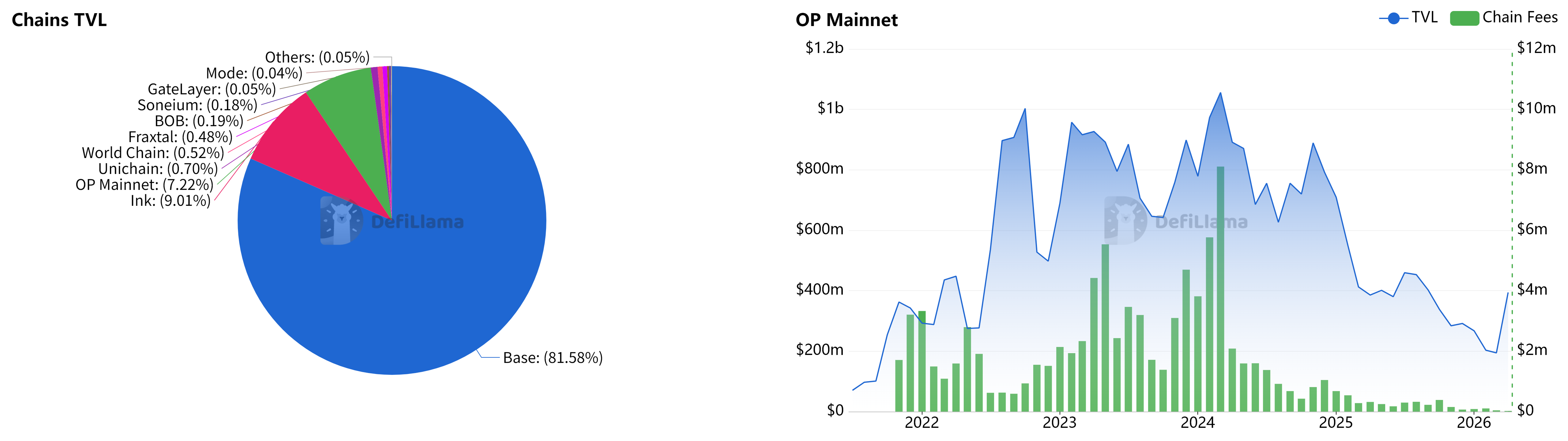
Left: Superchain TVL Pie Chart by Chain | Right: OP Mainnet TVL and Chain Fees (Monthly)
Starknet’s situation is even more severe. Its current TVL is only about $241 million, less than one-twentieth of Base’s. Its native token STRK has plummeted from its airdrop high in February 2024 to $0.033, with a total market cap of approximately $187 million—even lower than the company’s historical total funding of $260 million.
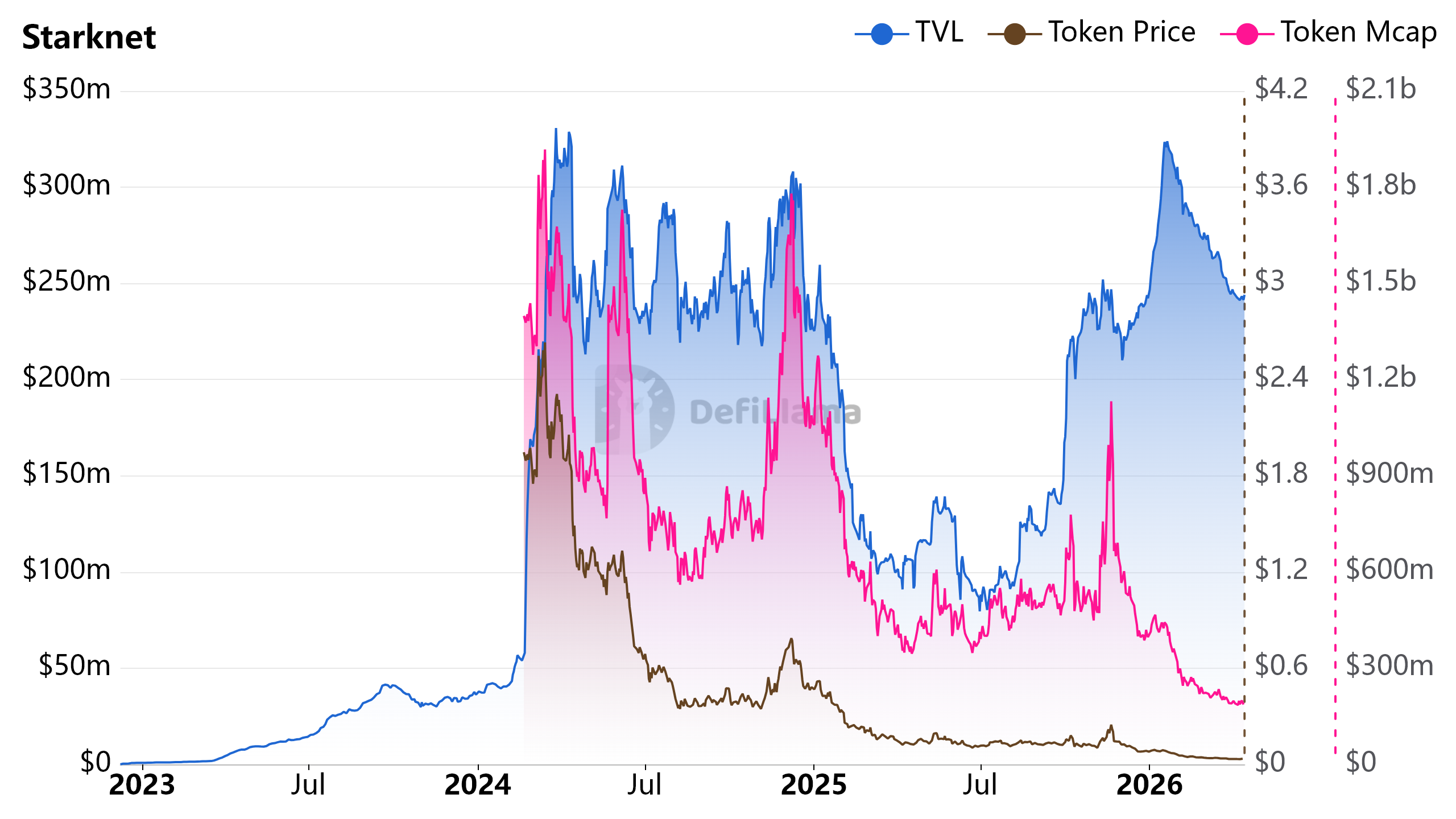
Starknet TVL, STRK Price, and STRK سوق كاب
Distribution Capability Determines Who Stays at the Table
“Infrastructure alone doesn’t win the race.” Ben-Sasson’s statement is a reflection on StarkWare’s eight-year strategy of “build it and they will come.”
StarkWare’s investment in cryptographic engineering far exceeds that of its peers. Its from-scratch development of the Cairo language and quantum-resistant STARK system is exceptionally hardcore. However, in reality, its technical purism in refusing to be EVM-compatible has erected a significant migration barrier for developers, which is one of the factors limiting ecosystem growth.
The core driver of L2 growth is no longer technical differentiation, but rather distribution capability and strategic alliances. Currently, Base and Arbitrum together lock in nearly 75% of the total L2 value.
21Shares predicts that the L2 sector will consolidate into “a smaller, more resilient set of networks” by the end of the year. In this winner-takes-all elimination game, retreating to self-developed applications is one of the few remaining differentiated paths for StarkWare.
Technical prowess is merely an entry ticket, not the finish line. What StarkWare now needs to prove to the market is no longer what cutting-edge technology it can “invent,” but rather what products it can truly “sell.”
هذا المقال مصدره من الانترنت: StarkWare Makes Drastic Cuts to Survive, L2’s “Technological Faith” Faces Market Reckoning
Related: Weekly رمز مميز Unlocks: EIGEN Unlock Reaches 7.5% of Circulating Supply
EigenLayer Project Twitter: https://x.com/eigenlayer Project Website: https://www.eigenlayer.xyz/ This Unlock Amount: 36.94 million tokens This Unlock Value: Approximately $6.39 million EigenLayer is a protocol built on Ethereum that introduces the concept of restaking, a new primitive in cryptoeconomic security. This primitive allows for the restaking of ETH at the consensus layer. Users who stake ETH can opt into EigenLayer smart contracts to restake their ETH and extend cryptoeconomic security to other applications on the network. The specific release schedule is as follows: Optimism Project Twitter: https://twitter.com/Optimism Project Website: https://app.optimism.io/governance This Unlock Amount: 31.44 million tokens This Unlock Value: Approximately $3.27 million Optimism is a Layer 2 scaling solution that achieves the goal of scaling the Ethereum network by adopting the Optimistic Rollup approach. It can process transactions at scale while maintaining…
相关文章































 العربية
  English
  繁體中文
繁體中文  简体中文
简体中文  日本語
日本語  Tiếng Việt
  한국어
한국어  Bahasa Indonesia
  हिन्दी
  اردو
اردو  Русский