







Odaily Interview with Bitwise: BTC Could Reach $95,000 Range by Year-End
Author|jk
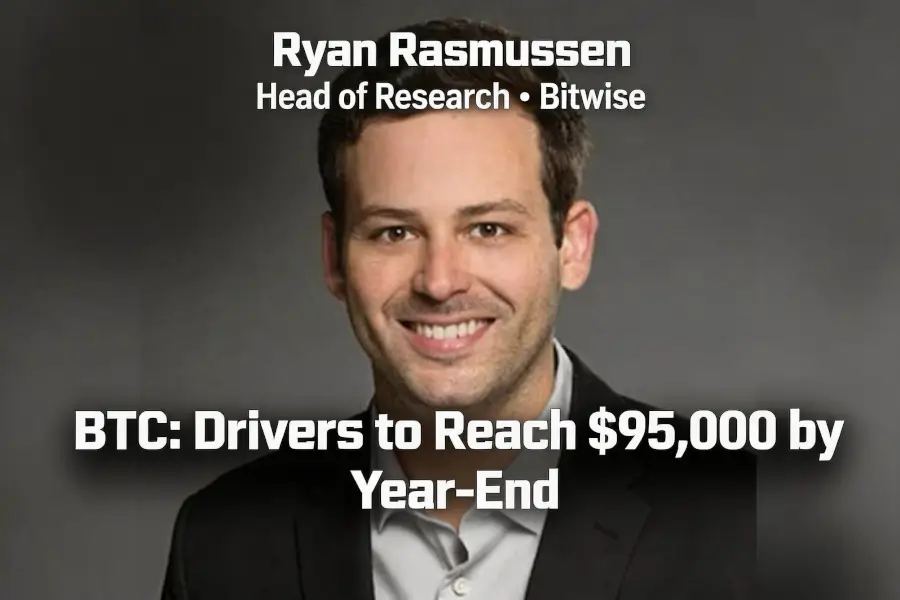
Against the backdrop of Bitcoin’s price halving from its all-time high and geopolitical clouds looming over global markets, are institutional funds retreating or quietly accumulating? On March 24th, Odaily conducted an on-site interview in New York with Ryan Rasmussen, Head of Research at Bitwise Asset Management.
Bitwise currently manages approximately $15 billion in assets, making it the world’s largest provider of تشفير index funds and a major issuer of Bitcoin, Ethereum, and Solana ETFs. In this interview, he outlined the core drivers for Bitcoin’s price in 2026, gave specific year-end price predictions, discussed the ongoing “great portfolio migration” between retail and institutional investors, and touched on the role of Asian markets in the global تشفير landscape.
Here is the full interview:
Odaily: Today we are at the DAS Summit in New York, and we are honored to have Ryan from Bitwise with us. Before we begin with questions, could you please introduce yourself, and give a brief introduction for our Asian audience?
Ryan: Absolutely. I’m Ryan Rasmussen, Head of Research at Bitwise Asset Management. We are a global crypto asset management firm primarily serving institutional investors with public and private funds, as well as staking solutions. We currently manage around $15 billion in assets and operate in the US, Europe, and Asia. We are one of the largest issuers in the Solana ETF, Bitcoin ETF, and Ethereum ETF space, and we also manage a variety of index funds. We operate the world’s largest cryptocurrency index fund.
Odaily: What are the biggest factors influencing Bitcoin’s price in 2026, could you rank them and roughly assign weight percentages? For example, inflows and outflows of structured products from US traditional financial institutions, statements and policies from Trump and his family, the awakening and selling by long-term holding whales, survival pressure on the mining community, and the lingering effects of past hacking incidents?
Ryan: The biggest long-term driver for Bitcoin’s price is institutional adoption. The reason is that for the past fifteen years, most institutional investors globally have been unable to access Bitcoin or other crypto assets. With the launch of US Bitcoin ETFs in January 2024, and now with Ethereum, Solana, and other ETF products coming online, we are seeing institutional investors starting to catch up on Bitcoin investing. But this doesn’t mean those allocations have truly begun: in fact, many investors we speak with, whether in the US, Europe, or Asia, have not yet started investing in Bitcoin. So I believe the biggest driver is the speed at which institutional investors begin making large-scale allocations to Bitcoin. I believe this has already started happening in 2026, and we will see more progress in the second half of 2026. This will be a combined short-term and long-term driver, fueled by demand from those institutional investors who are not yet in the market.
Odaily: Can you talk more specifically about the weights?
Ryan: This is indeed a very interesting topic. Investors who started allocating with us a few years ago began with about 1%, and today most of our clients have crypto allocations around 5%. What’s most interesting is that investors starting their initial allocations now are not starting at 1% anymore, but rather at 2% to 3%, while many of our longer-term clients are already around 5%. So I would say the typical allocation for new investors is around 2%, and for existing investors with crypto exposure, it’s about 5%. But when you consider the wealth controlled by global institutional investors, this number is substantial—1% to 2% to 5% of $100 trillion in wealth already exceeds the total current market cap of Bitcoin. This is why institutional allocation will ultimately dominate Bitcoin’s price in the long run, and why it’s such an important factor.
Odaily: Is there still a possibility for Bitcoin to experience another significant decline? Could the current level be the bottom of this cycle?
Ryan: Our view is that we are closer to the bottom for Bitcoin, and the downside is not as large anymore. I wouldn’t be surprised if Bitcoin trades sideways for a few more months because macro factors are really dominating right now—conflict in the Middle East, a lot happening in South America, uncertainty about what might happen in Cuba in the short term, and we saw the situation in Venezuela earlier this year. So there’s a lot of macro and geopolitical uncertainty, which I think is putting all risk assets, all financial assets, under this kind of pressure.
Once macro uncertainty stabilizes and geopolitical uncertainty stabilizes, I think we’ll see Bitcoin and other crypto assets truly start to accelerate upwards. But I do believe Bitcoin and the crypto market will largely trade sideways over the next few months. In the second half of the year, we believe we will see significant institutional inflows through ETFs, pushing prices higher and ending the year above where we started, which implies Bitcoin ending the year around the $95,000 range, representing about a 40% gain from today’s price. We believe we are in a crypto bear market that has lasted about a year, and our judgment is that Bitcoin will end the year higher, with 2027 being a very positive year.
Odaily: From last year’s ATH to this year’s price halving, who do you think is accumulating, and who is reducing their positions?
Ryan: What we are observing is a shift from retail investors to institutional investors. This is a one-time shift that is having a profound impact on Bitcoin and the broader crypto market, as institutional investors enter through ETFs and other funds, and as we see increasingly clear regulatory environments in the US and abroad, giving institutional investors more confidence in making allocation decisions.
At the same time, retail investors have been through many cycles of crypto booms and busts. Those early investors who got in when Bitcoin was $1, $10, $100, watched it go to $125,000, maybe rode it back down to $70,000, and have now reached a point where they are ready to take some chips off the table. This is actually very typical of what happens when a private company finally goes public: early investors finally get their IPO and are ready to cash out, and then new shareholders come in to participate in the equity of the company. I think this is exactly what’s happening in the crypto market right now: early, predominantly retail investors are transferring their holdings to long-term oriented, systematic institutional investors. They don’t have a one-to-two-to-three-year horizon; they have a five-, ten-, twenty-year horizon.
To summarize: currently, retail is selling, and institutions are buying. This shift is a net positive for crypto market dynamics because institutional investors have less behavioral bias, they are more systematic, and more long-term focused.
Odaily: In the current context of sudden global changes, BTC has disappointed some investors’ expectations as a safe haven. Compared to traditional assets like gold, silver, and oil, why should people still believe in Bitcoin?
Ryan: I think Bitcoin’s long-term prospects have never been stronger. The world’s largest financial institutions are moving towards Bitcoin. We speak with investors every day, from financial advisors to family offices, to hedge funds, endowments, pensions, and even sovereign wealth funds, all of whom are researching crypto assets and Bitcoin. I think these are journeys that take many years to complete, and it would be shortsighted to expect Bitcoin to complete the transition from a niche asset to a mature global asset in just fifteen years of history.
What Bitcoin brings to a portfolio is the same type of thing that gold, oil, and other commodities bring: significant diversification benefits and low correlation with other asset classes. If you look at Bitcoin’s role in a portfolio (assuming you add 5% Bitcoin to a traditional stock, bond, and commodity portfolio), it improves risk-adjusted returns because it has almost no correlation with other assets and has very strong risk-return characteristics over the long term. But investing in crypto assets must be done with a long-term perspective, removing emotional biases, and only then can you truly begin to see the value of crypto assets in a portfolio.
Odaily: Is Bitwise currently operating in Asia? What are the main activities?
Ryan: Yes, we operate in Asia. I personally have traveled to Singapore multiple times over the past few years. Our institutional partnership team has also been to Hong Kong, Singapore, and other Asian markets. We have people on the ground who are ready to meet with various institutions like banks, clients, family offices, etc., to help them gain exposure to crypto assets through various means such as private funds, SMAs, public funds, and staking products.
Speaking of staking, we recently expanded significantly into Asia through the acquisition of Chorus One. Chorus One is one of the world’s largest staking service providers. We are seeing a lot of interest and demand in Asia, especially from many family offices proactively reaching out to us for exposure; many banks are also contacting us, wanting to understand how their wealth management and private banking clients can access crypto assets. We are very excited about the growth prospects and have a team stationed locally. Anyone interested is welcome to contact us anytime.
Odaily: Are there any notable differences between Asia and other regions that you can share?
Ryan: The differences are quite significant. The three markets—the US, Europe, and Asia—are very different in terms of how they view crypto assets.
US institutional investors have been lagging in crypto assets because the US has been very adversarial towards crypto from a regulatory perspective. The previous administration from 2020 to 2024, from the White House down to various regulatory agencies, was actively trying to suppress the crypto industry at every turn. We are now seeing that shift. This means institutional investors were delayed for many, many years because they were afraid to touch an asset that the government might be trying to kill through regulation.
Europe is slightly different, although European institutional adoption of crypto assets has been slower than in Asia.
In Asia, we see a lot of enthusiasm for participation. I think Asia is actually more forward-thinking in adopting and investing in this technology than is commonly recognized externally. This is also part of why we find expanding into this market so exciting and attractive.
هذا المقال مصدره من الانترنت: Odaily Interview with Bitwise: BTC Could Reach $95,000 Range by Year-End
“They were fcking us the whole time.” This expletive, circulating on Reddit and CT (Crypto Twitter) following the lawsuit, along with an epic short squeeze involving over $240 billion in liquidations, has directed the market’s fury towards a single target: Jane Street Capital. At 10 AM, the liquidity freeze point for the Asian market over the past few months, the tip of the iceberg was finally revealed with the U.S. Department of Justice’s complaint. It all traces back to the Wall Street top-tier market maker Jane Street Capital, founded in 2000, which is accused of executing a months-long “shell game” between spot and derivative order books by exploiting the creation and redemption mechanism of spot ETFs through targeted ETF arbitrage in the market. It wasn’t until the lawsuit brought this…
相关文章
































 العربية
  English
  繁體中文
繁體中文  简体中文
简体中文  日本語
日本語  Tiếng Việt
  한국어
한국어  Bahasa Indonesia
  हिन्दी
  اردو
اردو  Русский