







During the quiet period of the prediction market, Polymarket prepares its killer move to catch up with Kalshi
Author: Asher (@Asher_ 0210)

Following the World Cup, most other major sports events are also in their off-season, and trading activity on Polymarket has cooled off.The platform recently underwent a series of intensive adjustments to its management, market direction, and promotional strategies, preparing in advance for the upcoming slate of major sporting events and the U.S. midterm elections in November.
On the personnel front, Travis VanderZanden—founder of shared e-scooter company Bird and a former executive at Uber and Lyft—has joined Polymarket as Chief Growth Officer, taking charge of the company’s marketing system. At the same time, Polymarket has also brought in several executives from institutions including Robinhood, Coinbase, Nasdaq, and even the FBI, covering roles in compliance, regulation, investigations, and risk management.
Additionally, Polymarket continues to ramp up its push to re-enter the U.S. market, and the upcoming series of sports events and political milestones is expected to further boost trading activity in its U.S. operations.
One Year After U.S. Return, Polymarket US Enters a Growth Phase
From Acquiring a Licensed Exchange to Launching a Web Version, Polymarket US Accelerates Its Rollout
In 2022, Polymarket reached a settlement with the CFTC over unregistered derivatives trading operations and subsequently withdrew from the U.S. market.
It wasn’t until July 2025 that Polymarket acquired QCEX, a CFTC-licensed derivatives exchange and clearing house, for $112 million, paving the way for its return to the U.S. QCX LLC subsequently began operating under the name Polymarket US and received a modified designation order from the CFTC in November of that year, further solidifying its foundation for conducting regulated trading in the U.S.
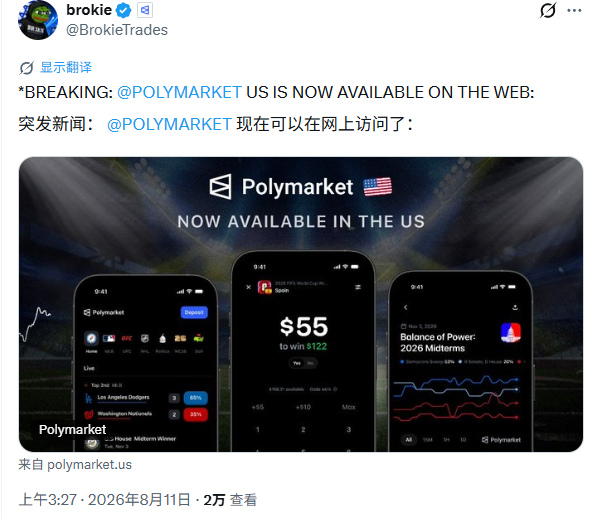
In December of the same year, Polymarket US began opening access to users on its waitlist; this May, Polymarket US fully opened to U.S. iOS users.Then, as of yesterday, community members reported that Polymarket US has also launched its web version, continuing to expand the channels available to U.S. users.
Polymarket US Trading Volume Keeps Growing, Gradually Closing the Gap with Polymarket International
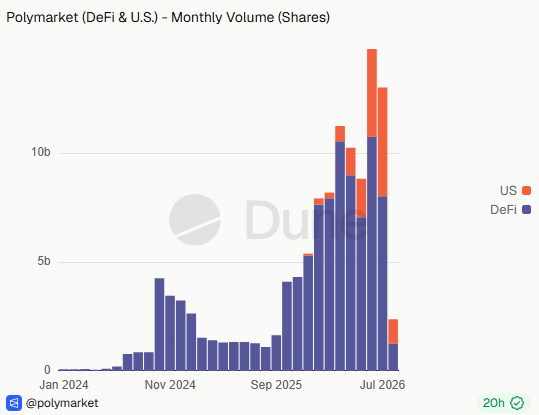
This May, as the U.S. user ramp-up began, Polymarket US trading volume started to increase noticeably.
According to Dune data, Polymarket US recorded trading volume of $1.769 billion in May, while Polymarket International saw $7.077 billion over the same period—meaning US volume was approximately 25% of International’s. By June, Polymarket US volume had surged to $4.041 billion, more than doubling month-over-month, while International posted $10.773 billion; the ratio climbed to roughly 38%.
In July, the gap narrowed further. Polymarket US recorded approximately $5 billion in monthly trading volume, setting another new high, while International’s July volume came in at just $8.044 billion.US volume now equals about 62% of International’s—compared to just 25% two months earlier.
User access points are expanding and trading scale continues to rise. Going forward, Polymarket not only needs to further acquire U.S. users but also must address a range of more specific issues around marketing, compliance, and risk management. This is why growth, marketing, compliance, and risk control have become the key focus areas of this latest round of team restructuring.
Hiring for Both Growth and Compliance, but First Things First: Cleaning Up Past Marketing Issues
Travis VanderZanden, founder of shared e-scooter company Bird and former Uber and Lyft executive, will first need to address the promotional controversies left behind before taking over marketing operations.
Earlier, a Wall Street Journal investigation found that Polymarket had used promotional partners to have content creators showcase simulated trading. Some videos featured website interfaces closely resembling the real Polymarket platform, leading viewers to believe creators were making real trades and earning real profits. The investigation reported that the roughly $1.9 million in wagers shown across more than 1,100 related videos were all simulated trades. Subsequently, the CFTC also opened an investigation into Polymarket’s marketing practices.
Polymarket then began overhauling its marketing system, including restructuring the marketing department, updating rules for promotional partners, and providing relevant training to employees. The company also hired consulting firm AlixPartners to review content published by partners and verify compliance with the new promotional guidelines.
So VanderZanden’s arrival at Polymarket isn’t just about continuing to grow the user base. He’s taking over a marketing system still in flux. Polymarket US is currently expanding user access points and trading volume is still in a growth phase. With more sports events and political developments on the horizon, the platform hopes to further attract U.S. users and boost trading activity—but the previous regulatory scrutiny also means that some of the more aggressive promotional tactics of the past will be difficult to continue.
Autumn Is the Real Test: Polymarket Still Needs to Catch Up with Kalshi
In the U.S. prediction market, Kalshi remains significantly ahead of Polymarket US. In July, Kalshi recorded roughly $37.7 billion in monthly trading volume, compared to about $5 billion for Polymarket US and approximately $8 billion for Polymarket International—a combined total of around $13 billion for the two platforms, less than one-third of Kalshi’s volume. And Kalshi’s business is almost entirely concentrated in the U.S. market.
This gap is also reflected in capital market valuations. At the end of June, Kalshi was in talks for a new funding round targeting a valuation of approximately $40 billion; just a month earlier, the company had completed a $1 billion raise at a $22 billion valuation. By comparison, Polymarket was valued at around $9 billion in October 2025, rose to $15 billion after completing a roughly $1 billion funding round this April, and entered August seeking another ~$1 billion round at a target valuation exceeding $20 billion.
Starting in September, a series of high-profile sports events and the November U.S. midterm elections will arrive in quick succession.The U.S. regulated prediction market is Kalshi’s core foundation, and it is increasingly becoming Polymarket’s most important growth engine. For Polymarket, the next few months will be a critical window for US to further expand trading volume—and how much this latest team restructuring truly delivers will soon be put to the test.
This article is sourced from the internet: During the quiet period of the prediction market, Polymarket prepares its killer move to catch up with Kalshi
Related: The “most uncertain” moment in years—will tonight’s Fed deliver a shock?
Original Source: Wall Street CN Tonight’s Federal Reserve decision is highly likely to be a “hold,” but what the market truly fears is not this baseline scenario, but rather a rare surprise rate hike, or a pause accompanied by sufficiently hawkish rhetoric. At 2:00 AM Beijing time on July 30th, the Federal Reserve will announce its latest interest rate decision. This meeting has no dot plot or economic forecast updates, and the federal funds rate target range is expected to remain at 3.50%-3.75%. According to a Reuters poll, all 104 respondents forecast no change in rates. However, money markets still imply about a 32% probability of a rate hike this week and have priced in roughly 42 basis points of tightening within the year, making tonight one of the most…
Related articles































 English
  繁體中文
繁體中文  简体中文
简体中文