






Robinhood has gained a new batch of young investors, the oldest being 1 year old and the youngest being -3 years old.
Author | Azuma (@azuma_eth)

On April 6th local time, the U.S. Department of the Treasury officially announced the latest developments regarding the “Trump Accounts” — The Bank of New York Mellon (BNY) has been selected as the U.S. government’s designated financial agent to manage the initial accounts; Robinhood will partner with BNY to serve as the broker and initial custodian for the “Trump Accounts.”
All parties will work together to support the Treasury’s goal of ensuring that every eligible newborn American child can quickly and easily obtain a “Trump Account.”
What are the “Trump Accounts”?
The so-called “Trump Accounts,” also known as 530A accounts, are a tax-deferred investment account plan established under the authorization of the “Big and Beautiful” Act by then-President Trump on June 9, 2025. The plan aims to create government-funded savings accounts for the children of U.S. citizens born between January 1, 2025, and January 1, 2029.
The initial funding for the “Trump Accounts” primarily comes from government appropriations, private donations, and family deposits. The federal government will provide an initial $1,000 for each account; Michael Dell, founder of Dell, and his wife announced a donation of $6.25 billion in December last year, which will open accounts for 25 million children from families with a regional median income below $150,000, injecting $250 into each account. Parents, friends, and other designated individuals can also deposit funds into the specified accounts, with a maximum annual contribution of $5,000 per child.
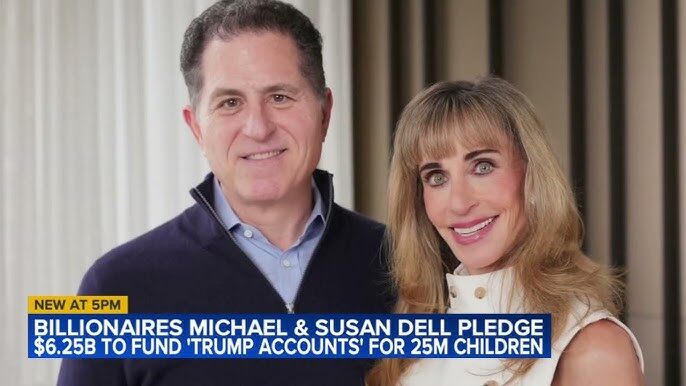
Odaily Note: Regarding the $6.25 billion donation from Michael Dell and his wife, Trump called it “one of the most generous acts in American history.”
In terms of investment, the “Trump Accounts” will be limited to investing in low-cost investment funds or exchange-traded funds (ETFs) that track broad stock market indices such as the S&P 500. They cannot be used to invest in specific industry or sector indices. The use of funds is also restricted. Funds in the account cannot be withdrawn for any reason (unless the child passes away or the funds are transferred to another similar restricted account) until January 1st of the year the child turns 18 and becomes a legal adult. After the child turns 18, the account will be treated the same as a traditional Individual Retirement Account (IRA).
According to the current plan, the “Trump Accounts” are tentatively scheduled to begin accepting initial deposits on July 4, 2026 (the 250th anniversary of the Declaration of Independence). This timing coincides with the eve of the 2026 midterm elections and is expected to become a key policy “trump card” for the Republican Party to win over voters.
What is the Potential Scale?
According to Statista data, since 2020, the annual number of births in the United States has fluctuated around 3.6 million.
Using this data as a baseline, during the planned coverage period from January 1, 2025, to January 1, 2029, the number of newborn children in the U.S. is expected to reach approximately 14.4 million. If the federal government opens a $1,000 “Trump Account” for each child, this would represent a massive fund of $14.4 billion. With the addition of potential private donations and family deposits, this figure will continue to grow to tens of billions of dollars. If the plan continues as a long-term initiative beyond 2029, its potential scale would be even more staggering.
Due to its operational characteristics of long-term lock-up, passive investment, and continuous new inflows, the “Trump Accounts” will essentially become a long-term passive fund pool with a potential scale of hundreds of billions of dollars. Beyond its simple child welfare attributes, this resembles establishing a long-term capital transfer channel between fiscal policy and the capital market, directly integrating the future generation into the stock market system.
The Biggest Beneficiary: Robinhood?
After the “Trump Accounts” plan was announced, financial institutions such as JPMorgan Chase, Charles Schwab, and Robinhood began fiercely competing for related services. With the U.S. Treasury’s official designation of Robinhood as the broker and initial custodian yesterday, Robinhood, having secured the “entry ticket,” is poised to become one of the most direct beneficiaries of the plan.
The most immediate benefit lies on the user side. Based on the current policy coverage estimates, the “Trump Accounts” will correspond to tens of millions of newborn accounts, and the interaction portal for these accounts will be completed through a unified application — in other words, Robinhood will gain a group of potential users bound to the platform from birth, with the oldest being just 1 year old and the youngest not even born yet… More importantly, these users are not one-time traffic but potential clients with extremely long lifecycles. After children turn 18, their accounts will convert into long-term investment accounts similar to IRAs. This means Robinhood has the opportunity to directly inherit these users’ investment behaviors into adulthood and further extend into more business scenarios such as ETFs, options, and even 加密 assets. From a lifecycle perspective, this is almost the longest user path a brokerage can obtain.
The benefits on the asset side are equally significant. The funds in “Trump Accounts” are characterized by obvious long-term lock-up, with almost no outflows before the child reaches adulthood. Furthermore, the investment scope is limited to index funds. For a brokerage, such funds represent high-quality custodial assets — low volatility, long retention, and predictable scale. Additionally, Robinhood’s core label has historically been a “retail trading platform,” with growth highly dependent on market conditions and trading activity. The “Trump Accounts” introduce low-frequency, long-term, passive investment capital, which aligns more closely with the capital attributes of traditional wealth management businesses. As the proportion of such funds increases, it will, to some extent, enrich Robinhood’s business diversity and address relative weaknesses.
Simultaneously, the endorsement at the policy level also carries symbolic significance. Participating in an account plan led by the Treasury Department brings Robinhood into the U.S. government’s financial infrastructure system for the first time. This not only enhances its institutional credibility but also provides new narrative space for its future expansion into retirement accounts, long-term investment, and wealth management services.
From a political perspective, the “Trump Accounts” are an important policy chip for the Republican Party in the midterm elections. From a capital market perspective, this plan introduces an institutionalized long-term funding source for the U.S. stock market. Robinhood happens to stand at the intersection of both — as millions of newborns who have not yet entered society are “automatically opening accounts,” this policy design centered around votes has quietly paved a growth curve for Robinhood that could last over a decade.
Compiled by Odaily (@OdailyChina); Translated by Azuma (@azuma_eth) Editor’s Note: Last night, the leading venture capital firm Dragonfly Capital announced the closing of its $650 million Fund IV. On the same evening, Dragonfly Capital’s star partner Haseeb Qureshi published a lengthy post on X titled “Crypto was not made for humans.” The article proposes a novel perspective that “加密currency was not made for humans, but should serve AI tokens,” suggesting that “in 10 years, we might be amazed that humans ever interacted directly with crypto.” Below is the full text by Haseeb Qureshi, compiled by Odaily. We are a crypto fund. If anyone should believe in cryptocurrency, it should be us. Yet, when we sign an agreement to invest in a startup, we sign a legal contract, not a smart…






























 简体中文
简体中文  English
  繁體中文
繁體中文  日本語
日本語  Tiếng Việt
  العربية
  한국어
한국어  Bahasa Indonesia
  हिन्दी
  اردو
اردو  Русский