








Losing $19,000 per Bitcoin Mined, Public Bitcoin Miners Massively Defect to AI
Original Compilation: Shenchao TechFlow
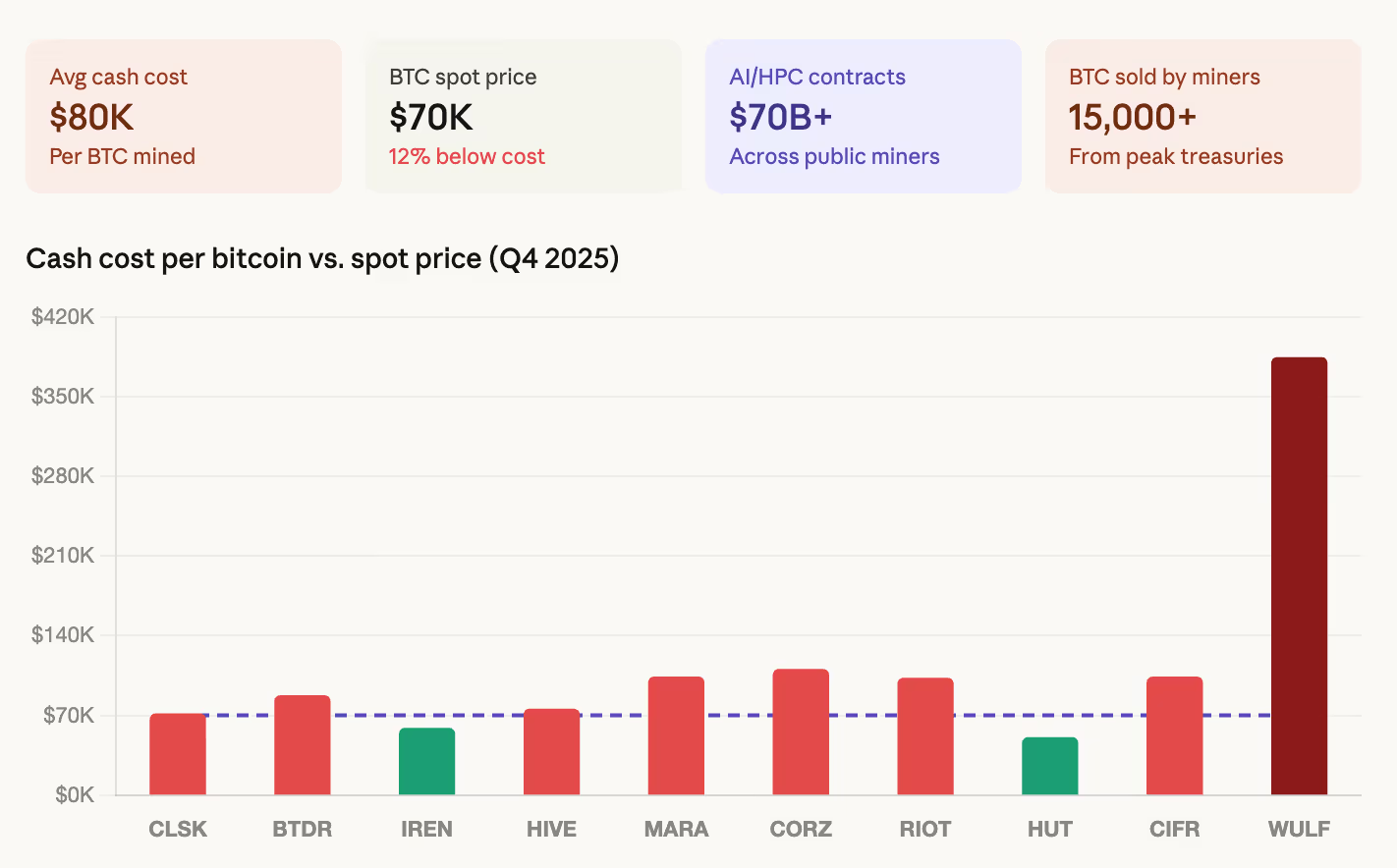
Introduction: The latest mining report from CoinShares shows that the weighted average cost for listed mining companies to mine one Bitcoin has risen to approximately $80,000, while BTC’s current price is between $68,000 and $70,000—resulting in a loss of about $19,000 per coin mined.
The industry is undergoing its most fundamental transformation since its inception: over $70 billion in AI/HPC contracts have been signed, listed mining companies have cumulatively sold over 15,000 BTC, and companies like IREN and TeraWulf have taken on tens of billions in debt. By the end of 2026, AI revenue could account for up to 70% of revenue for some miners. They are transitioning from Bitcoin miners to data center operators that happen to still mine. The core contradiction is: the companies selling BTC to pivot to AI are the very ones securing the Bitcoin network. The hash rate has dropped from a peak of 1,160 EH/s to around 920 EH/s.
- The Bitcoin mining industry is undergoing its most fundamental transformation since its inception, and the clearest signal is not hash rate or difficulty adjustments, but balance sheets.
- CoinShares’ Q1 2026 Mining Report released this week shows that the weighted average cash cost for listed miners to mine one Bitcoin rose to approximately $79,995 in Q4 2025.
- Bitcoin has been trading in the $68,000-$70,000 range, and a CoinDesk report last week estimated a loss of about $19,000 per BTC mined.
- This number is unsustainable, and the industry knows it. The response is a full pivot to AI infrastructure—which is reshaping the very nature of these companies.
According to the CoinShares report, listed mining companies have cumulatively announced over $70 billion in AI and High-Performance Computing (HPC) contracts. The expanded agreement between CoreWeave and Core Scientific is valued at $10.2 billion over 12 years. TeraWulf has secured $12.8 billion in HPC contract revenue. Hut 8 signed a $7 billion, 15-year AI infrastructure lease at its River Bend campus. Cipher Digital signed a multi-billion dollar agreement with Google-backed Fluidstack.
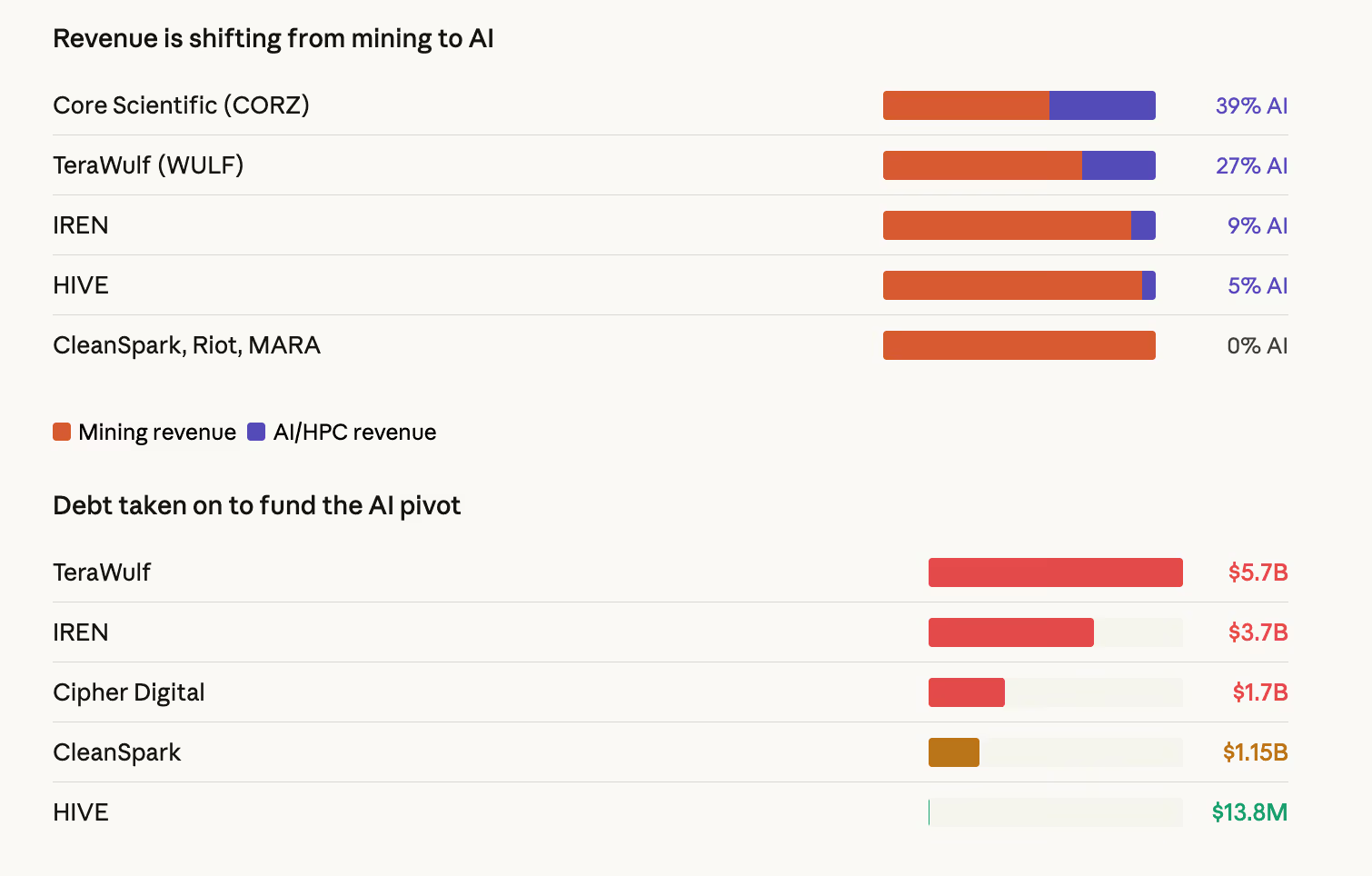
Listed miners could see AI revenue account for up to 70% of their total revenue by the end of 2026, compared to about 30% currently. AI hosting revenue already makes up 39% of Core Scientific’s total revenue. For TeraWulf, it’s 27%. IREN is currently at 9% but is rapidly expanding, with up to 200 megawatts of liquid-cooled GPU capacity under construction.
This means these mining companies are increasingly resembling data center operators that just happen to still mine Bitcoin.
The economics explain why. CoinShares data shows that Bitcoin mining infrastructure costs roughly $0.7-$1 million per megawatt, while AI infrastructure costs about $8-$15 million per megawatt. The gap is significant, but AI offers structurally higher and more stable returns.
Hash price—a metric measuring miner revenue per unit of computing power—fell to a post-halving record low in early March, around $28-$30 per PH per day.
At this level, miners using mid-generation machines need electricity costs below $0.05 per kilowatt-hour to remain cash-flow positive. In contrast, AI infrastructure contracts promise profit margins exceeding 85% with multi-year, visible revenue streams.
Where is the Money for the Pivot Coming From?
The CoinShares report points to two sources of funding for this transition, both clearly visible in the data.
First, debt. The leverage level across the industry has changed qualitatively. IREN now carries $3.7 billion in convertible notes, split across five series. TeraWulf has total debt of $5.7 billion, consisting of convertible notes and senior secured notes from its hashrate subsidiary.
Cipher Digital issued $1.7 billion in senior secured notes in November, causing its quarterly interest expense to skyrocket from $3.2 million in the first nine months to $33.4 million in Q4 alone. This is not a mining-level debt burden; it’s an infrastructure-level bet—wagering that AI revenue will arrive fast enough to cover debt obligations.
Second, selling Bitcoin. Listed miners have cumulatively sold over 15,000 BTC from their peak holdings. Core Scientific sold about 1,900 BTC (worth $175 million) in January and plans to liquidate nearly all its remaining holdings in Q1 2026. Bitdeer zeroed out its holdings in February. Riot Platforms sold 1,818 BTC (worth $162 million) in December.
Even the largest listed holder, Marathon (holding 53,822 BTC), quietly expanded its policy in its March 10-K filing, authorizing sales from its entire balance sheet reserve. Part of the reason is pressure from its $350 million Bitcoin-collateralized credit facility—the loan-to-value (LTV) ratio has climbed to 87% as the price fell towards $68,000.
Who Will Secure the Bitcoin Network?
The entities selling Bitcoin to fund AI are precisely the companies whose mining operations secure the Bitcoin network. This constitutes the core contradiction of this transition. When mining is unprofitable and AI is profitable, the rational economic decision is to shift capital away from mining. But if enough miners do this, the network’s security budget contracts.
Hash rate data already reflects this. The network hash rate peaked at around 1,160 EH/s in early October 2025 and has since declined to about 920 EH/s, with three consecutive negative difficulty adjustments—the first since July 2022.
Valuation Divergence
The market has already priced in this divergence. Miners with signed HPC contracts currently trade at 12.3 times their next 12-month revenue. Pure-play mining companies trade at only 5.9 times. The market is paying a premium of over two times for AI exposure, further reinforcing the incentive to pivot.
The geographical landscape is also shifting. The US, China, and Russia currently control about 68% of the global hash rate. In Q4 alone, the US gained about 2 percentage points in market share. But emerging markets are also entering the scene—Paraguay and Ethiopia have entered the top ten global mining countries, driven by HIVE’s 300 MW and Bitdeer’s 40 MW facilities, respectively.
Hash Rate Forecast
CoinShares forecasts the network hash rate will reach 1.8 ZH/s by the end of 2026 and 2 ZH/s by the end of March 2027 (one month later than previous forecasts).
But this prediction assumes Bitcoin returns to $100,000 by year-end. If the price remains below $80,000, CoinShares anticipates hash price will continue to fall, hash rate will decline further, and more miners will exit. A sustained drop below $70,000 could trigger larger-scale capitulation—ironically, this would benefit survivors by lowering the difficulty.
Next-generation hardware offers a potential lifeline. Bitmain’s S23 series and Bitdeer’s self-developed SEALMINER A3 both boast energy efficiency below 10 joules per terahash and are expected to ship in large volumes in the first half of 2026. Compared to current mainstream mid-generation machines, these miners could roughly halve the energy cost per Bitcoin. But deploying them requires capital—and many miners are directing that capital towards AI.
The Bitcoin mining industry entered this cycle as a group of companies securing the network and hoarding Bitcoin. It is exiting this cycle as a different entity: a group of companies building AI data centers and selling Bitcoin to finance them.
Is this a temporary response to unfavorable economics or a permanent structural shift? It depends on one variable: the price of Bitcoin. If it returns to $100,000, mining profitability recovers, and the AI pivot slows. If it stays at $70,000 or lower, the transition accelerates, and the mining-centric industry of the past decade will continue to disappear into something entirely different.
本文来源于互联网: Losing $19,000 per Bitcoin Mined, Public Bitcoin Miners Massively Defect to AI
Related: Weekly Token Unlocks: STRK Unlock Accounts for Approximately 4.6% of Circulating Supply
Starknet Project Twitter: https://twitter.com/Starknet Project Website: https://starknet.io/ Unlock Amount This Time: 127 million tokens Unlock Value This Time: Approximately $6.34 million Starknet is an Ethereum Layer 2 that utilizes zk-STARKs technology to make Ethereum transactions faster and cheaper. Its parent company, StarkWare, was founded in 2018 and is headquartered in Israel. Its main developed products include Starknet and StarkEx. By using STARKs, Starknet validates transactions and computations without requiring all network nodes to verify every operation. This significantly reduces the computational burden and increases the throughput of the blockchain network. The specific release schedule is as follows: Kamino Project Twitter: https://x.com/kamino Project Website: https://kamino.finance/ Unlock Amount This Time: 12.5 million tokens Unlock Value This Time: Approximately $13.63 million Kamino is an automated liquidity solution based on the Concentrated Liquidity 市场…































 简体中文
简体中文  English
  繁體中文
繁體中文  日本語
日本語  Tiếng Việt
  العربية
  한국어
한국어  Bahasa Indonesia
  हिन्दी
  اردو
اردو  Русский