








Since late February 2025, tensions in the Middle East have escalated dramatically. The United States and Israel launched large-scale airstrikes against Iran, sending shockwaves through global financial markets.
During a weekend of relentless conflict, while traditional financial markets were closed and Wall Street traders could only wait anxiously for Monday’s opening, another wave of investors was trading frantically on-chain platforms.
They weren’t trading 加密currencies; they were trading gold, crude oil, and silver.
Prediction markets like Polymarket and Kalshi saw their trading volumes surge due to war-related contracts, becoming the focal point of the market. But on the other side of the lens, perpetual DEXs (perp DEXs), including Hyperliquid, also “profited handsomely from the war”: trading volumes for commodity contracts on these platforms skyrocketed, with on-chain derivatives for traditional assets like gold, crude oil, and silver experiencing an unprecedented liquidity explosion.
The War Dividend for Prediction 市场s
Before delving into perp DEXs, it’s necessary to review the performance of prediction markets during this geopolitical crisis. After all, it was the impressive data from Polymarket and Kalshi that made people truly feel for the first time that the era of “betting on anything” had arrived.
According to data from Dune Analytics, for the week ending March 1, 2025, traders wagered a staggering $425.4 million on geopolitical issues on Polymarket, far exceeding the $163.9 million from the previous week. The platform’s total trading volume reached a record $24 billion, a significant increase from $18 billion the week before. Kalshi also performed strongly, with its contract on “Whether Khamenei will step down” attracting over $54.5 million in trading volume.
Behind these numbers is the powerful stimulation of user trading appetite by a globally known event like war. When missiles streaked across Tehran’s night sky, and when Trump announced on social media that “Khamenei is dead,” the price curves on prediction markets reflected the “truth” faster than any press release.
However, it’s important to clarify that “profiting from the war” here is not meant pejoratively. Prediction markets provide an unprecedented way for people to express their judgments on major events with real money. As Kalshi CEO Tarek Mansour said, the essence of these platforms is to “make uncertainty priceable,” and war simply pushes this pricing demand to the extreme.
The “Crazy Saturday” on Hyperliquid
Prediction markets are undoubtedly a direct beneficiary of the war in the Web3 space, but another, slightly “older” sector has also opened a door to a new world because of this conflict.
On March 1, the second day after the official outbreak of the US-Iran war, Iran acknowledged that Supreme Leader Khamenei had been killed in the conflict. That day, the cryptocurrency market quickly recovered after a brief dip, with Bitcoin’s intraday volatility slightly exceeding 7%, a reaction not considered particularly dramatic.
It happened to be a weekend, and most people’s focus was still on cryptocurrencies because, in their eyes, cryptocurrencies were the only “commodity” that could be traded without restrictions on weekends. However, this has long ceased to be the case.
Bloomberg reported on March 1 that on the first day of the war, a Saturday, the price of oil perpetual contracts on Hyperliquid rose about 5% to $70.6 per barrel, while gold and silver perpetual contract prices rose about 1.3% and 2% to $5,323 and $94.9 per ounce, respectively. Silver futures trading volume exceeded $227 million within 24 hours, and gold futures trading volume was approximately $173 million.
The perpetual contract markets for gold, silver, and crude oil had already launched on Hyperliquid’s largest HIP-3 market, trade.xyz, by the end of 2025 and early 2026. Furthermore, February 28 was not the peak of daily trading volume. On January 29, when silver hit a new all-time high of $120 per ounce, the daily trading volume of silver contracts on Hyperliquid exceeded $12 billion. This number was refreshed to over $35 billion on February 5, accounting for 68% of the total RWA market trading volume on HIP-3 that day.
Crude oil, newly arrived on the on-chain market, also performed remarkably well.
Before the conflict erupted, the average daily trading volume of crude oil contracts on Hyperliquid was only around $20 million. After the war broke out, as crude oil prices continued to rise, the daily trading volume of crude oil contracts on Hyperliquid quickly surpassed $100 million. On March 9, this number reached nearly $2 billion, second only to Bitcoin contract trading volume on the platform and far exceeding Ethereum’s.
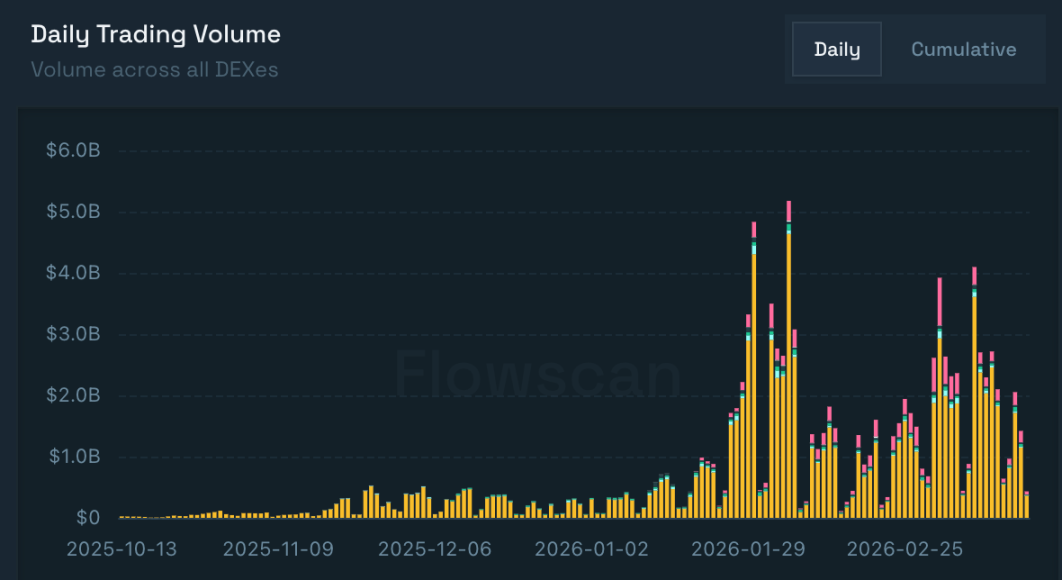
According to data from Flowscan, on March 8, the trading volume of Hyperliquid’s HIP-3 market exceeded $880 million, setting a historical record for weekend trading volume. Just one week later, this number was refreshed to nearly $966 million.
The ample weekend liquidity not only provided investors with a place where “money never sleeps” but also offered a better pricing mechanism for traditional financial markets. The managing partner of Arete.xyz stated on X that this was the first time a decentralized platform had achieved price discovery for traditional assets.
If this continues to develop, traders won’t need to scramble after the Monday opening. Perhaps they have already completed their trades on Hyperliquid over the weekend, or perhaps the opening price is very fair, leaving little arbitrage opportunity.
Of course, it’s not just on-chain platforms eyeing this lucrative opportunity.
Who’s Watching Closely?
Major exchanges also smelled the business opportunity early.
Well-known exchanges like Binance, OKX, and Bitget have long since listed RWA tokenized assets. OKX listed gold perpetual contracts as early as May last year, while Binance and Bitget did so in December.
交流s may not have paid much attention to these assets in the past, possibly because their volatility was low, and their “investment” attribute outweighed their “trading” attribute, making them less appealing. But with Trump first capturing Maduro and then beheading Khamenei, the volatility of assets like gold, silver, and crude oil rivals that of former altcoins, while today’s altcoins have long since “played dead.”
With cryptocurrencies failing to rally and traditional financial markets partying every day, anyone would be envious. Cryptocurrency exchanges are inherently never closed, and the listed commodity markets have no settlement deadlines. Trading these is just like trading “air,” same as altcoins, so having one more asset class doesn’t hurt.
It’s not just cryptocurrency exchanges. The holy temples of global quality assets, Nasdaq and the New York Stock Exchange (NYSE), are also unwilling to give up pricing power for commodities.
As early as last year, the rivals Nasdaq and NYSE hinted to the market that they were not only researching security tokenization but also wanted to support 7×24 trading. However, it’s clearly not easy for traditional institutions to take this step. Changing rules that have lasted for a century requires simultaneous changes upstream and downstream: who will be the market maker? Who will handle clearing? Can T+0 be achieved? These are all issues on the table.
The specific details are still hidden under the table. But just this month, Nasdaq announced a partnership with xStocks, a subsidiary of the US-based cryptocurrency exchange Kraken, while NYSE’s parent company ICE officially announced a $25 billion valuation investment in OKX. Clearly, they don’t want to hand over the territory they’ve built to others. The arrow is already on the bowstring, waiting for the launch command.
On the second weekend of March, Bloomberg again reported on Hyperliquid’s commodity trading data. This second report in a short period made many sensitive people feel the change: a platform that makes money from data and information began paying attention to on-chain exchanges and used the trading prices of commodities on them as a reference. But this raises another question: why did leading cryptocurrency exchanges get an early start but not attract the same level of attention as Hyperliquid?
Taking the silver perpetual contract as an example, on March 9, the trading volume of the XAGUSDT contract on Binance was $6.464 billion, while on Hyperliquid it was over $3.5 billion. Although numerically, Hyperliquid’s trading volume in this single market was only 54% of Binance’s, Binance has over 300 million users, while Hyperliquid’s total user count is only close to 1.7 million.
Winner Takes All
According to data from crypto asset research firm ASXN, Hyperliquid’s total trading volume exceeded $8 trillion (other data shows $4 trillion, possibly ASXN double-counted both sides of trades). Accounts with trading volumes over $10 billion accounted for 76% of the total volume, and accounts with trading volumes between $100 million and $1 billion accounted for 16%.
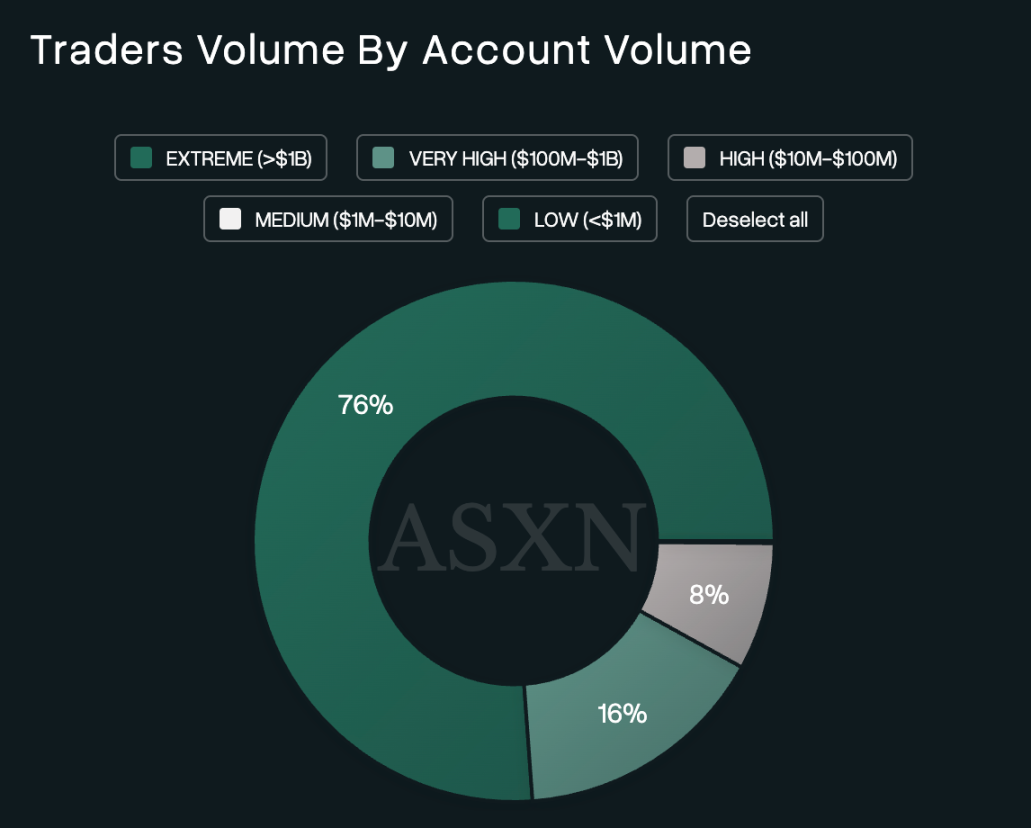
There are no designated market maker accounts on Hyperliquid, and some accounts with trading volumes reaching hundreds of billions of dollars are likely controlled by market makers. Even so, the 76% proportion is enough to prove that most users trading on Hyperliquid are actually whale investors. Although the overall volume may not match that of CEXs, the prices derived from whales trading with real money indeed have more reference value.
But this still doesn’t answer why the market consistently chooses and favors perp DEXs. The author previously compiled Chinese users’ views on perp DEXs in an article titled “Choosing Perp DEX is a Rebellion of ‘The World Has Suffered Under Qin for Too Long'”. Not many people said CEXs were doing poorly; more switched to DEXs for profit potential or airdrop farming needs.
But for foreigners, it’s a different story.
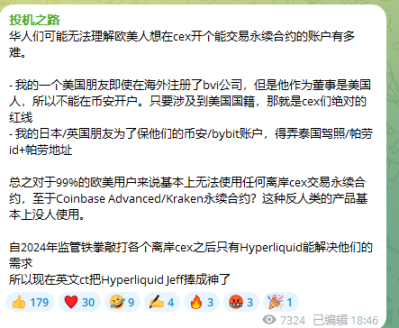
Vida, the founder of Equation News and a genius trader born in the 2000s, once shared some insights on Telegram to explain why foreigners are so bullish on Hyperliquid. According to a screenshot provided by X user JinMu, Vida attributed the reasons to strict KYC and the poor user experience of US-based exchanges.
Several investment institutions within the Web3 industry have also told the author that high-net-worth investors and family offices in China with large funds have relatively low trust in crypto. Even Li Lin, the founder of Huobi, holds Bitcoin positions indirectly through BlackRock’s IBIT via his family office in Hong Kong. In contrast, large funds or high-net-worth individuals abroad have a higher acceptance of crypto, and many traditional financial institutions are experimenting with Web3 products.
This explains why Bloomberg started paying frequent attention to Hyperliquid in March, as the whale users on the platform might include some traditional financial institutions that couldn’t find liquidity on weekends.
As for CEXs, no matter how high their trading volume, you never know who is actually trading. From the single dimension of “reference value,” they indeed can’t compare to DEXs. Additionally, DEXs’ self-custody, transparent transactions, and unrestricted leverage provide fertile ground for financial traders to operate freely.
“Such an unregulated platform will inevitably be taken down by regulators.”
This is likely a sentiment many have seen recently. Listing new assets without review, not questioning fund sources, and uniform leverage are indeed actions dancing on regulatory red lines. But this might be a platform tacitly allowed to exist in a gray area. Like TikTok, the government could shut it down citing “national security,” but the American public wouldn’t agree, and stakeholders and officials hoping to profit from it wouldn’t either.
In the future, when certain international events affect the prices of metals, grains, or raw materials, Hyperliquid can still replicate the miracle of gold and crude oil. The author believes that, in the short term, regulators will not crack down on Hyperliquid. The “Golden Triangle” region, once ungoverned, was ultimately eradicated not entirely because of the harm of drugs themselves, but possibly because someone else wanted to make that money. The fact that S&P Dow Jones Indices authorized Hyperliquid, not any CEX, to launch the S&P 500 index perpetual contract is the best evidence.
The same logic applies to Hyperliquid and other perp DEXs. As long as they don’t touch certain core interests, they have value in existing.
Pricing “Uncertainty”
While HIP-3 is in full swing, HIP-4 is also quietly gathering strength.
HIP-4, launched on the testnet on February 2, 2026, introduced the “Outcome Trading” function, a type of fully collateralized contract settled within a fixed price range, specifically designed for prediction markets and option-like products.
Unlike Hyperliquid’s core perpetual contracts, HIP-4 outcome contracts have an expiration date, require no leverage, carry no liquidation risk, and settle within pre定义ned price ranges. For example, if you believe Bitcoin will break $80,000 by the end of March, you can buy the corresponding outcome contract. At expiration, if Bitcoin indeed exceeds $80,000, the contract settles at the upper limit for profit; if not, it settles at the lower limit, with losses limited to the initial investment.
The market generally interprets HIP-4 as “Hyperliquid entering the prediction market,” but this may underestimate its strategic significance. The true value of HIP-4 lies in expanding Hyperliquid from a pure derivatives exchange into a more comprehensive “uncertainty pricing platform.”
Isn’t Polymarket pricing uncertainty? Not really. Prediction markets display more of a probability. When you think an event has an 80% chance of happening, but the amount you intend to invest would directly push the probability to 99%, you naturally choose to reduce your capital.
Outcome contracts, however, can reveal risk appetite through capital volume. Taking the example of whether Bitcoin will break $80,000 by the end of March, many on Polymarket might choose “no,” but on Hyperliquid, you might see many people buying call options. This means that although many are indeed bearish, they are not that pessimistic, or these investors believe they need to hedge against a possible rise.
If Bitcoin really rises to $80,000 by the end of March, watching the probability on Polymarket jump from 20% to 80% when it’s at $79,000 is too late.
Furthermore, HIP-4 complements Hyperliquid’s existing perpetual contracts. Traders can seamlessly switch between linear derivatives (perpetual contracts) and non-linear derivatives (outcome contracts) under the same account and margin system, building more sophisticated and efficient portfolios. This “composability” is Hyperliquid’s advantage over specialized prediction market platforms.
Money Never Sleeps
We are witnessing an era where “money never sleeps” is becoming a reality.
On one hand, prediction markets, a sector teetering on the edge of gambling, allow events with deterministic outcomes to be wagered on with money. On the other hand, on-chain trading platforms provide ample liquidity to price unexpected events even during holidays when markets are closed.
The arbitrage space created by information asymmetry has become the foundation for a “platform’s” survival. The boundaries of platforms will continuously expand. For now, they are temporarily confined to Earth. In ten or twenty years, you might be able to trade lunar minerals on a spaceship heading to Mars.
We are pleased to see finance, a human invention, advance further with the support of blockchain. But at the same time, we must remind ourselves:
My life is finite, while knowledge is infinite. To pursue the infinite with the finite is perilous indeed!
本文来源于互联网: Profiting from the US-Iran War Isn’t Limited to Prediction Markets
Price Structure Under Pressure: Selling Pressure Not from Institutions, but Dispersed Speculative Losses Over the past six months, Bitcoin has failed to strengthen in sync with gold and other risk assets. Since June 2025, sustained selling by early holders was once considered the primary suppressing factor. However, starting in October, as gold accelerated its upward move and Bitcoin entered a correction, it became clear that a single factor could no longer explain the current divergence. The flash crash on October 10, 2025, served as a significant watershed. This event led to a notable widening of cross-asset relative pricing and inter-exchange price spreads, squeezing the risk budgets of market makers and market-neutral capital, thereby weakening short-term liquidity. It is noteworthy that there is little indication of concentrated losses among major trading…































 简体中文
简体中文  English
  繁體中文
繁體中文  日本語
日本語  Tiếng Việt
  العربية
  한국어
한국어  Bahasa Indonesia
  हिन्दी
  اردو
اردو  Русский