









Bitcoin stands out as a frontrunner in the 加密貨幣currency industry, with analysts predicting an exponential rise in adoption rates.
According to renowned analyst Willy Woo, Bitcoin is on the verge of a monumental leap, expecting to match the Internet’s growth trajectory from 1997 to 2005.
十億比特幣持有者意味著什麼
Woo believes this seismic shift in adoption has been brewing for years. For this reason, “1 billion people will own Bitcoin by the end of this cycle,” Woo asserted. He highlighted the Bitcoin price and the digital currency’s accelerated adoption rate, which outpaces that of the early Internet.
Given Bitcoin’s accelerating acceptance worldwide, cryptographer Adam Back suggested that the market is eyeing a much loftier goal, with $100,000 being viewed as “way overdue.”
“Bitcoin tapped $73,000 Tuesday. No one said anything. Spent much of Wednesday above $73,000. I think the reason things are muted is that $100,000 seems way overdue, for a few years now, so there’s not much bull market euphoria as the $1,000 to $5,000 green candles scroll by,” Back said.
了解更多:2024 / 2025 / 2030 年比特幣價格預測
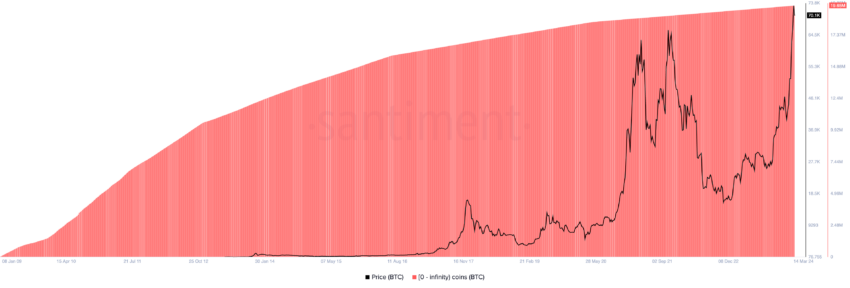
有趣的是,這種比特幣價格預測背後的催化劑很大程度上歸因於機構需求。
As CryptoQuant’s CEO, Ki Young Ju, pointed out, a “sell-side liquidity crisis” looms on the horizon if institutional inflows persist. This surge in demand, coupled with the successful launch of spot Bitcoin exchange-traded funds (ETFs) in the US, has validated Bitcoin as a viable institutional investment and introduced a paradigm where demand may soon outstrip supply.
事實上,現貨比特幣 ETF 已成為史上最成功的 ETF 發行,規模接近 $300 億。正如 Ki 所闡明的那樣,這種湧入可能會引發供應引發的價格衝擊。在這種情況下,可用的比特幣無法滿足不斷增長的需求。
Last week’s net flows into spot ETFs of over 30,000 BTC further exacerbate a potential liquidity crisis.
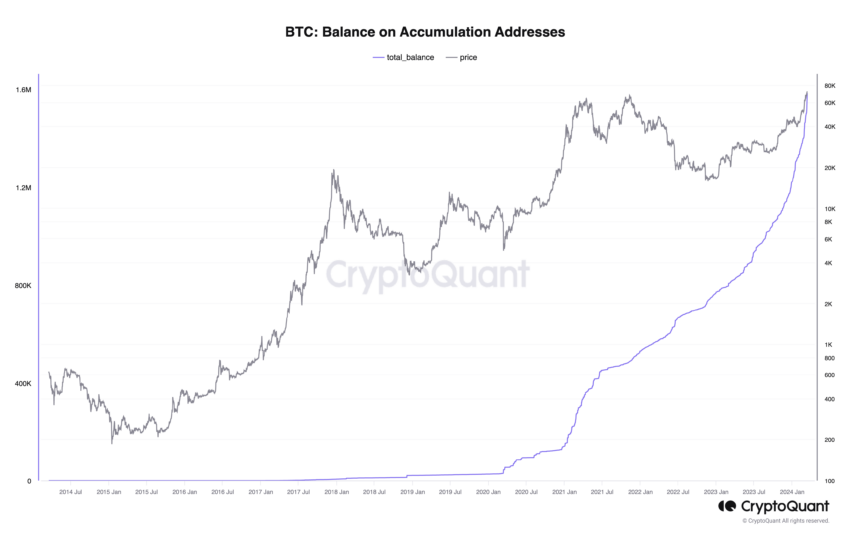
Moreover, Ki’s analysis sheds light on the accumulation of Bitcoin by wallets that only receive transactions. This uptrend in accumulation addresses signals a growing hoarding behavior. If it continues, it could herald the onset of a sell-side liquidity crunch.
了解更多:如何交易比特幣 ETF:逐步方法
As Bitcoin’s adoption curve steeply ascends towards the 1 billion mark, the interplay between escalating demand, particularly from institutional investors, and dwindling supply could catalyze unprecedented price impacts.































 繁體中文
繁體中文  English
  简体中文
简体中文  日本語
日本語  Tiếng Việt
  العربية
  한국어
한국어  Bahasa Indonesia
  हिन्दी
  اردو
اردو  Русский