






Exploring Hyperliquid’s Million-Level Builder Ecosystem: Can Lighter Still Catch Up with “Zero Fees”?
In the current Perp DEX landscape, the arms race for “liquidity” and “security” has entered its second half, and “ecosystem vibrancy” is rebất chấpning the moat of on-chain exchanges.
On one side is Hyperliquid, which, leveraging its first-mover advantage with the Builder Code mechanism, has fostered a vast application network of over 80 active developers. From seamless integrations with mainstream wallets to dedicated terminals for hardcore quantitative institutions, this ecosystem has generated a cumulative revenue of $64.22M. On the other side is Lighter, a hardcore player backed by top-tier capital (Founders Fund, a16z) and relentlessly focused on institutional-grade security on Ethereum L2. In Lighter’s current landscape, ecosystem application revenue remains at “zero,” with all protocol-level revenue relying on its unique “retail free + institutional paid” two-tier model.
The stark contrast between $64.22M and $0 is not just a difference in scale on paper; it represents a fierce collision between two paths of on-chain financial evolution. This article will deconstruct the top ten Builder applications within the Hyperliquid system, examining the operational logic of its ecosystem flywheel through real on-chain data.
1. How Does Builder Code Reshape the Revenue Landscape?
1.1 What is Builder Code?
Hyperliquid’s Builder Code mechanism allows third-party developers to attach a Builder Code when sending orders to Hyperliquid, enabling them to collect an additional fee (up to 0.1%) from each filled trade. The core features of this mechanism:
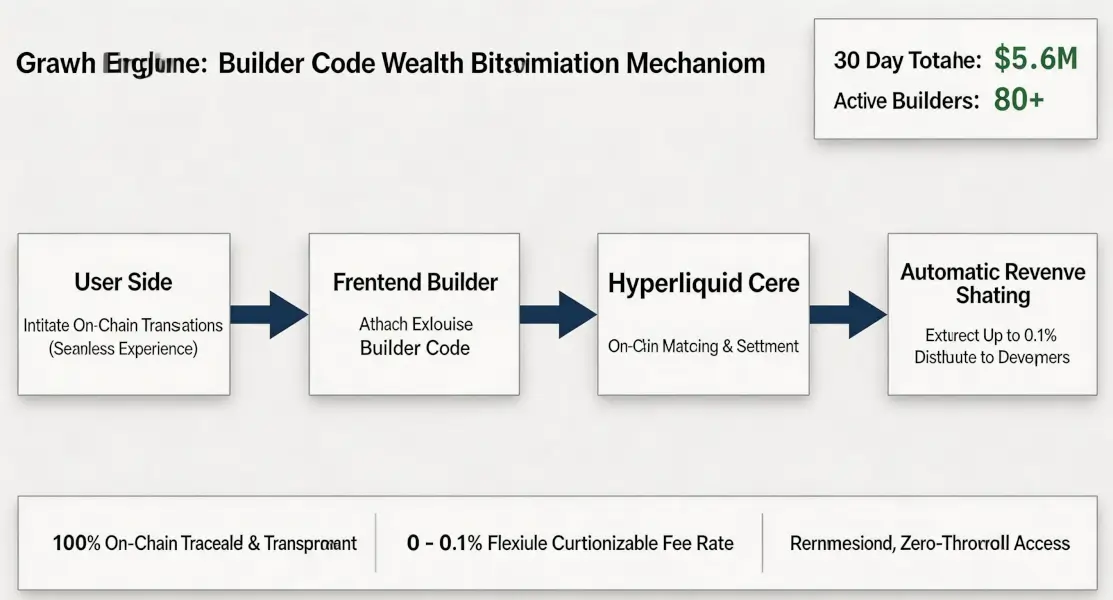
- On-Chain Transparency: All Builder revenue is traceable on-chain.
- Flexible Pricing: Each Builder can set its own fee rate (0-0.1%).
- User Agnostic: Fees are deducted from trading fees, with no difference in user experience.
- Không được phép: Any developer can register a Builder Code.
As of March 2026, the Hyperliquid Builder Code ecosystem has 80+ active Builders, with a historical cumulative revenue of $64.22M and a 30-day revenue of approximately $5.6M.
2. Hyperliquid’s Top 10 Application Map and Business Logic Deconstruction
2.1 “Traffic is Justice”: The Dimensional Strike of Wallet Giants
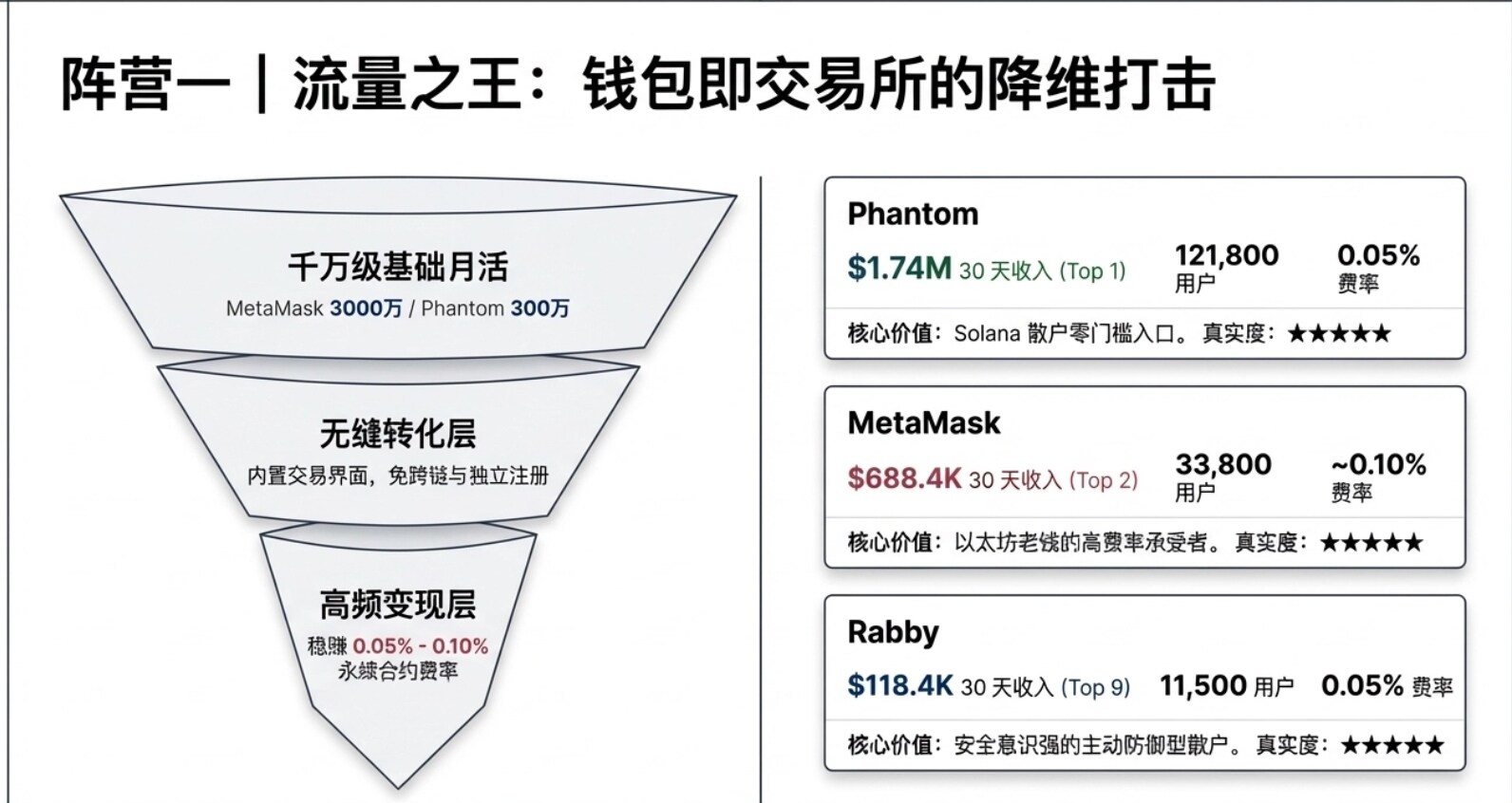
2.1.1 Phantom
Product Positioning
Phantom is the most mainstream wallet in the Solana ecosystem, with over 3 million monthly active users. Starting in the second half of 2025, Phantom directly integrated Hyperliquid perpetual contract trading into its wallet interface, allowing users to trade perpetuals without leaving the wallet. This is a key step in Phantom’s transformation from a “storage tool” to a “trading platform.”
Revenue Mechanism
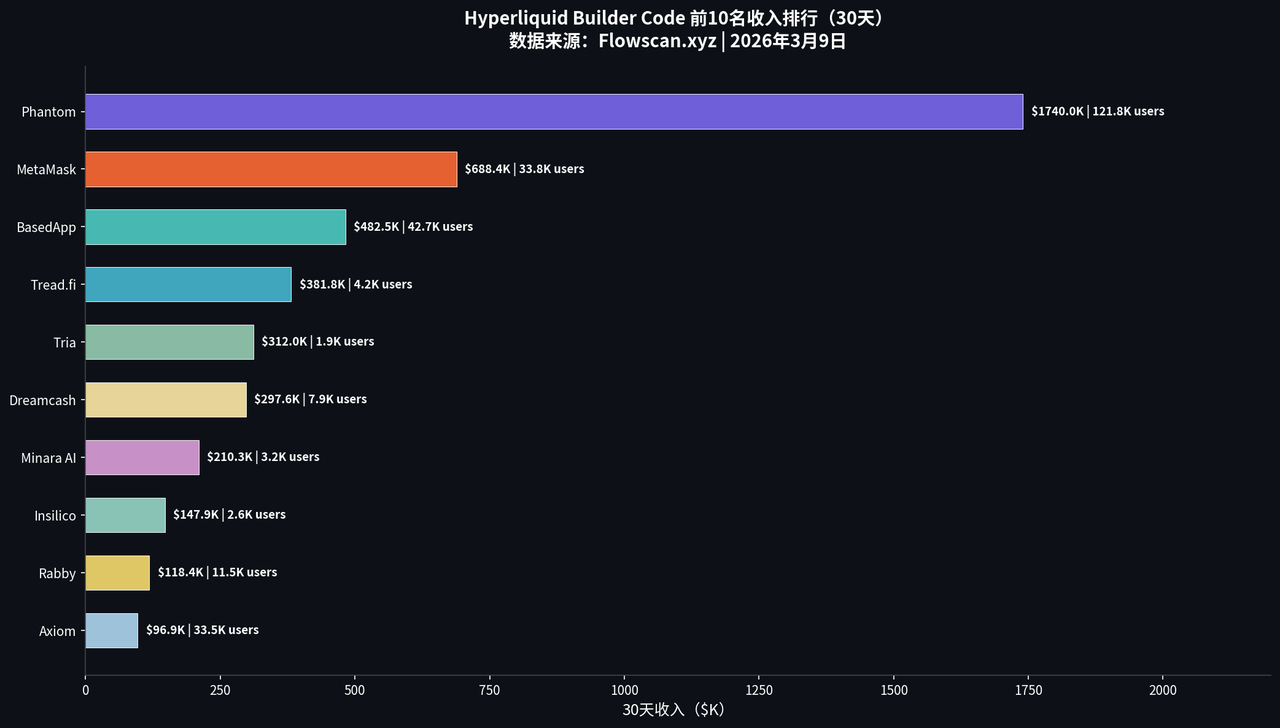
Phantom charges an additional 0.050% fee on each Hyperliquid perpetual contract trade via its Builder Code. Based on $3.48B in 30-day trading volume, the $1.74M revenue perfectly matches ($3.48B × 0.050% = $1.74M), indicating highly consistent data and extremely high revenue authenticity.
User Profile
Phantom’s Hyperliquid users are primarily retail users from the Solana ecosystem, with specific characteristics:
- Already hold Solana assets and wish to engage in leveraged trading without leaving their wallet.
- Have some understanding of DeFi but are unwilling to learn complex standalone trading platforms.
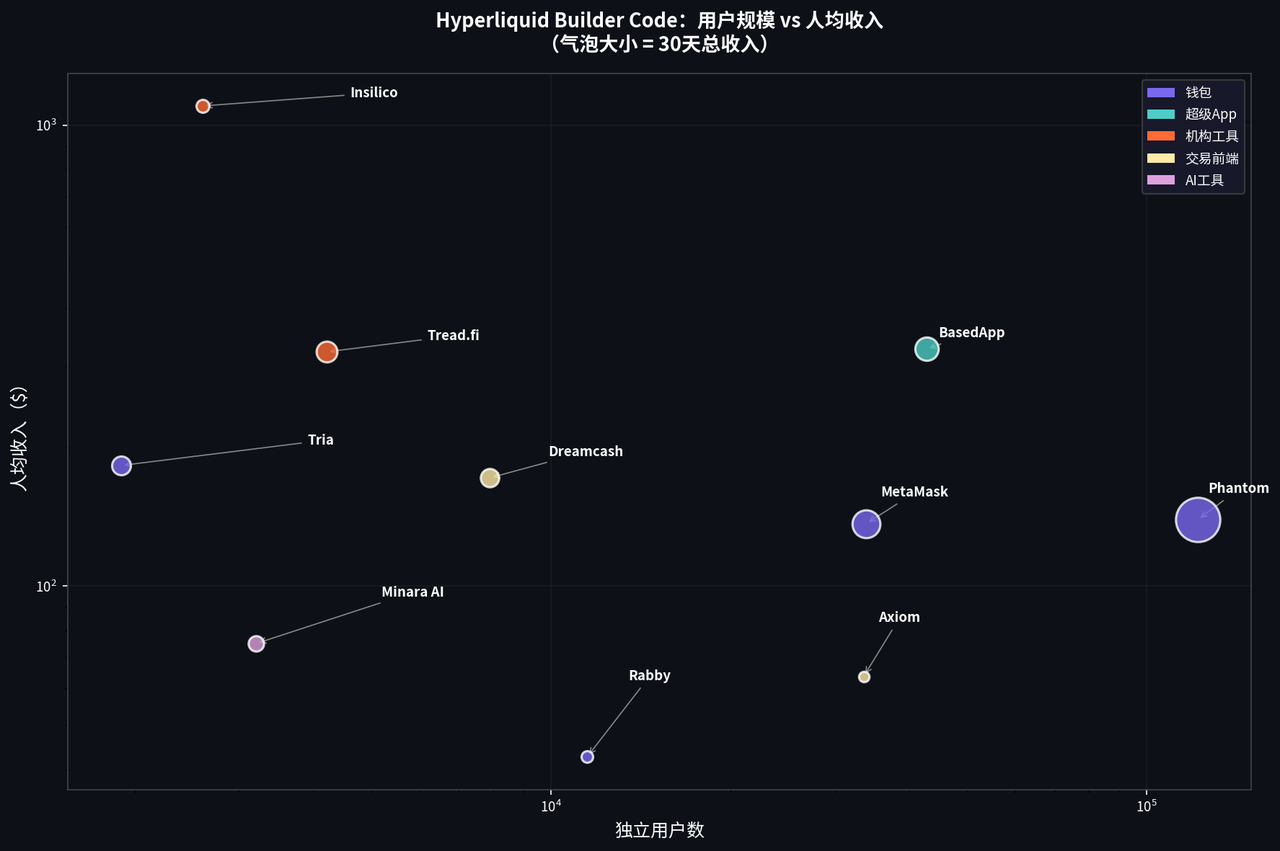
- Medium trading frequency, contributing $139 per capita revenue (30 days), representing moderately active users.
- 121,800 unique users, the highest among all Builders, indicating an extremely large user base.
Core Value Proposition
“Your wallet is your exchange.” The core pain point Phantom solves is: users already manage assets within Phantom, and switching to another platform (Hyperliquid’s official website) requires extra steps. By embedding the trading entry point within the wallet, Phantom significantly lowers the barrier to entry. For Solana users, Phantom is their primary gateway to interact with the DeFi world, a traffic advantage other Builders cannot replicate.
Competitive Advantage
Phantom’s core advantages are its user base (3M MAU) and brand trust. Other Builders need to actively acquire users, while Phantom simply needs to enable new features for its existing users. Its 121,800 unique users are 3.6 times that of the second place (MetaMask’s 33,800).
2.1.2 MetaMask
Product Positioning
MetaMask is the largest wallet in the Ethereum ecosystem, with over 30 million global MAU. In 2025, MetaMask integrated multi-chain DeFi operations, including Hyperliquid perpetual contract trading, through its MetaMask Portfolio feature. Similar to Phantom, MetaMask treats Hyperliquid as a key component of its multi-chain trading functionality.
Revenue Mechanism
MetaMask charges trading fees via its Builder Code. Based on the data, $688.4M in trading volume generated $688.4K in revenue, corresponding to a fee rate of approximately 0.10% (close to the upper limit), though the official rate is not public. This rate is significantly higher than Phantom’s (0.050%), possibly reflecting MetaMask users’ lower sensitivity to fees.
User Profile
MetaMask’s Hyperliquid users are primarily mid-to-advanced users from the Ethereum ecosystem:
- Hold Ethereum assets and want to explore Hyperliquid’s high-performance trading experience.
- Familiar with DeFi but accustomed to operating on-chain applications through MetaMask.
- Per capita revenue contribution of $136 (30 days), similar to Phantom users.
- 33,800 unique users, about one-fourth the size of Phantom’s.
Core Value Proposition
“The lowest-barrier path for Ethereum users to enter Hyperliquid.” MetaMask users are typically unfamiliar with the Solana ecosystem, and the Hyperliquid website requires separate registration. MetaMask provides a familiar interface for Ethereum users, lowering the psychological barrier for cross-chain exploration.
2.1.3 Rabby
Product Positioning
Rabby is a professional Ethereum ecosystem wallet developed by the DeBank team, renowned for its excellent security features:
- Pre-transaction simulation: Preview transaction results before signing.
- Multi-chain asset management.
- Built-in DeFi operation interface.
- Recently integrated Hyperliquid perpetual contract trading.
Revenue Mechanism
Rabby charges a 0.05% Builder Code fee. $583.18M in trading volume generated $118.4K in revenue. Per capita revenue contribution is $42.55, the lowest among the Top 10 Builders, indicating a user base dominated by small-to-medium retail traders.
User Profile
Rabby’s users are security-conscious users in the Ethereum ecosystem:
- 11,500 unique users, a medium-sized group.
- High security requirements; the core reason for choosing Rabby is its security features.
- Low per capita revenue contribution ($42.55), indicating users primarily engage in small trades.
- Relatively conservative in their use of Hyperliquid.
Core Value Proposition
“A security-first DeFi operation interface.” Rabby’s core differentiation is its pre-transaction simulation feature, allowing users to see the actual effect of a transaction before signing, significantly reducing the risk of phishing and misoperations. For security-conscious users, Rabby is an irreplaceable choice.
2.2 “All-in-One Manager”: Super Apps and Account Abstraction Gateways
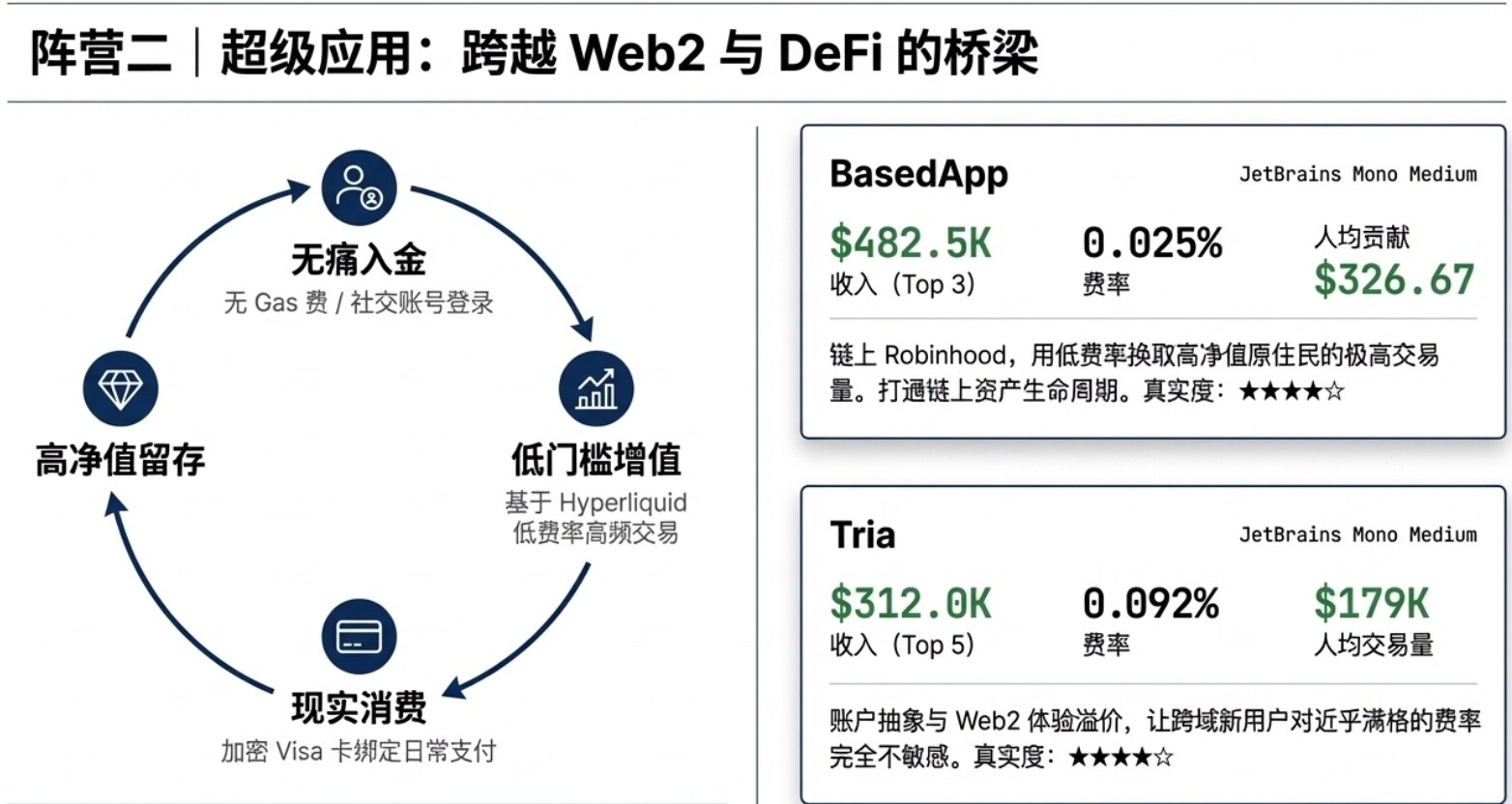
2.2.1 BasedApp
Product Positioning
BasedApp (Based) is a mật mã super app positioned as the “on-chain Robinhood.” Its core features include:
- Hyperliquid perpetual contract trading (primary revenue source).
- Crypto Visa debit card (can directly spend on-chain assets).
- Multi-chain asset management.
- Social features (copy trading, trade sharing).
Revenue Mechanism
Based charges a 0.025% Builder Code fee, lower than Phantom’s (0.050%) but with higher trading volume ($1.94B vs $3.48B). This strategy reflects Based’s positioning: attracting high-frequency traders with low fees, trading margin for volume.
User Profile
Based has the most unique user profile:
- High-net-worth DeFi-native users: Per capita revenue contribution of $326.67, 2.4 times that of Phantom.
- 42,700 unique users, but per capita trading volume is far higher than Phantom’s.
- Willing to pay a premium for the “super app” experience.
- Users holding the Visa card directly use on-chain assets for daily spending.
Core Value Proposition
“Full lifecycle management of on-chain assets.” Based solves the pain point where DeFi users’ assets are trapped on-chain and cannot be easily used for real-world consumption. Based’s Visa card bridges on-chain assets with real-world spending scenarios, a unique value proposition other Builders cannot provide.
2.2.2 Tria
Product Positioning
Tria is a multi-chain account abstraction wallet positioned as the “lowest-barrier entry for Web2 users into Web3.” Core features:
- No seed phrase (uses MPC technology, login via email/social accounts).
- No gas fees (Tria covers gas).
- Multi-chain unified account (same address works across all EVM chains).
- Built-in Hyperliquid perpetual contract trading.
- Up to 15% APY (via DeFi protocols).
- Crypto Visa card.
Revenue Mechanism
Tria charges Hyperliquid trading fees via its Builder Code. $340.44M in trading volume generated $312K in revenue, corresponding to a fee rate of approximately 0.092%, close to the upper limit. This reflects Tria users’ insensitivity to fees (as Tria’s core selling point is the “gasless” experience, not low trading fees).
User Profile
Tria’s users are the most typical Web2-to-Web3 migrants:
- New users who have never used MetaMask or Phantom.
- Login via Google/Apple accounts, no need to manage private keys.
- Per capita revenue contribution of $182.52, a medium level.
- Only 1,900 unique users, but high per capita trading volume ($179,179).
Core Value Proposition
“Enabling Web2 users to enter DeFi seamlessly.” Tria addresses Web3’s biggest UX pain points: complex seed phrase management, confusing gas fees, and cumbersome multi-chain operations. Through account abstraction technology, Tria completely hides this complexity; users only need to log in with an email to trade on Hyperliquid.
2.3 “Hardcore Harvesters”: Quant Terminals and High-Frequency Trading’s Speed Engines
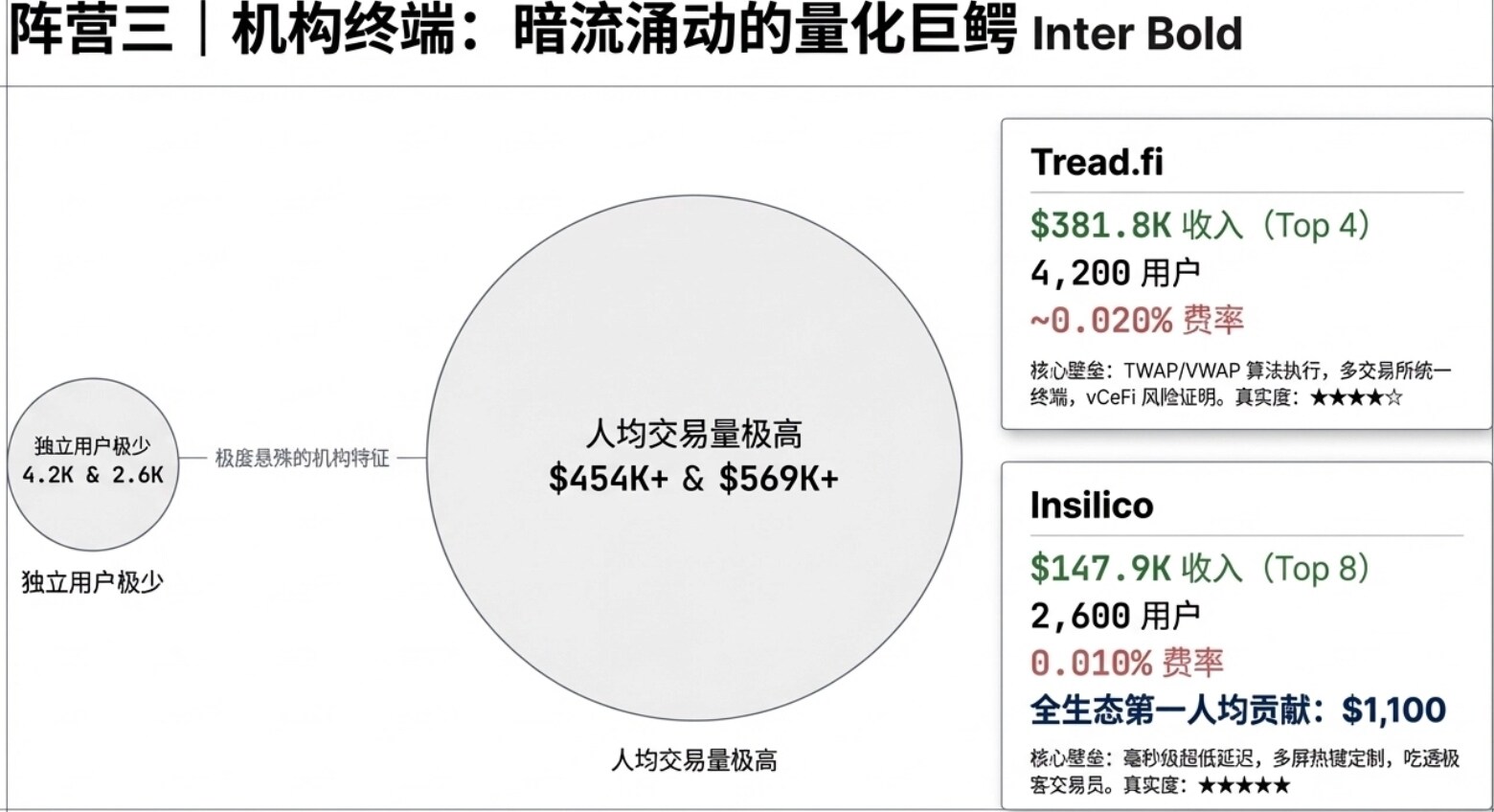
2.3.1 Tread.fi
Product Positioning
Tread.fi is an institutional-grade algorithmic trading terminal and OEMS (Order Execution Management System), founded by David Jeong, former VP of Quant at Morgan Stanley, which completed a $3.5M Pre-Seed round in July 2024.
Core features:
- Multi-exchange unified terminal: Simultaneously connects to CEXs and Perp DEXs like Binance, Bybit, OKX, Hyperliquid.
- Algorithmic execution suite: TWAP, VWAP, market maker bots, basis arbitrage.
- vCeFi: Makes CEX trading data verifiable on-chain for DeFi lending and risk proof.
- Self-custody TaaS: Institutions can deploy on private cloud; API keys never leave the local environment.
Revenue Mechanism
Tread.fi charges Hyperliquid trading fees via its Builder Code. $1.91B in trading volume generated $381.8K in revenue, corresponding to a fee rate of approximately 0.020%. Notably, Tread.fi has only 4,200 users but a trading volume of $1.91B, with a per capita trading volume of ~$454,762, characteristic of typical institutional/quantitative users.
User Profile
Tread.fi‘s users are the most institutionalized among all Builders:
- Quantitative market makers, arbitrage bots, hedge funds.
- Massive daily trading volume but very few users (4,200).
- Per capita revenue contribution of $321.93, second only to BasedApp.
- Require professional algorithmic execution tools like TWAP/VWAP.
Core Value Proposition
“The professional tool layer for institutional traders on Hyperliquid.” Tread.fi solves the pain point that Hyperliquid’s official interface lacks institutional-grade algorithmic execution features. Quant institutions need functions like TWAP order splitting, multi-exchange hedging, and vCeFi risk proof, which are the core value propositions of Tread.fi.
2.3.2 Insilico
Product Positioning
Insilico Terminal is a professional trading interface built for speed and ease of use, constructed by veteran traders and developers with decades of experience. Positioned as a “supercharged trading interface,” it focuses on:
- Ultra-low latency order execution.
- Professional-grade charts and analysis tools.
- Multi-account management.
- Advanced order types (conditional orders, trailing stops, etc.).
Revenue Mechanism
Insilico charges an extremely low 0.010% Builder Code fee, but $1.48B in trading volume generated $147.9K in revenue. Per capita revenue contribution is as high as $1,100, among the highest of all Builders, indicating its users are ultra-high-frequency traders.
User Profile
Insilico’s users are professional quantitative traders and high-frequency traders:
- Only 2,600 unique users, but per capita trading volume is ~$569,231 (extremely high).
- Per capita revenue contribution of $1,100, indicating users trade with extremely high frequency.
-
cái vítrao đổiSự an toànđầu tưDeFiDEXStandardtechnologyRWAWelcome to Join Odaily Official Community


Bài viết này được lấy từ internet: Exploring Hyperliquid’s Million-Level Builder Ecosystem: Can Lighter Still Catch Up with “Zero Fees”?
Related: Beyond Self-Criticism, What Else Is Vitalik Pondering?
Starting from the second half of 2025, he has been posting lengthy articles intensively on Twitter, with a frequency, length, and breadth of topics rarely seen in his public discourse over the past decade. This does not resemble a successful founder preaching, but more like an anxious thinker trying to rekindle something from the ruins. We have reviewed all his public tweets from 2025 to the present and found his interests to be extremely broad: from underlying consensus mechanisms to upper-layer social governance, from mật mãgraphy to AI ethics, from geopolitics to social media, all bear traces of his deep contemplation. Amidst these diverse topics, we attempt to distill the keywords he mentions most frequently and the core propositions he cares about most. These thoughts not only concern the future of…
相关文章
































 Tiếng Việt
  English
  繁體中文
繁體中文  简体中文
简体中文  日本語
日本語  العربية
  한국어
한국어  Bahasa Indonesia
  हिन्दी
  اردو
اردو  Русский