







Binance Issues Rare Statement to Regulate Market Makers, Targeting “Active Market Making” Manipulation Tactics
Author|jk
On March 25th, Beijing time, Binance published an official blog post specifically outlining red lines for криптовалюта market maker behavior. Starting from defining the role of market makers, the article outlines risk signals related to market makers and provides specific compliance requirements for project teams. Although it does not directly name any specific projects or institutions throughout, industry insiders widely believe this article targets the increasingly prevalent “Active Рынок Maker” (AMM) manipulation model.
What Did the Article Say?
The article begins by explaining what a market maker is: Рынок makers provide liquidity for trading pairs by continuously placing buy and sell orders. Their core value lies in “balancing buy and sell orders to maintain liquidity, stabilize prices, and support orderly trading.” Whether in centralized order books or decentralized AMM pools, market makers are an indispensable part of market operation.
The article then shifts focus, highlighting six types of “risk signals”:
- Selling behavior inconsistent with token release schedules: The article clearly states, “Premature, excessive, or frequent selling may indicate misaligned incentives or lax internal controls”;
- One-sided trading behavior: Healthy market making should provide two-sided liquidity. “If there is a persistent presence of sell orders without corresponding buy orders, it may increase downward price pressure”;
- Cross-platform coordinated selling: Depositing and selling large amounts of tokens simultaneously across multiple exchanges, “exceeding the scope of normal liquidity rebalancing,” is characterized as coordinated distribution rather than genuine market making;
- Mismatch between trading volume and price action: High volume with stagnant prices is seen by Binance as “potentially indicative of wash trading rather than genuine demand”;
- Sharp price volatility under thin liquidity: “When liquidity is insufficient or the order book is shallow, even relatively small trades can trigger significant price swings, making prices more susceptible to artificial inflation or suppression”;
- And imbalance between trading volume and liquidity: “When liquidity is shallow, large trades can easily move prices. Therefore, if an asset appears to be actively traded but has limited order book depth, the related activity may not represent genuine market demand.”
In the section outlining requirements for project teams, the wording is more direct: Strictly prohibit “large-scale selling behavior that leads to abnormal price declines (also known as dumping)”; prohibit profit-sharing and guaranteed return models; do not collude with third parties to manipulate prices or liquidity; token lending agreements must clearly specify token usage.
It Didn’t Mention Active Market Makers, But Every Sentence Pointed to Them
The so-called “Active Market Maker” model is a popular token operation strategy in the altcoin market: Project teams lend a large number of tokens to market makers, who then actively intervene in price action, attracting retail investors by pumping the price before gradually selling off, and sharing profits with the project team. The core characteristics of this model precisely align with the risk signals listed in Binance’s article—cross-platform coordination, one-sided selling pressure, opaque lending agreements, and selling patterns that contradict official token release schedules.
Although Binance did not directly name the “Active Market Maker” concept this time, its explicit statements against “profit-sharing and guaranteed return models” and the requirement that “token lending agreements must clearly specify token usage” are almost an open naming within the industry. The abnormal price action and on-chain behavior of certain tokens recently have clearly triggered the exchange’s alert.
Was SIREN the Trigger?
To understand the context of Binance’s announcement, we must first clarify the recent events surrounding SIREN.
On March 22nd, SIREN broke above $2, with a 24-hour surge of 131%.
According to on-chain analyst Yu Jin’s monitoring, among the top 54 SIREN token holder addresses, except for the burn wallet and Binance’s Web3 wallet, the remaining 52 addresses are suspected to be owned by the same controlling entity—holding a total of 644 million SIREN, accounting for 88.5% of the total supply, valued at up to $1.44 billion.
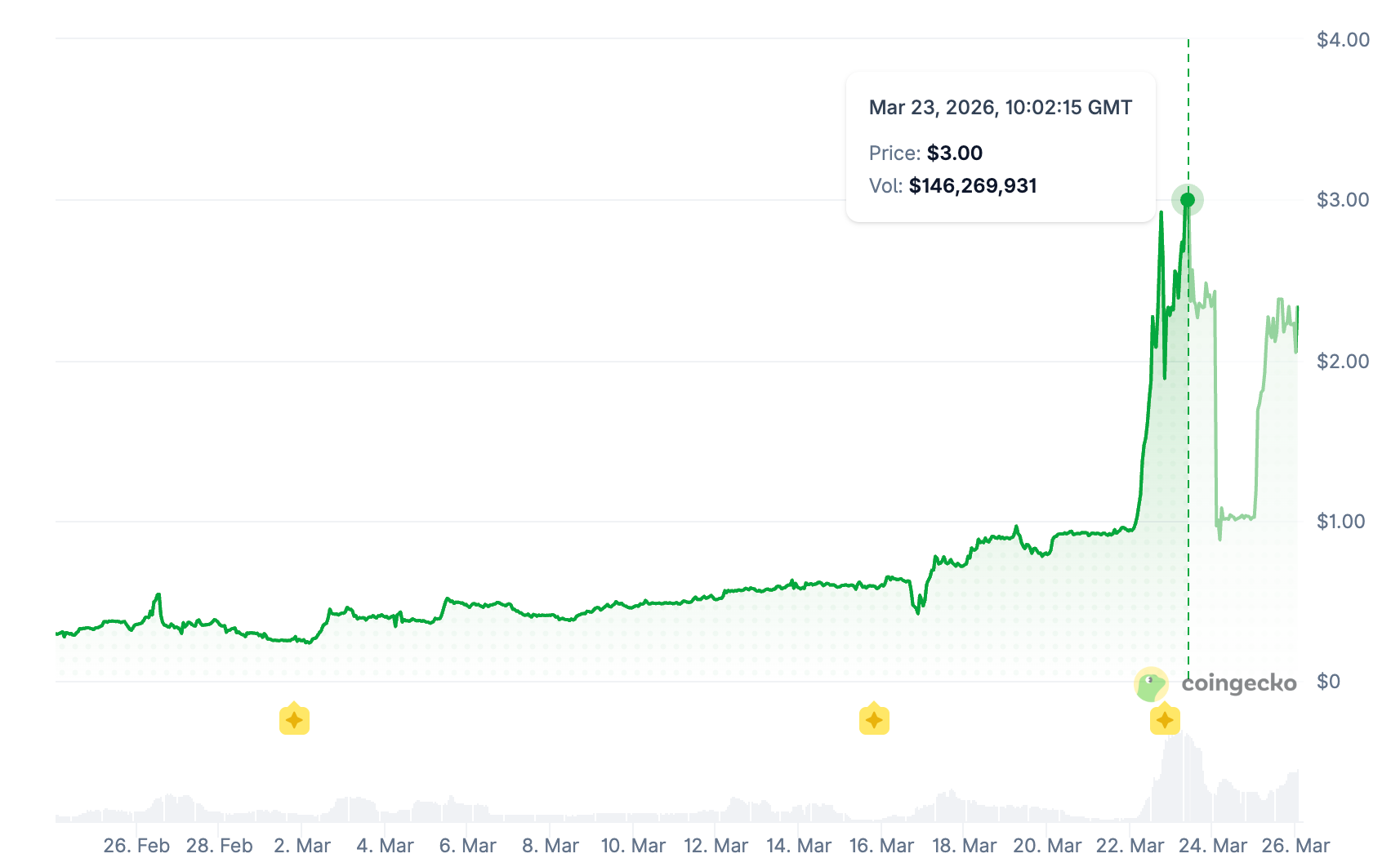
SIREN’s price action. Source: Coingecko
Nearly 90% of a project’s circulating supply being held by a single entity far exceeds the scope of normal market making. Simultaneously, the controlling entity profits by holding almost all the spot supply and utilizing futures contracts, which is the reason SIREN surged 30x within a month and a half. The suspected controlling entity is DWF Labs, whose public wallet holds 3 million SIREN tokens, and a dense consolidation of 66.5% of the tokens occurred the day after its SIREN transfers.
Subsequently, on March 24th, SIREN plummeted 59.38% in a single day, dropping to $1.01, with its market cap evaporating from its high to $740 million; but by the 25th, the price had been pumped back to $2.4. Retail investors who chased the rally likely became the final bag holders in this game.
Binance is Getting Serious
The statement at the end of the article is thought-provoking. Binance stated it will “take swift and decisive action against any violations, including blacklisting non-compliant market makers,” and attached a reporting email, publicly soliciting relevant tips from users and project teams.
For an exchange that typically maintains a stance of commercial neutrality, such a public statement signifies a degree of “anger.” Considering recent token price action and the market turning bearish, Binance’s move seems more like drawing a red line for the industry. As for the strictness of its enforcement, we still need to observe.
Of course, the other side of the issue also exists: If active intervention by market makers is comprehensively restricted and liquidity tends to be “natural,” some low-market-cap tokens might even lose basic price fluctuations, and market activity would subsequently decline. How to balance market integrity with trading vitality remains a difficult problem without a standard answer.
Эта статья взята из интернета: Binance Issues Rare Statement to Regulate Market Makers, Targeting “Active Market Making” Manipulation Tactics
Related: The Big Year for Crypto IPOs: The Path to Public Markets for “Pick-and-Shovel” Players
In 2025, криптовалюта companies raised $3.4 billion in the U.S. stock market. Circle and Bullish each raised over $1 billion, and Gemini surged 14% on its Nasdaq debut. By January 2026, BitGo rang the opening bell on the NYSE, jumping 24.6% on its first day with a market cap of $2.6 billion. These pioneers proved one thing: Wall Street is willing to pay for compliant crypto infrastructure. The pipeline for 2026 is even thicker. Kraken, Consensys, and Ledger are all queuing up for IPOs, with valuations ranging from billions to $20 billion. Even the security auditing firm CertiK announced its IPO plans at Davos. Обменs, wallets, custody, security… the “water sellers” of the crypto industry are collectively heading to the public markets. When will these companies go public, what are…
Related articles































 Русский
  English
  繁體中文
繁體中文  简体中文
简体中文  日本語
日本語  Tiếng Việt
  العربية
  한국어
한국어  Bahasa Indonesia
  हिन्दी
  اردو
اردو