








Last week, the company purchased 34,164 BTC for $2.54 billion, bringing its total holdings to 815,061 BTC. Strategy’s TWAP strategy injects genuine spot demand into the market, while the market remains in a wait-and-see mode: near the critical resistance level of $80,000, can the current trend stabilize independently?
Looking back at March, following the ex-dividend week, Strategy noticeably slowed its BTC purchases, which subsequently dragged down BTC’s price. BTC held its price only because Strategy was providing support. The future direction entirely depends on whether this buying pressure persists after the ex-dividend window closes.
March’s price action already exposed this risk. Strategy went on a buying spree during the window period, then went quiet, and BTC’s price almost immediately “stalled and fell.” Entering the post-ex-dividend period in April, the situation is similar. The real question now is whether Strategy will continue buying once the ex-dividend window closes.
If April can avoid repeating the “post-ex-dividend weakness” seen in March, the bullish argument will be much stronger. If not, it’s just a repeat of last month’s playbook.
Executive Summary (TL;DR)
- Marginal Buyer: Strategy is the largest marginal buyer in the market. The recent rally during US trading hours proves that Bitcoin’s gains over the past month have been largely driven by it.
- March’s Script: Strategy aggressively bought BTC ahead of $STRC’s ex-dividend window, but BTC prices plummeted in the following two weeks.
- April’s Difference: As of April 22, BTC has yet to experience post-ex-dividend weakness, with prices holding firm around $77,500.
- Key Signal: The upcoming 8-K filing (due April 27) is crucial. It will determine whether Strategy continued buying after the ex-dividend window closed.
- Long-term Risk: Strategy’s high dividend yield of 11.5% is costly. If capital markets tighten, they may eventually be forced to sell BTC or dilute stock to fund it.
Bitcoin’s Largest Marginal Buyer: Strategy
Over the past month, almost all of BTC’s gains occurred during US trading hours. This is partly thanks to spot ETFs, but more so due to buying pressure from Strategy. The best way to understand this rally is not as a vague “risk-on” rebound, but as concentrated bullish sentiment backed by US capital, supported by ETF flows. Farside’s daily data shows net inflows of around $1 billion, highlighting tangible market demand.
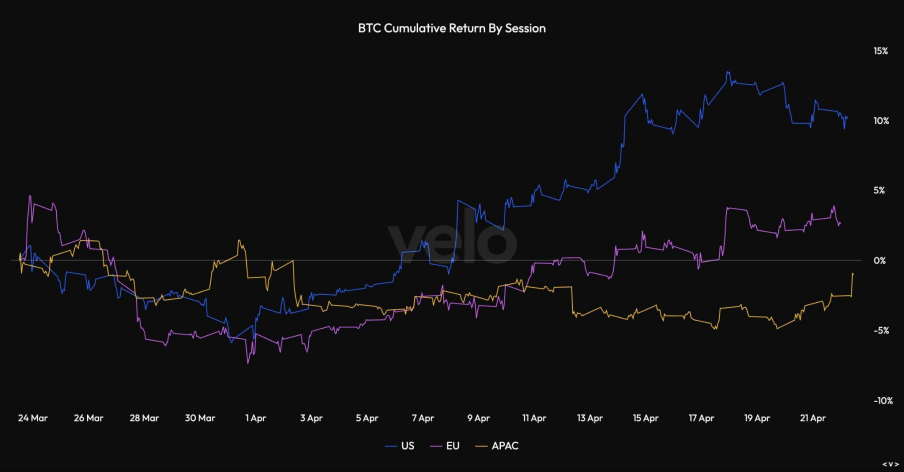
However, this alone doesn’t fully explain the price action. In the week ending April 19, Strategy’s massive $2.54 billion purchase exceeded ETF net inflows. This confirms a more plausible interpretation: it’s not that “ETFs were absent,” but rather both ETFs and Strategy were buying, and Strategy’s buying volume was large enough to become one of the most significant marginal buying forces in the market, perfectly aligning with the trading session charts. Since almost all gains occurred during US trading hours and one of the largest US buyers spent $2.54 billion, Strategy’s absolute influence on BTC’s price is self-evident.
The Real Test for the Rally Comes After Ex-Dividend Day
In March, Strategy bought aggressively during the $STRC ex-dividend window, but BTC prices fell sharply in the following two weeks. In the week ending March 22, demand for $STRC plummeted from $1.18 billion to a mere $76.5 million. ATM (At-The-시장) offerings of MSTR common stock also dropped to zero. By the week ending March 29, total ATM proceeds were zero. This was the first time in 13 weeks that Strategy did not purchase any BTC.
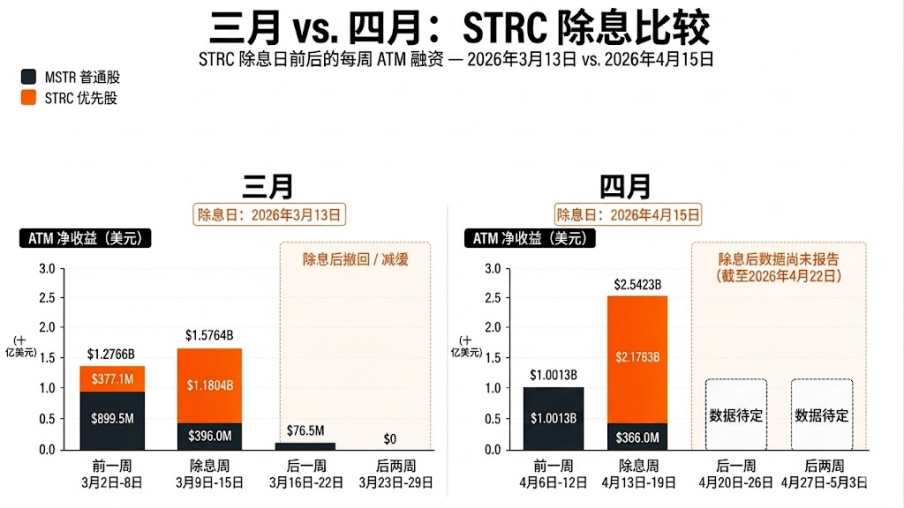
Strategy’s two-week absence, accompanied by a concurrent decline in BTC, provides the clearest evidence of its decisive impact on BTC’s price trajectory. BTC drifted lower to just over $70,000, hitting around $70,400 on March 20 and around $70,600 on March 23. The price reflected reality: when STRC issuance stopped and MSTR common stock didn’t fill the gap, buying power significantly weakened.
Therefore, the core question now is whether April will repeat March’s “hangover” or break this pattern.
The next 8-K filing (due April 27) will cover the week ending April 26. If STRC issuance again falls to negligible levels and MSTR common stock ATM remains near zero, then April is just a bigger version of March, not a true paradigm shift. However, if STRC remains active and MSTR common stock ATM reaches a meaningful scale (over $150 million), then the playbook has truly changed.
April is Crucial Because BTC Remains Strong
April 15, 2026, is the ex-dividend date for $STRC in April, and STRC’s annualized dividend yield remains at 11.50%. In the week ending April 19, Strategy raised $2.5 billion and bought 34,164 BTC, unleashing enormous demand. However, the real test is BTC’s performance afterward: unlike March, BTC hasn’t immediately dropped in price.
We could say Strategy has changed market dynamics. But the upcoming filing is far more important than the last one. If the typical “post-ex-dividend weakness” reappears, April might just be a replay of March. If it doesn’t, the market must seriously consider that Strategy is buying not just within the window, but supporting BTC over a longer timeframe.
Will the Buying Continue?
This is what traders really care about.
Merely noting that Strategy bought a lot of BTC last week won’t make you money. What truly matters is whether this buying continues once the pure ex-dividend logic plays out.
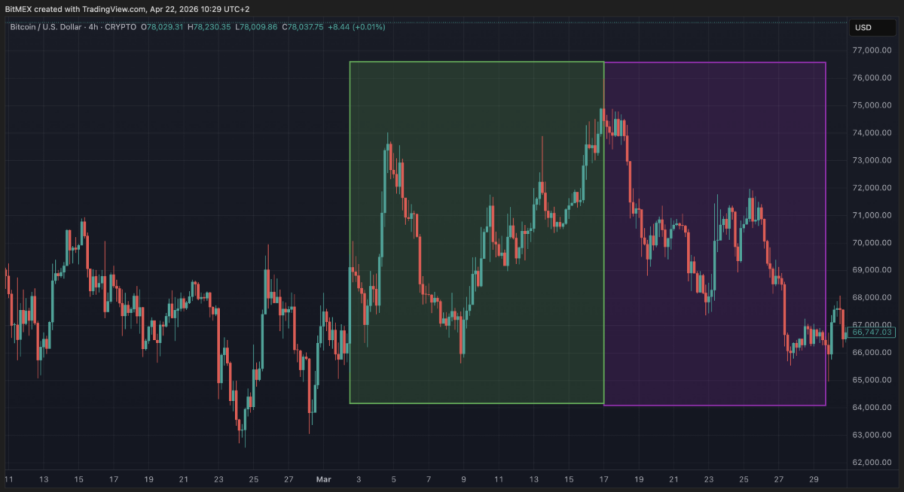
March’s lesson tells us that a strong ex-dividend week alone is not enough. Strategy bought 22,337 BTC in the reporting period ending March 15 but was largely absent in the following two weeks, and BTC’s price weakened accordingly.
April’s performance suggests there might still be a chance for a turnaround, because Strategy bought more – a full 34,164 BTC – and BTC’s price hasn’t yet repeated March’s decline.
The logic here is very straightforward. If the next 8-K filing shows significant buying after the ex-dividend date, the market must assume this buying remains active. If it shows another cliff-like drop in issuance, then March’s performance was their standard operating procedure, not an anomaly.
Why It’s Bullish Now – But Future Concerns Remain
As of April 2026, STRC’s annualized dividend yield is high at 11.50%. As long as the market is happy to pay for this structure and BTC’s price cooperates by rising, this isn’t a problem. But if BTC stalls and capital markets become less generous, things could get very tricky.
While this is a medium-term issue, not the immediate trading logic, the risk is real. This flywheel only works perfectly when BTC is rising and investor appetite is strong.
Therefore, the clearest framework for understanding this is: As long as Strategy is buying, it’s bullish for BTC, but this doesn’t mean its capital structure is risk-free. For now, however, the market only needs to focus on the first part of that sentence.
Final Conclusion
Recent BTC price action looks like a market propped up by an extraordinary super-marginal buyer. March showed us what happens when this buyer disappears. When Strategy’s $STRC capital raising stopped in the first two weeks after the ex-dividend date, April’s price action threatened to repeat the pattern.
So, the right way to interpret the current market is not to dwell on the headlines about the last purchase figure, but to ask a simpler question: Once the obvious window period ends, is Strategy still bidding for BTC?
If the answer is yes, BTC is likely to continue finding support. If the answer is no, BTC will immediately feel what it’s like to lose the support of the largest visible marginal buyer. If it can continue to rally even then, that would be the clearest ultimate bullish signal.
이 글은 인터넷에서 퍼왔습니다: Without Strategy’s buying, can Bitcoin still rise?
Related: In-Depth Analysis of STRC: MicroStrategy’s New Magic Trick for Raising Funds to Buy Bitcoin
Compiled by | Odaily (@OdailyChina); Translator | Azuma (@azuma_eth) Over the past two weeks, we’ve seen a significant increase in STRC trading volume, alongside growing buzz about the product on social media platforms like X. Therefore, I believe now is a good time to write an article about Strategy and its new structure. This is my fourth article on Strategy and the Bitcoin treasury model: The first article introduced the Strategy playbook, where I clarified some common misconceptions about the model. The second article explained the “full-stack treasury company” model and the mechanisms supporting its NAV premium. The third article introduced the preferred share playbook, a new model launched by Strategy in 2025, which is now the company’s primary strategy. In this article, we will focus on STRC. It has…































 한국어
한국어  English
  繁體中文
繁體中文  简体中文
简体中文  日本語
日本語  Tiếng Việt
  العربية
  Bahasa Indonesia
  हिन्दी
  اردو
اردو  Русский