








Original Author: Joe Duarte
Original Compilation: Peggy, BlockBeats
Editor’s Note: Just as the market regained upward momentum driven by liquidity, new uncertainties have been accumulating on the other side. The situation in Iran has fluctuated again, with risks in the Strait of Hormuz emerging, bringing geopolitical conflict back to the core variable of asset pricing. Within just a few days, the market has shifted from a single logic of “fund-driven” to a dual game of “liquidity vs. risk events.”
The current market is caught in a tug-of-war between “liquidity-driven gains” and “risk shocks from the escalating Iran situation.” On one hand, the Federal Reserve and the U.S. Treasury injected nearly $200 billion in liquidity into the financial system in a short period, driving a rapid rebound in stocks and risk assets; on the other hand, geopolitical uncertainty, private credit risks, and overheated sentiment keep the market fragile.
Within this structure, Bitcoin’s role is beginning to change. Unlike traditional risk assets, it is more sensitive to liquidity changes and often signals turning points in the funding environment first. Historical experience shows that whether it was the early decline in October 2025 or the first signs of stabilization in this rebound, Bitcoin has, to some extent, played the role of a “leading indicator.”
Therefore, the question is no longer just “will the market rise,” but rather—when liquidity is still being released while war risks resurface, which force will dominate pricing? If funds cannot continuously hedge against external shocks, the current rally may only be a temporary mismatch; whereas if liquidity persists, the market may continue its upward trend amidst volatility.
Moving forward, the key lies not in a single variable, but in their relative strength. And Bitcoin might once again be the asset that provides the earliest answer.
The following is the original text:
“Oh, think twice, ’cause it’s another day for you and me in paradise.” — Phil Collins
Friday was an unusual trading day for traders and investors. But Monday is still some time away, and the market is already brewing new variables—as early as Saturday morning news reported a reversal in Iran’s stance on the Strait of Hormuz issue, which could trigger market turbulence once again.
Furthermore, Friday’s rebound has pushed market sentiment indicators (see below) to a relatively fragile level, making the market more prone to a pullback. This places the market in a “tug-of-war”: on one side is the massive liquidity injection mentioned below, and on the other is the uncertainty stemming from a potential reversal in the Iran war situation.
What Just Happened?
The impact of liquidity on the market is facing a test—its opponent being the potential for further volatility from the Iran war.
Q: What happens when roughly $200 billion floods into the financial system almost simultaneously?
A: Asset prices experience a dramatic “melt-up.”
Lately, I’ve been focusing on four factors collectively suppressing the stock market: the Iran war, the liquidity squeeze in the financial system that has persisted since January this year, widespread market pessimism, and insufficient understanding of the true state of the private credit market.
But last week, these factors were almost “all overturned”: the liquidity squeeze reversed, the Iran situation seemed to ease, and market pessimism once again proved to be—as it often is—a leading indicator for a potential stock market rebound.
Are we out of the woods? No one can be sure, as the Iran situation is heating up again. Additionally, liquidity could dry up again if investors re-enter “panic mode.” And we still lack a clear understanding of what’s truly happening in the private credit market.
For now, however, let’s focus on a relatively observable variable: liquidity.
The Dual “Liquidity Tsunami”
If you’re wondering where the funds driving the stock market rally over the past two weeks came from—think again: the answer is the Federal Reserve and the U.S. Treasury. Around April 15th, together they injected approximately $200 billion into the financial system, providing traders with a “tax day buffer.”
First, look at the first “barrel”—the Federal Reserve.
On April 15th, the Fed injected nearly $11 billion into the market via repo operations (using Treasuries and mortgage-backed securities). That alone is significant, but more crucially, the Fed continues to inject about $40 billion per month into the market through its Reserve Management Purchasing (RMP) program.
The real attention-grabber is the second “barrel”—the U.S. Treasury.
Drawing on Garret Baldwin’s analysis, the U.S. Treasury injected approximately $140 to $200 billion into the market during the same period. In other words, roughly speaking, without any formal quantitative easing (QE) announcement, the Fed and Treasury quietly injected close to $240 billion in liquidity into the market.
It’s not hard to understand why the stock market experienced an explosive rally.
The More Covert Part: Treasury Operations
How did the Treasury accomplish this “covert operation”?
The key lies in an account—the “U.S. Treasury General Account” (TGA) held at the Federal Reserve. When this account balance rises, it typically signals liquidity tightening; when it falls, it signals liquidity release.
According to Garret’s calculations, around tax day, the balance of this government “checking account” at the Fed dropped from about $837 billion to about $697 billion. Then on April 15th, it rebounded to about $924 billion.
The key point is that about $140 billion of this had already flowed into the banking system before tax day, meaning the financial system was actually in a “liquidity-abundant” state before April 15th.
Even more interestingly, the U.S. National Financial Conditions Index (NFCI, tracked weekly in this report) reversed its previous tightening trend in the latest data (April 10th).
We noted this change in the daily report of *Smart Money Passport*: “The Fed injected about $10.5 billion into the financial system that day, while the NFCI index declined for the first time since January 23, 2026. These two signals combined may indicate the Fed has adjusted its liquidity-tightening stance.”
The biggest suspense now is: will liquidity take the lead, or will a new escalation in the Iran war re-emerge as the market’s core variable?
Bitcoin Becomes “Active”: Why It’s a Liquidity Bellwether
Bitcoin’s next move is crucial.
Because compared to stocks, Bitcoin is more sensitive to liquidity. Therefore, its performance after recently breaking above $75,000, and whether it can challenge the $80,000–$85,000 range, deserves close attention.
From a technical perspective, resistance in the $80,000–$85,000 range is not strong. The Volume-by-Price (VBP) distribution in that range is thin, indicating no effective support was formed during the previous decline. Therefore, barring abnormal circumstances, this level should not pose strong resistance during a price recovery.
If the rally fails here, it implies two things: first, a lack of confidence in this rebound; second, potential issues with liquidity itself. More importantly, if Bitcoin cannot break through this key range, it might also mean the “liquidity tsunami” created by the Fed and Treasury is rapidly receding.
If $200 billion in bank reserves are absorbed by the market within just a few weeks, that would be a dangerous signal. It could mean risks are accumulating in the private credit market or other external areas.
Don’t forget, Bitcoin’s decline in October 2025 accurately foreshadowed the stock market’s troubles in 2026. Simultaneously, Bitcoin also stabilized weeks before the stock market bottomed and rallied ahead of the Fed and Treasury’s liquidity injections.
Against the backdrop of the evolving Iran situation and unresolved global risks, any weakness in Bitcoin should not be ignored.
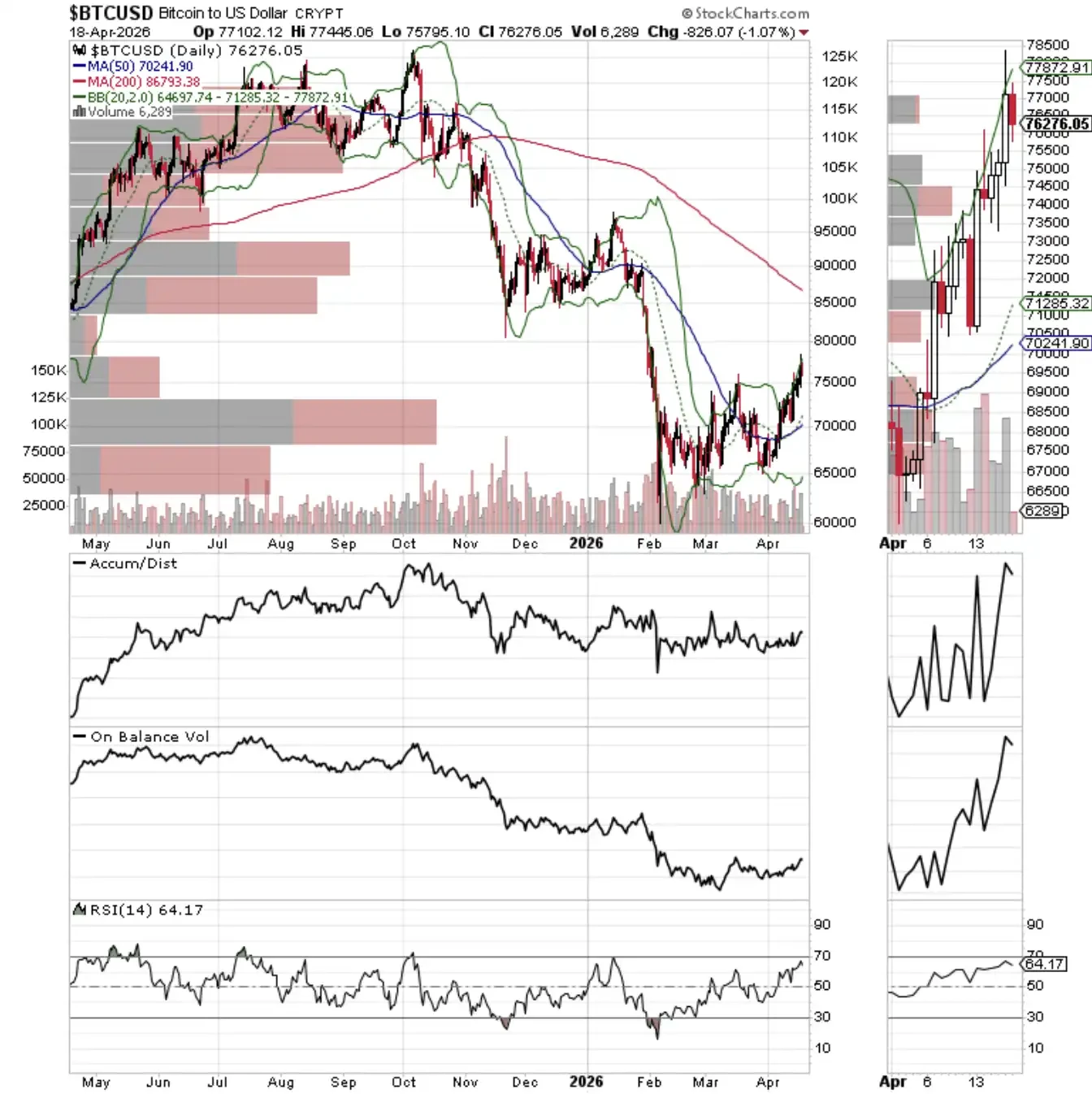
The $70,000–$75,000 range is a key support zone.
Sentiment Summary: 시장 Suddenly Turns Fully Optimistic
The CNN Fear & Greed Index (GFI) closed at 68 on April 17, 2026, in the “Greed” zone.
CoinMarketCap’s Crypto Fear & Greed Index was at 59 on Saturday morning, a relatively high “Neutral” level.
The Chicago Board Options 교환 (CBOE) Total Put/Call Ratio was 0.65, with the index options P/C ratio closing at 0.82. Overall options market sentiment remains neutral for now, but is gradually tilting towards bearish territory as bullish sentiment heats up rapidly.
The CBOE Volatility Index (VIX) closed at 17.48, a relatively positive level. However, it could still rise back above 20 (often seen as a risk threshold) in the short term.
It’s important to note that the VIX typically rises when traders buy a large number of put options. Increased demand for puts forces market makers to hedge by selling stock index futures, creating downward pressure on the market.
Conversely, when the VIX falls, it means put demand is decreasing, market sentiment is turning optimistic, and more call option buying often follows. This prompts market makers to buy stock index futures to hedge risk, increasing the probability of a stock market rise.
Liquidity Watch
1. Positive: Liquidity is Easing
The Federal Reserve’s National Financial Conditions Index (NFCI) latest reading (released April 10) for March 27, 2026, was -0.47, down from the previous week’s -0.44, indicating financial conditions are easing and liquidity is improving.
A declining NFCI is generally seen as a bullish signal, and a negative index value suggests market liquidity is relatively abundant.
2. Bond Yields Retreat
U.S. Treasury yields retreated later in the week but could rise again in the future depending on developments in Iran.
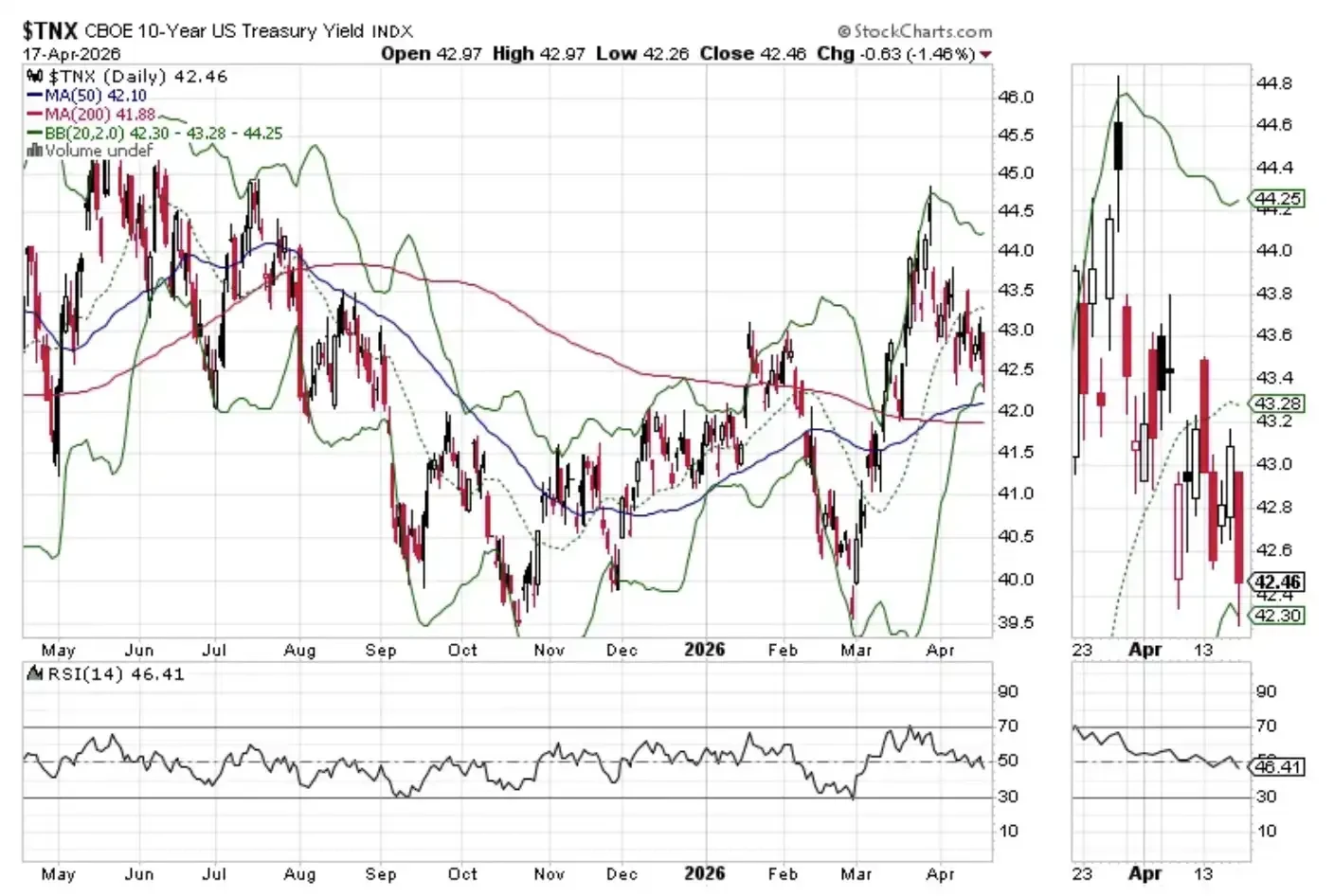
The U.S. 10-Year Treasury Yield closed the week below 4.3%, also breaking below its 20-day moving average. A further break below the 200-day moving average would be seen as a bullish signal; conversely, a rise back above 4.5% could push yields back towards the highs near 4.6% seen in May 2025.
3. NYAD, SPX, and NDX Simultaneously Hit New Highs
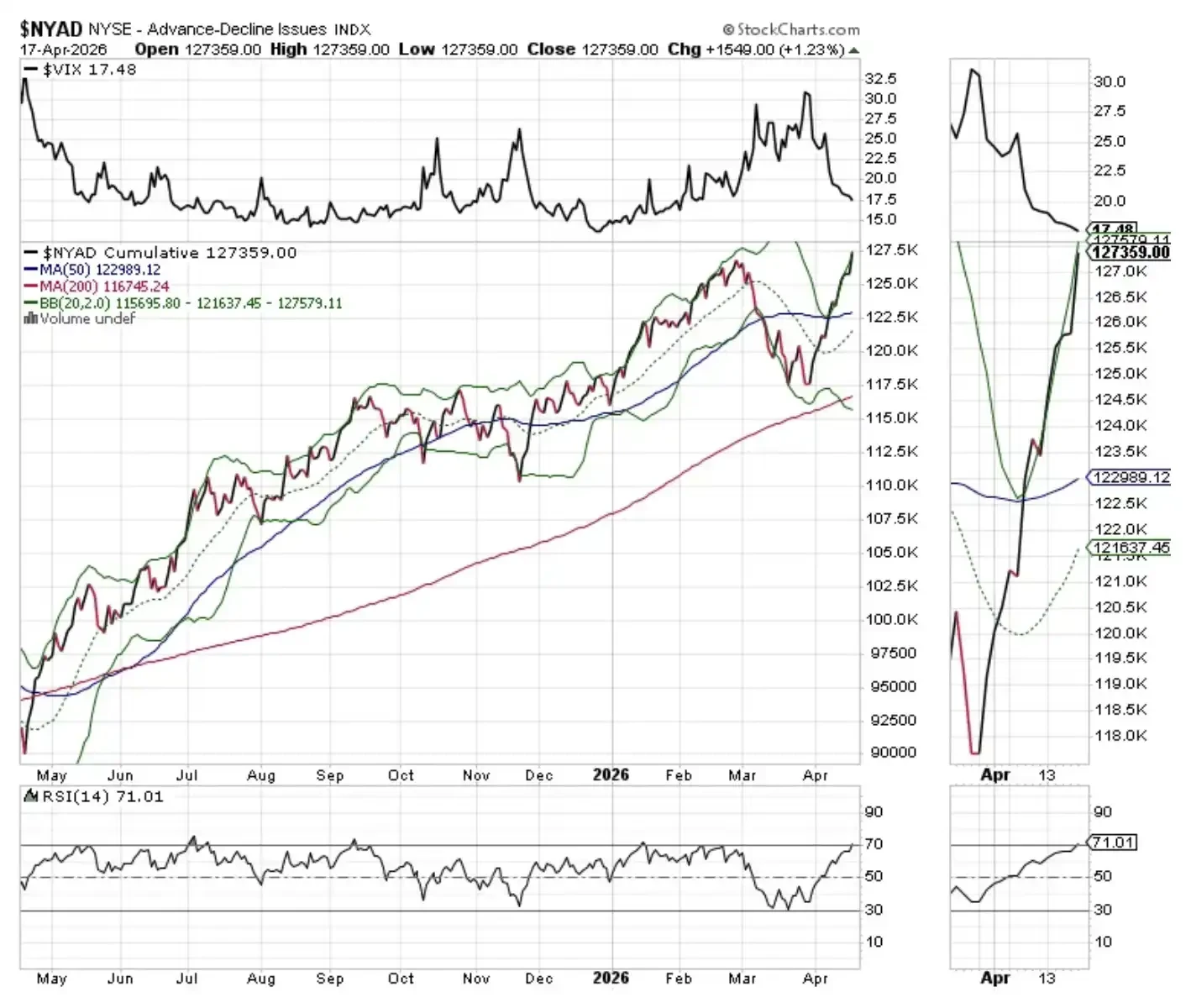
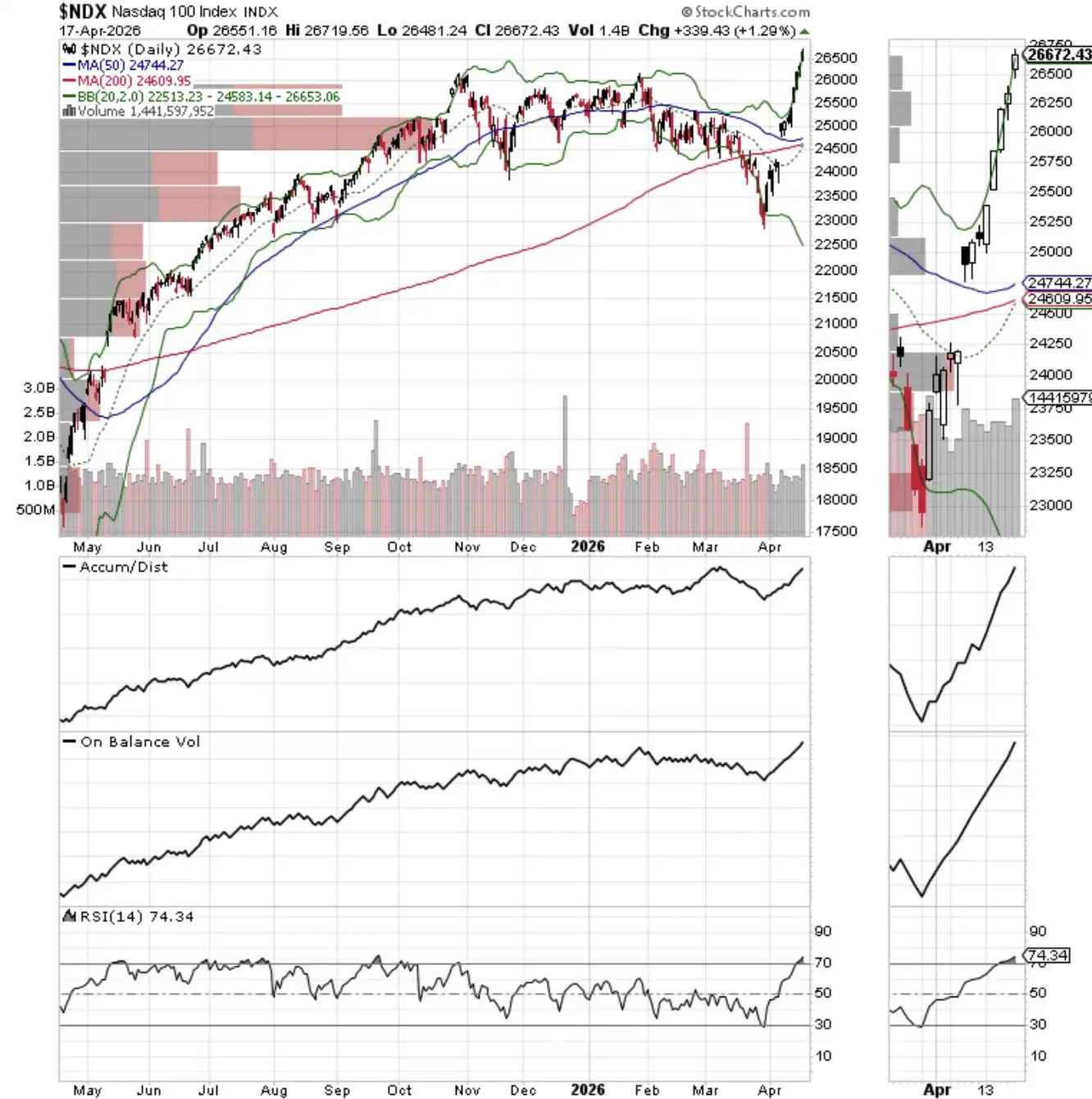
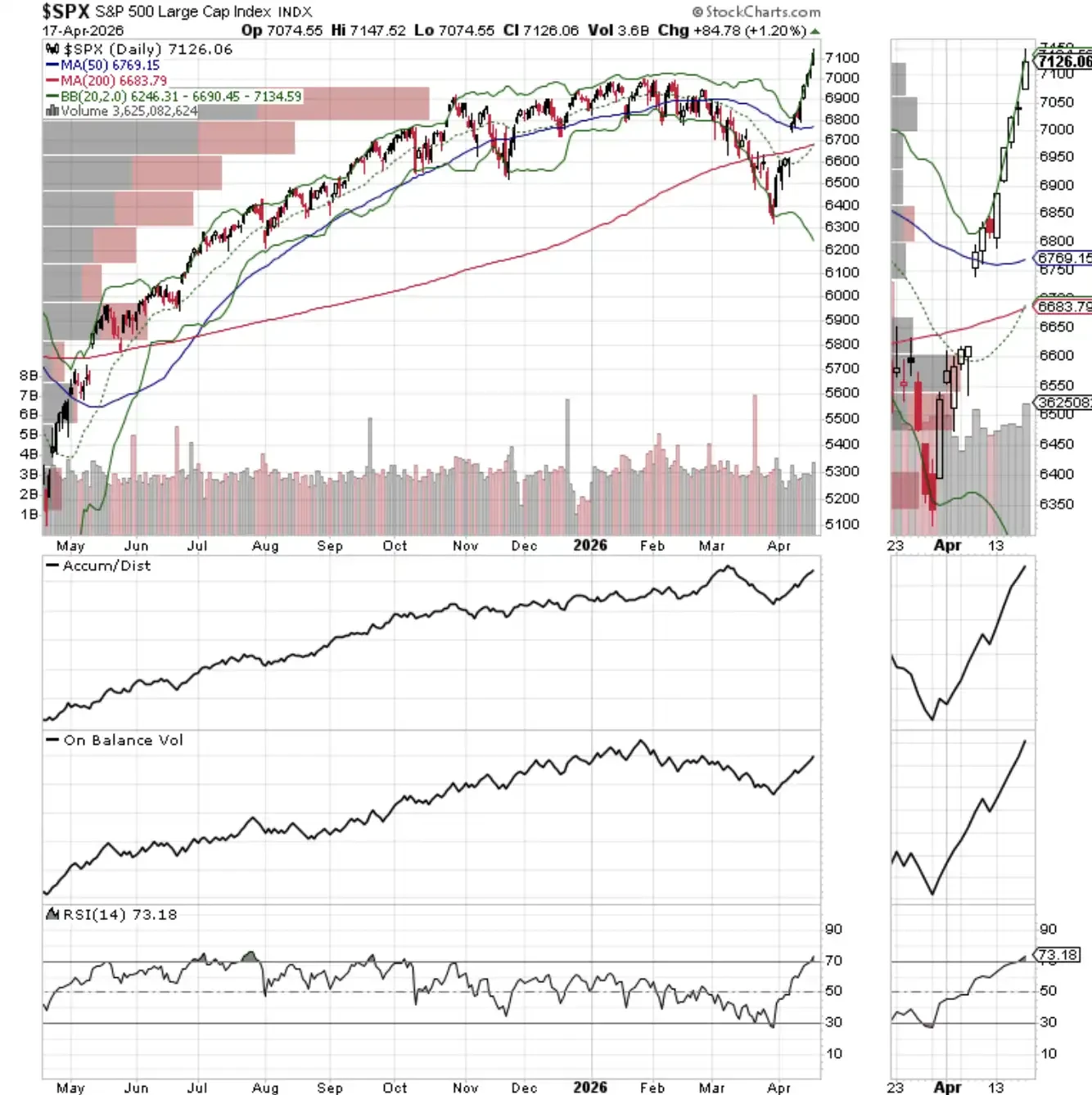
The NYSE Advance-Decline Line hit a new high, confirming the new highs in the S&P 500 Index and NASDAQ-100 Index.
The current uptrend is validated—but only for now. A break below the 20-day or 50-day moving average could quickly change the market landscape.
The NASDAQ-100 Index hit a new high last week, with 26,000 points now serving as short-term support.
The S&P 500 Index hit a new high last week, breaking through the 7,000-point level. The 7,000-point level now serves as short-term support.
이 글은 인터넷에서 퍼왔습니다: Geopolitical Risks Persist, Is Bitcoin Becoming a Key Bellwether?
This week, we will focus on two main themes: First, HYPE’s Wave IV correction is nearing completion in terms of both time and price. The daily chart bottoming pattern is strengthening, and our quantitative model has also triggered a bottom warning. We will focus on capturing long entry opportunities this week. Second, Bitcoin’s medium-term bearish trend remains unchanged. We maintain our range-bound consolidation forecast for this week and will flexibly execute two short-term trading plans (A and B) based on support/resistance levels and model signals. Summary of This Week’s Core Trading Views: • HYPE multi-timeframe structure analysis. (See Part 1) • HYPE market forecast and short-term trading strategy for this week. (See Part 2) • BTC multi-timeframe structure interpretation. (See Part 3) • BTC market forecast and medium/short-term trading strategies…































 한국어
한국어  English
  繁體中文
繁體中文  简体中文
简体中文  日本語
日本語  Tiếng Việt
  العربية
  Bahasa Indonesia
  हिन्दी
  اردو
اردو  Русский