








After being repeatedly exploited by Perp DEXs, will the upcoming TGE of Genius be an exception?
저자 | 애셔 (@애셔_0210)

Last Friday, Genius, which received a “tens of millions of dollars” investment from YZi Labs and saw CZ personally join as an advisor, announced on X platform that the airdropped share is 21% of the total token supply. It is divided into three seasons: Season 1, Season 2, and Season 3, with each season accounting for 7%.
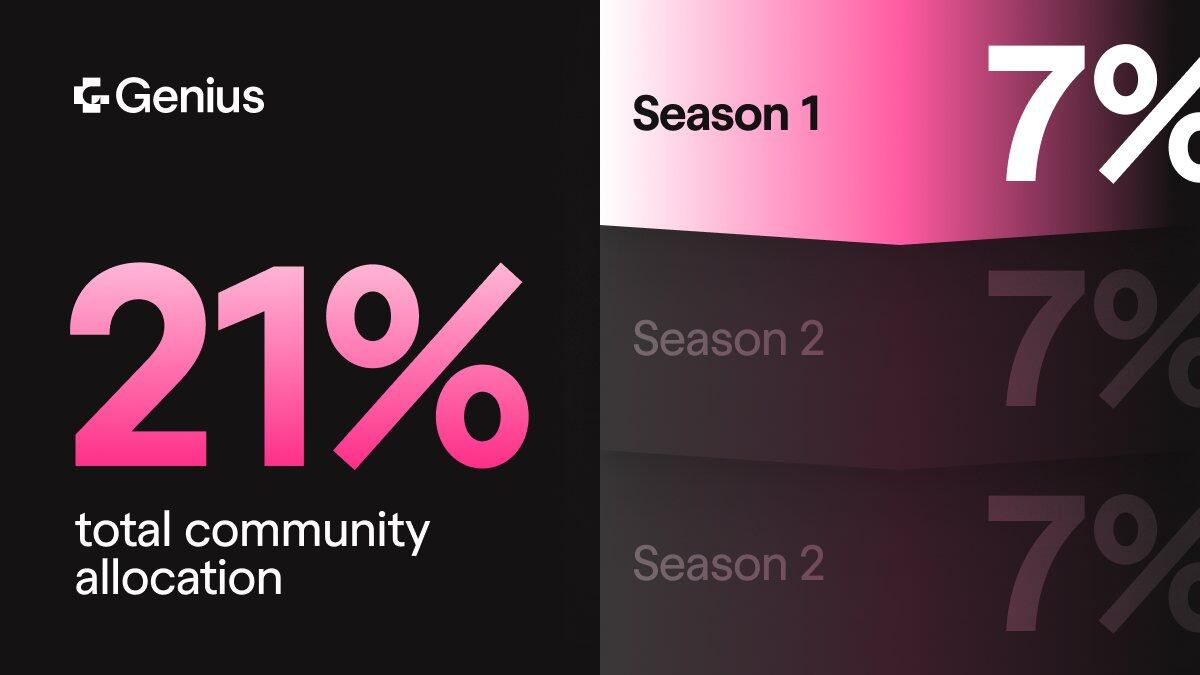
Official original image. There is an obvious error in the image: the bottom right ‘Season 2’ should be ‘Season 3’.
According to Genius’ previous statement, Season 1 will end before April 12th. More importantly, the TGE will occur before April 12th. Therefore, at the TGE before April 12th, the community airdrop share will be 7% of the total token supply, which means 70 million tokens will be airdropped.
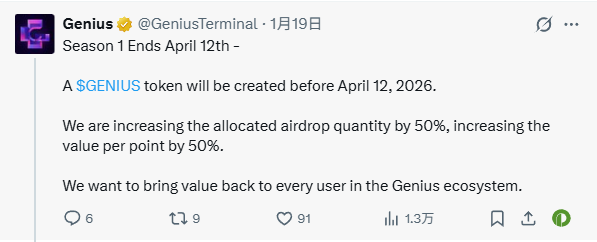
Genius previously stated that the TGE will occur before April 12th.
Next, Odaily will take you through an understanding of Genius, the current cost of farming GP through trading volume, and an analysis of the airdrop’s value.
Genius: Backed by a “Tens of Millions of Dollars” Investment from YZi Labs, with CZ Personally Joining as an Advisor

Genius is a privacy-centric decentralized trading platform offering spot, perpetual contracts, and copy trading. It supports over 10 public chains including BNB Chain and Solana, aiming to become an on-chain alternative to Binance — bringing the speed, liquidity, and privacy experience of a CEX on-chain while maintaining full self-custody and non-custodial features (users hold their private keys).
As early as October 2024, Genius announced the completion of a $6 million seed funding round, led by CMCC Global, with participation from institutions including Cadenza Ventures, AVA Labs, Arca, and Flow Traders.
Then, on January 13th of this year, Genius announced that YZi Labs invested “tens of millions of dollars” in it, and CZ personally joined as an advisor.
Season 1 has a total of 200 million GP points. The cost per point in recent weeks has been concentrated in the $0.025 to $0.045 range.
When Genius announced the new GP point rules at the end of January, it stated that Season 1 has a total of 200 million GP points and no more will be issued. Currently, the fixed total number of points before TGE means the potential airdrop value depends on the farming cost and the community’s expectations for Genius’s launch price.
Point Cost Concentrated in the $0.025 to $0.045 Range
According to feedback from several experienced “airdrop farming” users, the cost of farming GP through trading volume on Genius in recent weeks has been between $0.025 and $0.045 per point, with last week being the “lowest cost week.”
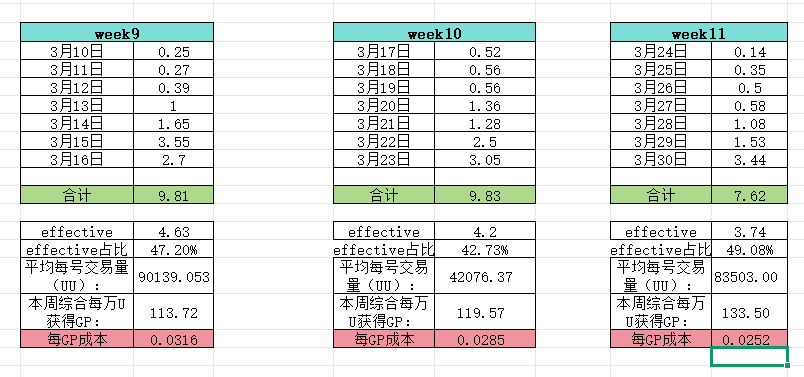
A farming user’s cost calculation for points over the past 3 weeks
Furthermore, Dune data clearly shows that most users farming Genius concentrate their trading volume farming on the last day of each week. In the past three weeks, the trading volume on the last day of each week has ranged between $300 million and $400 million.
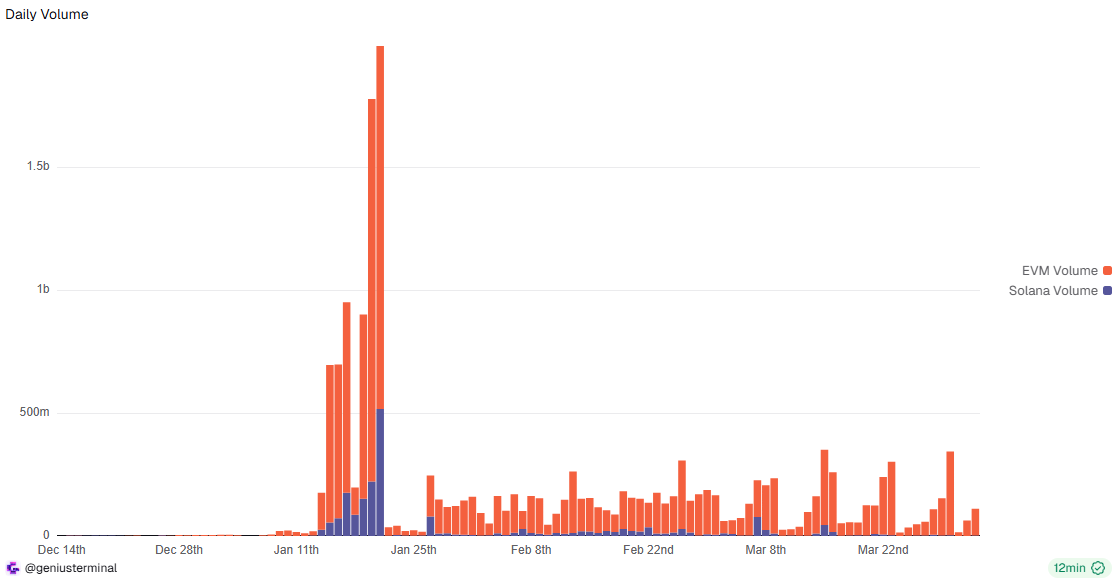
Genius Daily Trading Volume Data
This Week’s Trading Fees Plunged from 0.3% to 0.04%
Yesterday, Genius announced that as Season 1 is about to end, the platform’s trading fees for all transactions have been drastically reduced from the original 0.3% to 0.04%. Combined with the upcoming TGE, trading volume in the last 2 days of this week may see a massive surge.
시장 Generally Expects Genius’s Launch FDV to be Between $100 Million and $150 Million
Monitoring by Odaily Seer Channel shows that Polymarket has now launched a prediction market for “Genius FDV One Day After Launch”. The probability of the FDV being greater than $100 million one day after launch is predicted at 74%. Additionally, the probability of it being greater than $200 million is only 27%.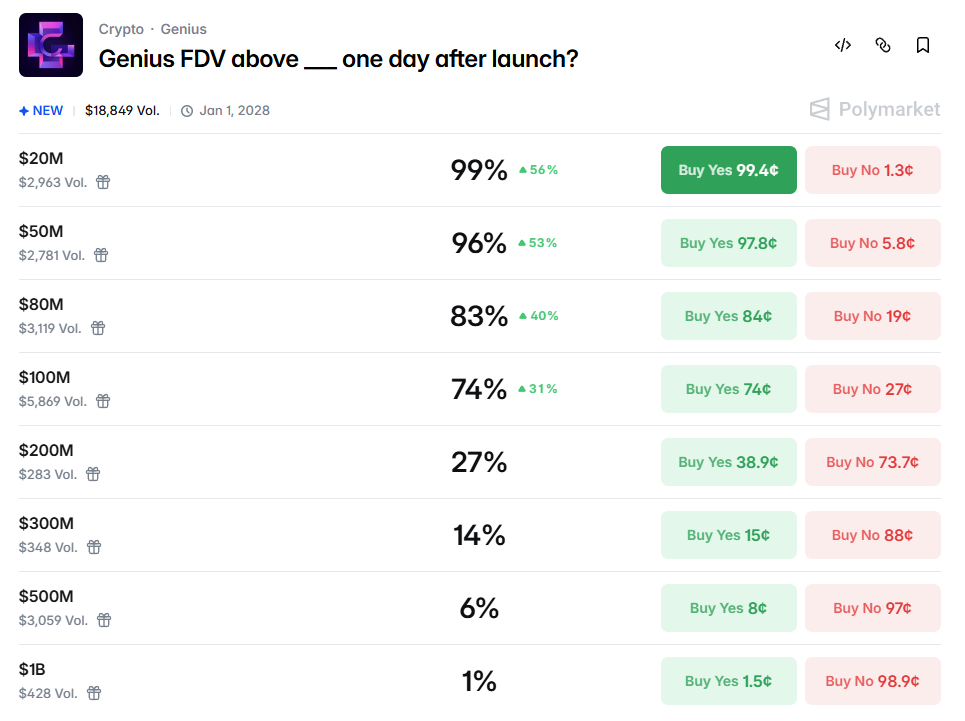
Polymarket has launched the “Genius FDV One Day After Launch” prediction market
Based on the available data, the airdrop at TGE is 7% of the total token supply, which is 70 million tokens. For the 200 million GP points, assuming a fair distribution of tokens, each GP point would yield approximately 0.35 tokens. Therefore, the corresponding value per GP point at different launch FDVs is as follows:
- If FDV is $100 million, each GP is worth about $0.035: Most consider this the “barely break-even line” or cost-recovery threshold; low-cost farming users might make a small profit.
- If FDV is $200 million, each GP is worth about $0.07: Low-cost farming users would see significant positive returns, representing an optimistic community scenario.
- If FDV is $300 million, each GP is worth about $0.105;
- If FDV is $500 million, each GP is worth about $0.175: Combined with the dual buff of CZ as advisor + YZi Labs funding, this is the optimistic expectation of some KOLs.
Combined with Polymarket prediction data, if Genius conducts a relatively fair airdrop distribution as previously stated, the airdrop at Genius’s TGE is closer to “break-even with a slight positive return” — at the very least, it’s no longer a typical “rug pull case”.
However, the issue is that after a round of intensive “rug pull education” in Q1, market trust has been significantly eroded. Against the backdrop of a still sluggish market, whether Genius’s TGE will be a long-awaited return to rewards or another seemingly reasonable yet ultimately exploitative script remains to be seen in practice.
이 글은 인터넷에서 퍼왔습니다: After being repeatedly exploited by Perp DEXs, will the upcoming TGE of Genius be an exception?
Related: After Oil, Silicon is the New Chip
Original Author: Andy Kessler, WSJ Original Compilation: Peggy, BlockBeats Editor’s Note: In traditional geopolitics, oil has long been considered the core resource of war and power. However, as the importance of artificial intelligence and semiconductor technology continues to rise, new strategic variables are emerging. This article presents a clear judgment: in the competition of the 21st century, ‘silicon’ is replacing oil as the key resource affecting national power and the nature of warfare. The article begins with recent international conflicts and the energy landscape, outlining the energy and military supply chains between Venezuela, Iran, and Russia, and analyzing how oil prices, drone warfare, and the global sanctions system intertwine in real-world conflicts. As the narrative progresses, the author shifts perspective from traditional energy to technological competition, discussing the strategic significance…































 한국어
한국어  English
  繁體中文
繁體中文  简体中文
简体中文  日本語
日本語  Tiếng Việt
  العربية
  Bahasa Indonesia
  हिन्दी
  اردو
اردو  Русский