








Author|jk
On March 8 local time, Iran’s Assembly of Experts officially announced that 56-year-old Mojtaba Khamenei has been elected as the third Supreme Leader of the Islamic Republic of Iran. This appointment came less than two weeks after his father, former Supreme Leader Ali Khamenei, was killed in a joint US-Israeli airstrike on February 28, marking the first dynastic transfer of supreme power in Iran’s history.
A Hasty Succession in a Time of Crisis
On February 28, 2026, former Supreme Leader Khamenei’s residence in Tehran was hit by a joint Israeli and American airstrike, resulting in the deaths of approximately 40 senior Iranian officials. Following the confirmation of Khamenei’s assassination, Iran immediately formed a Provisional Leadership Council in accordance with Article 111 of the Constitution, with President Pezeshkian, Head of the Judiciary Mohseni-Eje’i, and Guardian Council representative Alireza A’rafi jointly holding interim power.
On March 3, the Assembly of Experts’ office in Qom was reportedly bombed, raising external concerns about the election process being disrupted. However, the 88-member Assembly of Experts ultimately passed a “decisive vote” on the 8th, electing Mojtaba Khamenei as the new Supreme Leader. They issued a statement calling on all Iranians, “especially the elite intellectuals in seminaries and universities,” to pledge allegiance to the new leader and safeguard national unity.
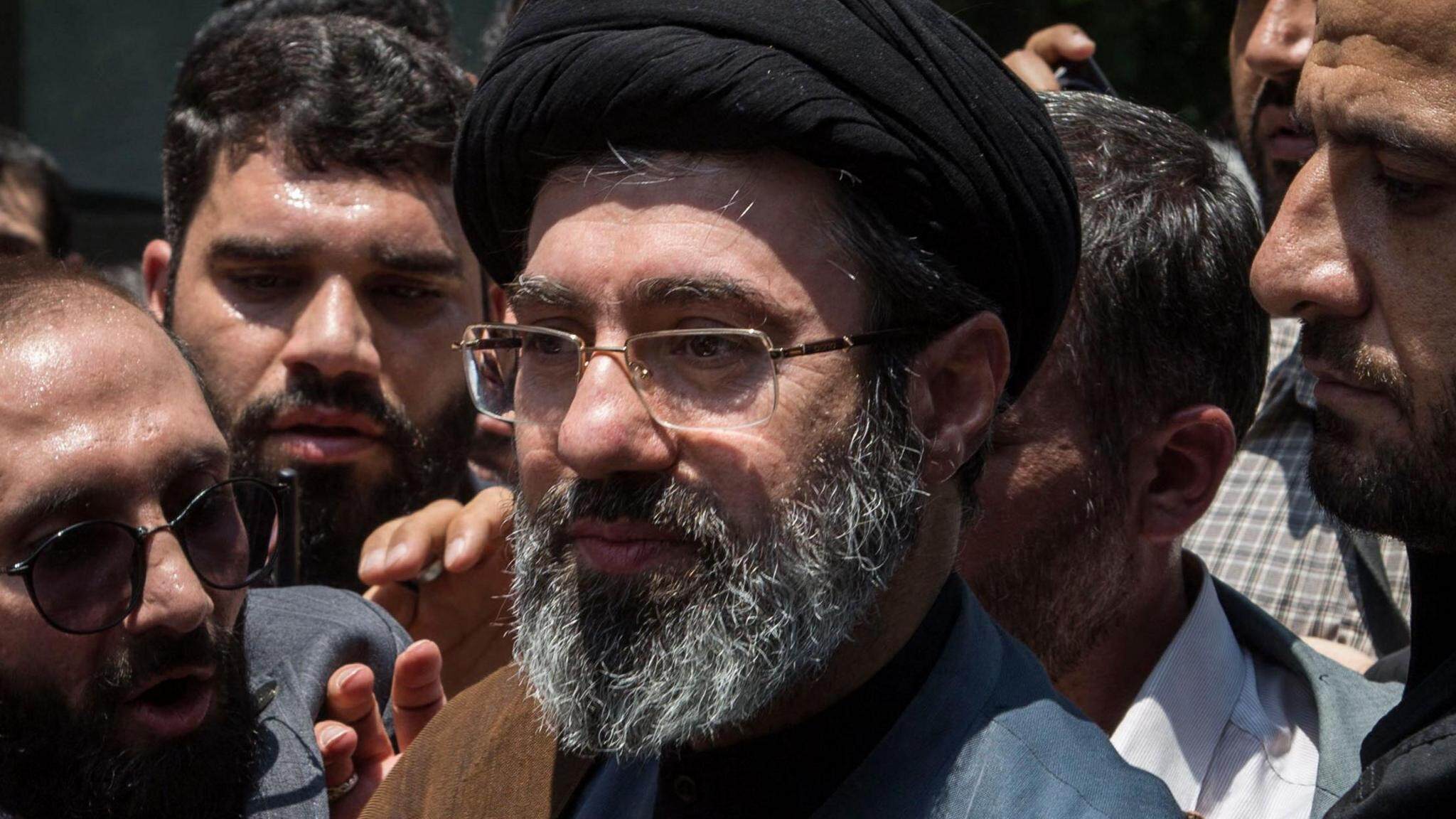
Mojtaba Khamenei, Source: BBC
Who is the Younger Khamenei?
Mojtaba Khamenei was born in 1969 in Mashhad, Iran’s holy city, and is the second son of Ali Khamenei. His childhood coincided with the turbulent years of his father’s rise as a revolutionary figure opposing the Pahlavi dynasty, with the 1979 Islamic Revolution profoundly shaping his political foundation. In terms of religious education, Mojtaba studied under the late Grand Ayatollah Mohammad-Taqi Mesbah-Yazdi, an ultra-conservative theologian known for advocating a hardline stance, who once publicly declared it religiously permissible to “kill Iranian youth who promote Western moral corruption.”
At the age of 17, Mojtaba joined the Islamic Revolutionary Guard Corps (IRGC), participating in operations with the Habib Battalion during the Iran-Iraq War. This battalion has been described by analysts as a “highly ideologically driven unit,” commanded by one of the founders of Hezbollah. Many of his comrades from this period later became senior figures in Iran’s security and intelligence apparatus, laying a crucial network foundation for his subsequent accumulation of power.
After his father assumed the position of Supreme Leader in 1989, Mojtaba became one of his most important aides. For years, he has remained active within the inner circle of the Supreme Leader’s office, with his influence significantly increasing after the political turmoil of the 2009 Green Movement. US diplomatic cables (revealed by WikiLeaks) referred to him as “the real power behind the robe.” In 2019, the US Treasury sanctioned him for allegedly assisting his father’s “destabilizing regional ambitions and domestic repression goals,” disclosing that the former Supreme Leader Khamenei had delegated some leadership duties to him.
In stark contrast to his political stature, Mojtaba has almost never made public appearances: he has never given a public speech, never led Friday prayers, and never made political statements, to the extent that many ordinary Iranians have never even heard his voice. He is also reported to have amassed a vast network of economic interests across multiple countries, allegedly moving tens of billions of dollars in assets through individuals and partners connected to the Iranian establishment.
Mojtaba is now married and has at least one son and one daughter. His wife is the daughter of former Iranian Parliament Speaker Gholam-Ali Haddad-Adel.
Continuation of Hardline Stance, Polarized International Reactions
Mojtaba’s election is widely interpreted as a signal that Iran’s hardliners remain firmly in control despite extreme pressure. Analysts note that given his deep ties to the Revolutionary Guards and security apparatus, the likelihood of Iran reaching a ceasefire agreement with the US and Israel in the short term is very low. Rami Khouri, a public policy researcher at the Lebanese American University, described the appointment as a “gesture of 디파이ance,” essentially declaring to the US and Israel that attempts to destroy the Iranian system will not succeed.
Domestically, Iranian President Pezeshkian stated that the appointment heralds a “new era of national dignity and strength”; the Revolutionary Guards immediately issued a statement pledging allegiance to the new leader and expressing readiness to fully obey his orders; Parliament Speaker Ghalibaf also stated that following the new leader is a “religious and national duty.”
Internationally, reactions are sharply divided. Russian President Vladimir Putin expressed “steadfast” support for Mojtaba’s appointment, while China explicitly opposed any strike actions targeting the new Supreme Leader. US President Trump publicly declared Mojtaba’s appointment “unacceptable” and warned in an interview with ABC that if the new leader is not recognized by the US, “he won’t last long.” The Israel Defense Forces also issued a warning, stating that any successor to Khamenei would be considered a target.
예측 시장s: Can Mojtaba Hold Onto the Leadership?
Following Mojtaba Khamenei’s formal assumption of office, multiple markets related to the Iranian situation rapidly emerged on the decentralized prediction market platform Polymarket, with traders betting on the political fate of this new leader.
“Will there be a change in Iranian leadership by the specified date?” This market opened on the evening of March 8, with total trading volume exceeding $530,000. Market data shows significant divergence among traders regarding the probability of Mojtaba being “removed from his position of power” in the short term: with March 13 as the deadline, the “Yes” probability is only 11%; with March 31 as the deadline, the probability rises to 33%; with April 30 as the deadline, the probability reaches 45%; if the timeline is extended to the end of the year (December 31), the “Yes” probability soars to 69%. This means over two-thirds of market participants believe Mojtaba cannot reach the end of 2026 as the de facto ruler.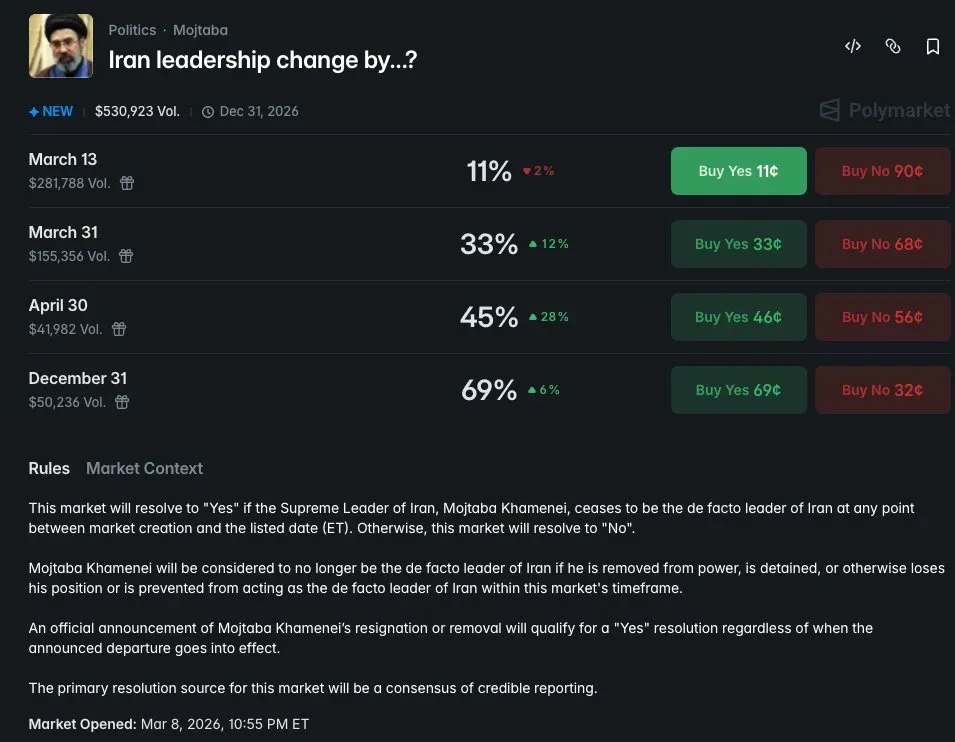
Will there be a change in Iranian leadership by the specified date? Source: Polymarket
“Who will lead Iran by the end of 2026?” Another market has a total trading volume exceeding $1.42 million. Among all candidates, Mojtaba Khamenei currently leads with a 32% probability, but this figure itself indicates that market confidence in the continuity of his rule is quite limited. Exiled Iranian Crown Prince Reza Pahlavi ranks second at 17%, current President Pezeshkian is third at 10%, and the possibility of “no head of state” (regime collapse or power vacuum) is also at 5%.
“Will Reza Pahlavi lead Iran in 2026?” The total trading volume for this market is close to $490,000, with the current price at 18%, a significant drop of over 26 percentage points from its previous high.
이 글은 인터넷에서 퍼왔습니다: Iran’s New Leader Mojtaba Khamenei: Where Will a Hardliner Lead the War?
Foreword Simultaneously, the three core characteristics unique to Web3—public data, protocol composability, and irreversible settlement—endow this automation transformation with a distinct duality: it possesses unprecedented potential for efficiency gains but is also accompanied by a steep risk escalation curve. This transformation is concurrently shaping three new realities: First, the disruptive change in trading scenarios: AI is beginning to independently undertake key decision-making functions such as signal identification, strategy generation, and execution path selection. It can even directly complete payments and calls between machines through innovative mechanisms like x402, accelerating the formation of a “machine-executable trading system.” Second, the escalation of risk and attack vectors: When the entire trade and execution process becomes automated, vulnerability comprehension, attack path generation, and illicit fund laundering also become automated and scalable. The speed of…































 한국어
한국어  English
  繁體中文
繁體中文  简体中文
简体中文  日本語
日本語  Tiếng Việt
  العربية
  Bahasa Indonesia
  हिन्दी
  اردو
اردو  Русский