




From “Guessing Game” to “Temporary Rules”: A Decade of Absurdity in Crypto Regulation
Original compilation: Block unicorn
On March 17, the U.S. Securities and 交換 Commission (SEC) and the Commodity Futures Trading Commission (CFTC) issued the rulebook the 暗号currency industry has been waiting for since 2013. I am relieved and working hard to make it happen.
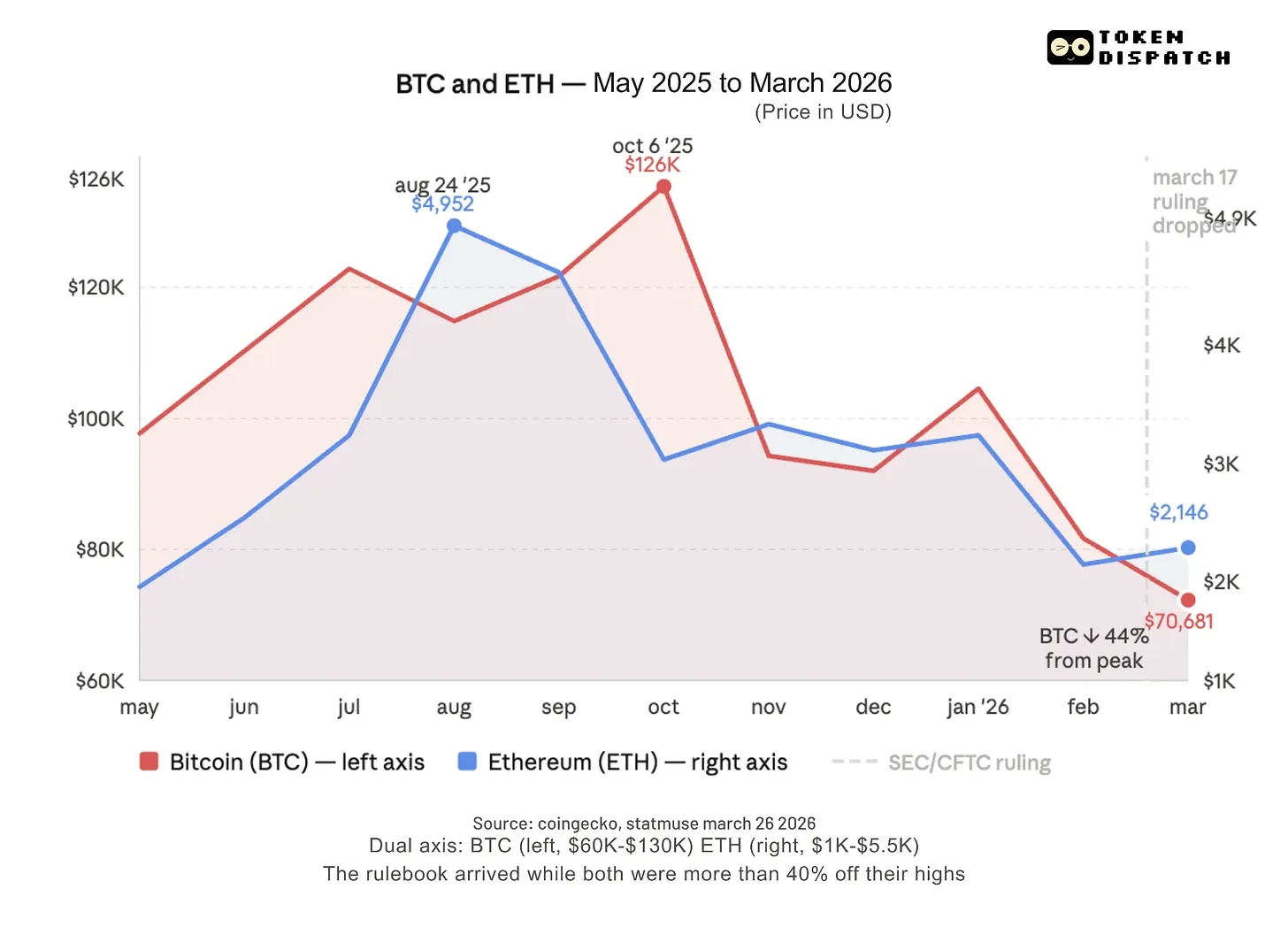
Bitcoin is down 44% from its October highs. Ethereum is around $2,000, less than half its price from seven months ago. The total market cap of altcoins has evaporated $470 billion since its peak. The Fear & Greed Index is at 11. This isn’t an 11 for a bad week; it’s an 11 out of 100. This means people have stopped arguing about where the bottom is and have started selling their remaining crypto.
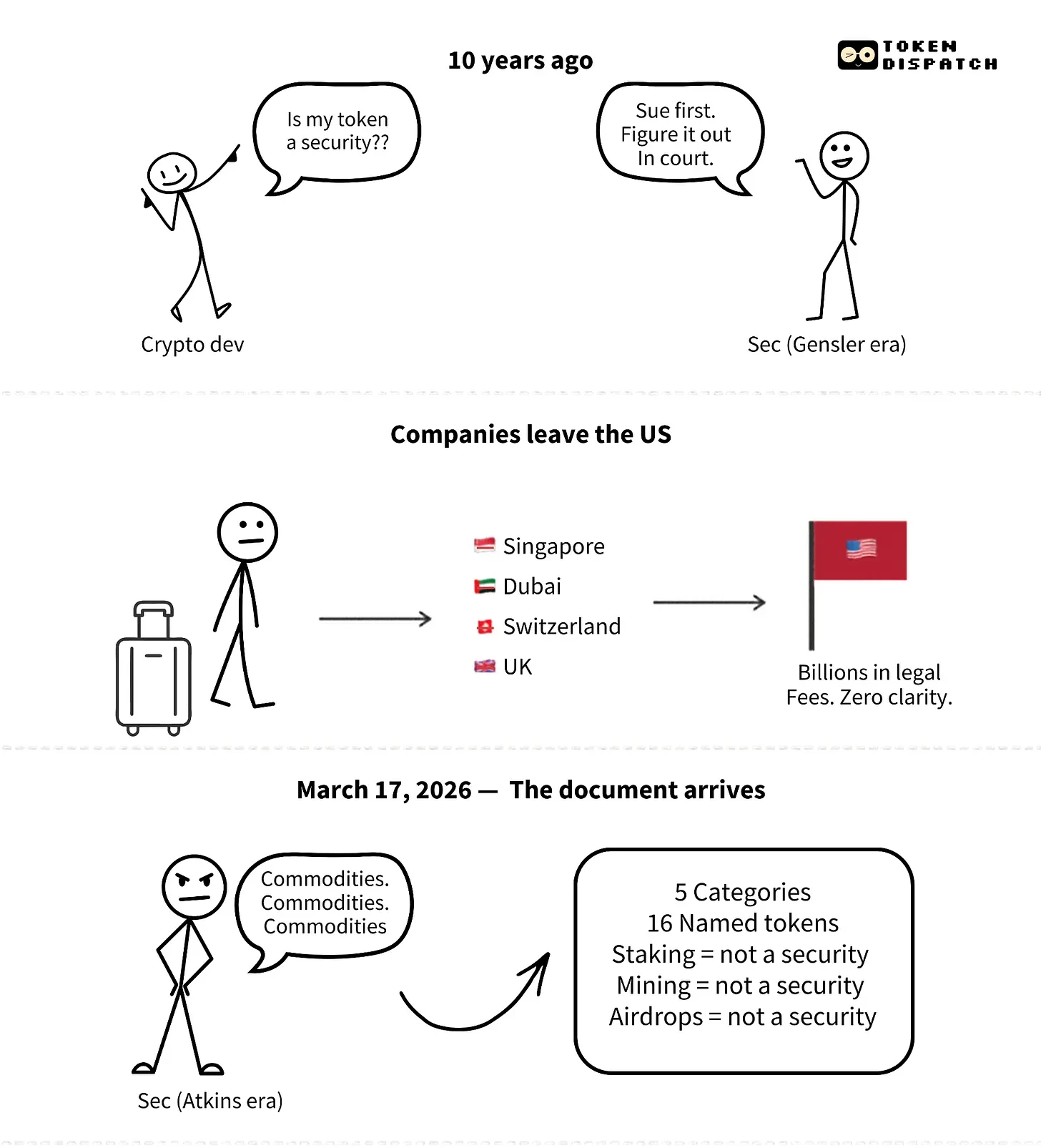
And right then, on March 17, the U.S. Securities and Exchange Commission (SEC) and the Commodity Futures Trading Commission (CFTC) released a document that finally reveals what the tokens you hold actually are. This came after a decade of litigation between the two sides, hundreds of enforcement actions, and billions in legal fees. Some companies even chose to relocate to Singapore rather than continue playing guessing games with Gary Gensler. And the answer finally came the week Ethereum fell below $1,900.
But the key point is that while the token economy itself has been hit hard, everything underlying it is thriving. The circulation of stablecoins has exceeded $316 billion, and the scale of real-world assets (RWA) on-chain has reached $26.5 billion and is still growing. This is precisely why Morgan Stanley is building a crypto trust bank. Meta abandoned its メタバース project but is introducing stablecoins to WhatsApp. Stripe is processing $400 billion in stablecoin transactions. Nasdaq is building a tokenized stock trading platform. Cryptocurrency is becoming a pillar of global finance, and for the most part, it doesn’t rely on tokens.
Cryptocurrency is no longer just a speculative asset class. The regulatory policy introduced on March 17 was originally designed for the first generation of cryptocurrencies, but it was officially implemented only after the arrival of the second generation.
But that doesn’t mean it’s meaningless.
SEC Chairman Paul Atkins once said: We are no longer the ‘Securities and Everything Commission’. “Is this statement a bit late?
U.S. regulators have a unified デフィnition of cryptocurrency for the first time. Five categories, each token belongs to one of them. I will give these definitions next, please read them as if you have never heard of these concepts.
Digital commodities are the main event. A digital commodity is a crypto asset whose value derives from the programmatic operation of a functional crypto system and supply-demand dynamics. Its value does not depend on the management of a central issuer. If the network is truly decentralized and functioning properly, with no single company supporting it, then the asset is a commodity. This falls under the jurisdiction of the U.S. Commodity Futures Trading Commission (CFTC), not the U.S. Securities and Exchange Commission (SEC).
Sixteen major tokens, including Bitcoin, Ethereum, Solana, XRP, Cardano, Avalanche, Polkadot, Chainlink, Dogecoin, and 柴犬, have been formally recognized as digital commodities. Dogecoin and Shiba Inu fit this definition because there is no promoter or institution driving their value increase. They have no promises, roadmaps, nor is the continuous work of a team critical to the token’s value. This is precisely why they are considered commodities, not securities. The criterion is whether someone has promised returns based on their work.
Digital securities refer to tokenized stocks, bonds, and treasury bonds. In short, these assets were securities before being put on the blockchain and remain securities afterward. The U.S. Securities and Exchange Commission (SEC) regulates these assets. It’s that simple.
Digital collectibles are NFT tied to specific items or experiences. Digital tools are assets used to access software or services, with no expectation of investment returns. Stablecoins have their own category under the framework of the GENIUS Act.

Staking, mining, and airdrops have all been approved. The ruling clearly states that receiving mining rewards, participating in on-chain staking, or receiving airdrops of digital commodities do not constitute securities transactions. This removes one of the biggest legal risks facing proof-of-stake networks since the Gensler era. Wrapping non-security tokens has also been approved.
These 16 named tokens are all underlying infrastructure with years of decentralized development behind them. DeFi protocol tokens—such as JUP, POL, METEOR, and the vast majority of tokens launched in the past two years—were not named and clearly do not qualify. The threshold for a functional crypto system without centralized regulatory participation is high. Most actively developed protocols do not meet this standard. The gray area that this interpretation was supposed to resolve remains unclear for the tokens most people actually hold.
Value must derive from the programmatic operation of a functional system, not from someone’s promise. This single test standard can transform a decade of ambiguity into something compliance officers can actually work with.
There’s More to the Story
This announcement does not constitute a formal rulemaking process under the Administrative Procedure Act, nor does it have the binding force of law or formally promulgated regulations.
You’d better read that sentence again. The 68-page document we’ve been waiting for is just an interpretive announcement, not a law or regulation, but merely an agency position statement issued by the current chairs of the SEC and CFTC, which they can withdraw at any time.
This interpretation is a formal agency action by the SEC and CFTC and is binding. However, without relevant legislation, a future administration could modify it. The document itself reserves the right for the agencies to refine or expand their views. A future SEC chair with different political views could overturn this interpretation without Congressional approval. The next administration wouldn’t even need a new law, just new leadership.
Atkins is well aware of this. He expressed this view on the day of the release, calling on Congress to act to provide more lasting clarity. He sees this interpretation as a transitional measure, pending Congressional action on comprehensive market structure legislation. That legislation is the 市場 Structure Transparency Act (CLARITY Act). Currently, the CLARITY Act is under consideration in the Senate.
The CLARITY Act
The House of Representatives passed the CLARITY Act in July 2025 with 294 votes. Such a high level of bipartisan support indicates genuine consensus.
Then it went to the Senate and stalled.
The key obstacle to the bill’s passage is stablecoin yields. The banking side argues that allowing crypto platforms to pay interest on stablecoin balances would trigger deposit outflows. People would take money out of savings accounts and put it into USDC for higher returns. The banking lobby immediately began lobbying. The Senate Banking Committee canceled a review scheduled for January 2026. The bill made no progress for the next two months.
On March 20, Senators Tom Tillis and Angela Alsobrooks confirmed a principled agreement on stablecoin rewards, supported by the White House. The agreement is: passive yield on stablecoins is prohibited; rewards tied to payment and platform usage activities remain allowed. Neither side is happy, and that’s usually how compromise happens.
But the yield agreement is just one of five things that need to be completed before the CLARITY Act can take effect. The remaining four legislative steps are due for completion during the most intense period of the year.
- Senate Banking Committee review; and full Senate vote (requires 60 votes)
- Coordination with the Agriculture Committee
- Coordination with the House version
- Presidential signature
The Banking Committee’s review work is planned for the second half of April, after the Easter recess. Senator Bernie Moreno warned that if the bill is not brought to the full Senate floor by May, digital asset legislation may not make progress for years.
Furthermore, the Iran war is consuming a significant amount of Senate discussion time. There’s also the voter identification bill that Trump has indicated he wants passed first. Provisions regarding decentralized finance (DeFi) remain unresolved, with Senate Democrats expressing concerns about illicit finance risks. Ethics provisions are also not finalized, particularly whether senior government officials should be prohibited from profiting from crypto assets—a politically sensitive issue given this administration’s crypto holdings. Senate Republicans are currently discussing attaching community bank deregulation provisions as a political bargaining chip to the bill, which would trigger a whole new set of negotiations.
The U.S. House Financial Services Committee recently held a hearing titled “トークンization and the Future of Securities: Modernizing Capital Markets.” Witnesses at the hearing included Kenneth Bentsen from the Securities Industry and Financial Markets Association (SIFMA), Summer Mersinger from the Blockchain Association, Christian Sabella from the Depository Trust & Clearing Corporation (DTCC), and John Zecca from Nasdaq. Both Nasdaq and the New York Stock Exchange are building tokenized stock trading platforms. DTCC handles current settlement. If DTCC recognizes the efficiency of blockchain, then the argument is practically over.
Therefore, infrastructure is being built based on a rulebook that may not exist in two years. This is the industry’s current dilemma. Companies are making multi-billion dollar decisions to build custody systems, tokenization platforms, and staking infrastructure, all based on a persuasive but non-legally binding interpretive document.
What is Eternal, and What is Not
For readers holding the aforementioned 16 tokens (e.g., ETH, SOL, XRP), due to the statements of the two regulatory agency heads, these tokens are now formally recognized as digital commodities under U.S. law. As long as these two heads or their successors maintain this designation, the classification will remain valid.
If the CLARITY Act is passed, it becomes law. Any future chair would have no authority to overturn it without Congressional approval. The listed assets would be permanently defined, and the classification criteria would be binding.
If it doesn’t pass by May, then the current classification system depends solely on the opinion of a single government agency. For now, the 16 named assets are temporarily safe, but not all assets have been named. Most DeFi, most new tokens, and any permissionless assets without a clear issuer remain in a gray area, an issue not clearly resolved in the previous interpretation.
The most anticipated sentence is like a draft written in pencil.
Someone needs to pick up a pen to formalize this. Everything depends on the Senate’s actions over the next six weeks. Will these rules last long enough for all of this to make sense?
この記事はインターネットから得たものです。 From “Guessing Game” to “Temporary Rules”: A Decade of Absurdity in Crypto Regulation
Related: He Stole $2 Million from pump.fun, Yet Calls Himself a Whistleblower
Jarett Dunn (online alias Stacc), the attacker, is a former pump.fun employee. Last December, he was sentenced to 6 years in prison by a judge in London. Two days ago, he exposed a large amount of Telegram chat logs from his time at pump.fun. So, I spent a considerable amount of time going through these chat logs line by line. Honestly, after reading them, I was confused. These records didn’t contain the kind of intentional wrongdoing I imagined, such as the pump.fun team manipulating liquidity or secretly taking user fees. Nor were there any major issues regarding the personal morals of founder alon or other team members. However, in Jarett Dunn’s tweets, he calls himself a whistleblower and views his exposure act as a form of “righteous self-detonation.” Someone expressed…
相关文章
































 日本語
日本語  English
  繁體中文
繁體中文  简体中文
简体中文  Tiếng Việt
  العربية
  한국어
한국어  Bahasa Indonesia
  हिन्दी
  اردو
اردو  Русский