







MiniMax: A Young Man from a Henan County Town and His 300 Billion
In 2014, an intern joined Baidu Research Institute. He was a Ph.D. from the Institute of Automation, Chinese Academy of Sciences, hailing from a county town in Henan. He had calculated his future: the ideal path after graduation was to work at IBM, writing Java code for an annual salary of 280,000 RMB.
During the 2026 Spring Festival, an Agent tool called OpenClaw went viral globally. Developers building on OpenClaw needed underlying large language models for support. One model was particularly fast and cheap, consuming 1.44 trillion tokens in a single week on OpenRouter, topping the charts across all platforms.
This model was called M2.5, and the company behind it was MiniMax.
Two months after its IPO, its stock price surged from 165 HKD to 1,300 HKD, with its market cap exceeding 300 billion HKD, despite being a company with annual revenue under $80 million.
The person who built MiniMax was that intern from twelve years ago: Yan Junjie.
A Bet Made Over a Year Early
During the 2021 Spring Festival, Yan Junjie returned to his hometown in Henan for the New Year and visited his grandfather.
His grandfather told him he wanted to write a memoir, documenting his 80 years of life. But he couldn’t type and struggled to organize his stories coherently. After mentioning it a few times, he gave up.
Yan Junjie had been in the AI industry for over a decade. At that moment, he suddenly realized that all the things he had worked on, even if they were deployed in the industry and helped countless enterprises, were utterly useless to an elderly man who simply wanted to write his memoir.
This detail has been repeatedly cited since, taking on a somewhat inspirational story flavor. But it genuinely explains one thing: his motivation for working in AI was simple—to make it truly usable for ordinary people. This obsession later drove a series of counter-intuitive decisions.
At the end of 2021, he left SenseTime.
The timing was crucial. SenseTime was preparing for its Hong Kong IPO at the time. He was a Vice President, Deputy Dean of the Research Institute, and CTO of the Smart City Business Group. He left at one of the company’s most valuable moments. He didn’t wait for the IPO, didn’t wait for his wealth to materialize; he walked away.
ChatGPT wasn’t released until November 2022.
MiniMax was founded in December 2021.
This time gap was the foundation for everything that followed. Yan Junjie later said that if they hadn’t started early, in the later fundraising environment where “star researchers and big tech AI backgrounds were more favored,” MiniMax would have had no chance against others.
His parents were ordinary people. He attended high school in a county town, got into the Mathematics Department of Southeast University, later pursued a Ph.D. at the Institute of Automation, Chinese Academy of Sciences, did a postdoc at Tsinghua University, then joined SenseTime. He climbed step by step, with no overseas background or illustrious network starting point.
During his internship at Baidu, he crossed paths with Yu Kai from Horizon Robotics. Yu Kai later said that academic ability can be trained, but those who can engineer and deploy AI technology are extremely rare. Yan Junjie was one of them.
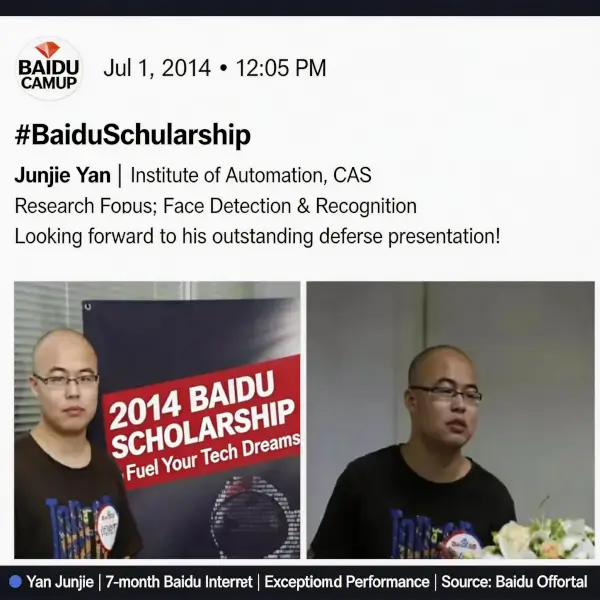
After joining SenseTime, he rose from intern to Vice President in seven years. In 2018, with limited manpower, he led a team to develop an “All for One” model algorithm, which helped them overtake Megvii and Yitu in a bid, securing the top spot in the industry. Some described him as having “an incredibly fast paper-reading speed, ignoring clichés and focusing only on the essence.” This efficiency later became part of MiniMax’s company culture.
He named the company MiniMax, derived from the minimax algorithm in game theory by John von Neumann.
His explanation was that decision-making should first guard against the worst risks, then select the relatively optimal solution.
An Unusual Shareholder Table
In December 2021, MiniMax completed its angel round, raising $31 million at a pre-money valuation of $170 million. Investors included miHoYo, IDG, Hillhouse, and Yunqi Partners.
miHoYo’s investment was somewhat special. Yan Junjie had a good personal relationship with Liu Wei, Chairman of miHoYo. They came in during the angel round, and Liu Wei still serves as a non-executive director on MiniMax’s board.
miHoYo itself is a customer of MiniMax, using their models for NPC dialogues and storyline generation in games.
After the angel round, the story hit a minor snag.
In March 2023, Silicon Valley Bank declared bankruptcy. At that time, all of MiniMax’s funds were in that bank. This was the most perilous moment in the early startup phase—money gone, and the fundraising environment in chaos. But they pulled through. Two months later, they secured a $257 million Series A round at a valuation of $1.157 billion.
The list of subsequent investors became increasingly impressive. Alibaba came in, Tencent came in, Sequoia followed. By the pre-IPO stage, after 7 funding rounds, they had raised nearly $1.5 billion cumulatively, with a valuation of $4.2 billion. Post-IPO, Alibaba held 12.52%, making it the largest external shareholder.
Yan Junjie had a habit in early fundraising: he would only negotiate with the highest-level person at the investment institution. He met with Neil Shen of Sequoia and Zhang Lei of Hillhouse.
But there’s one person on this shareholder list worth mentioning separately: Yun Yeyi.
Born in 1994, she holds a B.S. in Electrical Engineering from Johns Hopkins University, with minors in Economics and Mathematics. She joined SenseTime right after graduation in 2017, working in financing and strategic investment. A year later, she was promoted to Executive Assistant to CEO Xu Li and Director of the Strategy Department. She was deeply involved in SenseTime’s journey from its early days to its Hong Kong IPO.
In 2021, she left SenseTime to co-found MiniMax with Yan Junjie.
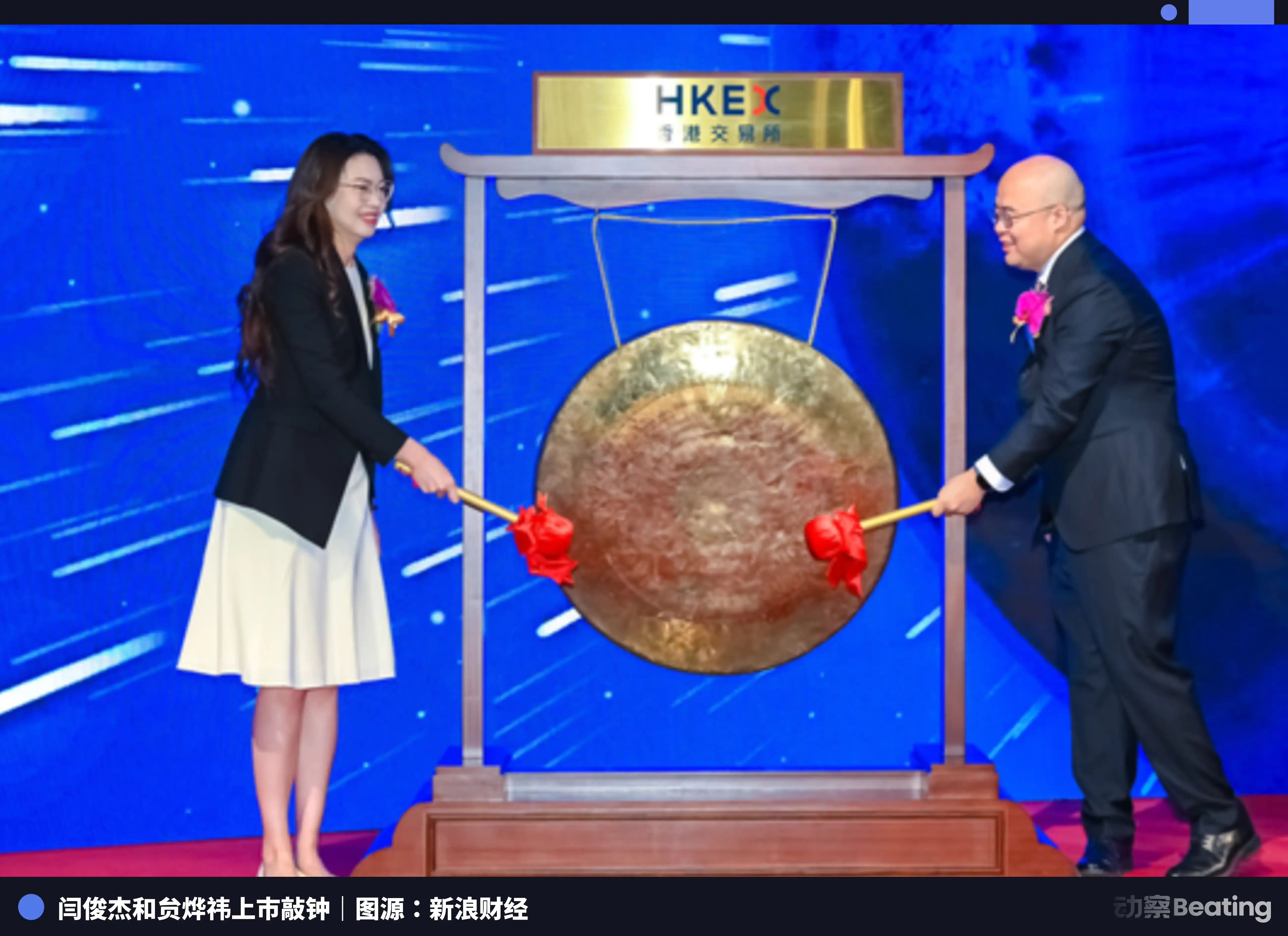
An investor described her as “capable, commanding, highly execution-oriented, with a maturity beyond her years.” Her division of labor with Yan Junjie was clear: one defined the technological vision, the other turned that vision into capital and resources. Yan Junjie could dive deep into technology, not caring if his hair was shaved off, but the market, capital, and globalization were Yun Yeyi’s battlefield.
On the day of the IPO bell-ringing, the two stood on the same stage. Yun Yeyi, at 31 years old, had a net worth exceeding 4 billion HKD.
385 People and 1% of the Money
At the time of its IPO, MiniMax had 385 employees, with an average age of 29.
From its founding to September 2025, the company had spent approximately $500 million cumulatively. OpenAI spent between $40 billion and $55 billion during the same period.
This comparison seems absurd. Using less than 1% of their competitor’s money, they built a globally leading, full-modal company. Saving money was just the outcome. The real reason was their extreme utilization of AI. 80% of the company’s code was completed by AI. Internally, they referred to AI as “interns.” These “interns” had high enough permissions to directly access code repositories and modify production environments. After chatting with it on Feishu and completing a review, code could go live directly.
This efficiency gave MiniMax an abnormally high output per capita.
On the product front, they pursued a full-modal strategy from the start: language, video, speech, and music, pushing all four directions simultaneously. While others were learning from ChatGPT to make chatbots, Yan Junjie bet on multimodal fusion. His judgment was that multimodality is a fundamental prerequisite for continuously improving intelligence. Without pursuing full modality, there would be no chance for the next-generation models.
In the summer of 2023, he made an even more radical decision.
He allocated 80% of computing power and R&D resources entirely to MoE (Mixture of Experts).
At that time, the mainstream in China was still iterating on dense models. MoE was considered “cutting-edge but immature” technology. Yan Junjie’s logic was simple: to serve tens of millions or even hundreds of millions of users, the cost and latency of token generation would be unsustainable with dense models. Without MoE, scaling was impossible; everything else was futile.
In early 2024, MiniMax released China’s first MoE large language model.
Product-wise, they also avoided the fierce competition in the domestic market. For the C-end, they launched Xingye and Talkie—one for China, one for overseas—focusing on AI companionship. Hailuo AI focused on video generation, holding the top spot globally in monthly active users for video generation apps for six consecutive months in the second half of 2024.
Current figures: 236 million users, covering 200 countries and regions, with overseas revenue accounting for 73%. For the B-end, 214,000 enterprise clients and developers. MiniMax’s models are already deployed on Google Vertex AI, Microsoft Azure, and AWS. Notion’s first open-source model choice was also MiniMax.
In February, ARR exceeded $150 million. The daily token consumption of the M2 series was 6 times that of December last year, with programming-related usage growing over 10 times.
This is why the market is willing to give it a 200x price-to-sales ratio.
But one set of numbers needs closer examination.
In the annual report, C-end gross margin was 4.7%, while B-end gross margin was 69.4%. 67% of the company’s revenue came from the C-end, but the C-end contributed almost no gross profit. A rough calculation for Q4 shows C-end gross margin had dropped to about 2.1%. The overall gross margin increased from 12.2% to 25.4%, mainly because the proportion of B-end revenue rose rapidly in Q4, pulling up the overall number.
This is an unsolved puzzle.
The Mountain is Not Unclimbable
In June 2025, MiniMax released the M1 model.
Yan Junjie posted a message on his social media:
“For the first time, I feel the mountain is not unclimbable.”
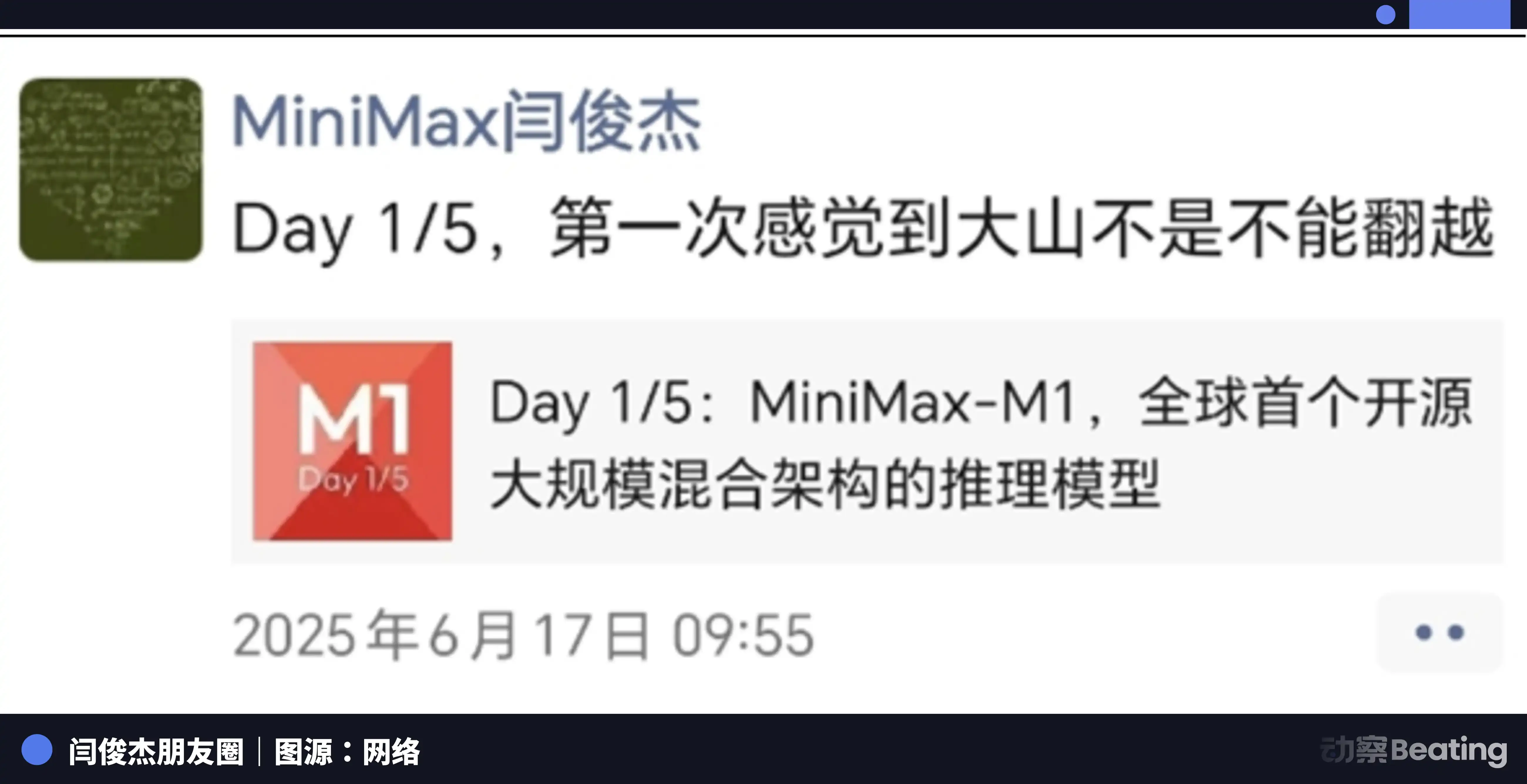
The reality behind this statement: the technical capability gap between top Chinese and US models might be only 5%. But this 5% allows overseas companies to capture scenarios with 10 times the value, charge 10 times the price, ultimately forming a nearly 100-fold gap in commercialization. OpenAI’s latest valuation exceeds $700 billion. MiniMax’s IPO market cap was 80 billion HKD, less than $10 billion.
He once predicted that there would be five top-tier AGI companies globally in the future, with at least two from China, and perhaps one could even be number one.
After the January 9th IPO, he appeared at an expert and entrepreneur symposium chaired by the Premier on January 19th, becoming the second AI large model founder to attend such a meeting after Liang Wenchun of DeepSeek.
Then on March 2nd, the first annual report was released, and Hong Kong stocks surged that day.
During the earnings call, Yan Junjie spent a long time explaining one thing: MiniMax needs to transition from a “large model company” to a “platform company in the AI era.”
He defined a formula for platform value: Intelligence Density × Token Throughput. The platforms of the internet era were traffic gateways; the platforms of the AI era are companies that can define the boundaries of intelligence while reaping commercial benefits. Google is doing it, OpenAI is doing it, and they aim to do it too.
The opponents he faces are dozens of times larger than him.
The Hong Kong IPO merely pushed him onto another battlefield. Quarterly reports, analysts, market cap pressure—these are completely different from writing code. The secondary market doesn’t believe in sentiment; it only looks at numbers. Can the C-end story translate into gross profit? Can B-end growth be sustained? When will M3 be released? These are questions that must be answered every quarter from now on.
But taking a broader perspective, the story of MiniMax is not just about one company.
The US has been tightening chip restrictions in recent years. A100 sales restricted, H100 restricted, H800 also restricted. The logic is straightforward: choke the computing power, choke the throat of AI.
China has been forced onto a completely different path.
DeepSeek achieved results close to H100 using H800s. MiniMax accomplished with $500 million what OpenAI spent tens of billions to achieve. Yan Junjie’s 2023 bet on MoE was because the limited GPU cards they had couldn’t support inference for hundreds of millions of users. M2.5 costs $1 for continuous operation for one hour, one-twentieth of GPT-5’s cost. Innovations like hybrid attention architecture, linear attention, and the CISPO algorithm were born out of necessity.
The original intent of the chip blockade was to widen the gap, but the actual effect was to force Chinese AI companies onto an evolutionary path of low computing power and high efficiency.
Less money, fewer chips, fewer people—this instead forced the emergence of extreme engineering capabilities and architectural innovation.
This logic is similar to Huawei making chips. You block one of my capabilities, I compensate in other dimensions. In the process of compensating, I might develop something you don’t have.
OpenAI now has over 4,000 people, burned $8 billion in cash in 2025, and plans to invest $600 billion in computing power by 2030. MiniMax has 385 people and has spent $500 million cumulatively.
Who will win is still unknown. But at least for now, fewer and fewer people are betting that MiniMax will fail.
The Henan-born Ph.D. student interning at Baidu in 2014 probably never imagined that twelve years later, the position he stands in is connected to an entire national-level technological competition.
He chooses to keep running.
Artikel ini bersumber dari internet: MiniMax: A Young Man from a Henan County Town and His 300 Billion
Author | Ding Dang (@XiaMiPP) “Altcoins are dead” has become a consensus that crypto users were reluctant to admit but had to face over the past year. Even former blue-chip tokens have fallen into prolonged sideways movement or gradual declines amidst the broader market’s sustained weakness, showing little sign of recovery. However, amidst this overall downturn, the MORPHO token has rebounded from its early February low of $0.96 to the $1.8-$1.9 range, doubling against the trend. Looking at the daily chart, this rebound has essentially formed a rounded bottom pattern, which could be a signal of a bottom reversal. Is this surge merely a short-term push driven by market sentiment, or the start of a trend fueled by the resonance of fundamental and structural variables? When the Old Regime Begins…
相关文章































 Bahasa Indonesia
  English
  繁體中文
繁體中文  简体中文
简体中文  日本語
日本語  Tiếng Việt
  العربية
  한국어
한국어  हिन्दी
  اردو
اردو  Русский