







Aya × Duncan Chiu Hong Kong Dialogue|ETH HK Hub Opening Day: The Ethereum Foundation’s “Subtraction Philosophy” – Success Means EF Does Less, While Ethereum Becomes Stronger
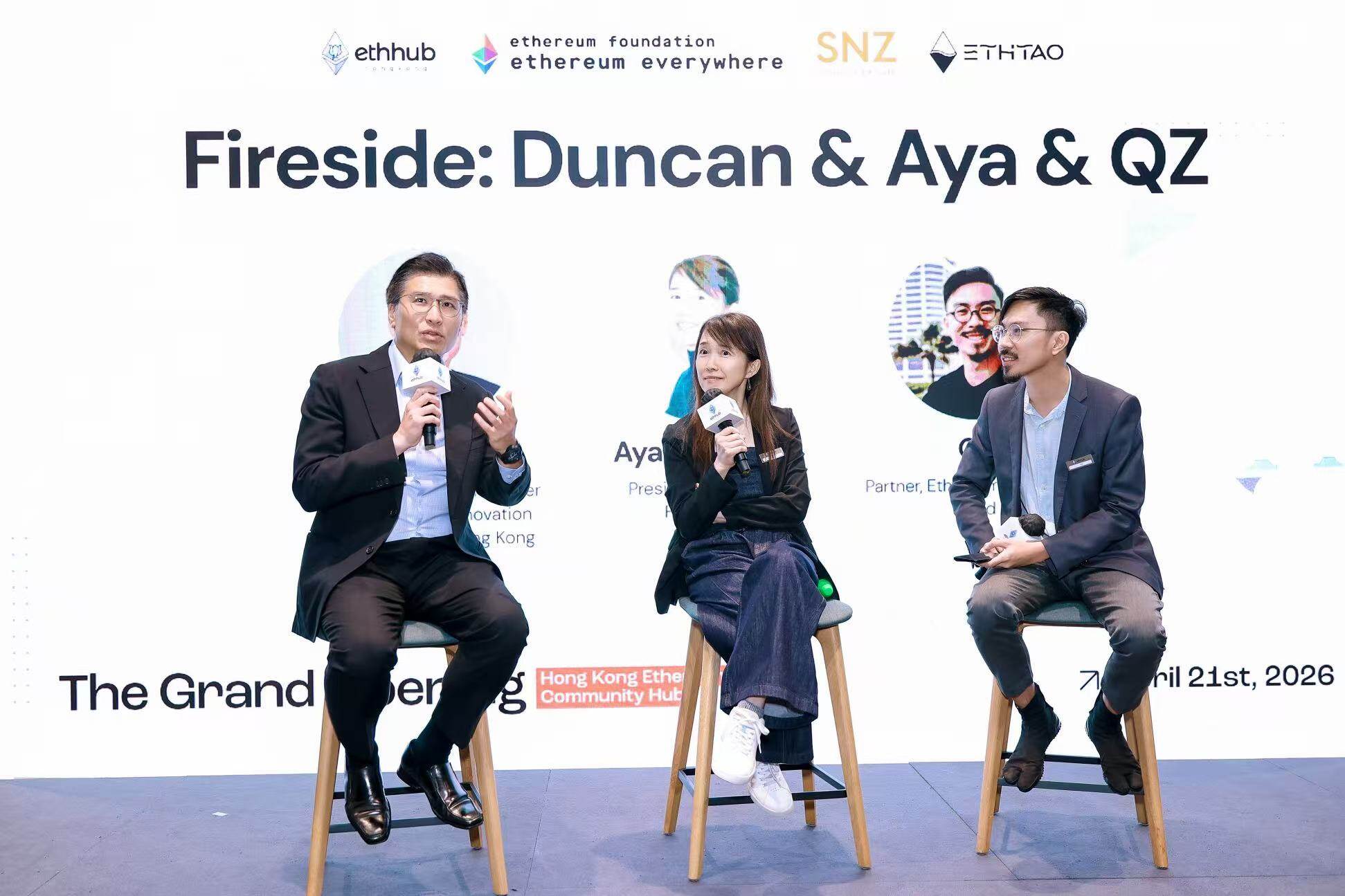
On April 21st, the ETH HK Hub, co-operated by SNZ and ETHTAO, officially launched in Hong Kong. The opening ceremony featured a panel discussion with Ethereum Foundation Chair Aya Miyaguchi, Hong Kong SAR Legislative Council Member (Technology & Innovation Sector) Duncan Chiu, and Ethereum Ecosystem Fund Partner QZ as the moderator.
The conversation revolved around the Ethereum Foundation’s long-termism, philosophy of subtraction, the Walk-away Test, the development of Hong Kong’s digital asset ecosystem, and the significance of the ETH HK Hub for the Asian Ethereum community.
Marking Ethereum’s tenth year, Aya emphasized that the Ethereum Foundation’s goal is not to become the control center of the ecosystem, but to allow the system to operate sustainably even without the Foundation’s involvement. Duncan Chiu, from the perspectives of Hong Kong’s policies, financial infrastructure, and talent mobility, shared the unique advantages of Hong Kong as a node for digital asset development.
The following is the full text of the translated conversation, edited and abridged for clarity.
Moderator QZ: This year marks the tenth anniversary of Ethereum’s development. Seeing the ecosystem evolve in Hong Kong from early small gatherings and discussions to having a physical community Hub is a very significant sign of progress.
Ethereum has always represented something beyond just technology—it embodies the possibility of building large-scale systems, even a new form of digital civilization. But this path is not easy.
The Ethereum Foundation recently put forward an important concept: a system must not only function effectively today, but also must not become a bottleneck in the future. This reflects the core principle of the Foundation – even when there are paths to faster short-term growth, choosing the more difficult but more sustainable long-term direction is paramount.
Aya, from your perspective, have there been truly difficult moments in adhering to this principle?
Aya Miyaguchi: This tension exists every day.
I joined the Ethereum Foundation during the ICO boom. The market had strong growth momentum, but it also came with immense external pressure. Many advised the Foundation to expand rapidly, aggressively hire, and operate like a traditional large company, such as establishing roles like CTO or CMO.
That seemed like the natural choice, but we didn’t do it.
Because Ethereum must pass what we call the “Walk-away Test”—the system must function properly even without the Ethereum Foundation. That is our long-term goal.
A typical example is The Merge in 2022. This was an extremely complex upgrade involving numerous already-running applications and collaboration among multiple client teams. It would have been much simpler for a single team within the Foundation to execute.
But we deliberately chose client diversity. This, while increasing difficulty, strengthened the protocol’s resilience over the long term. Therefore, in many cases, we choose the harder path to achieve long-term sustainability.
QZ: If the Foundation had chosen centralization back then, what things wouldn’t exist today?
Aya Miyaguchi: We always emphasize the “philosophy of subtraction.”
If the Foundation built everything for the entire ecosystem, participants would become dependent. In the long run, this would weaken competition, and without competition, optimal solutions cannot emerge.
Ethereum’s potential is too vast to be controlled by a single entity. Many significant innovations in the ecosystem today occurred without the Foundation’s direct involvement.
This is precisely Ethereum’s strength. Our role is to support and coordinate, not to over-control. And the community Hub we see here in Hong Kong today is itself an embodiment of this philosophy.
QZ: Duncan, from your perspective, how did you enter this space?
Duncan Chiu: Before answering, I want to welcome Aya to Hong Kong and hope this isn’t your last visit.
I encountered Ethereum around 2014, before the ICO era. As a venture capitalist, we looked at some blockchain projects then, but due to limited understanding, didn’t make large investments. However, we kept monitoring the field’s progress.
Starting in 2021, as a Legislative Council member, I got involved in analyzing technology trends and policy research. By 2022, the Hong Kong government realized blockchain would profoundly impact financial infrastructure, and as a global financial hub, we must remain competitive.
So, we began promoting initiatives including stablecoin legislation, tokenized financial products (like bonds and deposits), and encouraging financial institutions to explore on-chain infrastructure. Progress is being made step-by-step—from products and ecosystems to infrastructure and regulation.
QZ: What is the biggest challenge regarding adoption?
Duncan Chiu: All technology takes time to develop. Look at artificial intelligence; it went through decades of evolution. Blockchain is still in a relatively early stage. Adoption cannot be forced; it’s a result of innovation. When truly user-demanding products emerge, adoption will naturally follow, institutions will follow, and regulation will follow. Regulation is always lagging. Therefore, the most important thing is having builders continuously drive innovation and create new products.
QZ: Why is a “trustless system” so important?
Aya Miyaguchi: Because without that guarantee, there is no reason for anyone to build on it.
Trustlessness means no single entity can shut down the system. We have already seen the fragility of centralized systems. For instance, a global software failure in 2024 caused massive system outages, flight cancellations, and billions of dollars in economic losses.
This shows the immense risk of relying on centralized systems. So, this isn’t just an ideological issue; it’s a practical necessity.
QZ: Why should developers choose Ethereum?
Aya Miyaguchi: It depends on the properties Ethereum offers. It has the largest developer ecosystem globally and is the most active development platform. When developers join Ethereum, they aren’t just building products; they are participating in a global systemic exploration. Ultimately, the focus isn’t on Ethereum itself, but on the world it can help create.
QZ: What does “success” mean for the Ethereum Foundation?
Aya Miyaguchi: Success means the Foundation doing less, and Ethereum becoming stronger. The ecosystem is healthy when the community can thrive independently and innovation doesn’t rely on the Foundation. Ideally, Ethereum will become like the internet—a naturally used infrastructure.
QZ: Duncan, what is Hong Kong’s uniqueness in digital asset development?
Duncan Chiu: Hong Kong has multiple advantages, including bridging East and West, attracting global talent, and a mature financial system. It’s a place where you can quickly establish connections, collaborate, and realize ideas. We have also seen an increasing inflow of talent in recent years, and shifting global dynamics have further highlighted Hong Kong’s importance.
Ultimately, technological development relies on people, and Hong Kong is a place where people want to come to build.
QZ: Thank you, Duncan. Thank you, Aya. And thank you all for participating.
Artikel ini bersumber dari internet: Aya × Duncan Chiu Hong Kong Dialogue|ETH HK Hub Opening Day: The Ethereum Foundation’s “Subtraction Philosophy” – Success Means EF Does Less, While Ethereum Becomes Stronger
Few anticipated that a military conflict in the Middle East would eventually transmit along multiple links – natural gas, fertilizers, helium, semiconductors, consumer electronics – cascading into a systemic stress test spanning dozens of industries. In late February 2026, the US and Israel launched military strikes against Iran. Iran subsequently restricted passage through the Strait of Hormuz, forcing one of the most critical chokepoints for global energy transport into a semi-frozen state. Shortly after, the Ras Laffan Industrial City, Qatar’s largest natural gas facility, was repeatedly attacked, shutting down one of the world’s most important LNG production and export hubs. According to Reuters, approximately 17% of Qatar’s LNG export capacity was damaged, resulting in the shutdown of 12.8 million tons of LNG annually. Repair of some facilities could take 3…
相关文章
































 Bahasa Indonesia
  English
  繁體中文
繁體中文  简体中文
简体中文  日本語
日本語  Tiếng Việt
  العربية
  한국어
한국어  हिन्दी
  اردو
اردو  Русский