







Stripe Sessions 2026 Observations: Stripe Accomplished in One Night What the Crypto Circle Failed to Do in Five Years
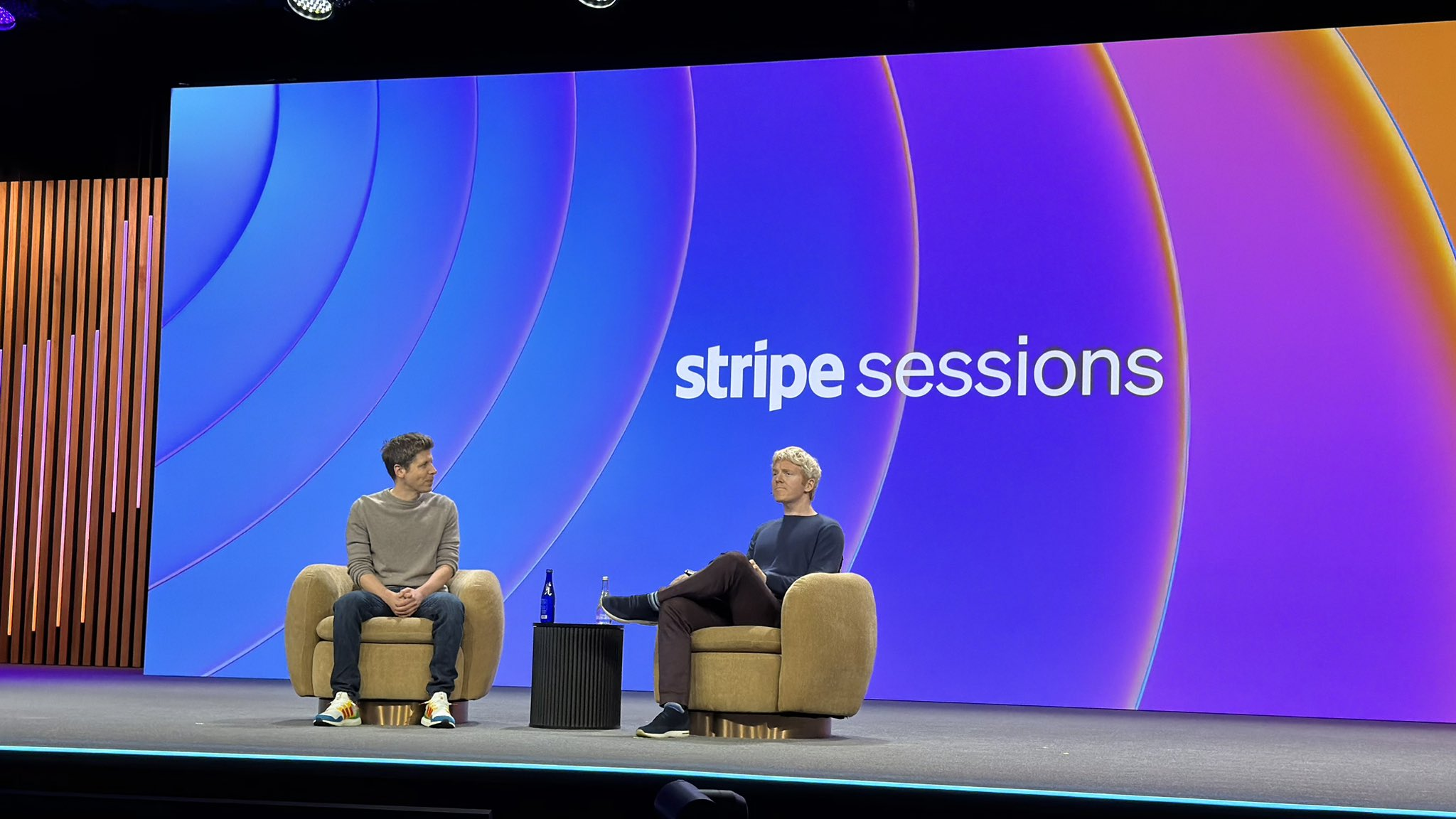
On April 29th, at San Francisco’s Moscone West, Stripe Sessions 2026 kicked off.
As the conference entered its second half, the lights dimmed. An image that made the entire audience raise their phones appeared on the big screen: Sam Altman, wearing his iconic beige sweater, seated on a light-colored sofa, across from Stripe’s President, John Collison.
Those familiar with this scene smiled knowingly: This is Sam’s second time in the Stripe Sessions sofa. The first was in May 2023, less than six months after ChatGPT exploded. In that conversation, Sam was still debating with John about “whether AI has existential risk.”
Three years later, things have changed profoundly.
Sam’s OpenAI has become a behemoth valued at $500 billion with 900 million weekly active users; Stripe’s valuation has surged 70% in the past year to $159 billion. The Agentic Commerce Protocol (ACP), co-launched by the two companies in September 2025, already allows ChatGPT users to directly order Etsy and Shopify products within the chat window.
Sam’s appearance this time is, in itself, a signal. OpenAI’s monetization channel for its 900 million weekly active users is betting on Stripe’s infrastructure.
Across from the sofa where he sat, on the big screen behind John, was the conference’s core number: 288.
This was the number of new products and features Stripe announced at this year’s Sessions. Over 9,000 people were in the audience, 1.32 times more than last year. Patrick Collison joked during his opening remarks, “and that doesn’t count the agents you snuck in.”
For the क्रिप्टो industry, at least 60 of these 288 updates directly impacted its “core territory,” endorsed by Sam Altman on stage.
Flattening those 288 updates reveals only three core themes
If you click on Stripe’s official article, “Everything we announced at Sessions 2026,” you’ll be overwhelmed by the dense list of product names: Checkout studio, Reader T600, Authorization Boost, Smart Disputes, Workflows, Custom objects, Stripe Console… each tagged with a status label like “preview,” “GA,” or “private preview,” resembling a Jira board for a SaaS company.
But let me, as an editor with a Claude MAX account, tell you: All these products essentially answer only three questions.
First question: How does money cross borders? The answer: Stablecoins.
Second question: The buyer isn’t human, but an AI agent. How do you get paid? The answer: Agentic Commerce Suite + Machine Payments Protocol.
Third question: What if merchants want to use Stripe like a bank? The answer: The full-stack rollout of Treasury.
Connecting these three questions, you’ll see Stripe is doing something rarely discussed publicly: Using its “payment company” compliance identity and distribution capabilities, it’s taking what the crypto industry has repeatedly tried but failed to bring mainstream over the past five years – stablecoins, the agent economy, on-chain settlement – and shoving them all at once into the existing pipes laid by Visa, Mastercard, and PayPal.
The disruptive nature of this lies in the fact that users don’t need to know they’re using blockchain.
Stripe May Have Already Won the Stablecoin Battle
First, look at some staggering data points.
At the 2025 Sessions, John Collison showed a chart: The payment volume growth curve for Bridge (the stablecoin infrastructure company Stripe acquired) over its first 24 months was steeper than Stripe’s own curve during the same period. This was a rare moment where Stripe was “outpaced by its own investment target.” A stablecoin pipeline, less than two years old, was growing faster than Stripe, which had dominated online payments for a decade.
By 2026, that curve hasn’t leveled off yet.
At this year’s Sessions, Stripe’s updates around stablecoins can only be described as full-stack:
- Treasury stablecoin accounts expanded to 41 new markets. Combined with the previous 100+, this means businesses in over 150 countries can now use Stripe to hold stablecoins and make cross-border payments. Patrick said on X: “This is the largest international launch we’ve ever done.”
- Stripe Issuing launched stablecoin-backed debit cards, covering 30 countries. Your stablecoin balance can be spent directly by swiping the card.
- Bridge now supports multiple stablecoins like USDG, CASH, and USDSui, with cross-chain coverage including Tempo, Plasma, Celo, and Sui.
- Privy enables stablecoin balances to be directly connected to Morpho’s DeFi yields. This means a user’s “current account” could theoretically earn DeFi yield passively.
- Crypto Onramp supports headless integration and allows purchases up to $500 without full KYC. This is a gift for crypto app developers, making the onramp experience as smooth as Apple Pay.
Putting these pieces together, what do you see?
A complete “stablecoin shadow banking” system. Cross-border payments, storage, interest accrual, card spending, withdrawals, cross-chain operations – what traditional crypto exchanges spent five years failing to do smoothly, Stripe has accomplished in one year by connecting the full stack.
Even more critical is the distribution capability. Stripe now covers over 16,000 platforms and 11 million businesses globally. When you accept a stablecoin payment from Ghana on Shopify, use stablecoins to pay DoorDash drivers, or accept stablecoin subscriptions on Substack, it all runs through Stripe’s pipes.
Crypto purists might say: “This isn’t real crypto; it’s centralized.” But the market doesn’t care. The market only cares about one thing: Money moving faster, cheaper, and with less friction.
During an AMA last year, Patrick was asked, “Will Stripe issue its own stablecoin?” His answer was telling: “We don’t plan to. Our goal is to catalyze stablecoin adoption.”
The Agent Economy: Stripe, Visa, and Mastercard Team Up to Turn “AI Paying” into TCP/IP
What really left me breathless at this year’s Sessions was something else.
It’s called the Machine Payments Protocol (MPP).
This was actually previewed on March 18th, when Tempo, the L1 blockchain co-incubated by Stripe and Paradigm, launched its mainnet alongside the MPP protocol. But back then, most people, including me, dismissed it as just another crypto project “competing with x402.”
We were wrong.
At Sessions, Stripe integrated MPP into a much larger narrative: Agentic Commerce Suite.
Here’s the storyline:
- Your online store can now be “seen by AI agents.” Merchants upload product catalogs on the Stripe Dashboard and authorize agent access. The underlying standard is ACP (Agentic Commerce Protocol), an open-source protocol co-published and jointly governed by Stripe and OpenAI in September 2025. Sam’s appearance at Sessions was essentially to endorse ACP.
- Stripe partnered with Meta, allowing products in Facebook ads to be directly ordered by AI.
- Stripe partnered with Google to integrate AI Mode and Gemini into the Universal Commerce Protocol (UCP).
- Link launched an agent wallet, allowing you to authorize AI agents to pay using your Link wallet while retaining approval and visibility.
- MPP enables agents to make micropayments, subscription payments, and even streaming payments on Stripe, using both stablecoins and fiat currency.
Note a subtle strategic landscape: Stripe simultaneously holds two agent commerce protocols – working with OpenAI on ACP and with Tempo, Visa, and Mastercard on MPP.
The former leans towards the application layer (“how does an agent place an order in ChatGPT”), while the latter leans towards the payment layer (“how does an agent settle on-chain, on-card, or in a wallet”). Google went its own way with UCP, Coinbase went solo with x402, but Stripe is the only company simultaneously establishing standard partnerships with OpenAI, Visa/Mastercard, and Google.
That’s why Sam showed up personally.
Connecting the dots: When you ask ChatGPT to book a flight, Claude to buy a gift, or an agent to manage your SaaS subscriptions, the money flowing in the background will go through Stripe.
Stripe’s smartest move this time was not building this in a silo. MPP is open-source and rail-agnostic. Visa has already expanded it to credit card payments, Lightspark to the Bitcoin Lightning Network, and Stripe to BNPL providers like Klarna and Affirm.
This “I set the standard, everyone uses it” approach reminds me of one thing: That’s exactly how TCP/IP won back in the day.
Even more impactful is MPP’s design. It features a primitive called “sessions.” An agent receives a one-time authorization limit and can then make continuous micropayments without needing on-chain confirmation each time.
By the day of Sessions, MPP’s payment directory already had over 100 integrated partners, including Alchemy, Dune, Anthropic, OpenAI, Shopify, DoorDash, Mastercard, Nubank, Revolut, Standard Chartered, and Deutsche Bank.
This is a list of partners any crypto protocol would envy.
Stripe Treasury: The “One-Stop Finance” for Silicon Valley Founders, Now Quietly Transforming into a Commercial Bank
If the first two updates were gifts for the crypto and AI sectors, the third – Stripe Treasury – is a direct assault on traditional banking in Silicon Valley.
The updates surrounding Treasury at this Sessions effectively unbundle a commercial bank for sale:
- Deposits: Treasury accounts for US and UK businesses now support 15 currencies.
- Payments: Internal Stripe transfers between US merchants are free and instant.
- Spending: Stripe launched its own Mastercard with 2% cashback.
- Wealth Management: Treasury balances can earn Stripe credit points to offset processing fees.
- फाइनेंसिंग: Atlas founders can now receive SAFE investment funds from investors via Treasury, supporting ACH, wire transfer, and stablecoins.
- Cross-border: Treasury balances, backed by Privy’s non-custodial wallet, can be sent instantly to over 150 countries.
- AI Integration: Agent-ready financial accounts allow AI agents to check balances, pay bills, issue cards, and manage cash flow, with human-in-the-loop for critical operations.
Putting it all together: Stripe has quietly issued a “commercial bank + investment bank + wallet + AI financial assistant” all-in-one package to all its small business users.
And the most crucial detail behind this is Privy’s non-custodial wallet.
When Stripe acquired Privy in 2025, most people thought it was just a small addition to its crypto wallet capabilities. But now you see: The entire foundation for Treasury’s rollout across 150 countries is provided by Privy’s non-custodial wallet architecture.
This means the most valuable asset of traditional banks – the “account” – has been redefined by Stripe using stablecoins and non-custodial wallets.
A developer in Nigeria, upon registering an account on Stripe, effectively obtains a Privy wallet. This wallet can both receive stablecoins and fiat currency on-ramp, linked in the background to Bridge for cross-border clearing and Morpho for DeFi yields.
Throughout the entire process, they never need to know the term “blockchain.”
Stripe’s AI Dual Narrative: Infrastructure for Merchants, Models for Itself
This Sessions also featured an easily overlooked point: Stripe itself is using AI to reimagine itself.
Last year, Stripe launched the “Payments Foundation Model,” a foundational model for payments trained on hundreds of billions of transactions. The upgraded version released this year reportedly improved fraud detection rates by 64%.
And the newly released Stripe Console is an agentic execution environment embedded directly in the Dashboard. You can ask in natural language, “Why did my conversion rate drop last Tuesday?” and it provides a cross-product diagnosis. Tell it, “Send reminders to all customers who haven’t paid in the last 30 days,” and it will execute, asking for confirmation before crucial actions.
Custom objects allow you to model your own business data within Stripe, calling it like a database.
Stripe Database offers a one-click, real-time, read-only Postgres database – something data companies would charge a separate annual subscription for.
Workflows are now GA, supporting loops, third-party actions, and Connect platform calls.
Taken together: Stripe is transforming from an SDK company into an “AI-native operational operating system.” Merchants aren’t just collecting payments on Stripe; they’re running companies, hiring agents, managing operations, and making decisions there.
Why Does This Matter for the Crypto Industry?
At this point, many readers might ask: What does this have to do with crypto?
My own assessment is: Stripe Sessions 2026 marks a “watershed moment” for stablecoins and the agent economy entering the mainstream.
For the past five years, the crypto industry has repeatedly told a story: Stablecoins are Web3’s “killer app.” They told this story for five years, and while on-chain stablecoin circulation has indeed grown remarkably, the vast majority of transactions still circulate among CEXs, market makers, and arbitrageurs. Real consumer-facing commerce and B2B cross-border payment scenarios have hardly been penetrated.
Why? The barriers: KYC, wallets, private keys, gas fees, on/off ramps, compliance – any single friction point can scare off a legitimate business.
What Stripe did this time was hide all these barriers behind its own proven SaaS experience.
यह लेख इंटरनेट से लिया गया है: Stripe Sessions 2026 Observations: Stripe Accomplished in One Night What the Crypto Circle Failed to Do in Five Years
Key Highlights for Next Week April 27 Sources: Second round of Iran-US talks scheduled for April 27; April 28 Bank of Japan to announce interest rate decision and economic outlook report on April 28; April 29 Bank of Canada to announce interest rate decision and monetary policy report on April 29; April 30 Federal Reserve to announce interest rate decision, Powell to deliver remarks; Bank of England to announce interest rate decision on April 30; European Central Bank to announce interest rate decision on April 30; MegaETH TGE scheduled for April 30; Below is a preview of other noteworthy events in the industry from April 27 to May 3. April 27 Sources: Second round of Iran-US talks scheduled for April 27 Odaily Planet Daily News According to NDTV: Sources say…
相关文章
































 हिन्दी
  English
  繁體中文
繁體中文  简体中文
简体中文  日本語
日本語  Tiếng Việt
  العربية
  한국어
한국어  Bahasa Indonesia
  اردو
اردو  Русский