







Four days to hit $40 million: Is SATO a Ponzi or a new narrative innovation?
In the current market environment, the تشفير market’s hunger for projects with “mechanism innovation” has reached an almost frenzied level. Compared to past Meme projects that relied solely on narratives, KOLs, or community sentiment, market capital is increasingly willing to pay for “new operational logic” and “new asset structures.”
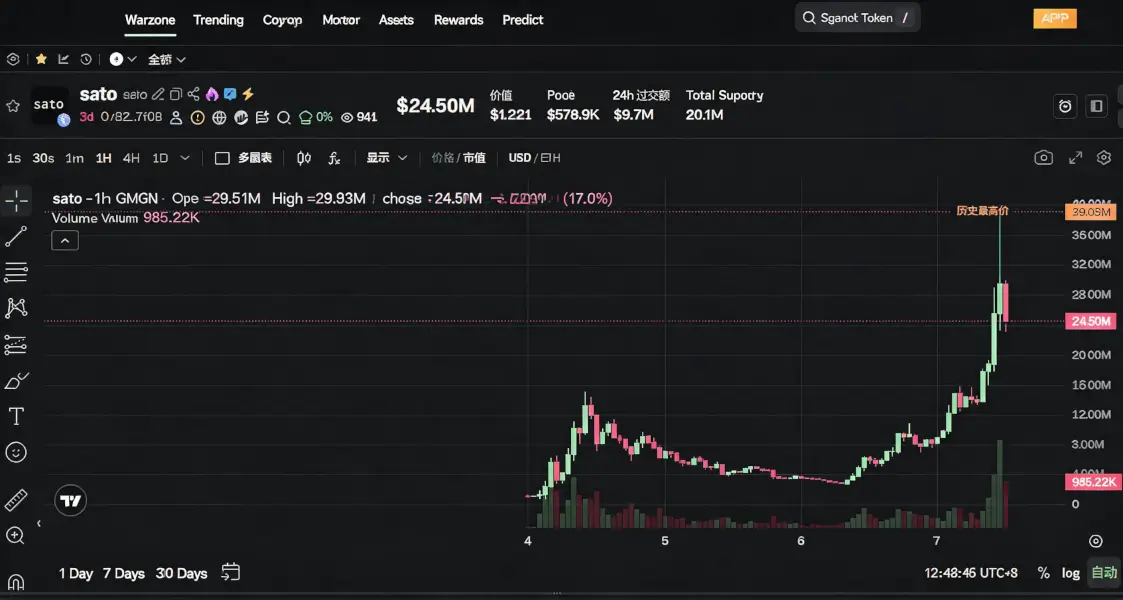
With almost no pre-launch hype and just a single website, sato has become the center of attention in the تشفير community over the past few days: Just four days after launch, sato’s market cap briefly approached $40 million and has now stabilized around $25 million. Odaily will explain the operational mechanism behind sato in detail in this article.
What Exactly is sato?
sato is an ERC-20 token deployed on Ethereum, with its core mechanism built on Uniswap v4 Hooks. There is no pre-mining, no team allocation, no admin keys, and no upgradeable or pausable functions. The entire system operates autonomously via on-chain code.
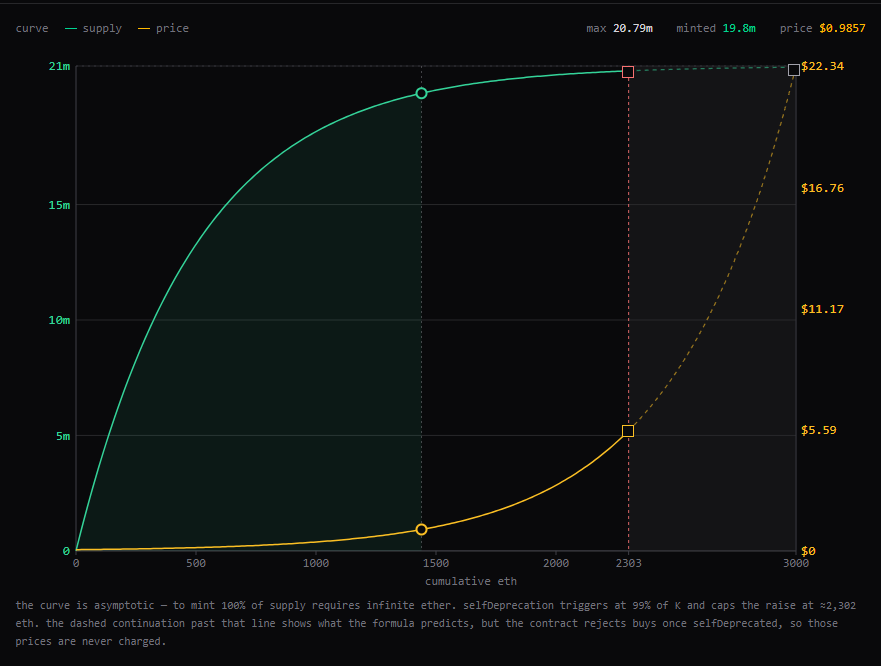
sato uses a Bonding Curve for issuance. When a user sends ETH to the Hook contract, the system automatically mints new sato tokens based on a fixed mathematical formula. As the cumulative amount of ETH entering the system increases, the subsequent purchase price becomes higher. All ETH remains permanently locked in the Hook contract as the system’s reserve.
When selling, users can return sato to the system in exchange for ETH; after the minted sato tokens reach 99% of the total supply, any sato sold back is burned directly and does not re-enter circulation. The system charges a 0.3% fee on both buy and sell transactions, which stays permanently in the Hook and cannot be withdrawn by anyone.
sato has a theoretical total supply of 21 million tokens, but the system will permanently stop minting once 99% of the supply (20.79 million tokens) is reached. After issuance stops, users can no longer purchase new tokens via the Curve, but can still sell sato back to the system for ETH. The Curve will continue to function as a permanent on-chain buyback pool.
The Core Mechanism of sato
The sato mechanism resembles a variation of Pump.fun’s Bonding Curve model, but is more extreme. In sato, users also buy tokens from the system via the Curve. However, unlike traditional Bonding Curve projects, sato explicitly divides the entire system into an “issuance phase” and an “external market phase.”
Phase 1: The Issuance Phase
In this phase, users are not trading with other holders, but directly with the system itself. When a user sends ETH to the system, the Curve automatically mints new sato tokens according to a fixed formula. As the cumulative amount of ETH entering the system increases, the minting price for subsequent tokens rises.
In a sense, this phase functions more like an automated “internal market system,” where the Curve itself is responsible for both token issuance and pricing.
Phase 2: The “External سوق Phase”
Once sato’s supply reaches the 99% cap, the system permanently stops minting, and users can no longer purchase sato from the system via the Curve. At this point, sato can begin trading on secondary markets like Uniswap, and its price is no longer determined by the Curve formula but by market supply and demand.
However, the Curve itself does not disappear. Although the issuance function is halted, the “redemption” function remains. Users can still sell sato back to the system for ETH, and the sold sato is burned directly, preventing it from re-entering the market. In a sense, the Curve transforms from an “issuance system” into a permanent on-chain buyback pool. The operational logic of sato can be understood as a gradual transition from an internal market to an external market.
sato: Reتحديning Digital Scarcity
What truly attracts the market to sato is not just the Bonding Curve, Hooks, or the deflationary mechanism itself, but rather its attempt to tell a new story of “digital scarcity.”
Bitcoin established the consensus of digital gold through a fixed supply and high creation costs. sato attempts to bring this same logic onto Ethereum. The difference is that Bitcoin completes its issuance through energy expenditure, while sato chooses to settle all costs directly into the system’s reserve. Every sato token corresponds to real ETH that has entered the system.
This is why many consider sato to be a very “sexy” on-chain experiment. It combines the scarcity and speculative acceleration dynamics of a Bonding Curve with the composability and liquidity of the Ethereum ecosystem. There is no pre-mining, no team market manipulation, no admin keys, and even the operational logic after the Curve concludes is pre-تحديned on-chain.
Whether this model can ultimately foster long-term consensus similar to Bitcoin’s remains to be seen by the market. But for now, sato appears to be more than just another Ponzi-style project; it looks more like an experiment on the concept of “native scarce assets on Ethereum.”
هذا المقال مصدره من الانترنت: Four days to hit $40 million: Is SATO a Ponzi or a new narrative innovation?
Related: BIT Research: Fed Leadership Change Ushers in a New Favorable Period for Bitcoin
Looking back at Bitcoin’s development trajectory, its birth followed the 2008 financial crisis, highly overlapping with multiple rounds of the Federal Reserve’s quantitative easing cycles. From Ben Bernanke’s large-scale balance sheet expansion, through Janet Yellen’s era marked by market skepticism, to Jerome Powell’s tenure which included the stress test of an interest rate environment above 5%, Bitcoin has continuously reshaped its market positioning under different policy phases. Notably, after the approval of spot Bitcoin ETFs in 2024, the “monetary debasement trade” has gradually entered the mainstream institutional narrative. Against this backdrop, potential shifts in Federal Reserve policy direction are becoming a significant variable influencing Bitcoin’s narrative. The Evolution of Monetary Cycles: From Quantitative Easing to Tightening, Bitcoin Completes a Narrative Reshaping Over the past decade, the Federal Reserve’s policy cycles…
相关文章
































 العربية
  English
  繁體中文
繁體中文  简体中文
简体中文  日本語
日本語  Tiếng Việt
  한국어
한국어  Bahasa Indonesia
  हिन्दी
  اردو
اردو  Русский