








$CATE Crashes 65% in One Minute, fomo Platform’s “Coincidental” Outage Sparks Fresh Scrutiny Over Alleged Manipulation
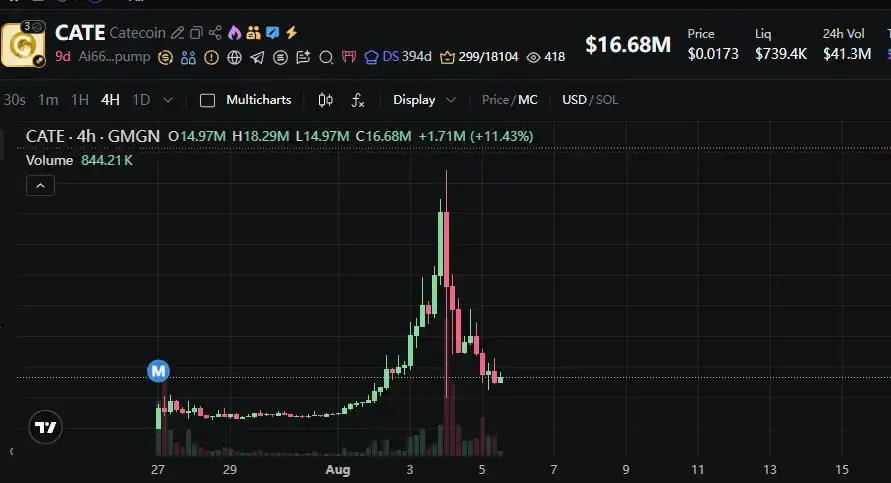
For seasoned on-chain players, such a price trajectory for a meme coin is hardly surprising. But when it happens to a coin in the spotlight, it’s quite dramatic—and it once again reveals some harsh realities about the current market.
The Harsh Reality
Let’s start with why this coin flash crashed. Players can easily sum up the reasons behind this massive plunge:
– $CATE’s X account was suddenly suspended
– fomo went down, leaving users unable to trade during the outage
The X account suspension is easy to understand, but why would a fomo outage cause this coin to flash crash?
Because, just as $ANSEM relies on Ansem’s influence and open endorsement, $CATE relies on the influence and open endorsement of “Little Ansem”—Poorgoat.
Poorgoat, a member of fomo’s Hall of Fame (recognized and inducted by fomo for achieving significant profits on the platform), currently ranks #1 on fomo’s 7-day profit leaderboard and #2 on the 30-day profit leaderboard. His average entry point on $CATE was around a $1.4 million market cap, with a total investment of approximately $44,700. At the coin’s peak price, this single trade alone netted him over $2 million in profit.
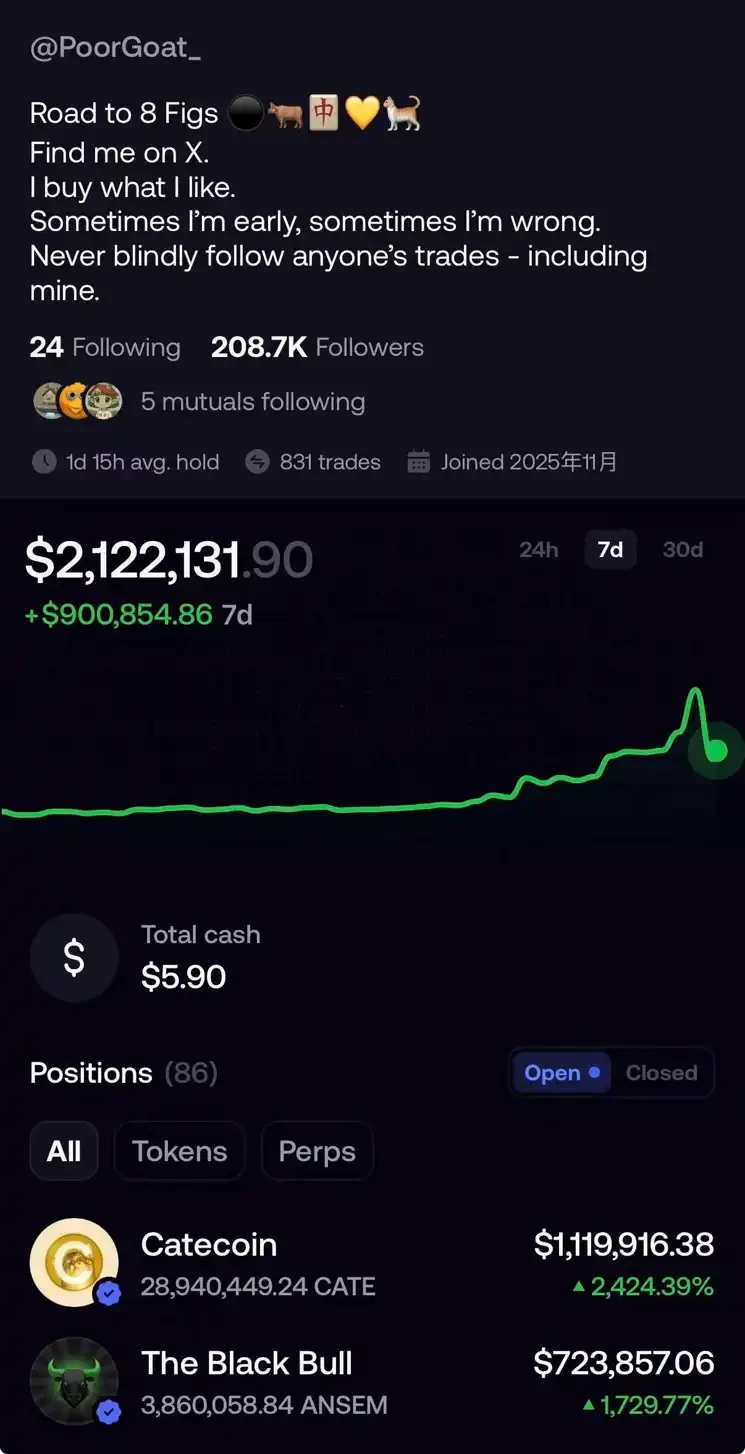
He first gained fame by diamond-handing a $30,000 $ANSEM airdrop, watching it grow to nearly $1.75 million at its peak. Now, he has amassed over 208,000 followers on fomo.
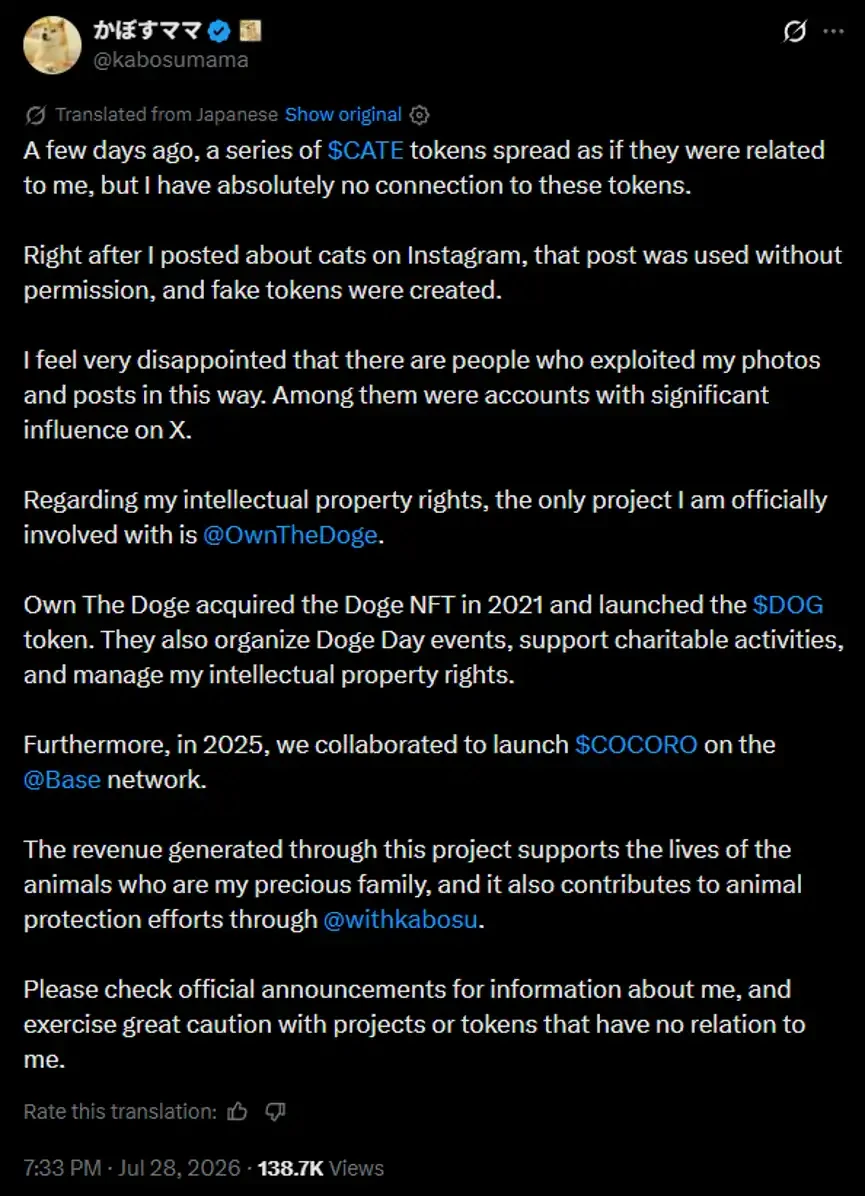
At this point, you should understand why the fomo outage is widely considered a major cause of the flash crash—because, frankly, this coin has nothing novel about its narrative. It’s just Doge’s “cat sister,” and even Doge’s owner has publicly denied any association with the coin:
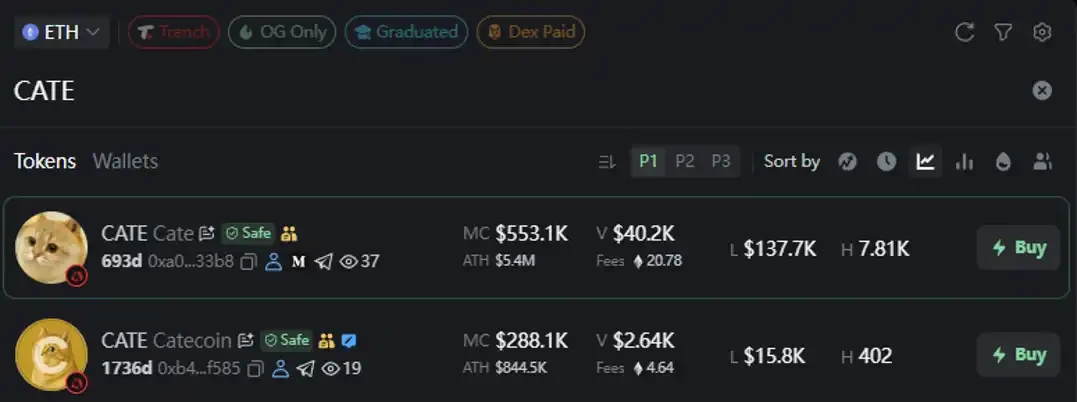
In fact, this same narrative has existed on the Ethereum mainnet for quite some time without showing any signs of revival:
What makes this flash crash even more controversial is that Poorgoat, as fomo’s current top influencer, essentially took on a CTO role for this coin, writing a lengthy post on X to argue that it was “organic”:

Yet, an “organic” coin with over 60,000 holder addresses was smashed down over 60% in one minute on a trading volume of less than $1.5 million:

This is the harsh reality we’re talking about. In the current market, any token that follows the traditional “organic” path of community building (excluding $SPX, $MOG, and others that left a strong impression in the earlier environment) may have a ceiling of only around $17 million—roughly where $neet currently stands. I won’t go into too much detail about why $neet is considered organic; just look at its price action over the past 460+ days and it becomes clear:

Next, let’s discuss why fomo has fallen into such controversy this time.
Fame Breeds Controversy
Back in early this year, when the “Nietzsche Penguin” $PENGUIN—up 6,000x in a week—catapulted trader logjam (now with roughly $138K in profits on fomo) to fame, the community was generally supportive of his track record. At the time, logjam pocketed around $564,000 in profits from $PENGUIN, and no one questioned it—only recognition and congratulations.
But later, after $ANSEM and the “airdrop wealth creation” playbook—pioneered by $unc, where small-circle airdrops then pump the price—fomo began courting controversy. Many who received airdrops were active KOLs on fomo, and their airdrop profits were amplified on the platform, allowing them to dominate the weekly and monthly leaderboards while serving as living billboards for these airdrop coins. Gradually, players began to suspect that fomo’s data was manipulated—a coordinated scheme with certain KOLs to attract more users to the app, after which the KOLs would be free to harvest them.
Whether or not insider schemes actually exist, as long as players can speculate along those lines, it’s enough to breed deep resentment—something we’ve seen play out vividly on BSC as well. Moreover, the most convenient explanation for $CATE’s crash this time was “fomo went down”—not because people believe the coin is so tightly correlated with fomo that an inability to trade constitutes a major negative. Rather, the timing was too coincidental, leading many to think it was an excuse to trap and slaughter users who trade through fomo.
Currently, $CATE still has over 60,000 holder addresses, and fomo shows more than 38,400 of those addresses—meaning over 60% of holders come from fomo. If that many addresses were batch-created by fomo itself, it would be hard to shake off suspicions of market manipulation. If not, then the heaviest losses fall on fomo’s retail users.
Another highly controversial point is that MarcellxMarcell, a trader with nearly 40,000 followers on fomo, “sold the top” when $CATE was around a $45 million market cap. Even though users could still export their addresses and trade on-chain during the fomo outage, the community questions: if you publicly bought in near a $30 million market cap, showing confidence in the coin, why would you consider a fomo outage such a massive negative?
Recently, fomo’s updated terms of service explicitly state that it provides no guarantees regarding the security of user assets. But to export a fomo address, users must log into fomo’s website to retrieve the private key—and whether fomo sufficiently encrypts the private key during its transmission to the page is also being questioned.

fomo’s official explanation is that the outage was caused by a surge in user traffic, but a significant portion of players find this hard to accept—because the trading volume during that one-minute flash crash wasn’t particularly large. Bro, you raised $75 million in funding, and a trading volume of under $5 million in five minutes was enough to cripple you?
If traders had stuck with on-chain terminals like gmgn, they wouldn’t have been caught in this kind of ambush with no time to react.
Fame breeds controversy, but the criticism fomo faces amid its rapid growth isn’t entirely without merit.
Related: BIT Research: As Liquidity Fades, Will Bitcoin Repeat the 2021 Bottoming Pattern?
Based on current pricing, the market still lacks the macro catalysts needed to fuel a new rally. Daily trading volumes have shrunk significantly compared to the 2025 peak, stablecoin growth rates continue to decelerate, and the supporting effect from Strategy (formerly MicroStrategy) buying Bitcoin via STRC preferred stock financing is gradually fading. Under the combined pressures of policy uncertainty, seasonal weakness, and liquidity contraction, Bitcoin’s short-term outlook remains under strain. Escalating Hawkish Expectations: Policy Uncertainty Suppressing 市场 Risk Appetite The market had broadly anticipated dovish signals from the new Fed Chair Kevin Warsh, but the FOMC surprisingly pivoted hawkish. Several committee members hinted that further rate hikes are possible this year if inflationary pressures persist, and Warsh clearly expressed his determination to rebuild policy credibility. Trend models indicate that as…
































 简体中文
简体中文  English
  繁體中文
繁體中文