








Virtuals Hyperboost New Gameplay: Betting a 14-Day Reward Pool Against the ‘First-Day Peak’ Curse
Official data shows that over 75% of tokens on the platform reach their peak trading volume within 24 hours of graduation, followed by a rapid decline. Hyperboost aims to extend this price discovery window, but only two days after the mechanism’s launch, early graduated projects still exhibit the typical “post-graduation crash” trend, leaving its effectiveness to be seen.
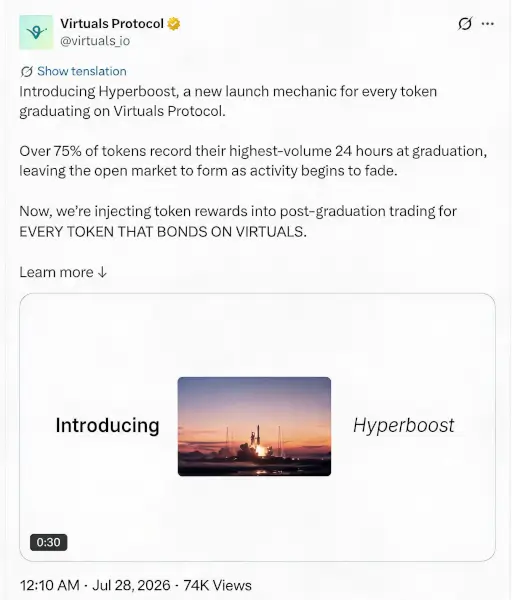
人工智能 Agent token launchpad Virtuals Protocol has long faced a persistent issue:
The trading volume of tokens generally peaks on the day they “graduate” from the bonding curve, then steadily declines. Platform data reveals that over 75% of tokens record their highest trading volume within 24 hours of graduation, with public market activity rapidly cooling off thereafter.
On July 27, Virtuals introduced the Hyperboost mechanism, attempting to use economic incentives to sustain market interest post-graduation.
Mechanism Breakdown: Idle Supply Becomes Trading Rewards, Released Daily for 14 Days
The core logic of Hyperboost is to activate a portion of idle token supply.
Previously, when a token graduated from the bonding curve and entered open trading on Uniswap, a portion of the supply was set aside to smooth the transition, effectively remaining idle.
Hyperboost reallocates this supply, converting it into a reward pool released daily over 14 days post-graduation.
Rewards are distributed along two lines: trading rewards are allocated based on a wallet’s proportion of the day’s trading volume; content rewards are directed at creators who publish content about the token on platforms like X. One-fourteenth of the total rewards are released each day, with no lock-up or vesting restrictions—available to claim upon receipt.
This mechanism activates automatically, requiring no configuration or manual activation by founders. All tokens graduating after 16:00 UTC on July 27 automatically enter the Hyperboost window.
The official whitepaper does not disclose the specific idle supply ratio or reward distribution percentages, only describing it as “a fraction of token supply.”
Details regarding the evaluation criteria for content rewards are also limited, and the community has raised questions about the transparency of anti-sybil mechanisms and content scoring rules.
Virtuals Ecosystem Status: 18,000+ Agents, 市场 Cap ~$400 Million
Hyperboost is not an isolated product; it is embedded within Virtuals’ broader 人工智能 Agent tokenization ecosystem.
As of the first half of 2026, the Virtuals Protocol platform has listed over 18,000 AI Agent tokens, with cumulative protocol revenue exceeding $75 million.
Amidst changes in the overall 加密 market landscape and the development of AI Agents, Virtuals has been highly active in expanding its ecosystem and products since early this year. In March, it launched the ERC-8183 standard (in collaboration with the Ethereum Foundation) for AI Agent on-chain identities;
in early July, it completed a cross-chain infrastructure migration from LayerZero to Chainlink CCIP, involving over $700 million in VIRTUAL liquidity; Robinhood Chain also announced plans to integrate Virtuals’ AI Agent infrastructure on its new chain.
These initiatives appear more focused on long-term considerations and underlying product updates, whereas Hyperboost resembles more of an innovative gameplay tweak related to token trading and rules.
Two Days Post-Launch, Some Graduated Projects Still “Crashing as Usual”
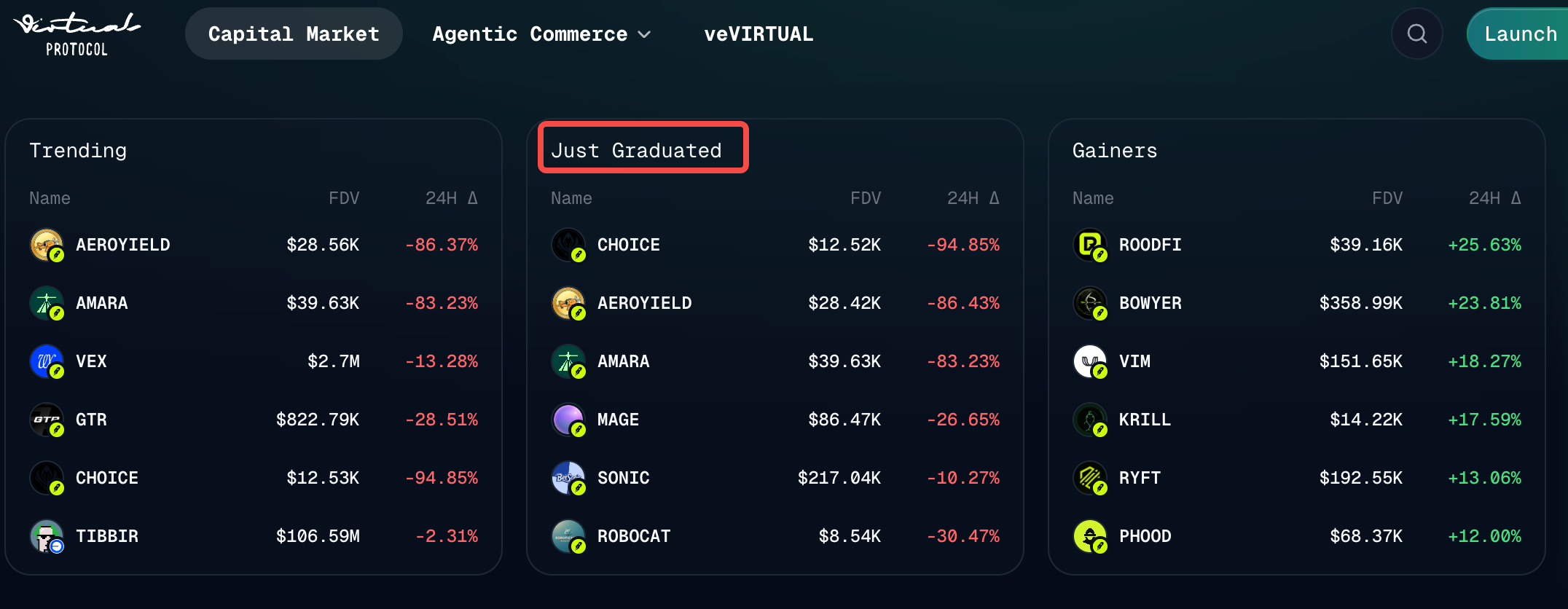
Hyperboost has been live for only about two days. Observing the “Just Graduated” section on app.virtuals.io, some early samples can be seen.
AMARA (Amara 交流) graduated approximately 9 hours ago, with an FDV of ~$51,000, a 24-hour decline of ~78%, trading volume of ~$358,000, and ~185 holders.
MAGE, related to the Mage Trading AI Agent, is down ~55% in 24 hours. GTR (gtr.trade) launched about 4 days ago, with an FDV of ~$700,000, a 24-hour decline of ~44%, ~1,700 holders, and ~$110,000 in liquidity.
These figures still depict the typical “post-graduation peak followed by decline” pattern that Hyperboost aims to mitigate. However, given the mechanism has been active for less than 48 hours and the 14-day reward cycle hasn’t completed its first round, the current sample size and timeframe are insufficient to judge its effectiveness.
Core Question: Will Trading Volume Rewards Become a Cash Cow for Farmers?
Currently, community discussion regarding this new feature centers on a few key points.
Firstly, if trading rewards are distributed proportionally to trading volume, the design naturally incentivizes wash trading. If a wallet contributes 50% of a day’s trading volume, it claims 50% of that day’s trading rewards. For tokens with an FDV of only tens of thousands of dollars, the cost of wash trading could be lower than the reward, creating a clear arbitrage opportunity.
The official response is that the daily reward pool has a fixed total, so even with wash trading, participants are simply competing for a larger share of the fixed pool, preventing infinite amplification. However, this argument holds only if the reward pool itself is not substantial (the official amount is undisclosed). If the rewards are significant, the incentive for wash trading persists.
Secondly, the evaluation criteria for content rewards remain vague. The current rules state that “parameters are set by the protocol and can be adjusted to maintain allocation integrity,” but they do not disclose specifics such as the content scoring mechanism, whether account verification is needed, or how to prevent mass spam posts.
For a mechanism publicly claiming to incentivize content creation on X, the absence of these rules leaves its actual effectiveness in question.
Limited Impact on the VIRTUAL 代币
On a narrative level, Hyperboost provides a new growth story for VIRTUAL. If the mechanism can effectively extend the active trading period of graduated tokens, it implies more trading volume flowing through liquidity pools paired with VIRTUAL, indirectly boosting demand for VIRTUAL.
According to TronWeekly, the VIRTUAL price showed short-term bullish technical signals shortly after the Hyperboost launch, with some analysts setting a short-term target price of $0.70.
However, VIRTUAL has fallen approximately 7.4% over the past 7 days, still negatively impacted by the broader market downturn. BTC has recently entered negative territory, and overall sentiment in the 加密 market remains weak.
Perhaps launching a phenomenal token would be more effective in reversing this downtrend. Going forward, close attention should be paid to the trading volume retention rate of graduated tokens during the 14-day window, whether the number of newly graduated tokens increases due to incentives, and the actual consumption of VIRTUAL as a paired asset.
It will take at least 2 to 4 weeks to accumulate sufficient data for these metrics. However, in the current environment where many crypto projects are shutting down or pivoting, Virtuals’ continuous efforts to innovate and update its gameplay is a welcome sight.
本文来源于互联网: Virtuals Hyperboost New Gameplay: Betting a 14-Day Reward Pool Against the ‘First-Day Peak’ Curse
Related: SpaceX Faces Epic Stock Unlock: $116 Billion in Shares Become Liquid on August 6
Original source: Wall Street CN The first lockup expiration following the largest IPO in history is approaching, and the market is assessing its potential impact on the stock price. According to SpaceX’s prospectus, a maximum of approximately 911.5 million shares held by insiders will be unlocked on August 6, representing a market value of around $116 billion. This timing coincides with just two days after the company releases its first-ever quarterly earnings report. By the end of the year, the total number of tradable shares will surge from the current ~639 million to 5.33 billion. Faced with this massive unlocking scale, SpaceX’s stock price is under significant pressure. Since its closing high on June 16, the stock has fallen by 37%, erasing over $425 billion in market capitalization. As of…





























 简体中文
简体中文  English
  繁體中文
繁體中文