








ASML ramps up production, TSMC doubles down: Why does the market still find the “second wave” of AI chips insufficient?
The financial reports subsequently released by ASML and TSMC both showed fundamentally solid performance, yet failed to fully meet the high expectations: The former significantly raised its full-year revenue and gross margin guidance and began increasing lithography machine capacity for 2027-2028; the latter maintained its revenue, gross margin, and operating profit margin at historical highs while simultaneously raising its full-year capital expenditure to between $60 billion and $64 billion.
Logically, this should be the ideal combination for 人工智能 semiconductors—equipment companies proving customers are still placing orders, and the foundry leader demonstrating that orders are converting into revenue and a willingness to continue massive investment in expanding capacity.
However, the market’s response did not fully match the strength of these earnings.
The reason isn’t a deterioration in the fundamentals of these two companies, but rather that expectations for the 人工智能 industry chain have been pushed to an unusually high level. The market is no longer satisfied with “demand remains strong”; instead, it expects every earnings report to show upward revisions, every margin to break limits, and all massive capital expenditures to immediately translate into higher profits.
This has caused the earnings reports from ASML and TSMC to convey two seemingly contradictory yet simultaneously valid signals: The expansion cycle for AI semiconductors is still ongoing, with some critical links even accelerating; however, the capital market’s pricing of this cycle has shifted from verifying demand to verifying returns.
1. ASML and TSMC Double Down: The Expansion Cycle is Far From Over
ASML kicked off this earnings season with its answers.
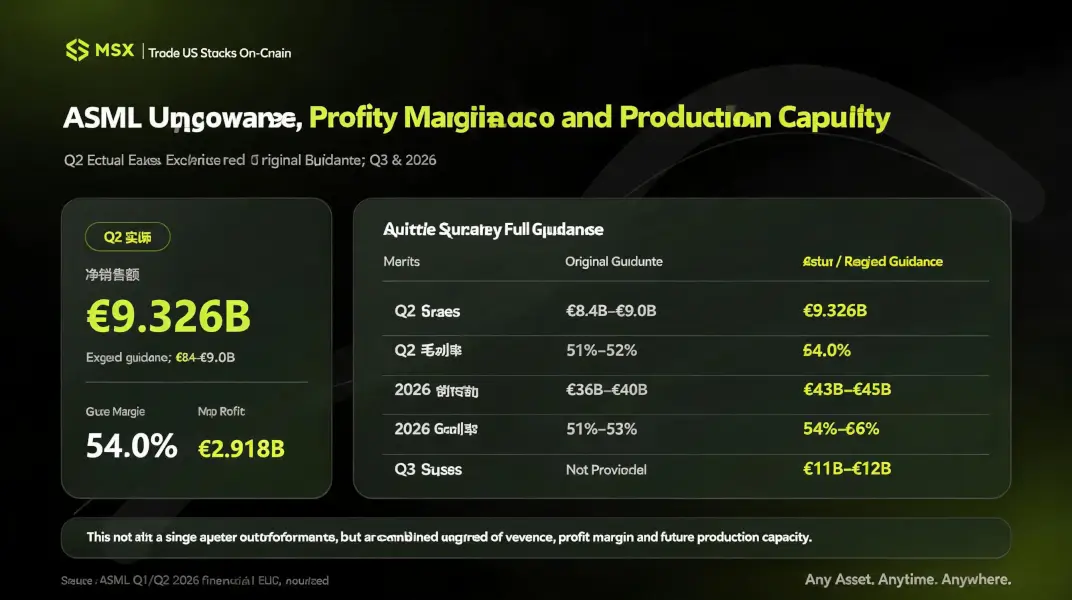
The company’s second-quarter net sales reached €9.326 billion, exceeding its prior guidance of €8.4 billion to €9.0 billion; gross margin was 54%, and net profit was €2.918 billion. Subsequently, the company raised its third-quarter sales guidance to €11.0 billion to €12.0 billion and significantly increased its full-year 2026 sales forecast from €36.0 billion to €40.0 billion, up to €43.0 billion to €45.0 billion.
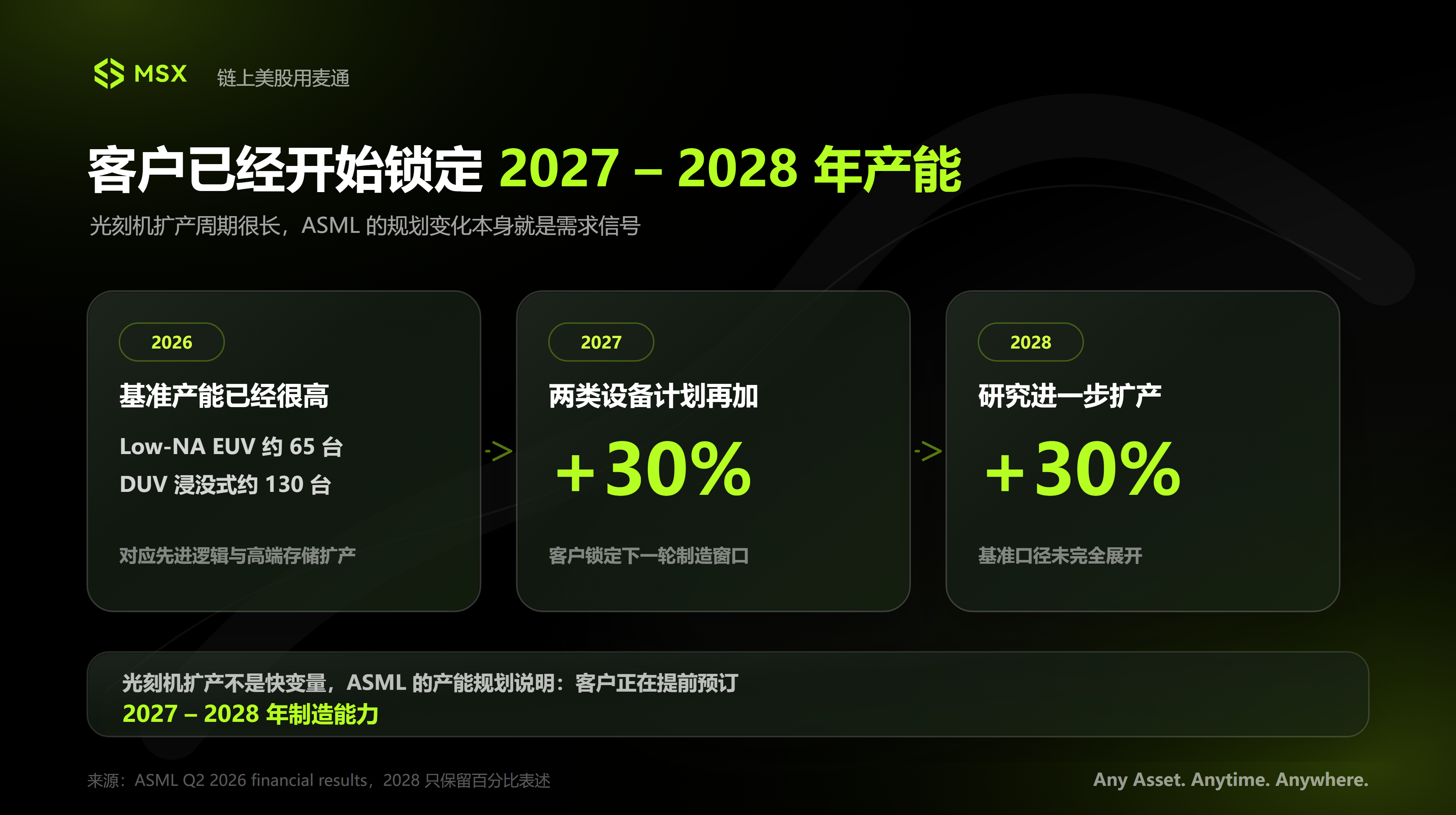
More important than the quarterly data was ASML’s adjustment of its equipment capacity for the next two years. The company plans to increase low-NA EUV capacity by 30% in 2027 from the approximately 65 units planned for 2026, and DUV immersion tools will also see a 30% increase from around 130 units. Concurrently, ASML is studying the possibility of further capacity expansion in 2028.
Given the complexity of the lithography supply chain and long delivery lead times, ASML wouldn’t rashly increase production capacity two years out based on just one or two quarters of order fluctuations. Such expansion plans imply that foundry customers are securing advanced process and high-end memory capacity for 2027-2028 well in advance.
A day later, TSMC provided the corresponding validation from the wafer manufacturing side.
The company reported second-quarter revenue of $40.2 billion, up 12% quarter-over-quarter, at the high end of its previous guidance of $39.0 billion to $40.2 billion. Gross margin reached 67.7%, slightly above the high end of guidance, and operating margin hit 60.3% for the first time. Net profit was NT$706.56 billion, up 77.4% year-over-year, with earnings per share of NT$27.25.
The revenue structure continued to shift towards AI and advanced processes. In the second quarter, high-performance computing (HPC) revenue grew 20% quarter-over-quarter, accounting for 66% of the company’s revenue. Advanced processes of 7nm and below contributed 77% of wafer revenue, with 3nm and 5nm contributing 30% and 33%, respectively. The 2nm node, ramping into volume production, contributed 3% of wafer revenue for the first time.
Even more significant was the capital expenditure. TSMC raised its 2026 capital expenditure plan significantly from the original $52.0 billion to $56.0 billion, up to $60.0 billion to $64.0 billion. About 70% to 80% of this will be allocated to advanced processes, with 10% to 20% going to advanced packaging, testing, and mask-making.
The company also lifted its full-year USD revenue growth forecast from over 30% to slightly above 40%. Management stated that AI-related demand remains extremely robust, with demand signals from cloud service providers and their downstream customers remaining positive.
ASML is preparing to increase lithography equipment capacity, while TSMC is expanding its wafer manufacturing and advanced packaging capabilities through higher capital expenditure.
So when both the equipment leader and the world’s largest foundry simultaneously raise their future investment outlooks, at least one thing is certain: The AI semiconductor capital expenditure cycle has not entered a contraction phase; the industry chain is even accelerating preparations for demand in the coming years.
2. Earnings Were This Strong, Why Does the 市场 Still Find It Insufficient?
The problem is that the market is no longer waiting for a report that merely “meets targets.”
Since TSMC releases monthly revenue data, the $40.2 billion revenue for the second quarter was already largely priced in. Therefore, ahead of the earnings release, the real variables were gross margin, third-quarter guidance, and the extent of the capital expenditure increase.
From this perspective, TSMC’s second-quarter gross margin of 67.7%, while above the company’s initial guidance of 65.5% to 67.5%, was roughly in line with the consensus forecast after market revisions, failing to satisfy the more aggressive expectations of some investors who anticipated near 69% or higher.
For the third quarter, the company expects revenue of $44.6 billion to $45.8 billion, representing another ~12% sequential increase at the midpoint. However, the gross margin guidance declines to 65% to 67%, with a midpoint of around 66%.
The dip in gross margin does not imply weakening demand.
TSMC expects the rapid ramp-up of its 2nm process to dilute gross margins by approximately 3 to 4 percentage points in the second half of the year. Overseas fab expansion will also continue to increase depreciation and manufacturing costs. Strong demand for advanced processes, high capacity utilization, and manufacturing efficiency improvements can only partially offset these pressures.
In other words, TSMC is facing a classic high-growth expansion paradox: the stronger the demand, the more the company needs to procure equipment, build fabs, and introduce new processes early. The higher the capital expenditure, the sooner the pressures from depreciation, overseas production costs, and new node ramping appear in the margins.
This is the key to understanding this earnings report.
Based on management’s comments on pricing strategy during the earnings call, TSMC is not trying to push short-term gross margins to their limits when supply is tightest. The company emphasizes being a long-term partner to its customers, avoiding squeezing them through sudden significant price hikes. Instead, it aims to maintain profitability levels sufficient to support long-term expansion.
This means TSMC currently prefers to balance pricing power, customer relationships, and continuous expansion, rather than cashing in all scarcity premiums at once. From an industry perspective, this is undoubtedly a positive signal. However, from a short-term trading perspective, it means investors need to accept a reality: AI demand remains strong, but not every dollar of new revenue will instantly translate into higher margins.
Therefore, the market’s lukewarm reaction to TSMC’s earnings should not be simply interpreted as AI demand peaking. A more accurate explanation is that in an environment of already exceptionally high expectations, strong results are becoming a necessary condition for valuations but no longer automatically constitute a new catalyst for upward movement.
After the earnings release, the strong results failed to immediately translate into sustained sector-wide gains, reflecting investors digesting margin pressures and overly optimistic expectations.
3. Looking at ASML and TSMC Together Provides Clarity on the “Second Wave” of AI Chips
When we examine ASML and TSMC’s earnings reports together, the outline of the so-called “second wave” of AI chips becomes clearer than before.
It is not a return to the broad shortage of “all chips are insufficient,” nor is it a simple replay of the past two years’ bull run centered on NVIDIA GPUs. Instead, supply bottlenecks are spreading across the entire AI system.
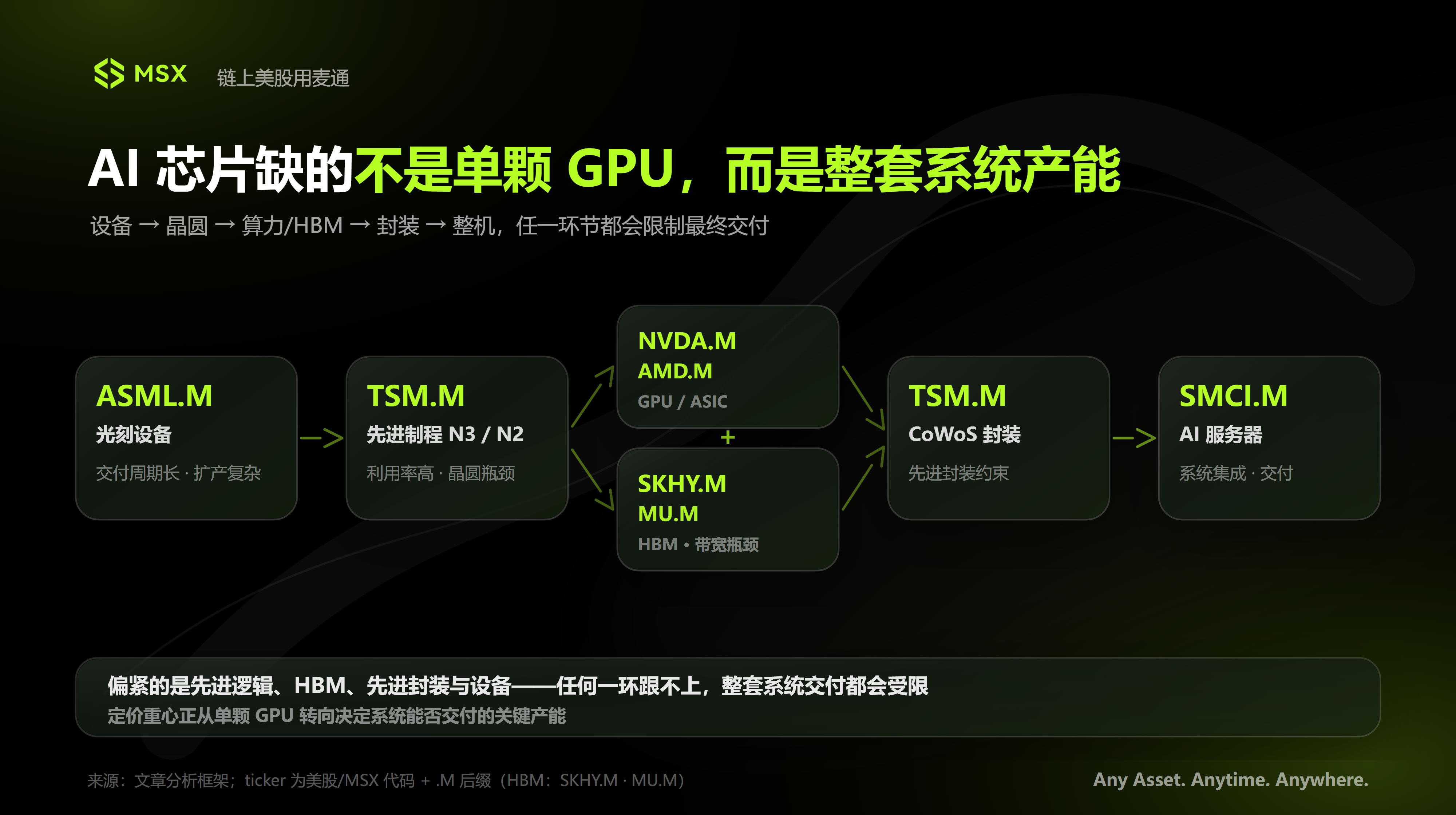
ASML’s EUV and DUV equipment determines how quickly advanced processes can expand. TSMC’s 3nm and 2nm nodes determine how much wafer capacity GPUs, CPUs, and custom ASICs can get. HBM determines memory bandwidth. Advanced packaging like CoWoS determines whether computing chips, memory, and high-speed interconnects can be finally assembled into deliverable data center products.
A bottleneck in any one link will slow down the entire AI system’s output.
TSMC management even explicitly stated that current advanced packaging capacity is so tight that it limits customer growth. The company is working hard to bridge the gap between demand and capacity while welcoming other packaging solutions to provide customers with additional options.
Meanwhile, AI demand is also spreading from single accelerators to a broader range of chip types.
TSMC believes the development of Agentic AI is re-elevating the importance of CPUs in data centers. Regardless of whether customers use x86, Arm, or RISC-V architectures, the advanced chips behind them still largely rely on TSMC for manufacturing. This implies future AI capital expenditure will not only flow to GPUs but will also continue to drive demand for CPUs, networking chips, memory, and advanced packaging.
Management’s outlook on long-term demand is equally positive. TSMC believes that AI-related trends will remain robust through 2029-2030, allowing for potential periodic fluctuations but seeing no change to the long-term direction. Regarding the previous forecast of a mid-50% compound annual growth rate for its AI-related business, management did not provide new specific figures, only stating that the demand trend is stronger than previously expected.
However, this does not mean all semiconductor companies will benefit equally.
- ASML (ASML.M) benefits directly from lithography equipment demand and advanced process expansion;
- Applied Materials (AMAT.M), Lam Research (LRCX.M), and KLA (KLAC.M) benefit from demand for deposition, etching, and inspection equipment, respectively, but the timing of order realization may vary;
- TSMC (TSM.M) controls advanced wafer manufacturing and packaging capabilities, making it the core recipient of AI chip capacity expansion;
- SK Hynix (SKHY.M), Micron (MU.M), and Samsung Electronics provide HBM and high-end memory supply;
- NVIDIA (NVDA.M), AMD (AMD.M), Broadcom (AVGO.M), along with cloud providers possessing in-house chip design capabilities like Amazon (AMZN.M), Alphabet (GOOGL.M), Microsoft (MSFT.M), and Meta (META.M), collectively determine how fast end-user demand can ultimately grow.
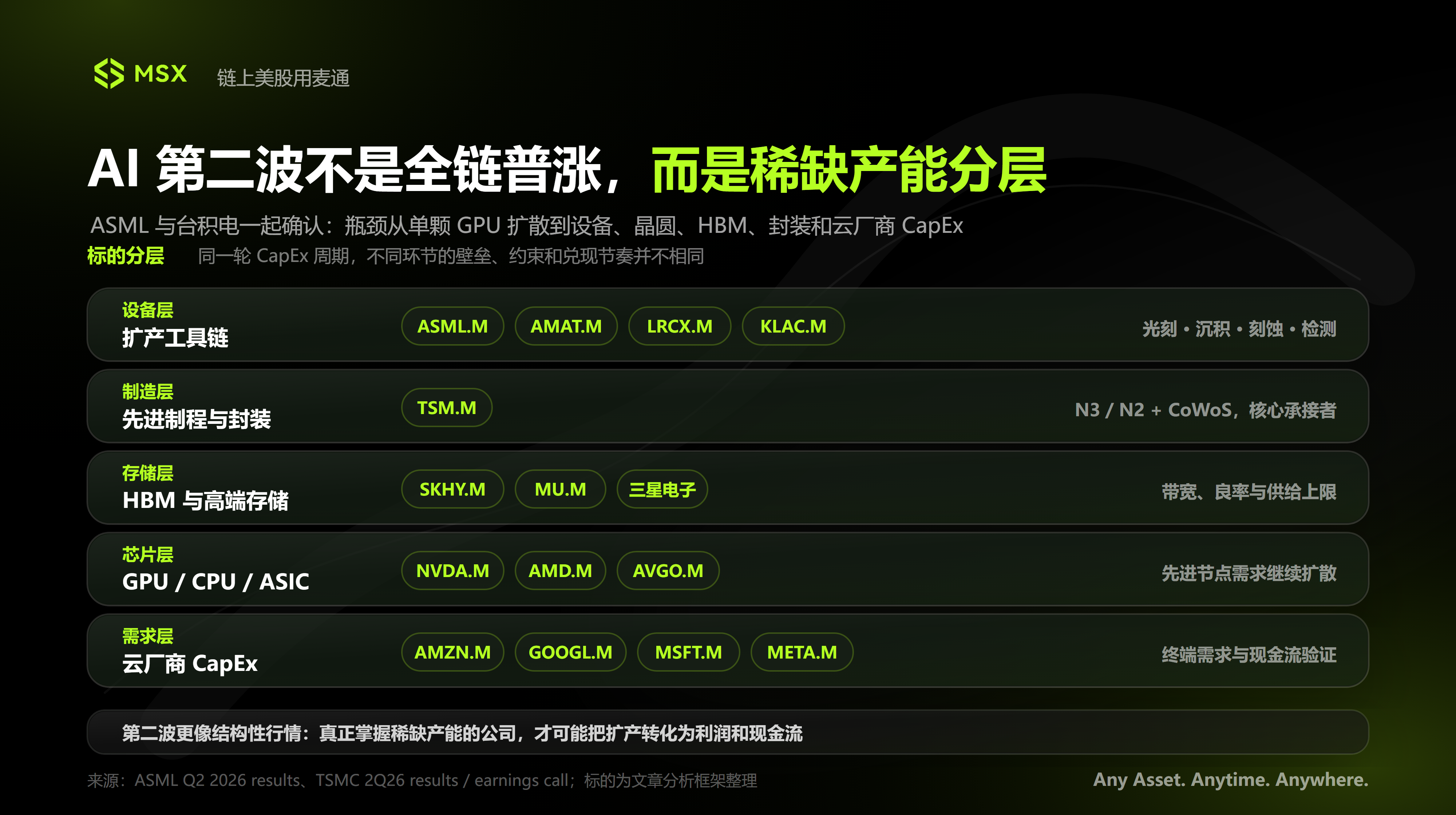
They exist within the same capital expenditure cycle yet possess entirely different technological moats, capacity constraints, profit structures, and valuation levels. Therefore, the “second wave” of AI chips is more likely to be a structural market trend rather than a synchronized rally across the entire hardware chain.
In the next phase, the market will pay closer attention to which companies truly possess scarce and irreplicable capacity, which are merely following customers in increasing capital expenditure, and which can sustain improving free cash flow and return on capital after expanding.
Following ASML and TSMC, the next critical verification will fall back onto cloud providers like Microsoft, Amazon, Google, and Meta. After all, equipment companies are willing to expand capacity, and fabs are willing to invest, but ultimately, cloud providers must continue increasing their capital expenditure and prove that the ever-growing AI infrastructure can generate real model inference usage, enterprise revenue, and cash flow returns.
最后的想法
Objectively speaking, ASML answered whether fabs are still willing to buy equipment. TSMC further proved that customer orders are sufficient to drive the company to continue increasing wafer and advanced packaging capacity.
From this perspective, the industrial cycle for AI semiconductors has not peaked.
毕竟, equipment capacity is expanding, advanced packaging remains tight, and TSMC even raised its full-year capital expenditure to a maximum of $64 billion. These are not signals an industry preparing to contract would send.
But the reason the market still finds it insufficient is that the questions for the next stage have changed. In the past, investors needed to confirm if AI demand was real. Now, denying demand is difficult. The market wants to know how much capital is needed to meet this demand and, ultimately, how much profit and cash flow that capital can generate.
Therefore, the “second wave” of AI chips may have already begun, but it will not be a simple replay of the first cycle.
What is truly scarce is no longer just companies that can provide more chips. It is those that can both control critical capacity and, after massive expansion, continue to sustain pricing power, profit margins, and returns on capital.
Author: Golem (@网页3_golem) On July 14, community users discovered that Coinbase quietly opened registration for users in the Chinese-speaking region—without requiring proof of overseas address. Users could successfully register using just their mainland China ID card and phone number, with the entire verification process taking less than a minute. As of the time of writing, the registration channel has not yet closed. According to its Q1 2026 earnings report, Coinbase’s global crypto trading market share stood at 8.6% (not including the Chinese-speaking market). Coinbase had previously restricted KYC for Chinese users. In April 2025, it briefly opened registration for Chinese users, where users had a chance to succeed by using a Chinese passport plus overseas proof such as a Hong Kong address, but those accounts were soon mass-banned. Thus, July…































 简体中文
简体中文  English
  繁體中文
繁體中文