








The “Lockup Expiry Slump” Myth Broken? AI Model Giants Surge, Zhipu Up 19%, Wall Street Banks Remain Bullish
原文来源: Wall Street CN
China’s 人工智能 large model sector staged a contrarian surge on the Hong Kong stock market.
Zhipu 人工智能 experienced its first lock-up share expiration since its IPO, and the market’s usual logic of “a sell-off upon lock-up expiration” completely failed here—its share price soared over 19% on the day, while MiniMax surged approximately 17% in tandem. Analysts point out that there was no liquidity stampede despite the large-scale unlock, with core institutional investors collectively expressing long-term holding intentions, signaling that Wall Street mainstream capital is systematically endorsing Chinese AI model companies.
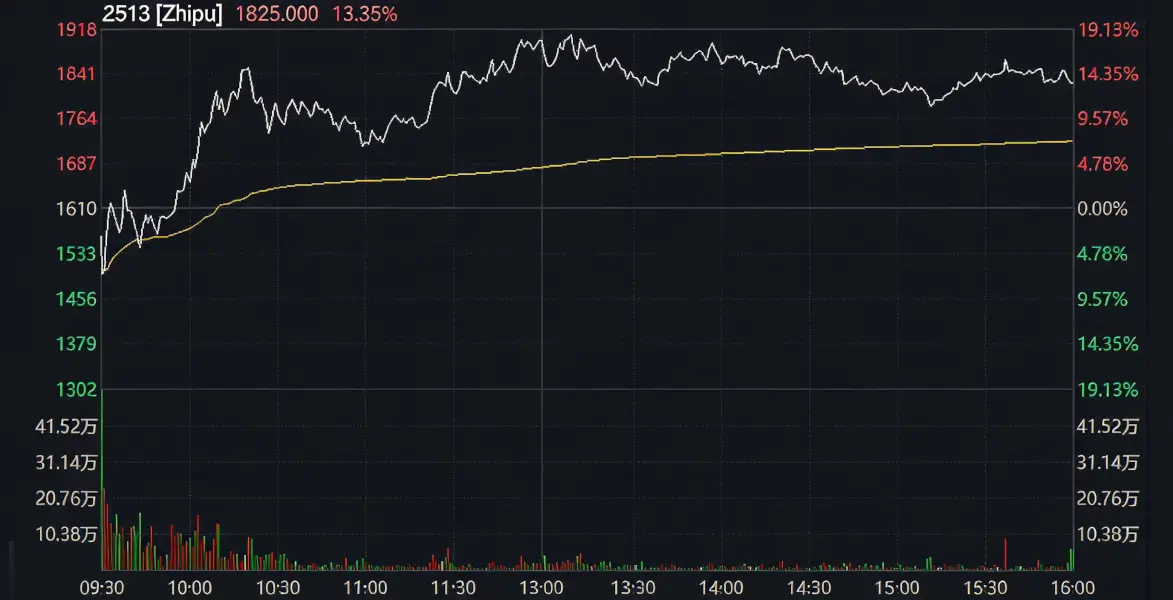
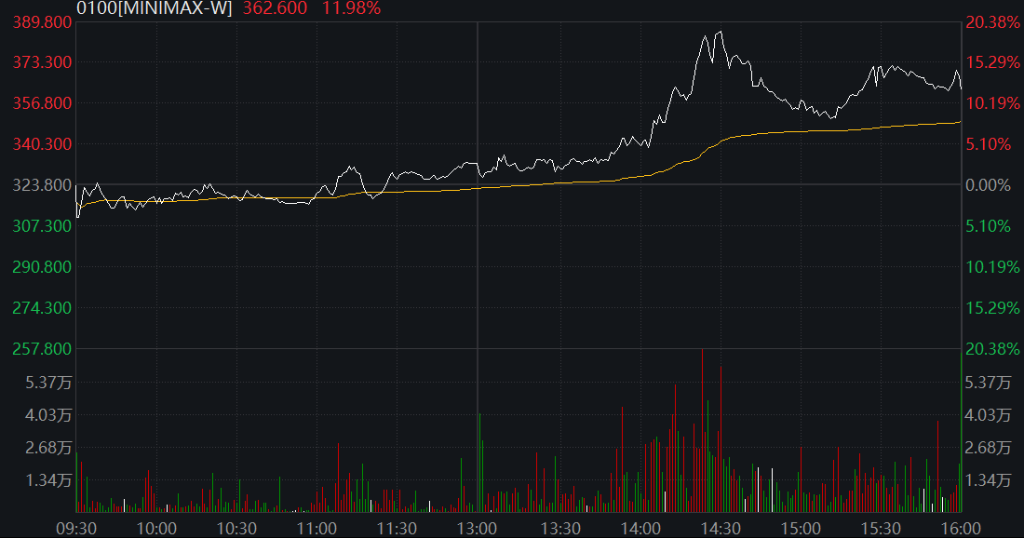
Meanwhile, as a Wall Street CN article noted, JPMorgan raised its target price for Zhipu AI from HKD 1,800 to HKD 2,000, maintaining an “Overweight” rating; Goldman Sachs, Bank of America, and Citigroup—three international investment banks—simultaneously issued “Buy” ratings for MiniMax.
The strong performance of the two large model leaders is a microcosm of the overall explosive rally in the Hong Kong tech sector. Today, the Hang Seng Tech Index opened high and climbed steadily, surging nearly 5%. Alibaba rose over 12%, Hua Hong Semiconductor gained over 10%, Lenovo Group rose over 9%, SMIC and Kuaishou were up over 8%, and Tencent Holdings briefly surged over 4%.
According to Securities China, analysts believe this round of strength in Hong Kong stocks is driven by two factors: First, Hong Kong stocks are attractively valued at low levels; second, the global memory chip sector has been suffering sustained heavy losses, with funds flowing out of those sectors into Hong Kong stocks. At the same time, People’s Bank of China Governor Pan Gongsheng delivered a speech at the “Hong Kong Fixed Income and Currency Summit and Bond Connect Forum,” outlining deployments in four directions: deepening financial market interconnectivity, supporting the prosperity of Hong Kong’s capital market, consolidating the offshore RMB hub status, and maintaining Hong Kong’s financial stability, which also provided policy-level support for market sentiment.
Lock-up Expiration Curse Broken: Institutions Show Collective Commitment, 市场 Completes Value Reassessment
Zhipu AI’s market performance following its lock-up expiration has broken the long-standing expectation in both A-share and Hong Kong stock markets that “lock-up expirations inevitably lead to sell-offs.”
The total number of restricted shares unlocked for Zhipu AI this time was 25.6816 million shares. JSC International Investment Fund SPC (under Beijing Financial Holding Group), investment firm WT Asset Management, Optimas Capital Limited, and early shareholder and cornerstone investor LUSTER LightTech Co., Ltd. have all successively expressed their willingness to hold long-term.
On the MiniMax front, its largest strategic shareholder, Alibaba, and miHoYo also clearly stated in late June their long-term bullish outlook. MiniMax’s founding team voluntarily imposed a 12-month lock-up period, exceeding the industry-standard 6-month arrangement, and this initial unlock did not involve the founding team or employee shareholdings.
From a market perspective, the sharp rise that day was not merely driven by short-term trading sentiment but was a concentrated release following the market’s reassessment of the company’s long-term value and a clarification of capital attitudes. Several core institutional investors publicly stated their intentions around the lock-up expiration, choosing to continue holding rather than reducing holdings for cash, effectively alleviating market concerns about a liquidity stampede.
JPMorgan’s rating upgrade provided crucial fundamental support for this rally. As the Wall Street CN article wrote, JPMorgan raised its target price for Zhipu AI from HKD 1,800 to HKD 2,000 by December 2026, maintaining an “Overweight” rating. The core logic is that GLM-5.2 reinforces the thesis that “commercialization of open-weight models can create significant option value for leading model providers.”
JPMorgan also noted that based on current valuations, the market has largely priced in Zhipu AI’s year-end ARR guidance of USD 1 billion. The remaining upside potential hinges on whether its powerful open-weight model can achieve scale through external infrastructure and distribution channels.
For MiniMax, Goldman Sachs, Bank of America, and Citigroup—three international financial institutions—simultaneously issued “Buy” ratings, a rare occurrence in the current environment of increasing divergence within the AI sector.
Goldman Sachs set a target price of HKD 860 per share. Its report focuses on changes in the pricing environment for China’s AI industry. Goldman Sachs pointed out that DeepSeek V4 is about to introduce peak-hour differentiated pricing, with API prices during peak hours being double those during off-peak hours. This is an early signal that the aggressive price war in the industry since late April 2026 is moving towards rationalization. In this context, MiniMax’s M3 model, leveraging a higher proportion of self-built optimized computing power and a more efficient architecture with fewer activated parameters, boasts significantly higher gross margins than its peers.
Bank of America set a target price of HKD 500 per share. Its report disclosed a major shift in MiniMax’s revenue structure: the company’s revenue has shifted from last year’s consumer-facing products accounting for approximately 70%, to an increased share from enterprise-side and cloud API businesses, with enterprise/cloud API now listed as a higher strategic priority. On the profitability front, the previous generation model, M2.7, ultimately achieved an inference profit margin exceeding 40%. Bank of America expects long-term profit margins to remain stable through continuous improvements in infrastructure efficiency. Regarding computing power acquisition, MiniMax collaborates with global cloud service providers and new-type cloud vendors, using overseas local computing power to serve overseas users, and can currently still stably acquire computing power.
Citigroup set a target price of HKD 533 per share, stating that the current stock price implies an expected upside of 53.8%. It also forecasts that MiniMax’s revenue growth rate will remain high, and the upcoming release of its next-generation video model could be a key catalyst to reverse market sentiment.
Related: If Hyperliquid is the new Nasdaq, which projects are acting as brokerages?
Author: Azuma (@azuma_eth) Amidst persistently sluggish crypto market conditions and shrinking liquidity, entrepreneurs in the industry are facing unprecedented pressure to break new ground. However, Odaily has recently learned that multiple entrepreneurial teams have begun to view the Hyperliquid ecosystem as a direction for breakthrough, hoping to attract users to the platform while capturing their own value by building trading front-ends, strategy platforms, AI Agents, and HIP-3 custom markets (which allow customization of oracles, leverage limits, and settlement rules). In the past, building a front-end to attract users for a specific DEX seemed unimaginative, as the market often held the inertia-driven belief that value is truly captured by the liquidity, matching engine, and underlying protocol itself, not by the front-end windows attached to them. But as the market elevates Hyperliquid’s…































 简体中文
简体中文  English
  繁體中文
繁體中文