








作者:Azuma(@azuma_eth)

Robinhood (HOOD) stock has shown considerable strength recently, even briefly climbing back above $100 last night, though it ultimately couldn’t hold that level at the close. Personally, I remain optimistic about HOOD’s future performance.
During this recent downturn, HOOD was one of the few assets I consistently accumulated (including through swaps). So, I’ve wanted to write a piece on HOOD for a while. In a past edition of Odaily Tea Chat, I briefly shared my accumulation logic. Today, with the stock price performing well, I thought I’d dive into the details. A disclaimer: This is not investment advice, nor does it represent the platform’s views. These are just some of my personal thoughts regarding building a position in HOOD.
Multi-Faceted Bullish Analysis
Looking at the reasons behind HOOD’s recent rise, you can find numerous bullish explanations across different dimensions.
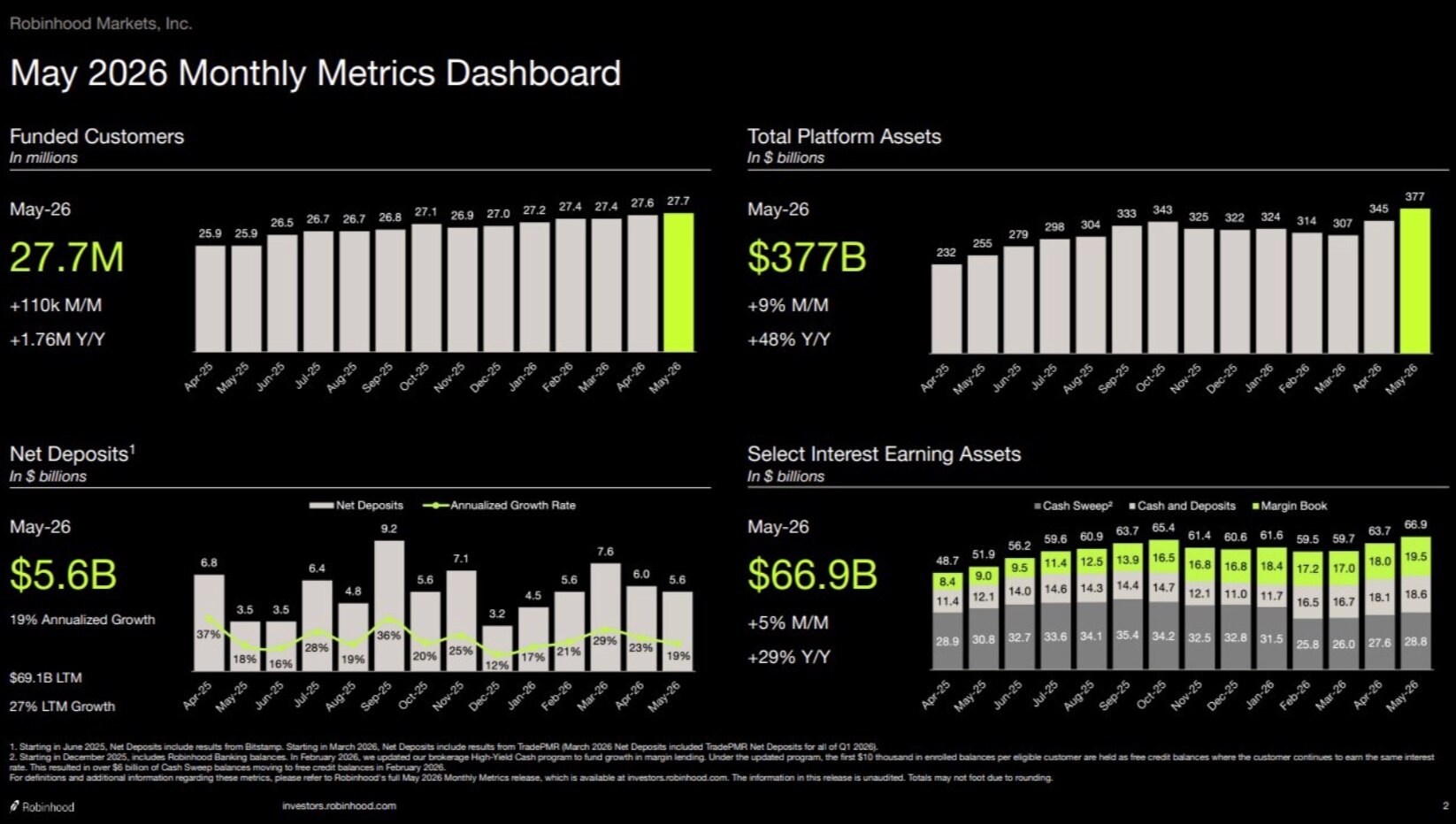
Starting with the fundamentals, Robinhood released its May operational data last week. Details are as follows.
- Total Assets: $377 billion, an all-time high;
- Funded Customers: 27.7 million, an all-time high;
- Margin Book: $19.5 billion, an all-time high;
- Event Contracts Volume: 3.9 billion contracts, an all-time high;
- Cash & Deposits: $18.6 billion, an all-time high;
- Options ADV: 11.6 million contracts, matching the all-time record;
- Equity Volume: $315 billion, the second-highest on record;
- Options Contracts: 231 million contracts, the second-highest on record;
- The only weak metric was Crypto Volume: $12.2 billion, ranking only 16th among historical monthly data…
Some positive catalysts on the news front might be even more effective at stirring investor sentiment.
- First is in the fastest-growing prediction market segment: Robinhood has begun diverting traffic from Kalshi to its proprietary prediction market, Rothera. It is expected that future related revenue will no longer need to be shared with Kalshi. For details, please refer to our article published yesterday: “The First Prediction Market Concept Stock Has Arrived!“.
- Second is in the IPO arena. SpaceX’s historic IPO brought record-breaking traffic to Robinhood. More importantly, Robinhood’s brokerage and clearing division, Robinhood Securities, was approved last week to act as an IPO underwriter. This means Robinhood could play a more central role in future IPO events (e.g., for Anthropic, OpenAI).
- Then there’s the news that Robinhood has been selected by the US Treasury to serve as the broker and initial trustee for the “Trump Account.” The “Trump Account” is a tax-deferred investment account plan authorized by President Trump on June 9, 2025, under the “Big and Beautiful” Act. It aims to establish government-funded savings accounts for children of US citizens born between January 1, 2025, and January 1, 2029. This means that millions of newborns in the US over the next few years will default to using Robinhood as their brokerage platform. Details can be found in: “Robinhood Gains a New Cohort of Investors: The Oldest is 1, The Youngest is -3“.
On the market action front, there are some more direct signals.
- Robinhood Director Meyer Malka has been continuously increasing his HOOD holdings. Over the past week or two, Malka has accumulated over $50 million worth of HOOD.
- Institutions are also setting more positive price targets for HOOD. Goldman Sachs maintains a “Buy” rating and has raised its price target from $105 to $108. Mizuho’s price target is $115. Piper Sandler is the most optimistic, setting a price target of $135.
Personally, my initial reason for accumulating HOOD was optimism about its Q2 earnings report. First, I anticipated a significant surge in stock trading-related revenue this quarter amidst the historic bull run in US equities. Second, I expected a spike in prediction market volume due to the World Cup, coupled with Rothera’s revenue-capturing effect.
However, the reason I later swapped a substantial portion of my positions (mainly some remaining 加密 assets) into HOOD involves a different logic. This is the real crux of this article.
An Alternative to Altcoins
In early May, a friend asked me what I had been buying recently. I mentioned HOOD. But at that time, HOOD had just dropped from above $90 following a disappointing Q1 earnings report (primarily due to an unexpected $100 million “Trump Account” related expense), and its short-term chart looked quite unfavorable.
My friend asked why I was buying. I briefly explained the reasons mentioned above. After thinking it over, he said it was a pity his positions were all tied up, leaving him with little dry powder. I asked what he was holding. Unsurprisingly, it was mostly altcoins.
I told him at the time: “Instead of clinging to hope for altcoins, you might be better off just swapping into HOOD.“
The background for this judgment is that for a long time, 加密currency-related revenue has been a significant component of Robinhood’s total income, and HOOD’s stock price has shown a strong correlation with cryptocurrencies. However, recently, there have been signs that Robinhood is breaking free from its dependence on the crypto business and positively delinking from this correlation.
First, let’s look at Robinhood’s cryptocurrency-related revenue over the past five quarters. It’s easy to see that overall, the proportion of this revenue has been declining, and in Q1, it fell to its lowest level since 2025.
- 2025 Q1: Total revenue $927M, Crypto revenue $329M, share 35%;
- 2025 Q2: Total revenue $989M, Crypto revenue $160M, share 16%;
- 2025 Q3: Total revenue $1,274M, Crypto revenue $268M, share 21%;
- 2025 Q4: Total revenue $1,283M, Crypto revenue $221M, share 17%;
- 2026 Q1: Total revenue $1,067M, Crypto revenue $134M, share 13%.
Next, let’s look at the direct comparison between HOOD and BTC price movements. Since the beginning of the year, HOOD has mostly tracked BTC’s trajectory, but a clear divergence has emerged recently.
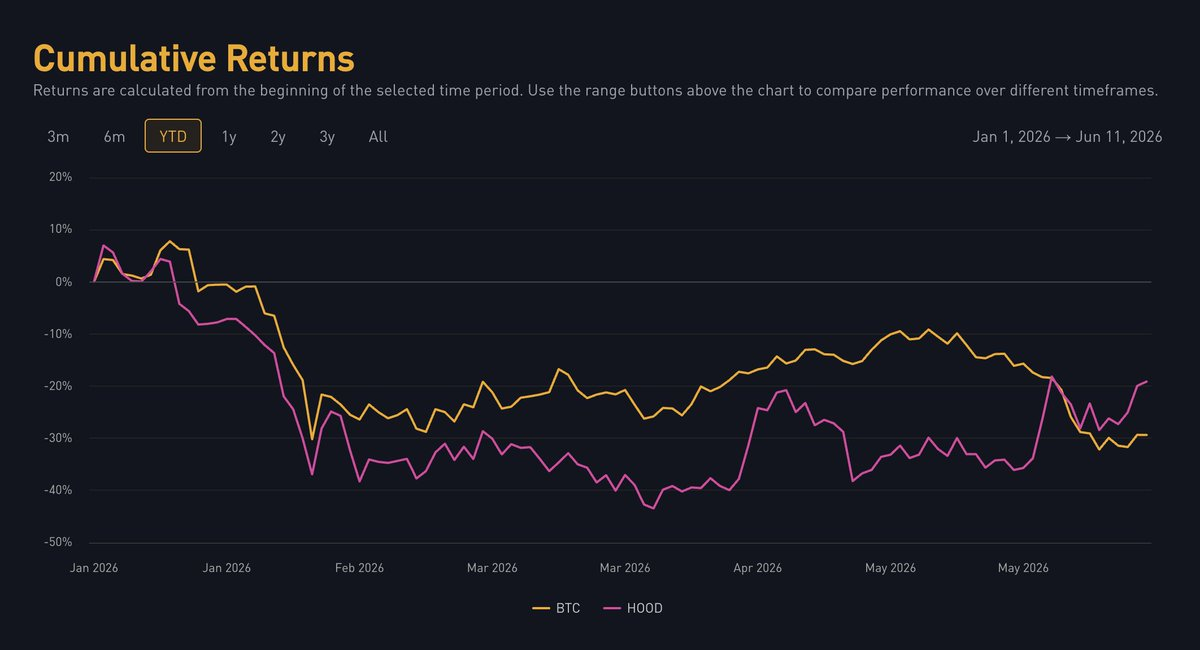
The point of emphasizing these two aspects is to illustrate that the valuation logic surrounding HOOD is beginning to change. In the past, HOOD was often viewed as a “shadow stock” of the crypto market, its performance exhibiting clear cyclicality alongside crypto bull and bear runs. When crypto markets boomed, retail investors flooded into Robinhood to trade altcoins frantically, fee revenue soared, and the stock price took off. When crypto markets slumped, retail investors retreated, and Robinhood’s revenue would quickly decline.
But now, Robinhood is no longer as highly dependent on the crypto business as it once was. Even if the crypto market continues its current lackluster state, its stock trading, prediction markets, Pre-IPO, and newly added underwriting business are still expected to support its earnings growth.
This doesn’t mean the crypto market won’t affect HOOD anymore. On the contrary, if the crypto market enters another bull run, Robinhood’s crypto trading revenue will likely explode in tandem, and HOOD can still benefit from the industry’s growth dividends.
In simpler terms: the crypto industry can still influence HOOD, but HOOD no longer relies on it. If the crypto bull market returns, HOOD will rise with it. If the crypto market remains in the doldrums, HOOD will be fine regardless.
For all those who still hold hope for altcoins but are increasingly worried about liquidity drying up, narratives failing, and value capture issues, instead of continuing to pin hopes on a token whose next narrative cycle is unknown, HOOD, at this moment, might be an option with a higher margin of safety.
本文来源于互联网: For those still fixated on altcoins, just go all in on HOOD
During extreme market conditions, prices flash crash, oracle feeds become distorted, liquidation robots swarm in, and a batch of positions gets cascadingly liquidated within minutes. The selling pressure compounds downwards, ultimately evolving into a liquidity crunch across the entire ecosystem. Starting with the “312” event in 2020, through successive crashes like “519” and “1011,” forced liquidation has consistently been the most criticized trigger. Faced with this dilemma, Vitalik Buterin published a research concept earlier this month titled “Building index-tracking assets on top of options instead of debt,” proposing a rather disruptive question: Can DeFi completely replace the traditional CDP (Collateralized Debt Position) and forced liquidation model with an options-based mechanism? According to Vitalik’s vision, the core advantage of this design lies in replacing real-time oracles with “slow oracles,” significantly reducing…
































 简体中文
简体中文  English
  繁體中文
繁體中文