








He paid $30 million to have dinner with Warren Buffett, only to cancel at the last minute citing a kidney stone. He spent $6.2 million on a banana taped to a wall, then ate it in front of everyone at the press conference. He invested $75 million to become the largest stakeholder in the Trump family’s 加密貨幣 project, securing a seat at the White House dinner. At 35, he flew past the Kármán line, declaring himself the youngest Chinese commercial astronaut.
There has been no shortage of negative press either. In 2023, the SEC sued him for market manipulation, including charges of over 600,000 wash trades to inflate TRX’s price and hiring celebrities for promotion without disclosing compensation. Currently, he is engaged in mutual lawsuits with the Trump family-affiliated project, WLFI.
These stories are so widely circulated that they almost overshadow a significant fact. Over the past decade in the secondary capital markets, this man has scarcely missed betting on any major trend.
Starting to buy BTC in 2013, by 2016 he was advising the post-90s generation not to buy houses, but to buy:
Bitcoin, Nvidia, Tesla, Tencent.
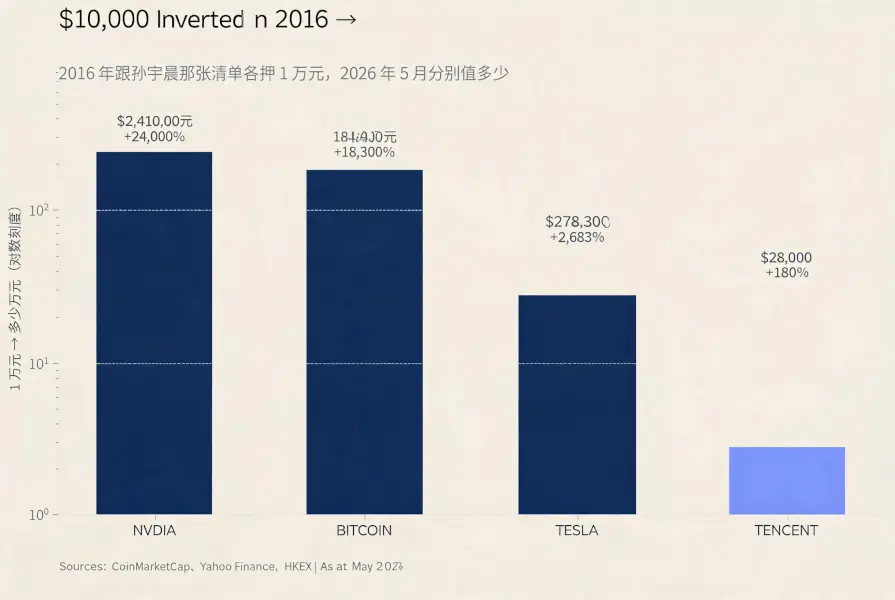
A decade later. As of May 2026, Tesla’s total return is approximately 2,683%, and Nvidia’s total return is nearly 24,000%.
If you had listened to Brother Sun back then and invested 10,000 RMB in Nvidia, it would be worth 2.4 million RMB today; 10,000 RMB in Tesla would be 278,000 RMB. A listener who followed that list and invested 200,000 RMB in each asset in 2016 would see their Nvidia stake alone worth approximately 48 million RMB, their Tesla stake around 5.4 million RMB, totaling over 53 million RMB.
And this man continues to make his moves even today. On November 6, 2025, Justin Sun threw out a statement:
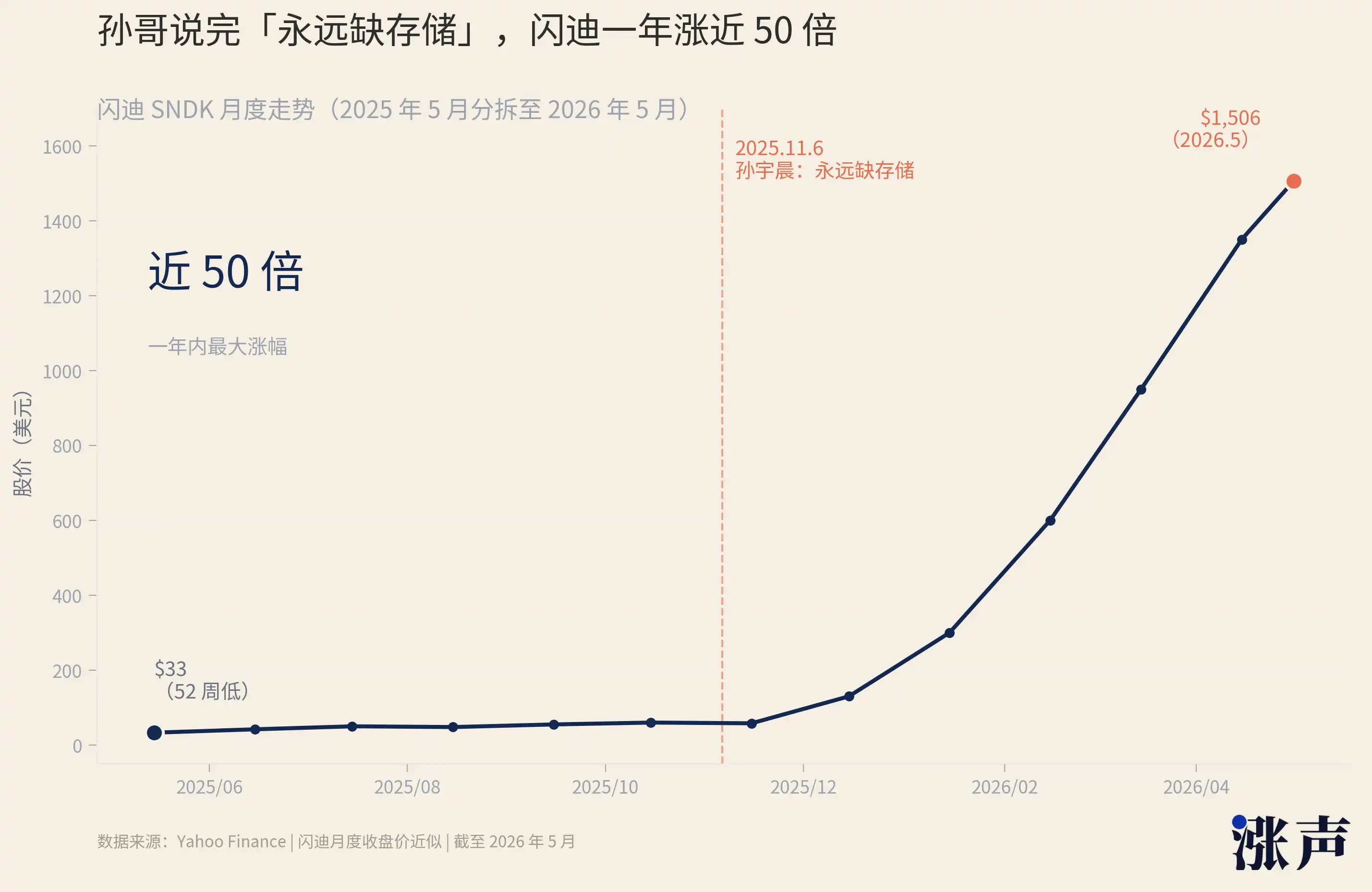
“Short-term chip shortage, long-term energy shortage, and an eternal storage shortage.”
The capital market’s reaction to this statement only turned fervent in 2026. SanDisk (SNDK), spun off from Western Digital, surged from a low of about $35 to $1,439 in one year, a maximum increase of nearly 50 times.
Production capacity for HBM memory from the three major manufacturers Samsung, SK Hynix, and Micron is fully booked, already sold out for 2026, with orders extending into 2027-2028.
Just as everyone was chasing the storage concept, in early 2026, Justin Sun changed his tune in a video.
That video was originally about his outlook for 2026. Besides discussing health goals for the new year, he specifically took time to advise young people to focus on: embodied intelligence, drones, spatial computing, and space exploration.
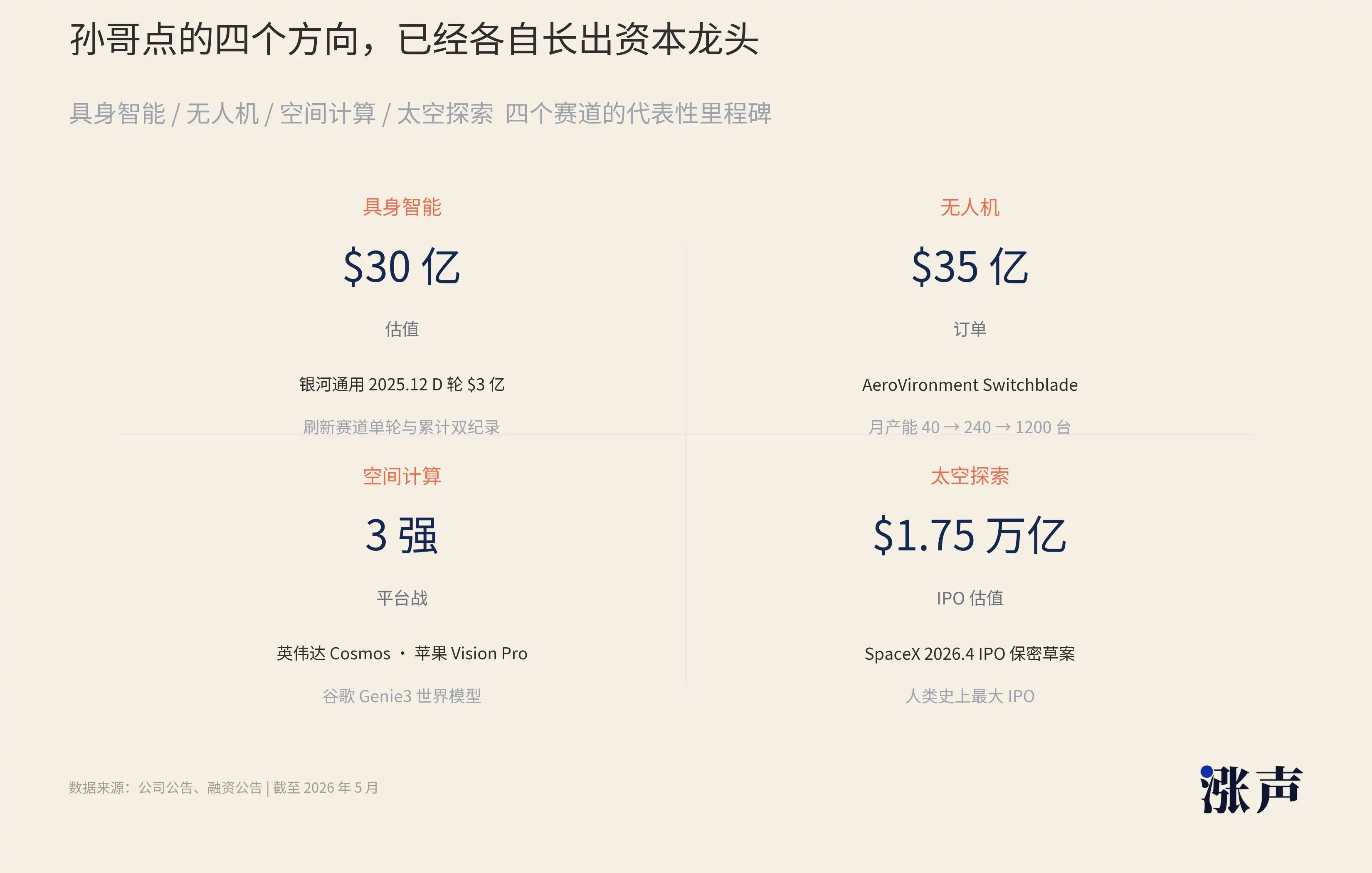
I have compiled Justin Sun’s public statements on these four directions over the past two years. Looking at them together, each path has already produced its initial leading capital.
Who is the Next Storage Stock?
The first area Justin Sun pointed to was embodied intelligence.
The concept of robots has been discussed by humanity for at least a century. Czech playwright Čapek coined the word ‘Robot’ in 1920. Industrial robotic arms have been used since the 1980s, and Honda’s ASIMO could walk up and down stairs over twenty years ago. But the real bottleneck has always been the ‘brain’.
In the last two years, the entire industry has shifted towards VLA models: Vision-Language-Action. In simple terms, past robots acted based on code; now robots are beginning to act based on their perception of the world.
Unitree shipped over 5,500 humanoid robots globally in 2025, ranking first worldwide. It filed its IPO application on the STAR 市場 (SSE) in March 2026. GalaxyBot secured $300 million (approximately 21 billion RMB) in new funding in December 2025, bringing its cumulative financing to about $800 million and a valuation of $3 billion (approximately 211 billion RMB), setting new records for single-round and total financing in the embodied intelligence track.
Justin Sun says he probably won’t build robots himself, but he has a keen sense of this narrative and capital flow. He said in a Bloomberg interview, “In a market where 99% of people don’t know what a wallet is, education costs must be factored into the business model.”
This statement explained stablecoins in 2018, and it applies equally in 2026. 99% of Chinese people have yet to use an embodied intelligent robot. But as soon as that robot can cook, carry boxes, and look after the elderly, that remaining 1% becomes the next opportunity.
The second track he pointed to was drones.
While humanoid robots are still scaling up production, drones have already advanced to commercial implementation. They are naturally suited for AI tasks, from autonomous navigation and swarm coordination to data collection – areas where AI excels. They don’t need to walk; flying is actually simpler for them than building a walking humanoid.
On the battlefield in Ukraine, AI drone swarms have already taken over a large portion of the role once held by tank units, with Ukraine’s annual drone production target reaching millions. Over the rice paddies in rural China, DJI agricultural drones fly, each replacing ten farm workers. Shenzhen’s Meituan has already made drone delivery operational, with orders arriving in under 15 minutes.
Drones are ahead of humanoid robots in implementation. They represent the first form of AI to achieve a complete commercial cycle in the physical world.
The third area Justin Sun pointed to was spatial computing. This is the least mainstream of the directions he highlighted.
When Apple released the Vision Pro in 2024, most people dismissed it as a VR headset costing several times more. That might be a misinterpretation.
The ambition of the Vision Pro has little to do with VR. It is Apple’s first attempt to make AI understand space: the size of your living room, the distance between the table and you, whether the coffee cup is to the left or right of the sofa, and whether you can reach it. This sounds simple, but it is ten times harder than training ChatGPT. Large language models only need to understand language; spatial computing needs to understand physics.
This happens to be the common prerequisite for robots, drones, and autonomous driving – they all require a form of spatial intelligence. Nvidia’s Cosmos platform, Google’s Genie 3 world model, and Tesla’s FSD are all doing the same thing: transitioning AI from understanding text to understanding the world.
ChatGPT understanding language is sufficient, but the next generation of AI needs to understand the world itself.
For the first three tracks, Justin Sun only named them rhetorically. But for space, he actually went there physically.
On August 3, 2025, he was inside Blue Origin’s New Shepard capsule for mission NS-34, flying past the Kármán line.
After returning to Earth, he expressed an ambition: to have his company no longer just a “加密貨幣currency exchange”, but an “infrastructure service provider for the space economy”, using blockchain to solve space asset ownership, satellite data trading, and interplanetary payments. It sounds like science fiction. But if you look back ten years to when he was evangelizing USDT, people thought that was science fiction too.
Back on Earth, his message to young people was more direct: “Space exploration is a common mission for all humanity. I hope this flight will inspire more young people to dedicate themselves to technology and innovation, jointly shaping humanity’s interstellar future.”
Brother Sun’s Investment Logic
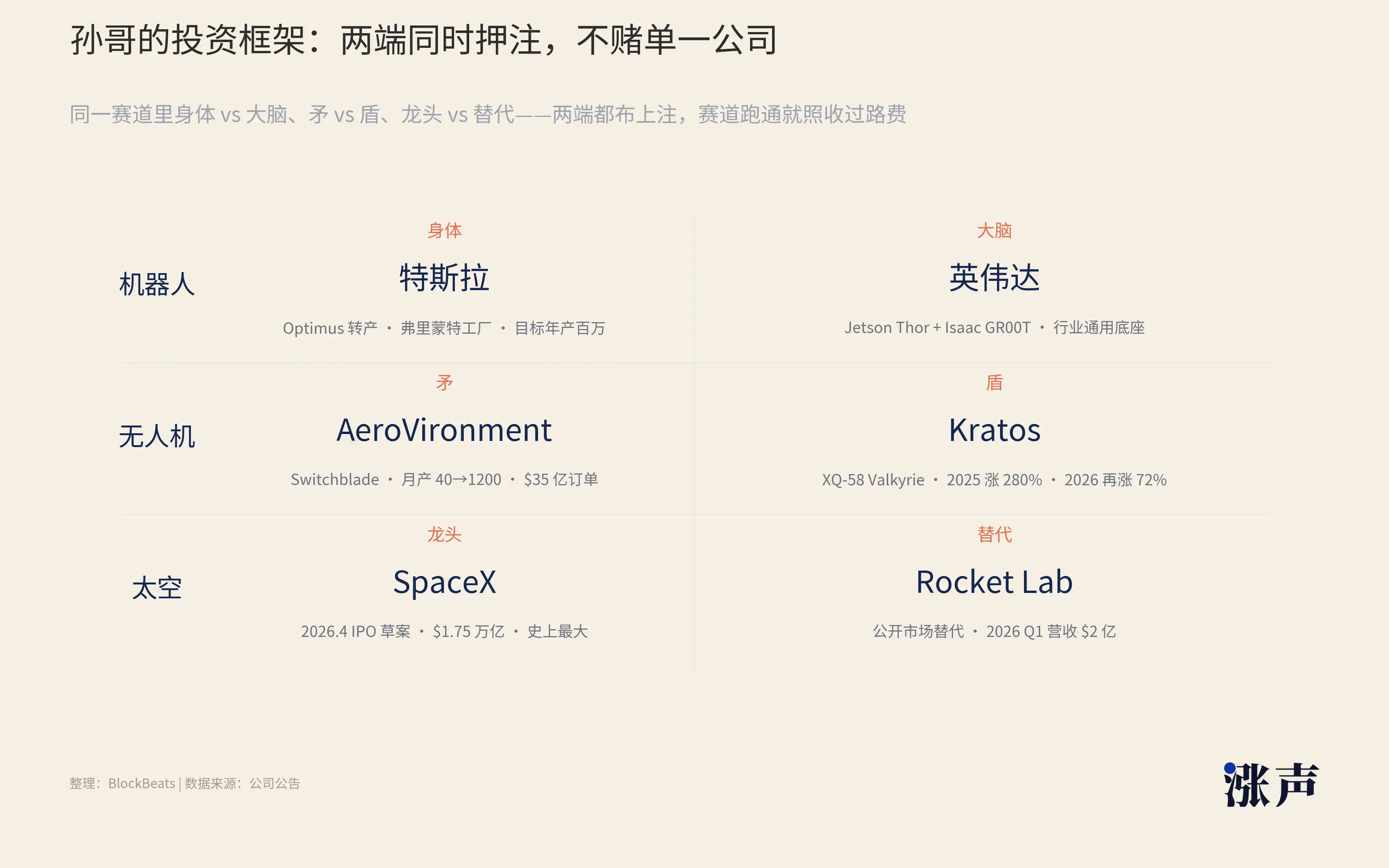
Justin Sun’s publicly stated investment logic is: find tracks with a clear direction, deploy capital at both ends, and don’t bet on the execution ability of a single company.
For the robotics track, his framework is to bet on the body and the brain separately.
Betting on the body via Tesla: In early 2026, Tesla announced the cessation of Model S and Model X production, converting the Fremont factory into an Optimus production line targeting an annual output of one million units, with a unit price of approximately $20,000 to $25,000. The current version of Optimus is already handling parts moving and sorting at the Austin and Fremont factories, with Gen 3 production lines starting in summer 2026.
Betting on the brain via Nvidia: Jetson Thor packs server-grade AI inference into the robot itself, Isaac GR00T has become an industry standard foundation model. Jensen Huang declared at GTC that there would be 1 billion humanoid robots globally by 2035.
Whether Optimus delivers on time is Musk’s problem, not Nvidia’s. As long as the track takes off, the toll road fees will be collected regardless.
For the drone track, the core judgment is the irreversibility of Physical AI in military scenarios.
AeroVironment’s Switchblade loitering munition became an iconic weapon in Ukraine, with monthly production capacity ramped from 40 to 500 units, targeting 1,200, and a $3.9 billion order backlog securing revenue for the next three years. Kratos’ XQ-58 Valkyrie serves as a ‘loyal wingman’ for the F-35; manned aircraft fly the mission, drones cover the flanks, at a unit cost a fraction of fifth-generation fighters. The stock rose 280% in 2025 and another 72% in 2026.
One company makes tanks uneconomical, the other makes manned aircraft redundant. The logic at both ends is complementary.
For the space track, Justin Sun won a Blue Origin flight seat for $28 million in 2021, donating the money to Blue Origin’s STEM charitable fund, distributed among 19 non-profit organizations. On August 3, 2025, he completed a suborbital flight aboard the New Shepard NS-34 mission.
In public markets, SpaceX submitted a confidential IPO draft to the SEC in April 2026, targeting a valuation of $17.5 trillion, potentially the largest IPO in human history. Rocket Lab’s Q1 2026 revenue exceeded $200 million, making it the most direct alternative when SpaceX stock is unavailable.
Once SpaceX goes public, the pricing coordinates for the entire space sector will be rewritten.
Listen to What Brother Sun Says
Connecting Justin Sun’s statements over the past two years: ‘AI, robotics, and blockchain have reached an iPhone moment’ is his judgment on embodied intelligence. ‘Robot armies, robot police’ is his prediction for autonomous weaponized AI. ‘The convergence of AI, robotics, and spatial computing’ is his bet on the next generation of human-computer interfaces. ‘Earth is too small, it is our home’ reflects his shift in perspective after flying past the Kármán line.
Put these four pieces together, and you get the complete picture of Physical AI.
Over the past twenty years, the internet changed the way information flows. WeChat replaced letters, Taobao replaced market fairs, TikTok replaced television.
But the underlying rules of the physical world remained unchanged: workers were still workers, factories were still factories.
Over the next twenty years, AI may change the operating mode of the real world itself. Factories will be staffed by humanoid robots that don’t need rest, roads will be traversed by autonomous vehicles, battlefields will hum with swarms of drones, and the first ‘residents’ on the Moon and Mars could very well be pioneering AI robots.
The young man who in 2016 told everyone not to buy a house has now flown past the Kármán line.
Meanwhile, most of us might still be waiting for the next Yanjiao.
本文源自網路: 50x storage later, Justin Sun is always looking at the next decade































 繁體中文
繁體中文  English
  简体中文
简体中文  日本語
日本語  Tiếng Việt
  العربية
  한국어
한국어  Bahasa Indonesia
  हिन्दी
  اردو
اردو  Русский