








Duan Yongping caught in a value trap? CoreWeave drops 11% in a single day, with billions in orders masking a 1% profit margin dilemma
On May 8, AI cloud computing provider CoreWeave (CRWV) plummeted 11.4% in a single day, closing at $114.15. This marked another “post-earnings drop” since the company’s IPO in March last year. However, unlike previous instances, this decline was amplified by a stark contrast: Duan Yongping, widely recognized in Chinese circles as a disciple of Buffett, had just opened his initial position in CoreWeave during the fourth quarter of 2025, with a stake of approximately $20 million. Based on his position size and the average price for Q4, his entry point was near CoreWeave’s lowest intra-year range in December 2025.
CoreWeave is currently one of the most debated AI assets in the US stock market. On one side, there’s a narrative of nearly $100 billion in order backlog and a deep alignment with Nvidia as a “picks and shovels” player; on the other side are the financial realities of expanding losses alongside scale, and continuous insider selling. The Q1 earnings report acted as a prism, sharply refracting this divergence.
Q1 Earnings: Revenue Doubles but Losses Widen, Q2 Guidance Pricks Valuation
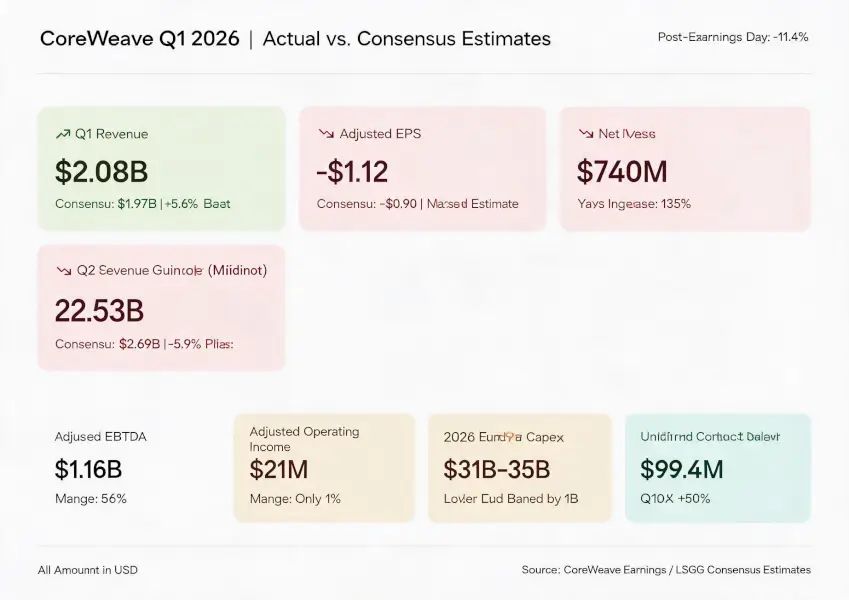
CoreWeave’s Q1 revenue was $2.08 billion, a 112% increase year-over-year and 32% quarter-over-quarter, surpassing the LSEG market consensus of $1.97 billion. However, the adjusted loss per share was $1.12, worse than the expected loss of $0.90. Net loss widened to $740 million, more than doubling from $315 million in the same period last year.
The real trigger for the sell-off was the forward guidance. The company provided a Q2 revenue range of $2.45 billion to $2.6 billion, with a midpoint of $2.53 billion, significantly below the market expectation of $2.69 billion. Concurrently, the full-year 2026 capital expenditure floor was raised from $30 billion to $31 billion, attributed by CFO Nitin Agrawal to rising component costs.
The fragility of the profit structure was fully exposed. Q1 adjusted EBITDA reached $1.16 billion (a 56% margin), which appears strong. Yet, adjusted operating profit was only $21 million, compressing the operating margin to 1%. This is because technology and infrastructure costs surged 127% year-over-year to $1.27 billion, and sales and marketing expenses skyrocketed over 600% to $69 million. Revenue is growing, but costs are growing even faster.
CEO Michael Intrator emphasized during the earnings call: “We have reached hyperscale.” He disclosed that the company now has 10 clients committed to spending over $1 billion, a significant improvement in concentration risk compared to 2024 when 62% of revenue depended on a single client, Microsoft. Intrator also projected that CoreWeave’s annualized revenue should exceed $30 billion by the end of 2027.
Bull Narrative: $100 Billion Order Backlog, Deeply Tied to Nvidia
The core of the bull thesis is the order backlog. As of the end of Q1, CoreWeave’s Remaining Performance Obligations (RPO) reached $99.4 billion, a sequential net increase of about $33 billion and nearly a fourfold increase year-over-year. Intrator stated that new contracts signed in Q1 alone exceeded $40 billion.
The client list is also reshaping market perception. In Q1, CoreWeave added Anthropic as a client to provide computing power for its Claude model series, signed a $2.1 billion AI cloud agreement with Meta, and secured approximately $6 billion in orders from trading firm Jane Street, which also completed a separate $1 billion equity investment. Nvidia purchased another $2 billion of CoreWeave’s Class A common stock this quarter. The world’s largest GPU supplier, simultaneously an investor and key client for CoreWeave, creates a triple-binding relationship, earning CoreWeave the moniker of Nvidia’s “favored son.”
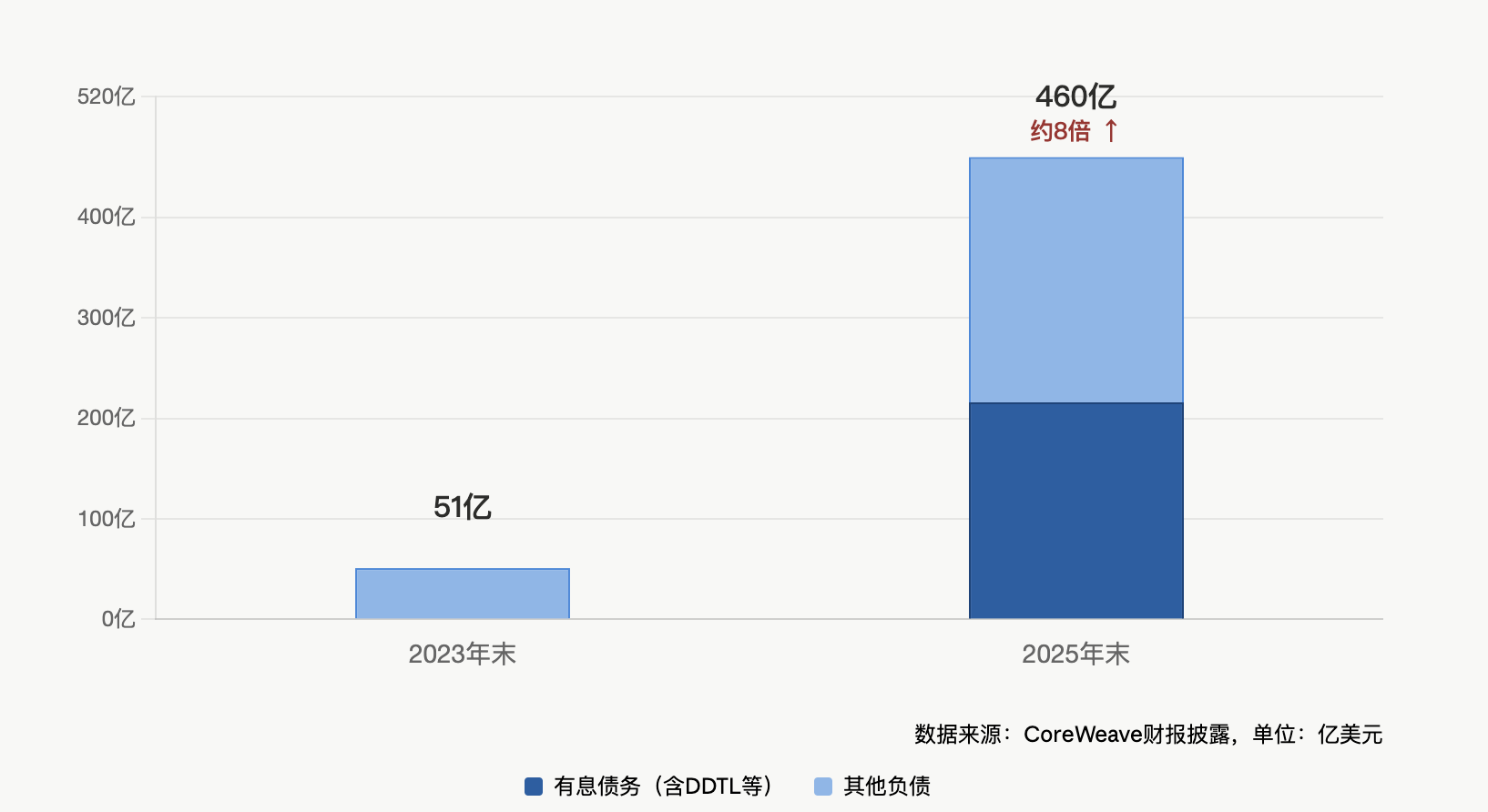
In terms of financing structure, CoreWeave completed an $8.5 billion investment-grade HPC (High-Performance Computing) Secured Delayed Draw Term Loan (DDTL) in Q1, priced below 6%, which management called a “first-of-its-kind.” Year-to-date, the company has secured over $20 billion in debt and equity financing, with a weighted average cost of debt declining by approximately 80 basis points. Simultaneously, S&P Global Ratings upgraded CoreWeave’s credit rating outlook from “stable” to “positive.”
Bear Narrative: The Bigger the Scale, the Less Profitable; Debt Snowball Grows
However, another set of numbers in the earnings report is creating anxiety. Q1 capital expenditures reached $6.8 billion, and the company expects Q2 CapEx to climb further to between $7 billion and $9 billion. The Q2 interest expense guidance range is $650 million to $730 million, reflecting the rapid expansion of the debt scale.
Total debt has already reached a staggering level. As of the end of Q1, CoreWeave’s total debt stood at approximately $25 billion. Relative to the company’s current annualized revenue level, this leverage is significantly higher than traditional cloud service providers. Morgan Stanley data indicates that CoreWeave’s debt financing for the full year 2025 amounted to roughly $11.8 billion, dwarfing the approximately $1.5 billion in equity financing during the same period. The company’s core expansion tool is the DDTL, a “sign contract, then finance” model where it pledges order contracts as collateral to borrow from banks for purchasing GPUs.
The most pointed criticism concerns profit quality. Despite management repeatedly emphasizing the 56% EBITDA margin, the adjusted operating margin is only 1%. After accounting for technology and infrastructure costs, the “true” gross margin is about 4%, which has compressed both sequentially and relative to market expectations. Intrator attributed this on the call to the transitional effects of scaling, stating that when a company rapidly expands from a 1-gigawatt operating scale, new capacity has a significant dilutive effect on margins. He promised this was the “margin trough” and that it would gradually rebound in future quarters.
But the market is currently unwilling to pay for that promise. Although analysts from Morgan Stanley and Jefferies gave positive ratings, CoreWeave has seen short-term pullbacks after each previous earnings report, and this decline was one of the steepest post-earnings drops.
Continuous Insider Selling Mirrors Duan Yongping’s Bottom-Fishing
Around the earnings release, the pace of insider selling at CoreWeave did not let up. CEO Mike Intrator sold 307,693 shares at the end of April. Co-founders Brian Venturo and Chen Goldberg also recorded sales. Institutional shareholder Magnetar Financial had previously sold over $300 million. Recent disclosures show a major shareholder sold approximately 1.2 million shares again recently.
This stands in stark contrast to Duan Yongping’s Q4 accumulation. According to the 13F filing for H&H International Investment disclosed in February 2026, Duan Yongping first established a position in CoreWeave during Q4 2025, buying 299,900 shares. At that time, the company’s stock price had retraced over 65% from its highs, and market concerns about its debt structure were at their peak.
It’s worth noting that CoreWeave represents only 0.12% of Duan Yongping’s H&H total portfolio, a “light position test.” During the same period, Duan Yongping aggressively increased his stake in Nvidia by over 1110% and established new positions in Credo Technology (high-speed interconnect) and Tempus AI (AI healthcare). These three new AI positions combined account for less than 0.3% of his portfolio. This suggests Duan Yongping’s real heavy bet is on Nvidia itself, and CoreWeave is more like a small exploratory extension downstream in the AI computing power chain.
The Key Question Now: Turning Point or Trap?
During the Q&A session of the earnings call, Intrator posed a somewhat emotional rhetorical question: “I’ve always felt that everyone is staring at the tree of the stock price and missing the entire forest.”
This statement perfectly encapsulates the current bull-bear standoff. The forest the bulls see is nearly $100 billion in contract backlog, a diversified customer base, triple binding with Nvidia, and an upgraded credit rating. The tree the bears see is a 1% operating margin, widening net losses, aggressive capital expenditure, and continuously selling insiders.
CoreWeave’s stock price is still up nearly 80% year-to-date and has gained over 200% since its IPO. However, when a stock’s bull thesis relies on forward narratives and the bear thesis on current numbers, every earnings report becomes an arena for these two stories to clash. Duan Yongping, in a previous interview with Fang Sanwen, stated: “AI is a huge revolution driven by a qualitative leap in computing power, with an impact potentially exceeding the internet and industrial revolutions. The current AI bubble is obvious, and 90% of companies may be eliminated, but those that survive will become the next generation of giants.” His 0.12% light position itself acknowledges the uncertainty of this bet.
The next test point is already clear: the Q2 earnings report. If the operating margin fails to rebound as management promised by then, the credibility of the “forest” narrative will face a true stress test.
Related: From Aave to X: Design Prodigy Benji Taylor, Why Was He Chosen by Musk?
In the early hours of March 26th Beijing time, former Base design lead Benji Taylor announced he is joining Elon Musk’s X and will lead design work. Personnel changes are never big news in the Web3 industry, but the nearly 15 million views on this post tell me it’s not that simple. After digging deeper, I realized this person is far from just the Base design lead. Rebellion and Talent Benji Taylor is only about 26 years old, likely a standard “post-00s” generation. Unlike most people who follow a conventional path, Benji Taylor was already somewhat famous by the age of 16. In 2016, this 16-year-old “Creative Director” from London, UK, was interviewed by the renowned British fashion and culture magazine *Dazed*. At an age when many are still scribbling…































 繁體中文
繁體中文  English
  简体中文
简体中文  日本語
日本語  Tiếng Việt
  العربية
  한국어
한국어  Bahasa Indonesia
  हिन्दी
  اردو
اردو  Русский