








Deconstructing 40 Addresses from the Polymarket Leaderboard: Only Three Ways to Make Money
What does the strategy of someone who made ten million dollars on Polymarket actually look like?
Using the Data API + on-chain data, I reverse-engineered the top 20 leaderboards for both the sports and Crypto tracks. That’s 40 addresses, over 100,000 transactions, analyzed one by one.
This isn’t about looking at dashboard screenshots. It’s about reconstructing every single buy, sell, and redemption into strategic behavior. Method: Pull transaction records per address via the Polymarket Data API, verify P&L with the LB API, and reconstruct the actual cash flow using on-chain REDEEM/MERGE data. Each address had between 2000 and 15000 transactions.
After breaking it down, I found that regardless of sports or Crypto, profitable addresses fall into three categories. The difference between these categories isn’t just different parameters; they are playing entirely different games.
Type 1: Directional – Buy and Hold Until Settlement
The most profitable strategy in sports is so simple I didn’t believe it at first.
Out of 18 valid addresses, 14 only bought and never sold. They held until settlement, redeemed if they won, lost everything if they lost—no trading in between.
Even among those who only buy, the methods to profit are completely different.
swisstony: $494 million in trading volume, 1% return rate, net profit of $4.96 million. Fully automated, placing 353 bets in 30 minutes, covering the five major leagues. Makes a tiny bit on each match, but the volume is massive.
majorexploiter: 39% return rate, single largest bet of $990,000. Over 600 transactions almost all placed on two Arsenal matches. Dares to place heavy bets; winning means millions.
One spreads volume, the other bets big; both made millions. Their methods are opposite, but they share one commonality: an information advantage in the events they bet on.
The #1 on the Leaderboard is Losing Momentum
kch123, ranked #1 on the sports leaderboard, with cumulative profits of $10.35 million.
However, as of the analysis in mid-March, they lost $479,000 in the last 30 days. The win rate in the last 7 days was only 31% (15 wins, 33 losses). All 14,303 transactions were buys, 0 sells. An average of 493 transactions per day, with 74% of trades having less than a 10-second interval.
The machine that made ten million is losing momentum. You wouldn’t know this just by looking at the leaderboard; you have to dissect the on-chain data to see it.
My Own Label Fooled Me
fengdubiying, ranked #13 in sports, profit of $3.13 million.
During batch analysis, I labeled them as “sell-dominant,” appearing to be a swing trader.
Breaking down the data: 93.6% of repayments came from redemptions, with sells accounting for only 6%. The real strategy is concentrated betting on LoL esports. Largest single market: $1.58 million (T1 vs KT Rolster), win rate 74.4%, profit/loss ratio of 7.5 to 1.
Selling is their stop-loss tool, not their main strategy. If you only look at the buy/sell ratio on the dashboard, you completely misjudge what this person is doing.
Type 2: Structural – Profiting Without Prediction
The Crypto leaderboard is a completely different beast. Sports is about betting on direction; Crypto is about being the house.
Digging deep into the Crypto Top 5: three are market-making bots running up/down binary options, one is a market maker using MERGE to manage inventory with price thresholds, and one specializes in arbitrage on public sale milestone events (43.3% return rate).
Retail is betting on price movements; top players are being the house.
How 市場 Makers Make Money
0x8dxd, a market maker for BTC 5/15-minute up/down markets.
94% of transactions are symmetrical orders, simultaneously buying “Yes” and “No.” Runs 24/7, with a median single transaction value under $6. The sum of the buy prices for Yes + No is less than $1; the difference in the middle is the profit. At least three independent addresses are running the same pattern.
Another market-making address is more extreme: it almost monopolizes liquidity supply in the Economics category. 982 buys, 0 sells, six-figure PnL. Profits come from maker rebates plus liquidity premiums.
Good Code Doesn’t Equal Profitability
Reading this, you might think market making is a sure win? There’s an open-source Polymarket market-making bot on GitHub. The code is very well-engineered: WebSocket real-time data, a three-part risk control suite (stop-loss + volatility freeze + dormancy period), automatic position merging. The author admits it themselves: it’s not profitable.
The reason is the pricing logic is “penny jumping,” inserting an order one cent ahead of the existing best quote. Essentially, it’s copy-trading without its own pricing power.
No matter how sophisticated the code is, profitability in market making depends on whether your pricing model can be more accurate than the market’s.
Another noteworthy data point: According to on-chain transaction timestamp analysis, over 70% of arbitrage profits in Polymarket’s 加密貨幣 price markets are taken by bots with latency under 100 milliseconds. Less than 8% of all wallets in the entire market are profitable. If a bot’s latency is at the second level, it’s essentially providing liquidity for high-frequency players.
Type 3: Cognitive – Few Bets, Each Backed by Judgment
The third type of address is completely different from the first two. Trading frequency is very low, maybe only two or three trades a month, but each one is backed by research.
A few examples. One address in the weather category models using public meteorological data, only entering when the win probability exceeds 0.77. It might only do two or three trades a month, with single-trade profits in the tens of thousands of dollars. Another address has 89% of its trades buying “No,” with holding periods calculated in months. The win rate isn’t high, but the payoff multiple averages over 9x, covering all small losses with a few big, correct bets.
An even more extreme one: In FDV (Full Result) markets, it only does one thing—buys “No” at 50-55 cents, waits for settlement to get $1. Win rate: 100%. It’s not luck; it’s that others didn’t notice this pricing discrepancy.
But the cognitive type isn’t about “research deep enough and you’ll profit.” I analyzed one case where someone built a probability matrix for BTC price deviations using 1.37 million lines of historical data. Backtest performance was perfect, but it collapsed as soon as they tried rolling validation. 市場 efficiency improves rapidly; patterns that worked last month have already been arbitraged away this month.
The true edge in the cognitive type is having a deeper understanding of a specific category than the market’s pricing, not having a more complex model.
Comparison of the Three Approaches
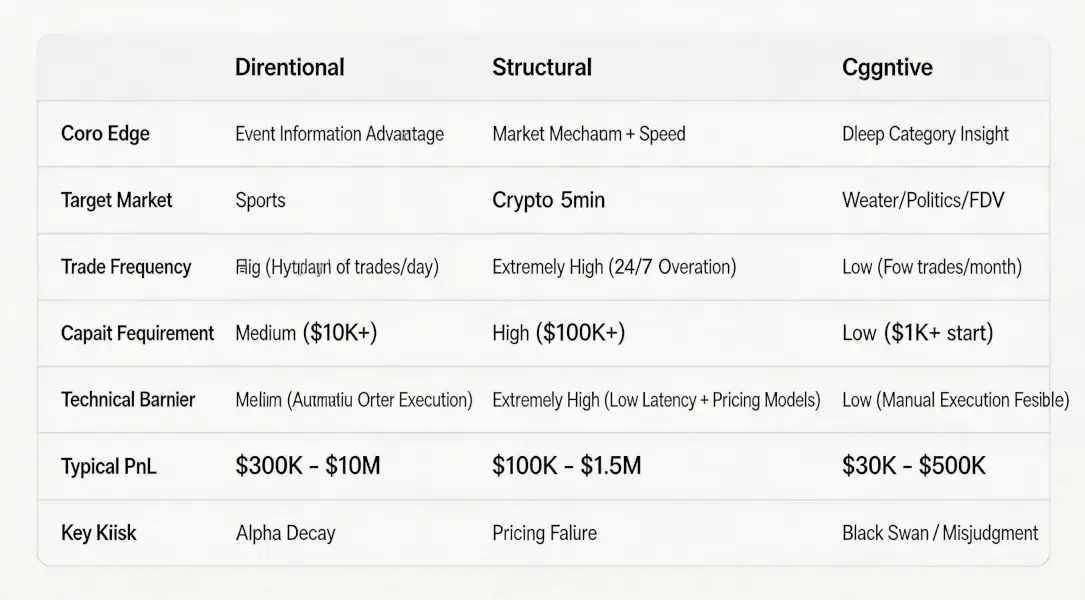
Comparison Table of the Three Approaches
What I’m Doing Myself
After talking about others, let’s talk about me.
I’m running several lines simultaneously: Crypto market making (structural), sports probability pricing (directional), and weather data modeling (cognitive). Each line is small-scale, nothing like kch123’s 493 daily transactions or swisstony’s $494 million volume.
The thing I’ve thought about most after dissecting these 40 addresses: Figuring out which game you’re playing is more important than optimizing any parameter.
If you’re playing directionally without an information advantage, even the best execution is just guessing. If you’re playing structurally but your latency can’t keep up, you’re the one being harvested. This isn’t motivational talk; it’s what I told myself after looking at the data.
Right now, I’m running small-scale validation on each line, confirming the edge exists before scaling up. Not rushing to expand; focusing on mastering one or two categories first.
Data Source: Polymarket Data API + LB API + Polygon on-chain data | Analysis Period: January – March 2026
Want to try on Polymarket? First, figure out which game you want to play.
本文源自網路: Deconstructing 40 Addresses from the Polymarket Leaderboard: Only Three Ways to Make Money
“It’s been a year, and Vitalik seems to have undergone some subtle changes.” This was the first thought that popped into my head right after my second interview with him in Chiang Mai. My memory rewinds to late 2024. Our first conversation took place in a closed, quiet room on Nimman Road in Chiang Mai. Back then, he was brimming with excitement about Web3 application-layer innovation. We talked for a full 90 minutes, covering everything from Farcaster to Polymarket to Solana and Base. This time, the clock had turned to a weekend in late January 2026 in Chiang Mai, and the setting had switched to a completely open space. That afternoon, Vitalik strolled over from the “Sihai Community” to the “Co-living Space of the 706 Community.” On the second-floor balcony,…































 繁體中文
繁體中文  English
  简体中文
简体中文  日本語
日本語  Tiếng Việt
  العربية
  한국어
한국어  Bahasa Indonesia
  हिन्दी
  اردو
اردو  Русский