







Is Satoshi Nakamoto Dead? The Silent Answer Under the Quantum Crisis
Original Compilation: Saoirse, Foresight News
Editor’s Note:The mystery surrounding Satoshi Nakamoto’s identity remains unsolved. On April 8th, The New York Times published another article pointing to Adam Back as the potential founder of Bitcoin, sparking widespread discussion. Nic Carter penned a rebuttal, arguing that the report lacks solid evidence and its reasoning is insufficient. He further introduces the perspective of the quantum security crisis, proposing a viewpoint: if Satoshi Nakamoto were still alive, he should step forward to address the early high-risk bitcoins to mitigate the threat; his prolonged silence may imply he is no longer with us. This article presents strong and controversial opinions; the related technical judgments and inferences represent only the author’s stance and are provided for readers’ critical consideration.
The New York Times believes Adam Back is Satoshi Nakamoto. Its analysis is based on Back being a member of the cypherpunk community, the inventor of Hashcash, and having linguistic similarities with Bitcoin’s founder. However, the article does not present any substantively new evidence. For a seasoned journalist like John Carreyrou, who exposed the Elizabeth Holmes and Theranos scandal, the quality of this report is genuinely disappointing.
Back has handled it quite graciously, accumulating goodwill within the Bitcoin community while ambiguously denying any connection to Satoshi Nakamoto—a tactic almost universally adopted by those suspected of being Satoshi.
This article does not shake my view in the slightest: Back is not Satoshi Nakamoto. The burden of proof for this identity is extremely high, and The New York Times essentially provides no effective evidence. Stylometric analysis can easily be manipulated to produce false conclusions, and the newspaper did not conduct rigorous statistical research, merely skimming the surface of grammar and spelling patterns. I have my own speculations about Satoshi’s identity and believe artificial intelligence might soon solve this mystery, but this report is clearly not the answer.
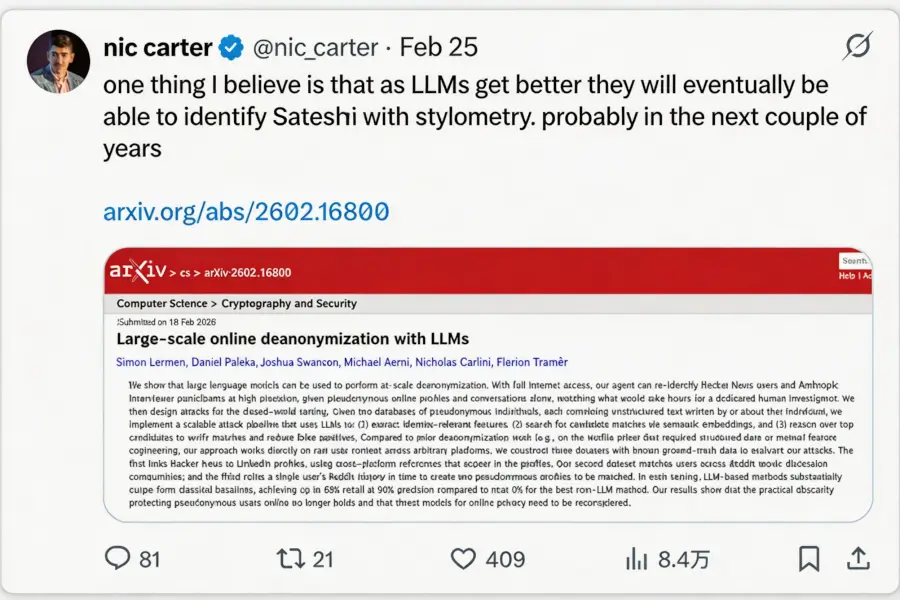
I believe that as large language models continue to advance, they will eventually identify Satoshi Nakamoto through stylometry, likely within the next few years.
Why would anyone deliberately cater to a New York Times reporter convinced they are Satoshi Nakamoto? I leave that for readers to ponder. Any rational person would not want the public to believe they secretly hold $120 billion worth of digital bearer assets.
And I have an even more critical reason for questioning the “Back is Satoshi” claim.
If Satoshi Nakamoto is alive today, he bears a significant responsibility—to address Bitcoin’s greatest lingering vulnerability: approximately 1.7 million bitcoins exposed in P2PK (Pay-to-Public-Key) format, vulnerable to theft by quantum computers at any moment.
To be clear, a sufficiently powerful quantum computer can reverse-engineer the mật mãgraphic relationship between public and private keys. Recent papers from Google and Caltech suggest this difficulty is lower than previously thought; a quantum computer with just 26,000 qubits could potentially crack it within days. Consequently, both Google and Cloudflare have set 2029 as the deadline for a comprehensive upgrade to post-quantum mật mãgraphy, and the U.S. government requires critical agencies to be prepared by 2030. Authoritative institutions within the industry widely believe the quantum threat will become a practical issue in the not-too-distant future.
As the “Quantum Threat Day” approaches, I expect the Bitcoin community will advance cryptographic upgrades to make addresses resistant to quantum computer attacks. Within the next decade or so, nearly all Bitcoin holders will need to move their assets to secure addresses using new cryptographic schemes. But a problem arises:
Addresses belonging to Satoshi Nakamoto and early miners hold millions of bitcoins, widely considered lost or abandoned. Among these, approximately 1.7 million bitcoins, worth around $120 billion, reside in old P2PK addresses with fully exposed public keys. This means anyone with a sufficiently powerful quantum computer could reverse-engineer the private keys and seize these assets. This would suddenly flood the market with what was considered permanently lost—9% of Bitcoin’s supply—devastating the price.
Unfortunately, because Satoshi and some early participants either lost their keys, abandoned them, or have passed away, the bitcoins in these old addresses cannot be migrated to a safer new format. Therefore, approximately 1.7 million bitcoins will remain permanently exposed to quantum attack risk, with attackers having virtually unlimited time to crack the addresses.
Of course, Bitcoin developers could propose a software upgrade to prohibit spending from such old addresses, effectively freezing these assets permanently. But this has no precedent in Bitcoin’s history and is essentially equivalent to confiscating user funds—something Bitcoin culture strongly opposes. Thus, I believe such a freezing solution is highly unlikely to be implemented. If enacted, Bitcoin’s core characteristic of upholding property rights and immutable monetary issuance rules would cease to exist.
This brings us back to Satoshi Nakamoto. Only he can truly resolve this dilemma. He could move his bitcoins to safer new addresses, or, if he has no intention of claiming them, transfer them to a burn address, rendering the assets completely unusable, thereby eliminating the market threat—all while maintaining anonymity.
This is why I conclude: Satoshi Nakamoto is most likely deceased. Unless developers take extreme measures to freeze nearly 10% of Bitcoin’s supply, only Satoshi can resolve Bitcoin’s quantum security vulnerability. If he were alive, he would undoubtedly feel a strong sense of responsibility to address the bitcoins in these P2PK addresses, either by migrating or destroying them. Even if he could no longer access these assets, he could easily prove his identity through old files, emails, credentials, etc.
As early as 2010, Satoshi participated in discussions about Bitcoin’s cryptographic system facing quantum risks; he was well aware of the issue. At the time, he was nonchalant, casually remarking that Bitcoin could simply switch encryption algorithms if necessary.
Fifteen years later, quantum computing has advanced rapidly, posing a real threat to Bitcoin likely within the next decade.
This is also why The New York Times’ claim identifying Back as Satoshi holds no water for me. It’s not that Back lacks qualifications or capability, but rather that if Satoshi were alive and cared about Bitcoin, he would inevitably feel immense pressure to address the increasingly severe issue of quantum-vulnerable assets. It’s hard to believe Satoshi would coldly stand by as Bitcoin faces peril.
Thus, I ultimately conclude: Satoshi Nakamoto is no longer with us. As the quantum day draws nearer, we need him more than ever, and he remains silent.
Bài viết này được lấy từ internet: Is Satoshi Nakamoto Dead? The Silent Answer Under the Quantum Crisis
Liên quan: Airdrop Weekly Report|Polymarket May Announce Major Token-Related News on March 23; DeAgentAI Has Distributed the Second Round of AIA Airdrop to Genesis NFT Holders (Mar.9-Mar.22)
Author | Golem (@web3_golem) Odaily has compiled a list of airdrop claimable projects from March 9, 2026, to March 22, 2026, along with key airdrop-related news during this period. For detailed information, please refer to the main text. Based Project and Airdrop Eligibility Introduction Based is an omnichannel trading platform. The project announced the opening of airdrop eligibility checks on March 10. The BASED airdrop tokens will be distributed directly to users’ wallets on Hyperliquid on the TGE day, with no manual claim required. Recipients can specify a preferred receiving wallet, but must set or update their receiving wallet by 12:00 UTC on March 25. If not specified, tokens will be sent to the default address. The total supply of BASED is 1 billion tokens, with 36% allocated to the…
相关文章

































 Tiếng Việt
  English
  繁體中文
繁體中文  简体中文
简体中文  日本語
日本語  العربية
  한국어
한국어  Bahasa Indonesia
  हिन्दी
  اردو
اردو  Русский