







Bitcoin Returns to $70,000, Has the Market Priced in the Worst?
During the Qingming Festival holiday, the A-share and Hong Kong stock markets were closed, but the Bitcoin market never sleeps.
Starting from April 6, BTC rose from its Asian session low of $67,400, reaching an intraday high above $70,300, setting a new high since March 26 and gaining over 4% from the daily low. Ethereum rose from around $2,050 to $2,170 during the same period, a gain of about 6%, and remained above $2,140 at the close of the US stock market, up nearly 4% in 24 hours.
Data from CoinGlass shows that the total liquidation across the network in the past 24 hours was approximately $229 million, with short positions liquidated at $127 million and long positions at $102 million. When BTC broke above $69,000, there were concentrated short positions worth about $136 million around $69,863. The rally directly triggered a large-scale short squeeze.
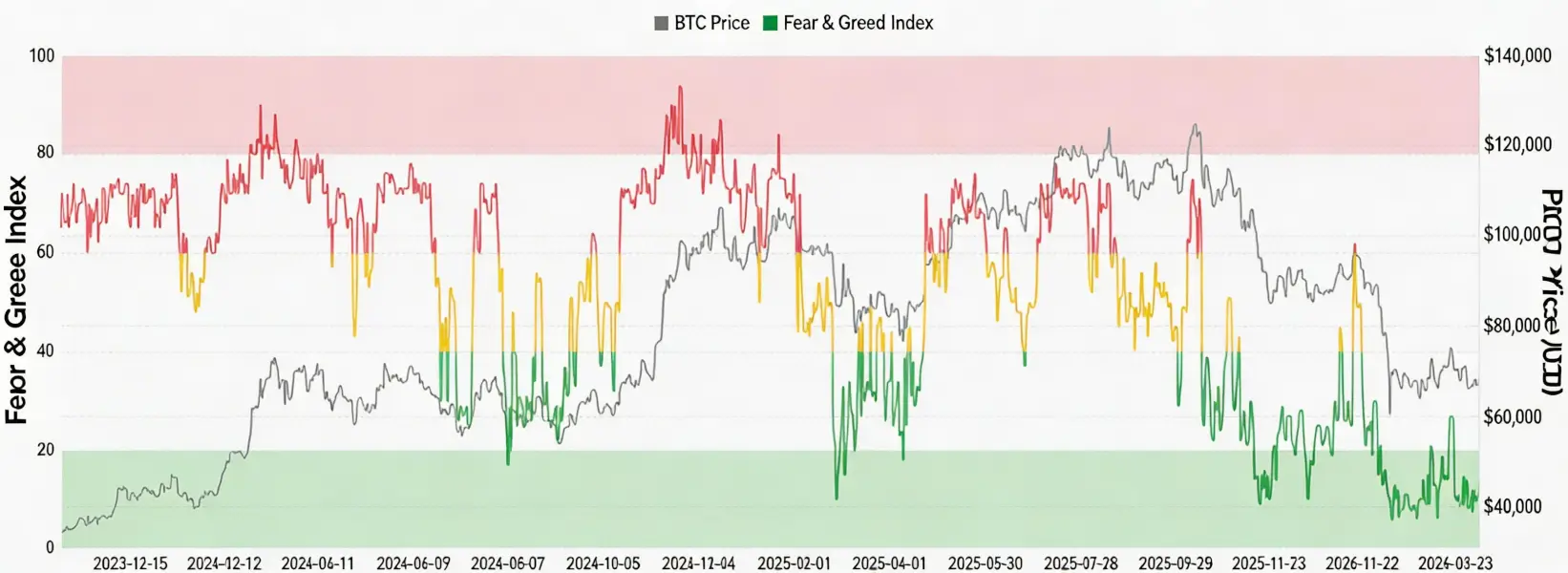
Holiday Chợ Driven by Middle East Situation
The macro logic driving this rally is still Iran, but the plot has new developments.
On March 21, Trump gave Iran a 48-hour ultimatum to reopen the Strait of Hormuz, but later extended it for over a week, instead announcing the start of diplomatic negotiations. In the following weeks, he vacillated between “reopening the strait after an agreement” and “reopening the strait without an agreement,” with the market fluctuating with each headline. 8 PM on April 7 was his second final deadline. This time, the rhetoric escalated, stating that if no agreement was reached by then, Iran would “live in hell,” and threatening strikes on energy infrastructure and civilian targets.
Meanwhile, US Secretary of Defense Hagerty announced at a press conference on April 7 that the largest airstrikes since the start of the Iranian operation would be launched that week. However, at the same press conference, Trump also said Iran had positive and willing negotiation participants and revealed that the US and Iran were discussing a two-phase plan: first, a 45-day temporary ceasefire, followed by negotiations for a comprehensive agreement. Iran publicly rejected the temporary ceasefire, insisting on a permanent end to the war, leading to a deadlock in negotiations.
When asked if he was gradually ending the war, Trump replied: “I don’t know, I can’t say. It depends on their [Iran’s] actions.”
Influenced by this macro environment, international markets also experienced back-and-forth fluctuations.
WTI crude oil futures for May settled at $112.41 per barrel, hitting new highs for two consecutive sessions since June 2022; Brent futures settled at $109.77 per barrel. Crude oil saw multiple tug-of-war movements after touching $115.48 during the Asian session, reflecting high market divergence over whether the Strait of Hormuz can remain open.
In the US stock market, the S&P 500 closed up 0.44%, and the Nasdaq closed up 0.54%, both reaching at least two-week highs. The chip stock index rose over 1%, with Micron and SanDisk gaining over 3%. The VIX closed at 24.15, slightly higher than the previous day.
This combination of rising oil, stocks, and mật mã appears contradictory on the surface but shares the same underlying logic. The market was not pricing in an escalation of war that day, but rather the exclusion of the worst-case scenario. News of the 45-day temporary ceasefire framework temporarily removed the tail risk of a systemic crash, leading to a collective rebound in risk appetite and a synchronous recovery across the three asset classes. Oil prices remained high because the Strait of Hormuz had not yet reopened, but they stopped accelerating upwards, meaning the market found a temporary equilibrium point where things wouldn’t get worse but weren’t yet good.
Steve Sosnick, Chief Strategist at Interactive Brokers, commented: “The market sees the carrot and the stick—on one hand, ceasefire talks, on the other, continued bombing. Apart from brief initial volatility following Trump’s remarks, investors clearly still hope hostilities won’t escalate rapidly.”
It is worth noting that this pattern has held since the outbreak of the Iran conflict. From the start of the conflict on February 27 to April 3, in terms of excess returns relative to the S&P 500, the top four performers were MSCI Global Energy (+13.0%), Ethereum (+11.3%), the US Energy Sector (+10.8%), and Bitcoin (+7.0%).
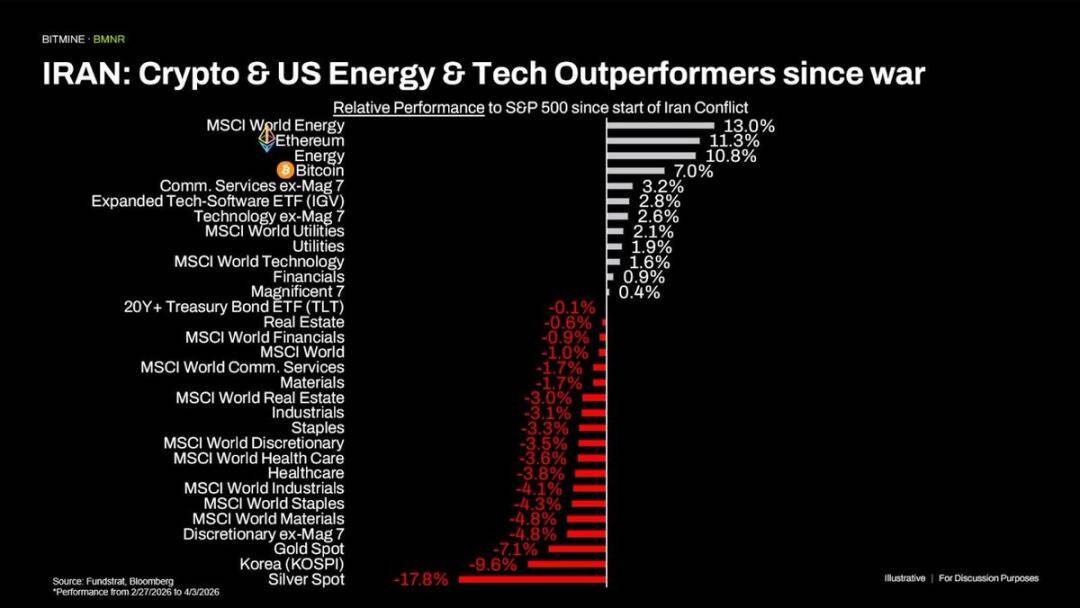
Conversely, the performance of traditional safe-haven assets was surprising. Gold fell 7.1% relative to the S&P 500, and silver fell 17.8%, completely contrary to the market habit of “buying gold for safety” in past rounds of geopolitical conflict.
On-Chain Structure Improves, But New Capital Has Not Yet Followed
A Glassnode report shows that the internal structure of this rebound is beginning to show signs of repair, with momentum strengthening, spot demand stabilizing, and a significant reduction in overall market loss-selling behavior.
The spot market shows early signs of recovering demand. Spot CVD flipped from -$47.8 million to +$27.9 million, turning net selling pressure into net buying pressure. The Relative Strength Index (RSI) rebounded strongly, and the spot Cumulative Volume Delta (CVD) turned positive, indicating renewed buyer enthusiasm. However, declining trading volume suggests market participation remains relatively low, indicating a promising recovery trend that is not yet fully confirmed.
Derivatives market position adjustments were modest. Open interest decreased, and long funding cooled, indicating reduced leverage and a more balanced market environment. Perpetual swap CVD rebounded sharply from -$412 million to $461 million, showing clear directional buying in the futures market. Open interest fell from $30.3 billion to $29.7 billion, with no signs of excessive leverage buildup.
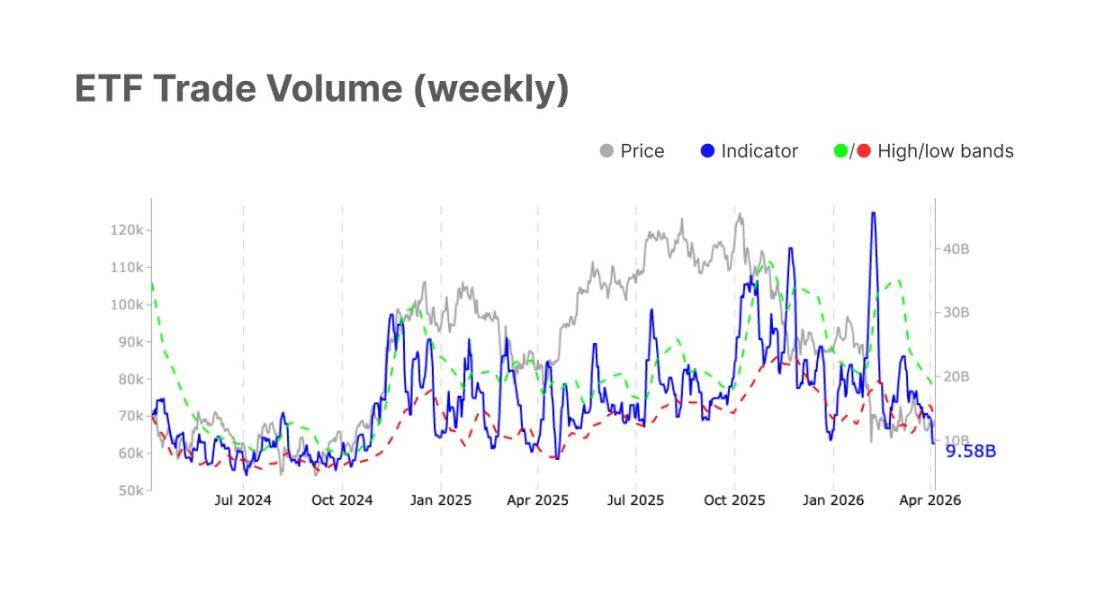
ETF fund flows showed significant improvement. The weekly net outflow of US spot Bitcoin ETFs narrowed sharply from -$405 million to -$22 million, a decrease of nearly 95%. The ETF MVRV ratio rose from 1.10 to 1.16, indicating expanded unrealized profits for institutional holdings.
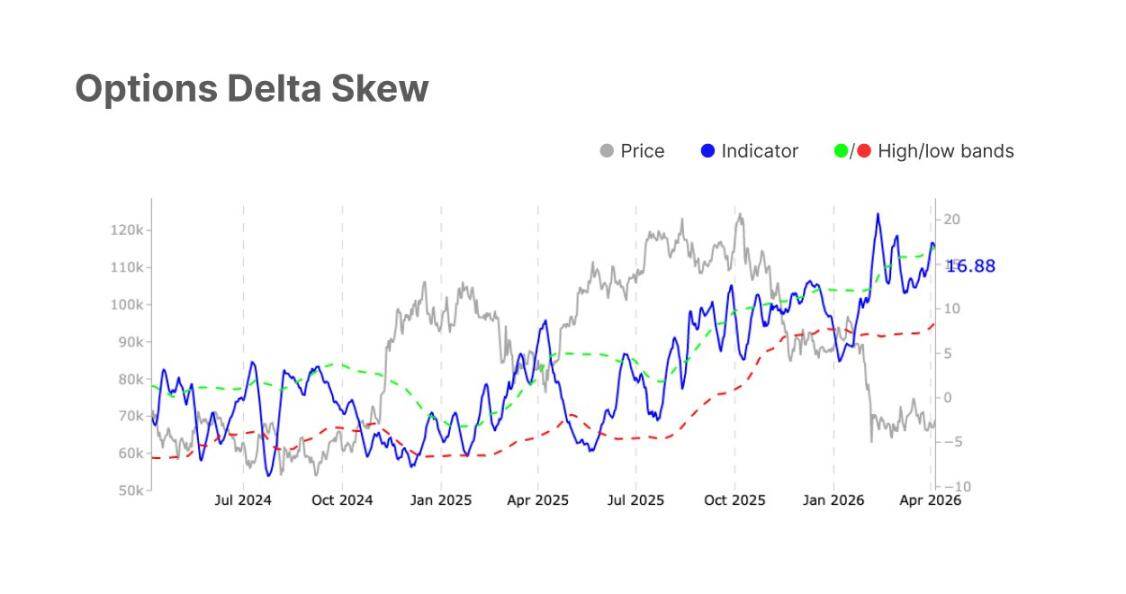
However, the recovery in on-chain fundamentals still lags. The change in Realized Cap further decreased from -0.6% to -0.7%, meaning new capital has not yet returned on a large scale. The Hot Capital Share dropped from 21.0% to 20.1%, indicating continued outflow of short-term speculative capital. The 25-Delta Skew rose to 16.88%, showing that the options market’s pricing of downside risk has not dissipated despite the price rebound.
Outlook for the Crypto Chợ
Can the market rally continue? Institutional views are diverging.
CoinDesk cited analyst views stating that unless Bitcoin can reclaim $75,000, the risk of falling to lower levels remains. If the current price cannot stabilize above $70,000, it will face renewed selling pressure from a loss of confidence among short-term holders.
Glassnode’s conclusion is relatively cautious, stating that the rebound momentum has improved, spot demand is stabilizing, and loss-selling pressure has significantly decreased. However, participation remains soft across exchanges, ETFs, and on-chain metrics, indicating that market confidence has not fully returned. For this rally to solidify, it requires further follow-through in trading volume, capital inflows, and network activity.
April 7 was Trump’s final deadline. Whether the situation substantially de-escalates after the deadline will directly determine the next move for oil prices and risk assets, and will also be a key variable in whether Bitcoin can hold above $70,000.
Bài viết này được lấy từ internet: Bitcoin Returns to $70,000, Has the Market Priced in the Worst?
Related: OpenClaw “Promotes” Venice: What Other Targets Are There in the Privacy AI Track?
Author | Ding Dang (@XiaMiPP) As the current hot topic OpenClaw begins to endorse privacy AI, the “desperate mật mã retail investors” seem to have found a new direction for speculation. It is precisely within this narrative context that a batch of projects related to privacy computing and AI Agent infrastructure have started to re-enter the market’s view. Odaily’s review found that during this wave of heated discussion, several projects have already become potential beneficiaries. VVV (#133) Venice is an AI generation platform focused on censorship resistance and privacy, positioning itself as a decentralized version of ChatGPT. The starting point of the privacy AI hype originated from Venice. This is because OpenClaw once highlighted Venice in its official documentation, only to remove it hastily within 24 hours. Although the recommendation could…
相关文章































 Tiếng Việt
  English
  繁體中文
繁體中文  简体中文
简体中文  日本語
日本語  العربية
  한국어
한국어  Bahasa Indonesia
  हिन्दी
  اردو
اردو  Русский