







Abandoning Inflation, Abolishing veBAL: Can Balancer’s “All-or-Nothing Gamble” Bring Rebirth?
On November 3, 2025, a security incident resulting in losses exceeding $120 million largely shattered the growth illusion of the veteran DeFi protocol, Balancer.
This was the largest security incident in Balancer’s history. However, the deeper wound lies not in that astronomical figure.
Examining the financial data attached to Balancer’s latest proposal reveals that its fundamentals have long been concerning: the protocol’s annualized fees are approximately $1.65 million, while the DAO’s estimated annualized revenue is only $290,000, accounting for 17.5%.
The remaining funds flow to various parties, including veBAL holders, core pools, and the Balancer Alliance program. The entire system resembles a continuously running “money printer,” but in reality, it’s “leaking” on both sides: on one hand, fees are split and lost through multiple layers; on the other hand, the BAL token’s annual inflationary release is about 3.78 million tokens, creating a continuous selling pressure of approximately $580,000 at current prices — it’s worth noting that BAL’s current fully diluted valuation (FDV) is only $11 million.
The annual operating budget is as high as $2.87 million, while the annualized revenue is only $290,000, resulting in a bất chấpcit of $2.58 million.
The DAO treasury (excluding BAL) holds only $10.3 million. At this rate, the treasury has less than 4 years of runway left.
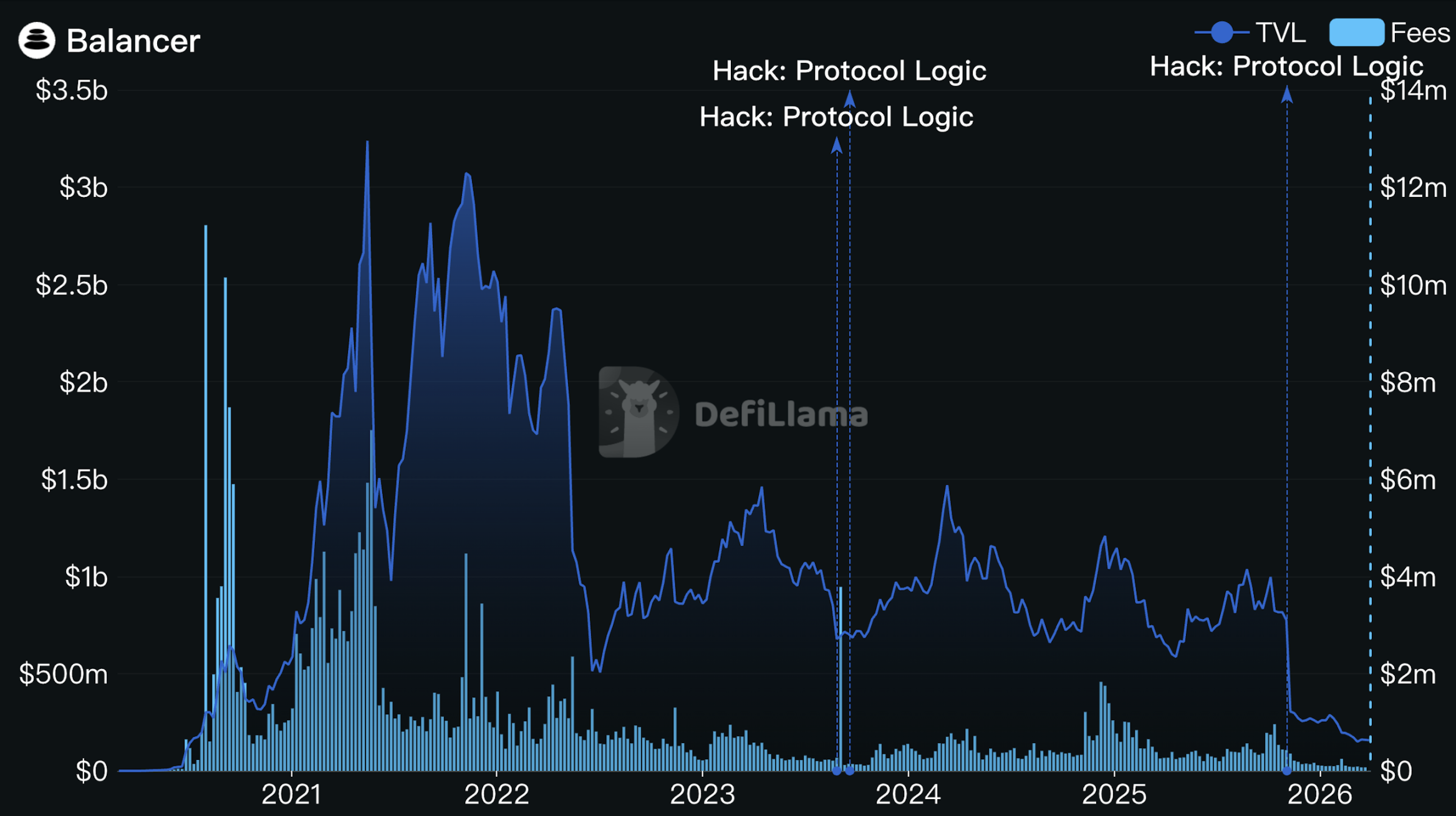
Following the security incident, Balancer’s TVL worsened further. Balancer’s TVL dropped from $800 million to around $300 million and has continued to decline since, with the current TVL below $160 million. It’s important to remember that at Balancer’s peak in 2021, its TVL once exceeded $3 billion.
Nguồn: DefiLlama
Balancer has officially reached a crossroads in its fate. On March 23, 2026, the Balancer core team simultaneously released two important governance proposals: a comprehensive overhaul of BAL tokenomics and an operational restructuring.
The core logic of both documents combined can be summarized in one sentence: abandon the token-release-driven growth model and shift towards revenue-driven sustainable operations.
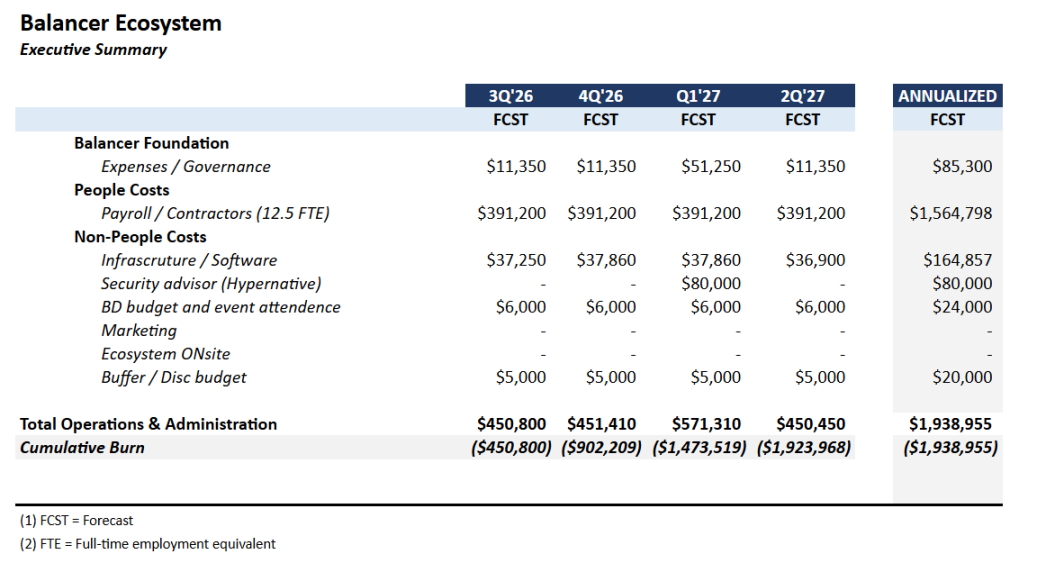
Operational Restructuring: Team “Downsizing,” Annual Budget Reduced by 34%
The proposal suggests formally dissolving Balancer Labs, with its core technical personnel transitioning as contractors into Balancer OpCo Limited, which will continue to operate as the DAO’s legal proxy entity.
The team size will be reduced from approximately 25 people to 12.5 full-time equivalents (including dedicated service providers like Con ongts and MAXYZ), and the annual operating budget will be lowered from $2.87 million to $1.9 million, a reduction of 34%.
The product line will also undergo significant narrowing. The team will concentrate resources on three products with validated commercial viability: Boosted Pools (flagship product), reCLAMM (to be relaunched after fixing vulnerabilities and possibly rebranding), and LBP (token launch pools, opportunistic operation).
Other exploratory directions, such as ETF-structured products, yield optimizers, and AI-driven liquidity tools, will only proceed subject to achieving “core KPIs.”
On-chain deployments will also be scaled back. The current model of maintaining V2 and V3 on over 9 chains is unsustainable. The team explicitly plans to retain four core chains: Ethereum, Gnosis, Arbitrum, and Base. Deployments on other chains will be reviewed individually based on fee revenue and operational costs, with termination for underperformance.
Mã thông báoomics Reform: A Complete Rebuild, Not Minor Tweaks
Stop BAL Emissions, Abolish veBAL
Upon proposal approval, Balancer will terminate BAL token incentive emissions without any transition period.
Simultaneously, the veBAL governance mechanism will be formally abolished. Holders will stop receiving any economic rewards after the final bi-weekly fee distribution. Their locked veBAL will become purely governance credentials, expiring naturally at the end of their lock-up periods.
This is a painful decision, but the underlying logic is clear: the veBAL mechanism has had a structural flaw prone to oligopoly since its design. Currently, Aura Finance (a veBAL meta-governance protocol) and whales already control a significant portion of the voting power, making genuine community voices increasingly faint in governance. This mechanism has not promoted the protocol’s healthy development but has instead become a vehicle for circular economic games — protocol funds flow to middlemen via incentives, and the middlemen’s votes direct more incentives towards themselves.
If veBAL was once an experiment by Balancer borrowing from Curve’s design, the team now frankly admits: the experiment is over, and the results did not meet expectations.
Regarding the termination of veBAL economic rights, Balancer stated it will provide a $500,000 compensation campaign, distributed directly to veBAL holders as pure cash compensation.
All Protocol Fees to DAO Treasury, Reduce V3 Protocol Fee Take
All protocol fees — V2 swap fees, V3 swap fees, Yield fees, LBP fees — will henceforth flow 100% to the DAO treasury, abandoning the old multi-party split mechanism.
Concurrently, the V3 protocol fee take rate will be reduced from 50% to 25%. This means that for the same transaction fee, liquidity providers (LPs) now receive 75% instead of 50%.
These two moves seem opposite in direction but share the same underlying logic: the former eliminates circular economics, allowing the treasury to obtain real, usable funds; the latter enhances LP attractiveness, trading a lower platform fee take for more organic liquidity and genuine trading volume.
The proposal estimates that post-reform, the DAO’s annualized revenue could reach approximately $1.22 million, over 4 times the current $290,000.
Exit Option: Burn BAL for Stablecoins at $0.16 per Token
The treasury will also allocate 35% of its assets (currently about $3.6 million) as a dedicated pool. This is not for actively buying BAL on the secondary market but for opening a “burn-for-stablecoin” channel: BAL holders can voluntarily send their tokens to a contract for burning and receive stablecoins of equivalent value at the NAV price (Net Asset Value, approximately $0.16 per token).
The window will open 12 months after proposal approval and last for 12 weeks. Any unused stablecoins will be returned to the treasury after the window closes. The 12-month waiting period is designed precisely to allow holders whose veBAL unlocks over time to participate.
As of writing, the BAL price is $0.1548, below the NAV price. Offering an exit at the NAV price provides those wishing to leave a more dignified option than a stampede on the secondary market.
If this channel is fully utilized, it would burn approximately 22.7 million BAL tokens, about 35% of the circulating supply, which is 6 times the current annual inflation emission.
9-Year “Runway” — Is It Enough?
If both proposals pass, the team’s projected financial model is as follows:
DAO annualized revenue approximately $1.22 million (assuming some TVL recovery after the V3 fee reduction), annual operating expenses $1.9 million, buyback expenditure about $3.6 million, plus the $500,000 veBAL compensation.
After completing the buyback and compensation, the treasury would still hold about $6.2 million. The annual funding gap would narrow from approximately $2.6 million to $700,000, resulting in a theoretical survival period of nearly 9 years.
For a DeFi protocol, 9 years is enough to span a complete industry cycle.
However, this model is built on optimistic assumptions: that the V3 fee reduction indeed drives more organic TVL; that the downsized team can truly support daily operations, security maintenance, etc.; and that core products (especially reCLAMM) can successfully regain market traction after fixes.
If any link underperforms expectations, the 9-year survival period will rapidly shorten. The team itself has explicitly stated that if DAO monthly revenue falls below $60,000 for 3 consecutive months, a revised plan must be submitted to the community.
For Balancer, this is a nearly all-or-nothing reform. Abandoning the once-proud veBAL mechanism, abandoning the complex multi-party split structure, and returning to an extremely streamlined starting point: letting real transaction fees drive protocol survival, not newly minted tokens sustaining false prosperity.
Whether this desperate reform will ultimately succeed will be left to the market and time, awaiting long-term observation.
Bài viết này được lấy từ internet: Abandoning Inflation, Abolishing veBAL: Can Balancer’s “All-or-Nothing Gamble” Bring Rebirth?
Related: Equity Swap for Tokens, Across Leads the “Rebellion”, DAO Model Faces Real-World Scrutiny
A DeFi project, Across Protocol, which has been operating for four years and raised tens of millions of dollars in funding, recently made a surprising decision to dissolve its DAO and transition into a private company. This veteran protocol’s leading “defection” is not merely an adjustment in corporate structure but reflects deeper challenges within the existing DAO governance model and tokenomics. Plans to Transition into a US Company, Token Holders Offered Equity or USDC Exit Options On March 11, Across published a temperature check proposal to transition from a DAO structure to a US C-Corporation. This marks a significant shift in the governance structure of the Across protocol, a first-of-its-kind move in the crypto space. Following the proposal’s release, the price of the ACX token unexpectedly surged. According to CoinGecko…
相关文章































 Tiếng Việt
  English
  繁體中文
繁體中文  简体中文
简体中文  日本語
日本語  العربية
  한국어
한국어  Bahasa Indonesia
  हिन्दी
  اردو
اردو  Русский