







Jensen Huang’s “Ignition” Fails: GTC Mentioned Optical Communication, So Why Did the Sector Cool Off?
After all, this narrative has been hot for too long. From CPO to silicon photonics, from optical modules to high-speed interconnects, the market has piled almost all its imagination about AI infrastructure upgrades onto this theme. Coincidentally, OFC 2026 was held the same week, with technical conferences from March 15th to 19th and the exhibition from March 17th to 19th. One event featured NVIDIA outlining its roadmap, the other showcased the muscle of the entire optical communication industry chain, naturally pushing the hype to a peak.
So, before Jensen Huang took the stage, the market wasn’t waiting for an ordinary speech, but for a spark. What people wanted to hear wasn’t “the future direction is fine,” but a clearer statement: In the next phase, optics is the main theme.
Unfortunately, Jensen Huang didn’t deliver that version of the speech.

Jensen Huang speaking at GTC. Source: The Business Journals
Jensen Huang clearly talked about optics, so why isn’t the market buying it?
The reason optical communication has been hyped so much lately isn’t just because it sounds advanced, but because the logic is too smooth—AI clusters are getting larger, data transmission pressure is increasing, copper will eventually hit bottlenecks, so isn’t the next step optics?
This story is too easy to believe. Precisely because it’s so easy to believe, the market naturally takes one step further: since the direction is so clear, realization shouldn’t be too far off.
So before GTC, many funds weren’t debating “whether optics will work,” but were betting in advance on whether Jensen Huang would frame it even more aggressively than expected.
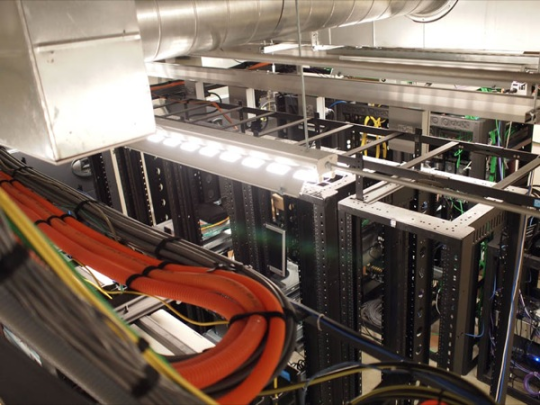
Data center server room and cabling. Source: The Fiber Optic Association
The issue isn’t whether he mentioned optics.
He certainly did, and he emphasized it. But what Jensen Huang actually said was that optics are important, but copper won’t be phased out anytime soon: “NVIDIA plans to continue using copper-based connectivity as well as newer optical technologies in upcoming platforms (including Vera Rubin Ultra and future systems).”
The market wanted to hear that optics would take over completely and immediately. This slight difference was enough to make the market turn first.
This is the market’s biggest discomfort, because what stocks often fear most isn’t bad news, but news that’s not as good as imagined.
The issue isn’t “whether optics are promising,” but “whether the payoff is immediate”
The most easily misinterpreted point this time is that many will understand it as “optics are done” or “copper won.”
Actually, neither is true.
A more accurate description is: The long-term logic for optics hasn’t changed; what’s changed is the market’s imagination about its realization speed. NVIDIA’s official technical blog description of the Vera Rubin platform actually makes this logic clear: larger-scale systems will use direct optical connections for rack-to-rack connectivity, but many positions within the rack will still be built on copper spines and pre-integrated copper cables.
Chỉ cần đặt, copper is still the mainstay in many places within the rack; optics’ importance only starts to rise significantly at larger scales, for cross-rack connections.
So, what GTC really corrected wasn’t the direction, but the timeline. Before, the market bought this narrative for a big future; now, the market is starting to ask: Who will realize this future first, and when?
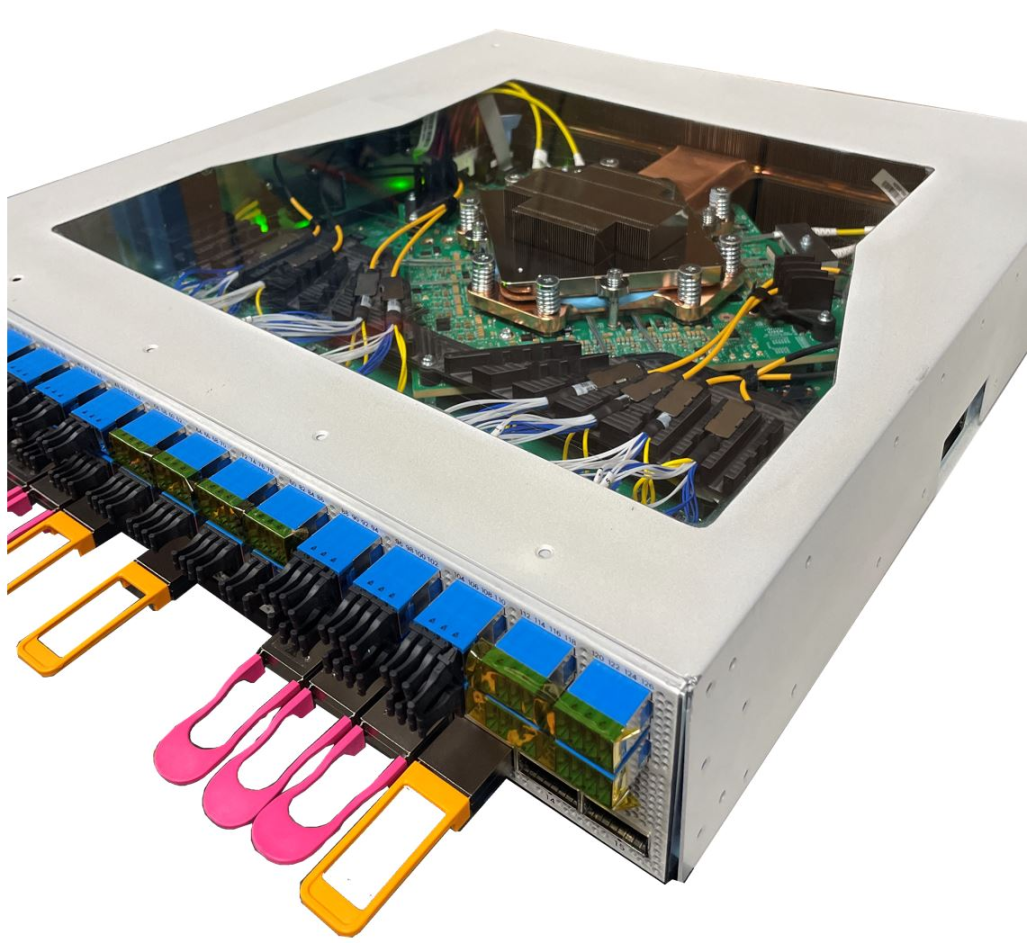
CPO equipment / system display. Source: Cisco Blogs
The market shifts from “full transition to optics” to “beginning to differentiate”
Precisely because of this, after the speech, it wasn’t “the entire sector surges together,” but first a period of confusion, then differentiation begins.
Barron’s summary of the market reaction is spot-on: the market interpreted Jensen Huang’s remarks as “both copper and optics will continue to be used,” which directly shifted the sector from a thematic trade of “anything optics-related goes up” back to a differentiated trade of “who truly benefits, and who was just lifted by hype.”
If we zoom in on individual stocks, this differentiation becomes more apparent.
- Lumentum (LITE.M) is still repeatedly discussed by the market not just because it belongs to the “optics” theme, but because in investors’ minds, it’s no longer just a concept stock; it’s been placed on the list of companies “with a real chance to enter the next-generation interconnect system.” That’s why, even if short-term sentiment fluctuates, the market’s understanding of it is more likely to stay at “a change in pace,” not “the logic is gone.” Barron’s noted that on March 17th, Lumentum was actually one of the few representative stocks that still closed higher;
- Coherent (COHR.M) is in a somewhat similar position to Lumentum, but the market won’t price it exactly the same. Because once the sector shifts from “telling a big story” back to “talking about implementation,” investors will care more about which layer each company actually benefits from, how long until realization, and whether expectations have already been priced in too much. It’s not that it lacks direction, but it’s more likely to enter a phase of “having logic, but needing to recalculate timing.” Barron’s same-day recap mentioned that Coherent’s performance was significantly weaker than Lumentum’s that day;
- Ciena (CIEN.M) is relatively special. It’s not like some high-beta names that are easily pushed up and then slammed down by sentiment. In this discussion, it’s more like a stock that makes the market think about “how optical networks will actually be deployed in the future.” Its significance isn’t just about riding a hot keyword, but reminding everyone: if large-scale AI infrastructure really needs continuous upgrades in the future, the final competition won’t be just about a component story, but about how the entire network capability moves forward. Barron’s post-GTC summary also placed Ciena in the “relatively stable within the optical chain” category;
- Applied Optoelectronics (AAOI.M) is more like the most typical high-beta representative in this rally. Such stocks are often the fastest to be pumped up by the market when sentiment is good; but conversely, as long as the catalyst isn’t strong enough to push expectations higher, they are also the first to bear selling pressure. Its volatility precisely illustrates one thing: when the market starts doubting “whether realization will be slower than imagined,” the first to be hit are often those that rose the fastest and had the most inflated expectations. Barron’s also placed AAOI on the pressured side in its March 17th report;
- Credo (CRDO.M) exposes another important change after this GTC: not everything related to “copper” automatically benefits. Jensen Huang made one thing clear this time—copper won’t exit immediately, but that doesn’t mean all copper-chain companies will be immediately rewarded by the market. Because funds will start asking more detailed questions: which segment of copper connectivity benefits the most? Short-reach? AEC? Or other parts? Barron’s recap shows that Credo also experienced significant volatility in this sentiment shift, which itself shows the market is no longer accepting the simple narrative of “everything goes up as long as you’re in the right theme”;
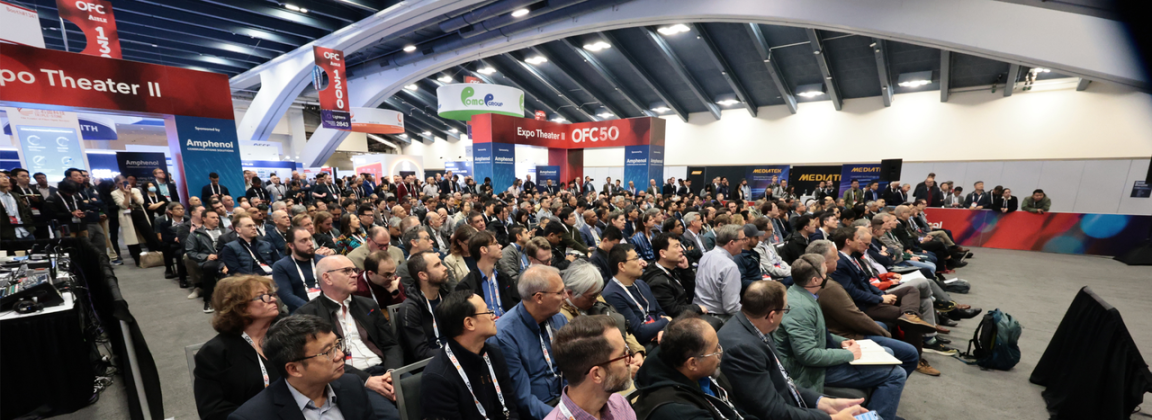
Live shot of OFC venue. Source: Public news images
Ultimately, looking at these stocks together, the most noteworthy point isn’t who rose or fell, but that the market has already started viewing them as assets with different positions, different realization timelines, and different levels of certainty.
In the previous phase, people were more willing to put them in the same basket, but starting after GTC, that basket is being unpacked. AI interconnect isn’t a multiple-choice question of “optics or copper,” but a division-of-labor question of “what gets used where first.”
In the end, Jensen didn’t deny optics; he just didn’t deliver the version the market most wanted to hear. So after GTC, the market is no longer just looking at “whether there’s a story,” but at “who is closer to implementation, who is closer to realization.” That’s why, even within the same optical communication theme, stock performance is starting to clearly diverge.
In the previous phase, many companies could still be traded together in the same basket; but from now on, the market will look more closely: who benefits first, who validates first, and who was just pushed up by sentiment.
The real differentiation has only just begun
The direction for optics hasn’t changed; what’s changed is how the market views this theme.
Before, people were more willing to pay for imagination first; next, the market will value realization more. So what will truly create a gap going forward isn’t who tells a better story, but who turns the story into performance earlier.
We’ll see.
Bài viết này được lấy từ internet: Jensen Huang’s “Ignition” Fails: GTC Mentioned Optical Communication, So Why Did the Sector Cool Off?
In the first month of 2026, the native token RIVER of the chain-abstract stablecoin system River experienced an extreme inverted V-shaped reversal within just four weeks. Starting from around $2 at the end of December 2025, it surged to a historical high above $87, marking a gain of over 2700%, before plummeting rapidly in just six days to a low near $11, a drop of 87%. This abnormal market volatility has drawn high attention from industry observers and on-chain data analysis firms. As third-party data agencies like Bubblemaps disclosed key evidence on January 27th, questions surrounding RIVER token price manipulation, highly concentrated early holdings, and profits for associated addresses are intensifying. New $12 Million Funding Round, Strongly Endorsed by Arthur Hayes The River project is developed by the RiverdotInc team,…
相关文章






























 Tiếng Việt
  English
  繁體中文
繁體中文  简体中文
简体中文  日本語
日本語  العربية
  한국어
한국어  Bahasa Indonesia
  हिन्दी
  اردو
اردو  Русский