







SpaceX is negotiating with Nasdaq, while Hyperliquid has already flipped the table
On February 8, 1971, the NASDAQ system went live.
There was no trading floor, no bell-ringing ceremony. It was simply an electronic quotation terminal, connecting over-the-counter dealers scattered across the United States into a network. A broker from the New York Stock Trao đổi glanced at it and didn’t think much of it. For two hundred years, the rule of stock trading was that you walked into that building, stood on that floor, and shouted bids face-to-face. What could a screen possibly change?
Twenty years later, Intel, Microsoft, and Apple listed on NASDAQ one after another. The era of tech stocks redrew the map of Wall Street. The NYSE began to catch up, acquiring the electronic trading platform Archipelago in 2006.
Another twenty years later, in 2026, SpaceX is negotiating with NASDAQ, demanding inclusion in the NASDAQ-100 index within 15 trading days after its IPO. If that can’t be done, it can go to the NYSE.
Each time, rules yield to sufficient power, but this time is different from before.
The rise of NASDAQ in 1971 was a new type of exchange using technology to leverage old rules. The NYSE’s transformation in 2006 was an old exchange surrendering to new technology. And the scene in 2026 is a company that hasn’t even gone public yet, demanding a market system with a two-hundred-year history to change its process for it.
This is not just a story about SpaceX’s IPO; it’s a cross-section of a shift in the direction of capital market gravity.
The Funding Window Is No Longer the Exclusive Domain of IPOs
What is the purpose of going public? The textbook answer is fundraising.
This answer was accurate in the 1990s. Back then, public markets were almost the only place that could provide large-scale, long-term capital for companies. SoftBank hadn’t yet created the Vision Fund, sovereign wealth funds didn’t touch tech stocks, and the private secondary market barely existed. If you wanted truly big money, there was only one path: knock on the exchange’s door, undergo audits, scrutiny, pricing, and then pray for a smooth roadshow.
Microsoft went public on NASDAQ on March 13, 1986, raising $61 million with a market cap of about $777 million. At the time, the company’s annual revenue was less than $200 million. It needed that money to expand its product line, recruit engineers, and seize the standard position in PC operating systems.
Forty years later, this logic is no longer the only answer.
SoftBank Vision Fund, Tiger Global, Coatue, a16z… an entire ecosystem of institutional capital has pushed the firepower of the private market to an unprecedented scale. A company can grow all the way to a $50 billion or even higher valuation in the private market, never touching the public market throughout the entire journey.
Revolut is the most direct proof. On November 24, 2025, this London-based digital bank completed a secondary equity transfer round, reaching a valuation of $75 billion. Lead investors included Coatue, Greenoaks, Dragoneer, and Fidelity, with participants including a16z, Franklin Templeton, and even Nvidia’s venture arm, NVentures.
Full-year 2024 revenue was $4 billion, up 72% year-over-year, with pre-tax profit of $1.4 billion. When asked about the IPO timeline, CEO Nik Storonsky said: We are building the world’s first truly global bank; an IPO is not a priority.
What does $75 billion mean? This figure exceeds the market capitalization of Barclays, Deutsche Bank, and Lloyds Bank on public markets. A private company received a higher valuation in a private transaction than listed banks.
And recently, there have been reports that Revolut will conduct another secondary share sale in the second half of 2026, with a valuation of $100 billion.
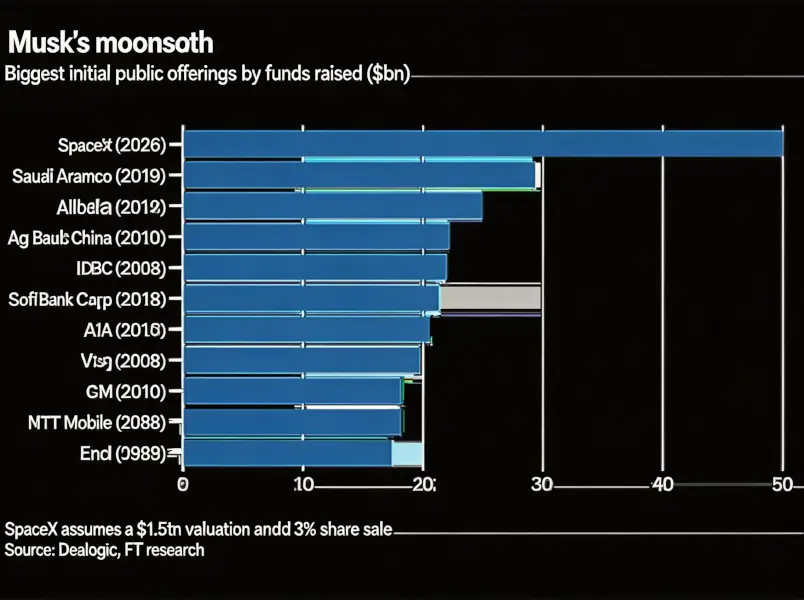
SpaceX completed a similar layout earlier. Its private funding rounds covered all the capital needs for three product lines: rocket development, Starlink deployment, and deep space exploration. According to Reuters, SpaceX plans an IPO with a valuation of about $1.75 trillion. If it goes public, it would become the largest IPO in history by fundraising size and immediately rank as the sixth most valuable company in the US, behind only Nvidia, Apple, Microsoft, Amazon, and Alphabet.
Then there’s Stripe. This payments company processed $1.9 trillion in transaction volume in 2025, a 34% increase year-over-year. In February 2026, through an employee equity buyback round, its valuation reached $159 billion. Co-founder John Collison was blunt in an interview: An IPO for us is just “a solution looking for a problem.”
These companies are not avoiding IPOs because of poor market conditions; it’s because they no longer urgently need public market money. The private market provides capital on a comparable scale, along with fewer regulatory constraints and disclosure requirements.
But not needing money doesn’t mean not needing to go public.
Index Inclusion, the Real Trophy
Fundraising is only the first layer of motivation for going public. The second layer is liquidity for people.
SpaceX has thousands of employees holding options and RSUs internally. The company has allowed some employees to cash out early through tender offers in recent years, but this method has quota limits, frequency limits, and pricing is company-led, not market-driven.
For a company with tens of thousands of employees, this pipeline is too narrow. Only the public market can provide a real, continuous, market-priced liquidity exit.
The same pressure exists on the VC side. Revolut’s shareholder list includes a16z, Fidelity, Coatue. The LPs of these funds need not just growth in paper valuation, but real cash returns. The private secondary market can solve part of the exit demand, but its scale and efficiency are far inferior to the public market. When a fund matures, LPs want to take their money and leave; paper wealth doesn’t count.
So these companies still need to go public, but the combination of driving variables has changed. The need for fundraising has decreased significantly. Employee liquidity and VC exits remain essential needs. And on top of these traditional motivations, a structural force that has been underestimated by most over the past decade is rapidly gaining weight.
In 1975, John Bogle founded the first index fund for ordinary investors at Vanguard, tracking the S&P 500. Wall Street’s reaction was ridicule. Active stock picking was professional; passive following was a lazy man’s strategy. No one wanted to buy a mediocre product.
Half a century later, the lazy man won.
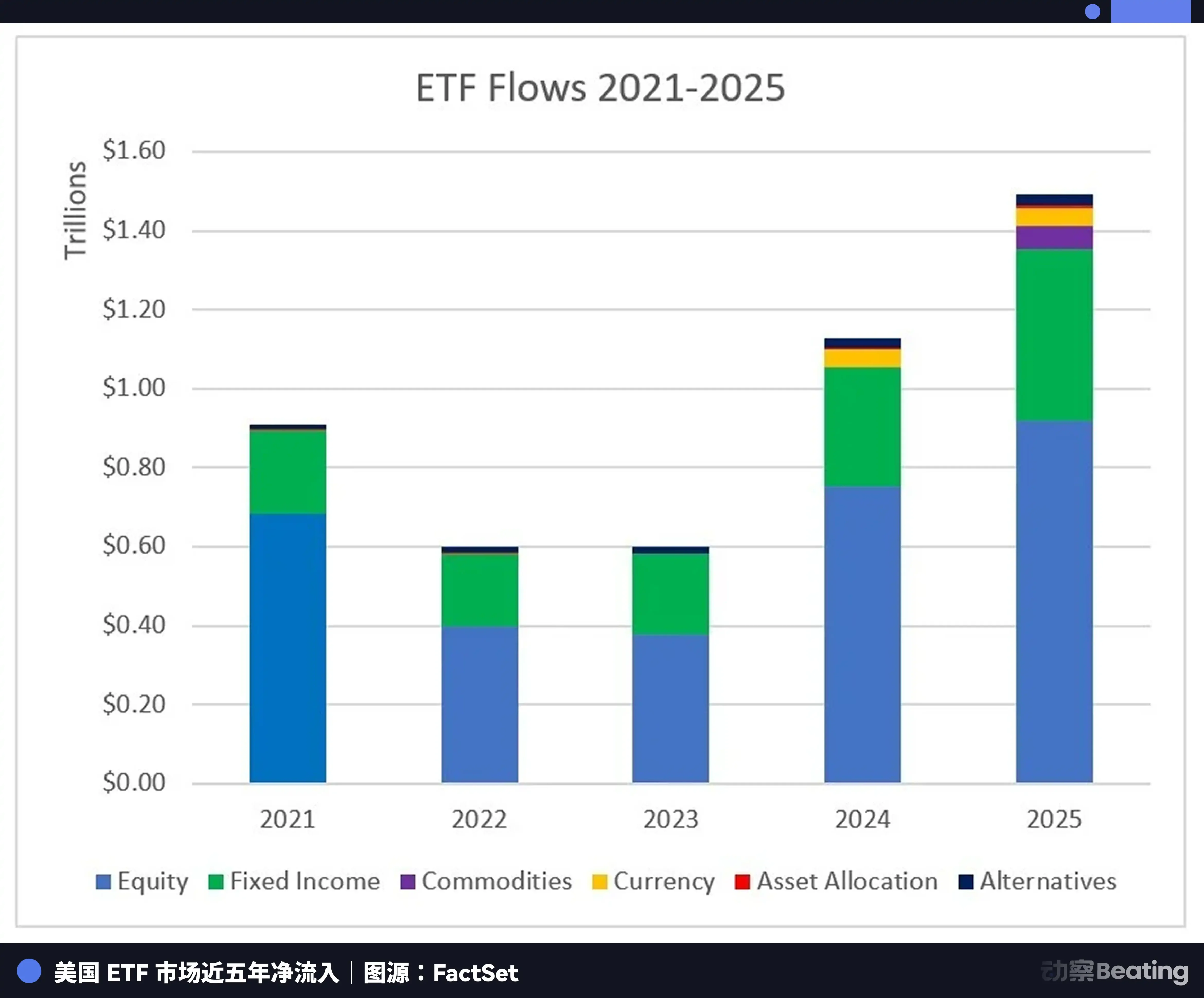
As of March 2025, assets under management in US passive funds (including mutual funds and ETFs) reached $15.96 trillion, accounting for 51% of all mutual fund industry assets, surpassing actively managed funds for the first time. In 2025, the US ETF market saw net inflows of $1.49 trillion, a historical record, with equity ETFs absorbing $923 billion.
Behind these numbers lies a mechanical logic. Once a stock is included in an index, all funds tracking that index must allocate to it according to its weight. No subjective judgment, no waiting for the right time—forced buying. And as long as the company remains in the index, the funds hold it perpetually.
One point needs clarification: passive funds are price takers, not price setters. Price discovery for stocks is still primarily done by active capital—analyst research, institutional trader games, hedge fund bets.
But what passive funds do is equally crucial. They provide a massive, stable, non-discretionary holding base. This base doesn’t panic sell because of a quarterly earnings miss, doesn’t cut positions because the CEO tweets something; it’s ballast.
For a company of SpaceX’s caliber, the value of this ballast is quantifiable.
SpaceX’s expected IPO valuation is about $1.75 trillion, which would directly place it in the top six of the NASDAQ-100. According to current rules, newly listed companies typically need to wait up to a year to be eligible for inclusion in major indices like the S&P 500 or NASDAQ-100. This waiting period was originally designed to verify whether a company could withstand the liquidity pressure from large-scale institutional buying.
But for SpaceX, this waiting period means that funds tracking the NASDAQ-100, including the Invesco QQQ managing over $400 billion, cannot allocate to one of the world’s top ten most valuable companies for up to a year. The tracking error would become unacceptable.
The pressure is not on SpaceX; it’s on the index funds themselves.
Therefore, NASDAQ proposed the “Fast Entry” rule. If a newly listed company’s market cap can rank within the top 40 of existing constituents, it can be accelerated for inclusion 15 trading days after listing. This rule is still under approval, but NASDAQ itself admits it was designed to attract high-valuation private companies like SpaceX, Anthropic, and OpenAI.
SpaceX made fast inclusion a prerequisite for choosing an exchange. It has the leverage to do so because the inherent needs of the passive index system have given it bargaining power.
Some might ask, if the core goal is index inclusion, why not do a direct listing? A direct listing saves underwriting fees, can also list, and can also enter the index.
The answer lies in scale.
SpaceX’s IPO is expected to raise over $25 billion. It needs to create a sufficiently large float on its first trading day to meet the liquidity threshold for passive fund allocation. A direct listing has no new share issuance; the first-day float depends entirely on how much existing shareholders are willing to sell. For a company with a $1.75 trillion market cap, if the first-day float is too small, passive funds simply cannot complete their position building, causing severe price distortions.
The structured issuance of an IPO is precisely the tool to pave the way for large-scale passive capital entry. This logic, in turn, explains why Revolut and Stripe are in no hurry.
Revolut’s $75 billion placed into the NASDAQ-100 would have limited weight, and the passive buying it would trigger would be disproportionate. Also, its delay has other practical reasons, such as its banking license still being in the finalization process, and management wanting a few more quarters of profitable data to solidify the valuation narrative.
But the arithmetic of index weight is also part of the calculation. Stripe’s $159 billion valuation is already significant, but John Collison says an IPO is not a priority. The underlying judgment might be similar: wait until the valuation grows further and the weight upon index inclusion becomes more meaningful, then the structural benefits of an IPO can be maximized.

The value equation of going public is being rewritten.
Fundraising is taking a back seat. Employee liquidity and VC exits are the fundamentals. And the perpetual holding base brought by index investing is becoming a new variable determining the timing of an IPO. It’s not the only variable, but its weight has been rising continuously over the past decade, and in the case of SpaceX, it has been publicly placed on the negotiating table for the first time.
So, what is the role of exchanges in this game?
Ambushed by the Hyperliquids
NASDAQ changed its index inclusion rules for a company that hasn’t even gone public yet.
And ICE, the parent company of the NYSE, invested $2 billion in the prediction market platform Polymarket in October 2025, at a valuation of about $8 billion. In March 2026, ICE took a stake in the mật mã exchange OKX at a $25 billion valuation, securing a board seat.
On the surface, these two things are competitive strategies, but at their core, they share the same anxiety: the scarcity of gatekeepers is disappearing.
There used to be an unwritten boundary between the NYSE and NASDAQ. Traditional industries went to the NYSE; tech and emerging industries went to NASDAQ. This boundary held for decades, with both sides maintaining monopolies in their respective lanes.
That tacit understanding is now broken.
The structure of ICE’s investment in OKX is worth a closer look. OKX’s 120 million users will gain access to ICE’s US futures market and tokenized trading of NYSE-listed stocks. ICE, in turn, gains access to OKX’s real-time mật mãcurrency pricing data for developing regulated crypto futures products.
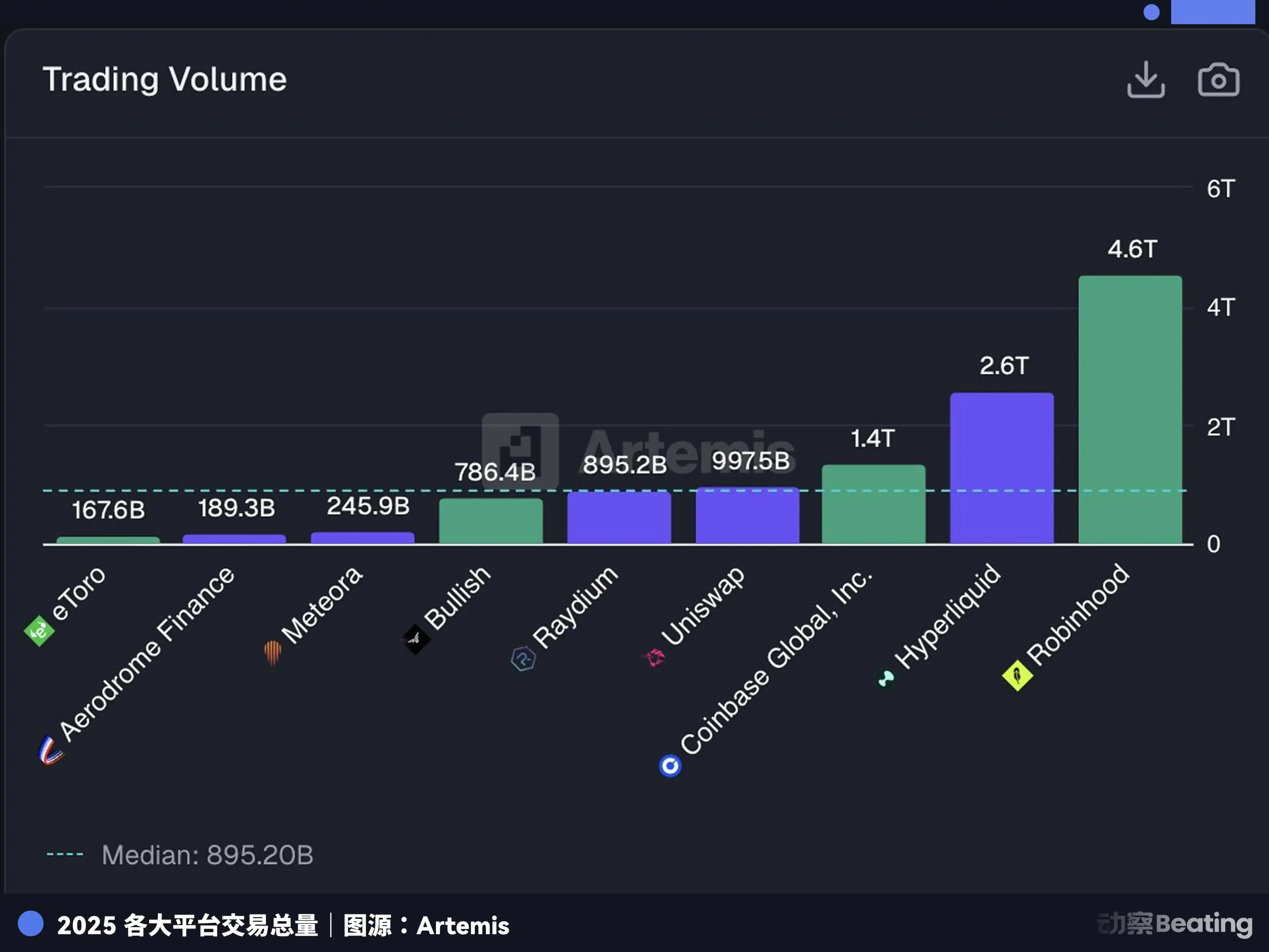
ICE Vice President Michael Blaugrund was blunt: In the future, ICE’s competitors might not necessarily be traditional institutions like CME or NASDAQ; they could be DeFi protocols or super apps. He named Robinhood and Uniswap.
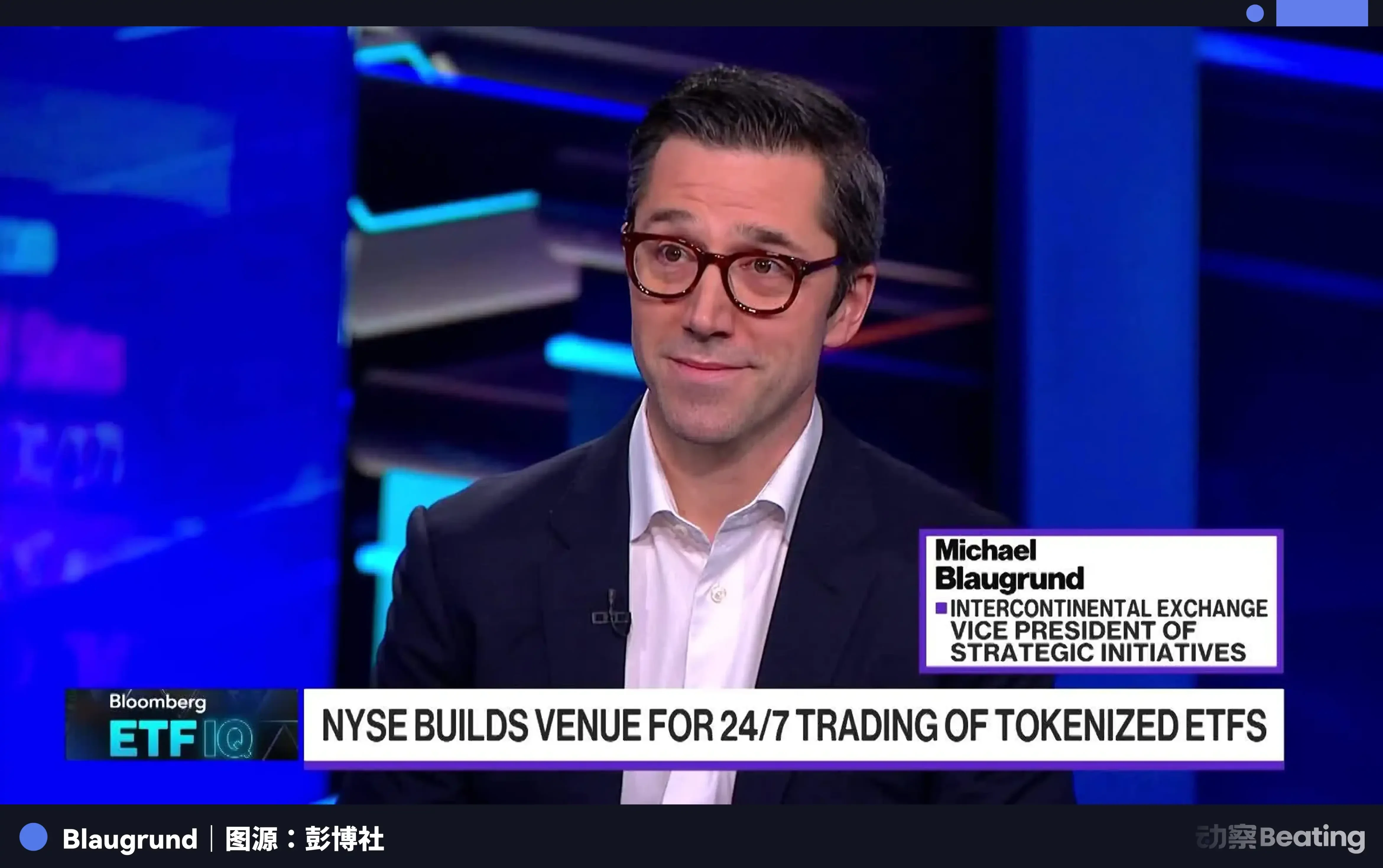
A company that owns the NYSE publicly admits that its future rivals could be a decentralized protocol. That statement itself is a signal.
The investment logic for Polymarket is similar. ICE isn’t buying a prediction market platform; it’s buying an entry point to on-chain trading infrastructure. The cooperation includes institutional distribution of Polymarket data and future tokenization projects.
In the 1990s, NASDAQ pierced the NYSE’s floor monopoly with electronic trading. The weight shifted, but the structure didn’t disappear. Today, on-chain infrastructure is replaying that script, eroding the share of derivatives and alternative assets at the edges of exchanges.
Hyperliquid provides the most specific cross-section.
This decentralized exchange had an annual trading volume of $2.95 trillion in 2025, with a daily average of about $8.34 billion, annual revenue of $844 million, and over 600,000 new users. For reference, Coinbase’s trading volume during the same period was about $1.4 trillion. An on-chain protocol with no corporate entity, no CEO making public appearances, had twice the trading volume of NASDAQ-listed Coinbase.
More noteworthy is the change in its user structure.
In 2025, Hyperliquid launched on-chain perpetual contract trading for global stocks like the S&P 500, NASDAQ index, gold, crude oil, Nvidia, and Tesla through its HIP-3 protocol. Among the top 30 markets by trading volume on its tokenization platform trade.xyz, only 7 were crypto trading pairs. On March 15, the total open interest in HIP-3 markets hit a historical high of $1.43 billion, a 100-fold increase in six months, with trade.xyz alone accounting for 90%.
In March, escalating tensions in the Middle East caused sharp oil price volatility. Traditional futures exchanges were closed on the weekend, and a group of professional traders flooded into Hyperliquid. These were not retail investors; they were professional futures traders drawn by 24/7 non-stop trading, on-chain transparency, and higher capital efficiency. While traditional exchanges were still opening and closing on schedule, on-chain markets had turned “all-weather liquidity” from a concept into a reality.
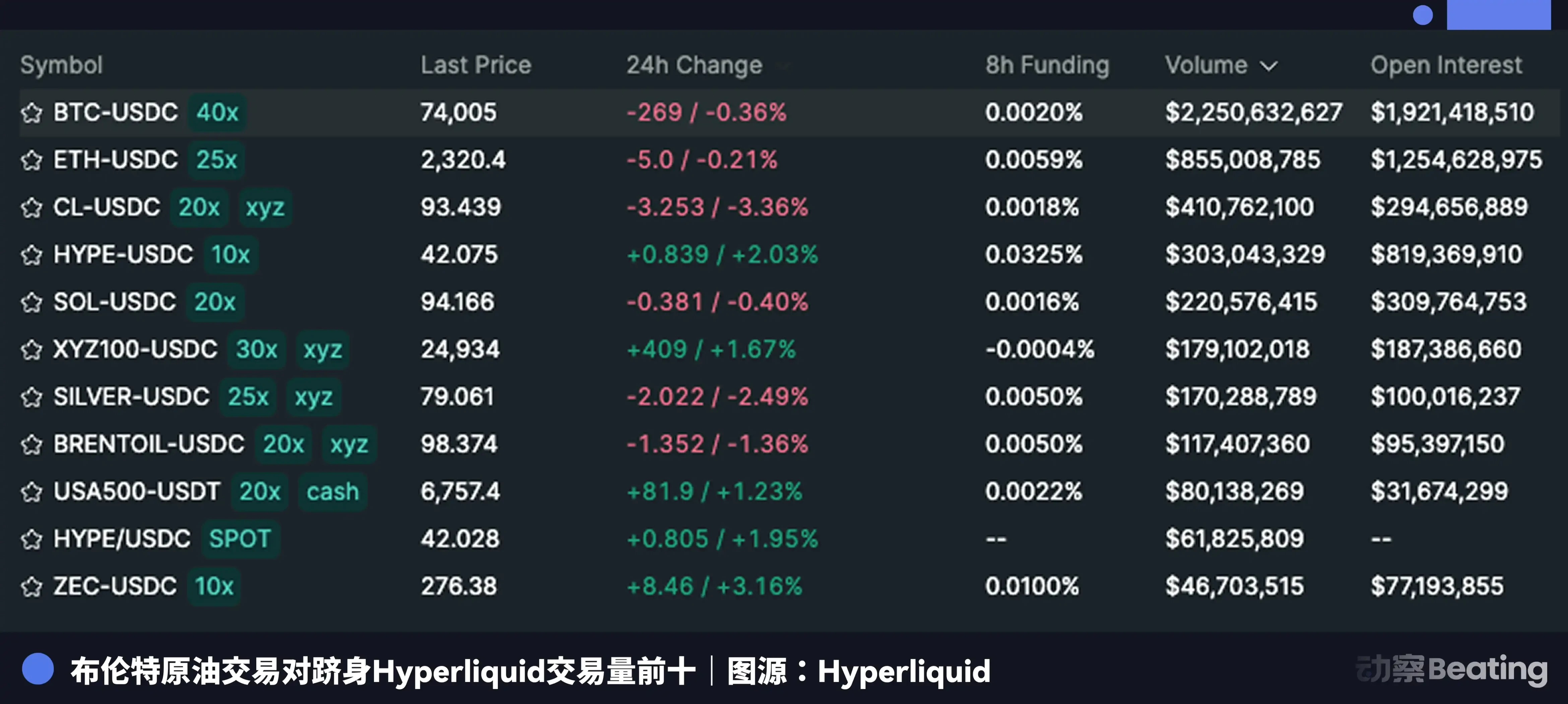
These numbers and the current IPO business of exchanges are not on the same track; direct competition between them is very limited. But ICE’s concern is not about today; it’s about the trend.
When on-chain infrastructure can host perpetual contract trading for global stocks, when professional traders start using on-chain tools for hedging and speculation, when the liquidity of tokenized stocks gradually approaches that of traditional exchanges, the moats of exchanges are being bypassed bit by bit.
The NYSE chose to invest in on-chain players; NASDAQ chose to change its own rules. Both actions point to the same judgment: the era of defending position through monopoly is over; proactive expansion is the only option.
Epilogue
In 1971, no one thought NASDAQ’s electronic quotation terminal was a threat. In 2006, no one thought the NYSE would actively dismantle its own trading floor. In 2026, no one knows how far Hyperliquid and the on-chain infrastructure it represents will go.
But after each rule yields, the old structure doesn’t disappear; it just re-stratifies.
The NYSE still exists today, still powerful, just no longer monopolizing pricing power. NASDAQ will become even stronger after SpaceX’s IPO; that perpetual holding base will continue to grow as market caps expand. ICE’s logic in investing in OKX and Polymarket is the same: if on-chain trading is inevitable, then become the infrastructure supplier for the on-chain world, rather than waiting to be bypassed.
The on-chain system won’t disappear either; it will likely grow even stronger, becoming the new infrastructure.
In a world where two systems coexist, where will the next company that is big enough and confident enough to set conditions go knocking? Or, to put it another way, will it even need to knock?
Bài viết này được lấy từ internet: SpaceX is negotiating with Nasdaq, while Hyperliquid has already flipped the table
Related: After Mainland China’s Document No. 42 Sets the Tone, What is the Best RWA Mã thông báo Standard?
Looking at on-chain data, from early 2025 to early 2026, on-chain RWA-type assets surged fivefold, reaching a scale of $23.7 billion, a market that can no longer be underestimated. 1. How to Understand Document No. 42 In the author’s view, reading the original text together with the attached document “Regulatory Guidelines on the Mã thông báoization of Domestic Assets for Overseas Issuance of Asset-Backed Securities” reveals a lot. The core point is that Document No. 42 dedicates significant space to bất chấpning and regulating “Real World Asset Tokenization” (RWA). This essentially amounts to the regulatory authorities formally acknowledging RWA as a business model and providing a path for compliant application and filing. There are three key pieces of information. I will present them in the original text and then interpret the context. First,…
相关文章
































 Tiếng Việt
  English
  繁體中文
繁體中文  简体中文
简体中文  日本語
日本語  العربية
  한국어
한국어  Bahasa Indonesia
  हिन्दी
  اردو
اردو  Русский