







Kalshi has issued a $10 billion free lottery ticket, remember to scratch it
Author | Azuma (@azuma_eth)

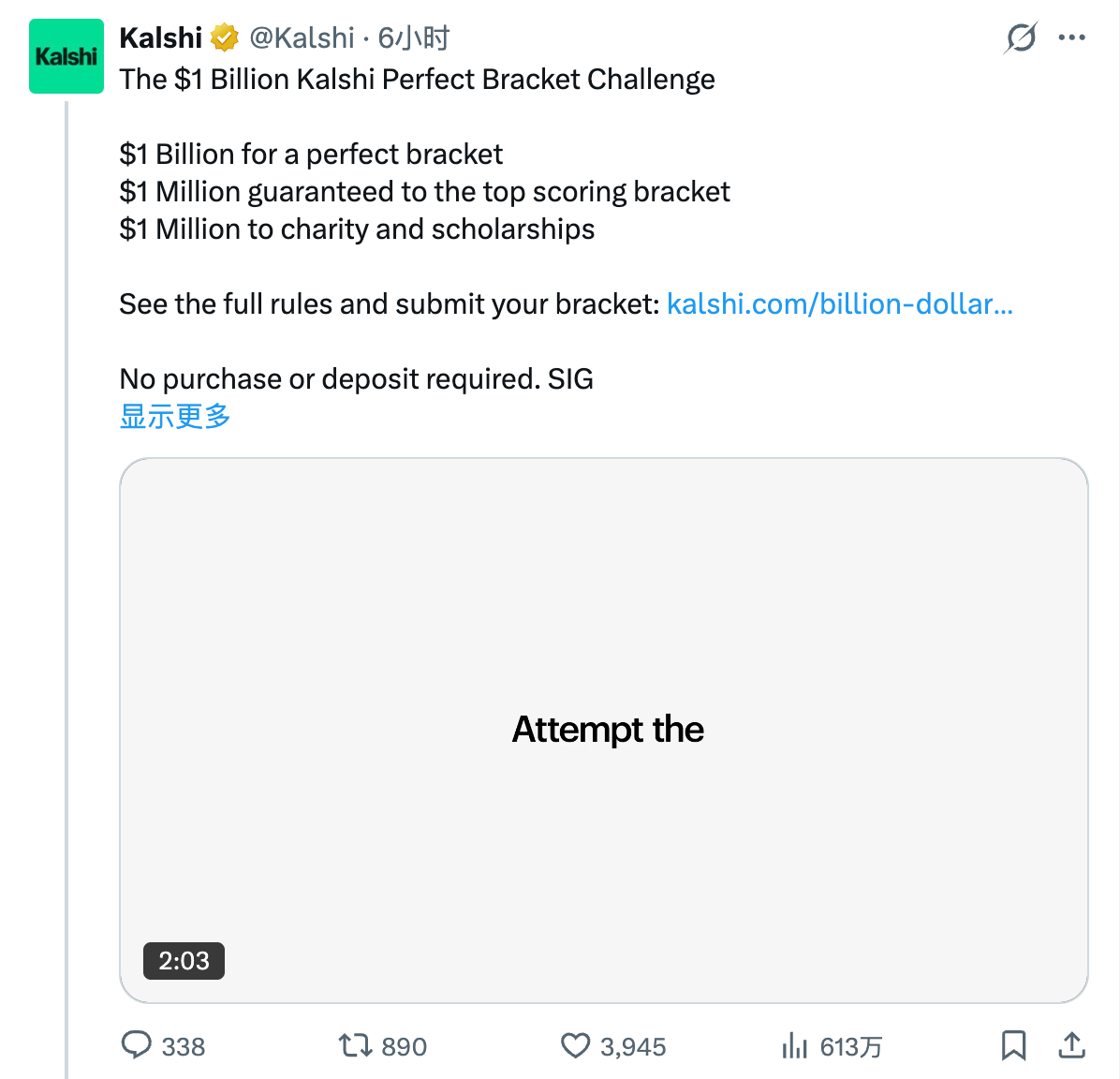
In the early hours of March 17, the prediction market Kalshi announced on X that, following the example of the “Oracle of Omaha” Warren Buffett, it would launch a “Perfect Bracket Challenge” for the upcoming NCAA “March Madness” tournament. The user who perfectly predicts the outcome of every matchup will take home a super prize of $1 billion.
“March Madness”: America’s Hottest Basketball Feast
The so-called “March Madness” refers to the NCAA Division I Men’s Basketball Tournament held by the National Collegiate Athletic Association (NCAA) every March. The tournament gets its name because it typically begins in March, features a single-elimination format, and has an intense, packed schedule.
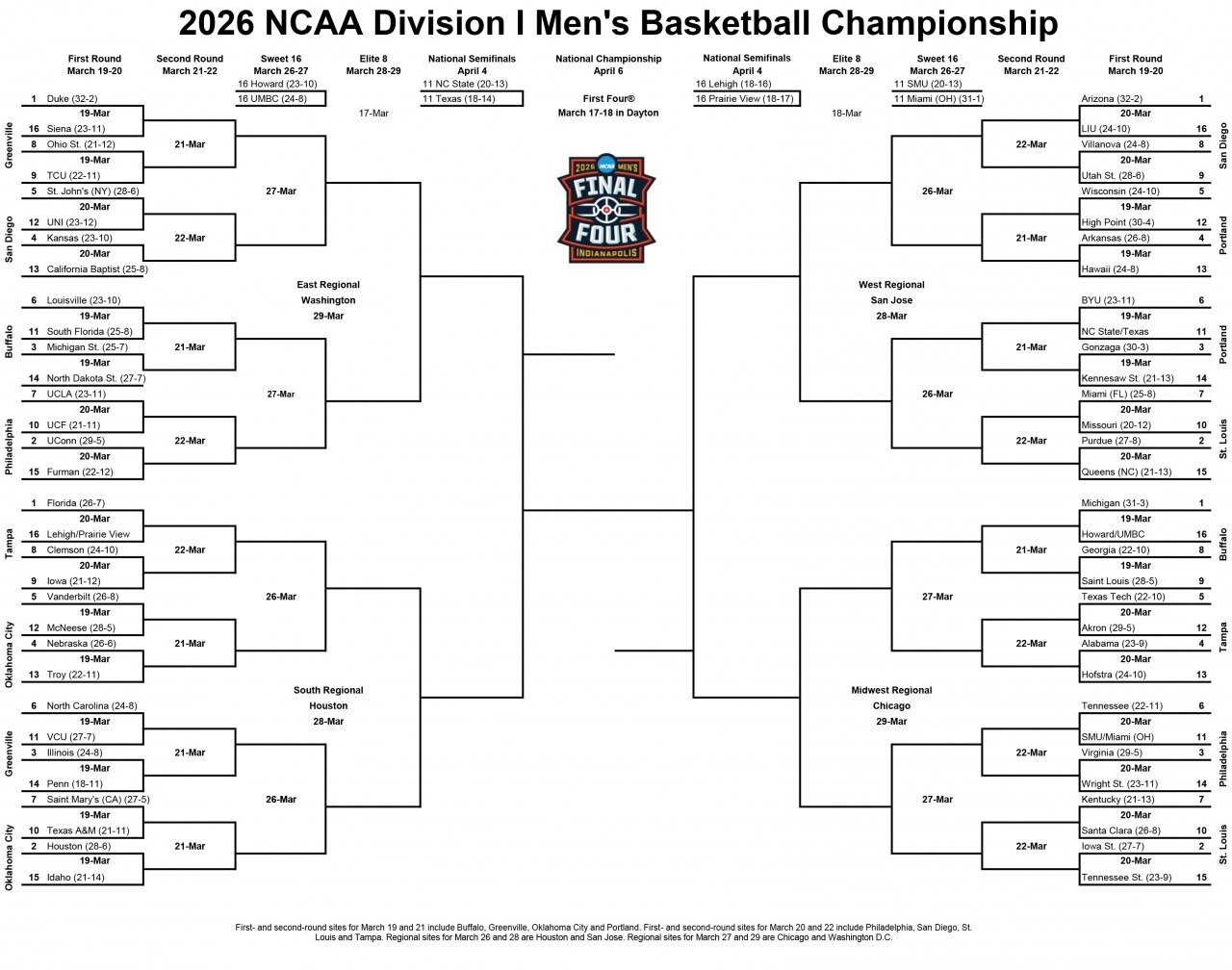
According to the schedule confirmed by yesterday’s bracket selection, the 2026 “March Madness” will officially tip off on March 18 (tomorrow) Beijing Time. The 68 university teams that have earned their “March Madness” berths through months of regular-season battles will now compete for the championship. The action starts with the First Four play-in games, where 4 of the 8 play-in teams will be eliminated immediately. The remaining 64 teams will then battle through five rounds of single-elimination games (Round of 64 → Round of 32 → Sweet Sixteen → Elite Eight → Final Four → Championship Game) to crown the ultimate winner.
As the most-watched collegiate basketball event in the United States, compared to the NBA, which features professional clubs, the NCAA, centered around universities, often fosters a stronger sense of “home team” identity among the general public. During “March Madness,” current students, alumni, and even the local communities of each university spontaneously rally behind their alma mater. Because of this, the atmosphere of nationwide participation this event creates can, in some ways, even surpass the hype of the NBA Finals.
From a competitive standpoint, while college players’ overall skill level is still difficult to compare with that of professionals, the unique aspect of “March Madness” is that the stage window for most participants is extremely limited—typically only 1 to 4 years. The most elite talents among them often enter the NBA after their freshman season. This “fleeting” opportunity makes every possession in the games feel more urgent—once they step onto the court, almost everyone competes with everything they have.
Meanwhile, 2026 is widely regarded as a strong NBA draft year, further amplifying the attention on this year’s tournament. Players like Darien Peterson from the University of Kansas, AJ Dybantsa from Brigham Young University, and Cameron Boozer (son of Yao Ming’s rival Carlos Boozer) from Duke University are seen as generational talents, potential contenders for the No. 1 overall pick in next year’s NBA draft. The direct matchups between these “future stars” add a layer of foresight into the future NBA landscape to this year’s “March Madness,” beyond just its entertainment value.
A Deluge of Traffic: Prediction Chợs Can’t Miss Out
During “March Madness,” filling out “brackets” to predict game outcomes through sports betting services is already a major tradition in the United States. How could specialized prediction markets miss this opportunity?
Currently, prediction markets like Polymarket and Kalshi have already launched prediction events related to the “March Madness” tournament. Polymarket has even included it among the first batch of pilot fee-based sports events, seemingly preparing to cash in big during the upcoming tournament frenzy.
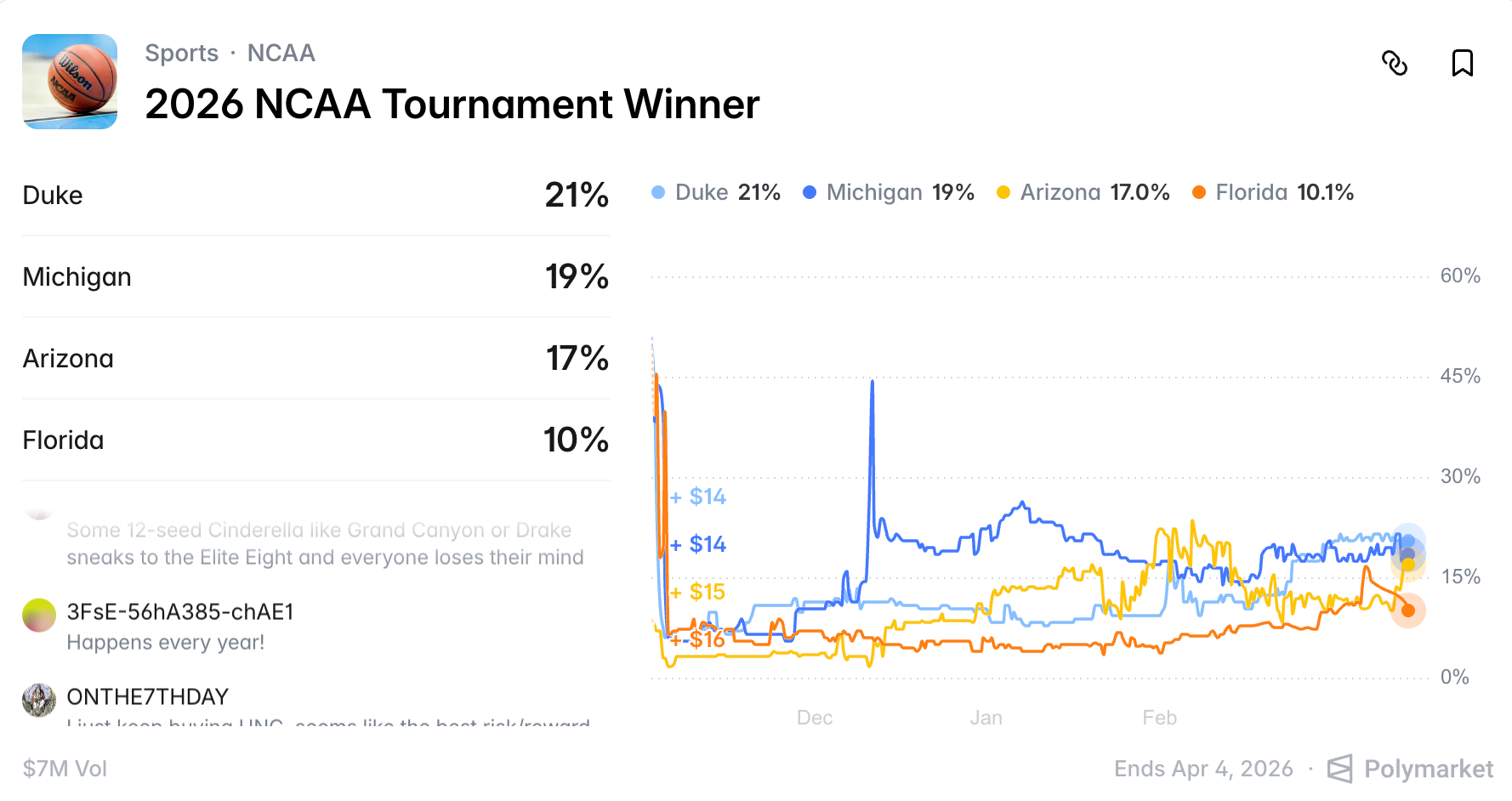
Polymarket’s real-time probability data shows that the current top four universities in the “March Madness” championship odds are the No. 1 seeds from the four major regions:
- Duke University, featuring next season’s potential NBA No. 1 pick Cameron Boozer, ranks first at 21%;
- The University of Michigan ranks second at 19%;
- The University of Arizona ranks third at 17%;
- Defending champion, the University of Florida, ranks fourth at 11%.
On the other side, Kalshi, following Buffett’s lead this morning, launched a blockbuster “$1 Billion Prize” campaign. All users can submit a prediction bracket for free on Kalshi, and the user who perfectly predicts the outcome of every game will win $1 billion. If no one achieves a perfect prediction, Kalshi will award $1 million to the user with the best prediction record and allocate another $1 million to support charitable organizations.
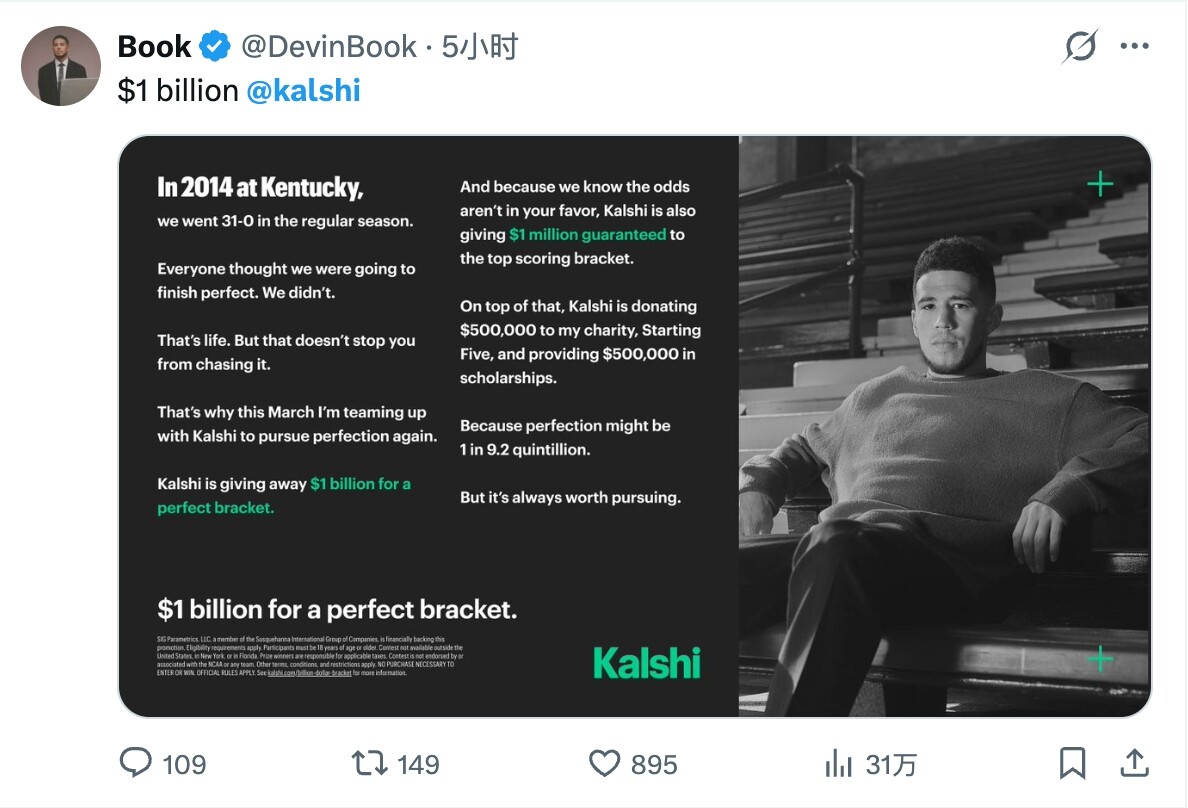
It’s worth mentioning that Kalshi also enlisted NBA star Devin Booker to help promote the campaign. In 2014, Booker’s University of Kentucky team achieved an undefeated 31-0 record in the regular season and was heavily favored to win the national championship that year. However, they lost to the University of Wisconsin 64-71 in the semifinals. Booker entered the NBA the following year, leaving that regret unfulfilled for life.
Buffett Has Offered the Prize for 12 Years, But No One Has Claimed It
The reason for mentioning that Kalshi’s prize is emulating Buffett is that Buffett himself established a similar prize as early as 2014—employees of his Berkshire Hathaway company who correctly guess the outcome of all tournament games could win a massive $1 billion prize, paid out by the company over 40 years (or a lump sum of $500 million can be chosen).
However, due to the immense difficulty of a perfect prediction, the prize has never been claimed. Buffett later lowered the guessing difficulty several times (with the reward adjusted accordingly). It wasn’t until last year that an anonymous employee from FlightSafety International, a Berkshire Hathaway subsidiary, correctly predicted 31 out of 32 first-round games and claimed the scaled-down million-dollar prize.
How difficult is a perfect prediction? The most classic number circulating in the industry is “1 in 9.2 quintillion.” This probability stems from the following mathematical calculation: Assuming each game is a 50% vs. 50% coin flip (completely random), disregarding seed strength, odds, or historical patterns, “March Madness” has a total of 63 games (excluding the First Four). The number of possible permutations and combinations would then be 2^63, which written out is 9,223,372,036,854,775,808… If you were to write down all these possibilities on paper, the weight of the paper would reach 180 trillion tons, equivalent to the weight of 500 million Empire State Buildings…
Does it seem utterly impossible? Don’t worry, I’ll help you significantly increase the odds!
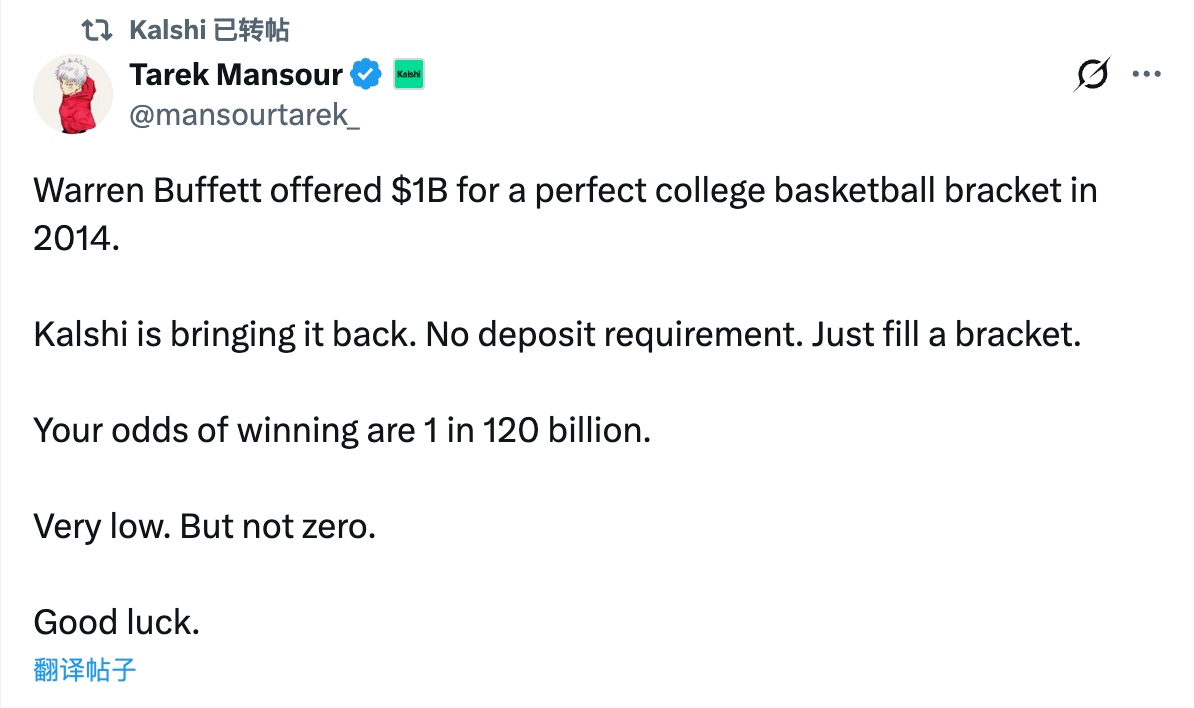
Kalshi CEO Tarek Mansour, speaking about the campaign this morning, stated that the probability of a perfect prediction is about “1 in 120 billion.” The reason for the vast difference between these two probabilities is that this figure is based on a more realistic model—sports games aren’t 50/50; stronger teams tend to win more often. After weighting calculations based on historical win rates and related odds, academic and statistical circles typically estimate the probability of a perfect “March Madness” bracket to be between “1 in 10^11 to 1 in 10^13.” “1 in 120 billion” falls within this range.
Yet, even “1 in 120 billion” means the possibility is virtually zero. Clearly, Kalshi is playing the same probability game as Buffett, betting that no one will be able to claim that $1 billion.
The Community is Gearing Up, AI Could Be the Key to Breaking Through
Following the announcement of Kalshi’s prize campaign, it immediately sparked widespread discussion on social media—after all, the prediction is free, what if you hit it?
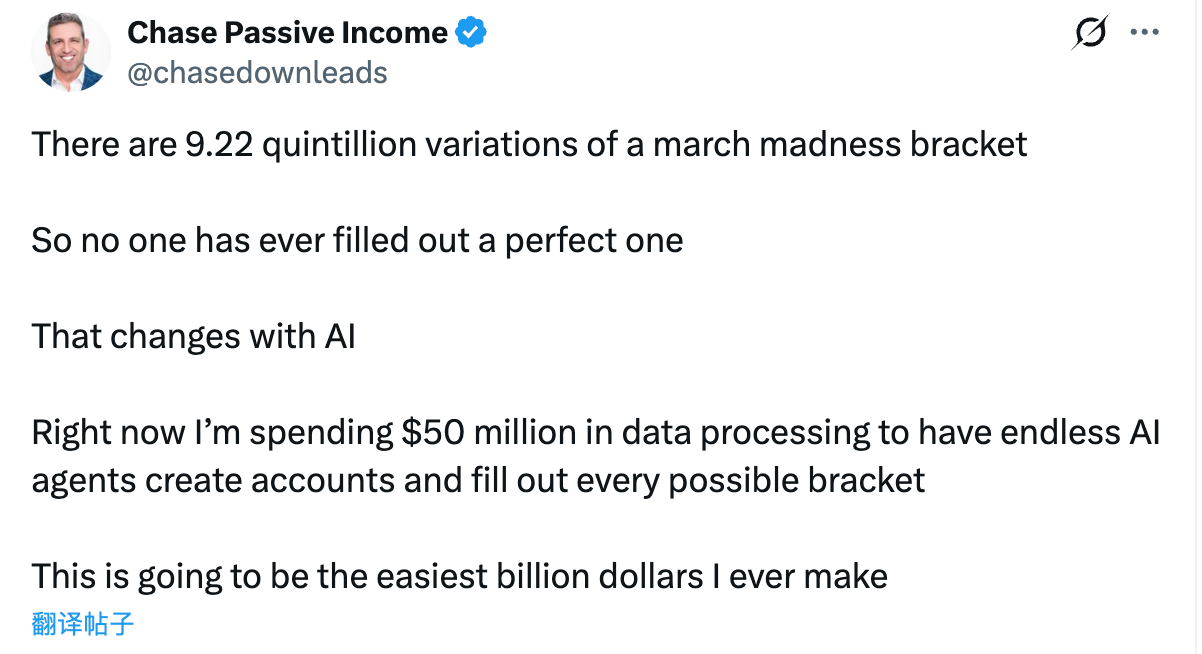
This time, many users are pinning their hopes on the breakthrough revolution of AI. Overseas KOL Chase Passive Income posted on X, stating he would spend $50 million on data processing, having countless AI agents create accounts and fill out all possible brackets, calling it “the easiest $1 billion ever made.”
Will the unsolvable probability puzzle persist? Can AI create a miracle? Until the national champion of “March Madness” is crowned, no one knows the answer.
As spectators, besides waiting to watch the games and enjoy the drama, don’t forget to head over to Kalshi and fill out your own bracket of dreams.
Bài viết này được lấy từ internet: Kalshi has issued a $10 billion free lottery ticket, remember to scratch it
Related: Matrixport Research: Why Is the Altcoin Bull Chợ Absent? Supply Pressure and Token Unlocks Emerge as Key Variables
Sustained Supply Pressure: Altcoin Upside Momentum Remains Constrained Since October 2025, although Bitcoin has experienced periodic pullbacks, its market dominance has not declined significantly and has recently trended higher again. This market movement appears more like a Bitcoin-led rally, with altcoins following intermittently. Meanwhile, an increasing number of companies adopting treasury allocation strategies continue to accumulate Bitcoin, maintaining its structural demand. In contrast, altcoins face more pronounced supply pressure. Continuous selling by early investors, coupled with new circulating supply from token unlocks, frequently caps price rebounds with selling pressure. Since August 2024, approximately $99 billion worth of tokens have been unlocked and entered circulation, creating a persistent supply shock for the market. As retail enthusiasm cools, the impact of supply-side factors has gradually become a key variable dominating price trends.…
相关文章
































 Tiếng Việt
  English
  繁體中文
繁體中文  简体中文
简体中文  日本語
日本語  العربية
  한국어
한국어  Bahasa Indonesia
  हिन्दी
  اردو
اردو  Русский