







AI Is “Draining” Bitcoin: The Capital Migration Behind $6.2 Billion in ETF Outflows
Original Compilation: TechFlow
Giới thiệu: Since Bitcoin hit its all-time high of $126,000 in October 2025, the mật mã market is experiencing its sharpest pullback since 2022. A recent report from market maker Wintermute points out that besides the massive net ETF outflows of $6.2 billion, capital is rotating en masse into the AI sector. The report delves into why the Coinbase premium, ETF flows, and basis rates will be key indicators for this structural recovery.
Full text as follows:
- Bitcoin ETFs have become a primary driver of the overall crypto market decline, with net outflows exceeding $6.2 billion since last November.
- The AI narrative is absorbing capital that would otherwise belong to Bitcoin and even software stocks.
- Bitcoin may struggle to emerge from its trough until the Coinbase premium turns positive, ETF inflows resume, and basis rates stabilize.
According to Wintermute, Bitcoin’s (BTC) current downtrend, following the leverage flush on October 10, 2025, has been primarily driven by persistent ETF outflows and a rotation into the AI narrative.
In a report released on Tuesday, the market-making firm noted that Bitcoin has erased all gains made since the U.S. presidential election victory of Donald Trump in November 2024. Over the past few months, the leading cryptocurrency has experienced its largest capital exodus since 2022, with its price plummeting over 50% from its October peak of $126,000 to around $60,000 last Friday.
The report states that after the sharp decline from October to November, Bitcoin largely traded sideways in December and January. The leverage that slowly accumulated during this period was wiped out again in the past week through liquidations worth approximately $2.7 billion.
Wintermute emphasized that the selling pressure is primarily from the U.S. market, evidenced by the negative trajectory of the Coinbase Premium since December and the heavy selling by U.S. counterparties in over-the-counter (OTC) trades last week.
Furthermore, the report points out that U.S. spot exchange-traded funds (ETFs) have witnessed outflows of $6.2 billion since November, marking their longest continuous outflow streak on record. Notably, BlackRock’s IBIT saw nominal trading volume reach around $10 billion during last Thursday’s market crash.
Jasper De Maere, Wintermute’s Desk Strategist, wrote: “A feedback loop becomes self-reinforcing when redemptions force sponsors to sell spot while prices are falling.”
However, last week’s decline was not limited to cryptocurrencies. Broader markets also experienced weakness, with precious metals and equities pulling back. On the surface, crypto once again demonstrated its negative skew, underperforming major asset classes during the downturn—just as it outperforms during uptrends—a pattern Wintermute says is consistent with bearish market conditions.
The AI Narrative Boom is at the Expense of Crypto and Software Stocks
The firm’s further analysis reveals that the resilience of stock indices during both market rises and falls is largely attributable to a rotation into the AI narrative, rather than broad-based strength across the entire stock market. Wintermute notes that Bitcoin and software companies within the S&P 500 have exhibited highly correlated trading patterns over the past two years.
De Maere wrote: “The real story is that for months, AI has been absorbing available capital at the expense of everything else… If you strip AI stocks out of the Nasdaq, crypto’s negative skew largely disappears.”
He added: “For crypto to outperform again, the froth needs to come out of the AI trade. Microsoft’s weak earnings print started this process, but more catalysts are needed.”
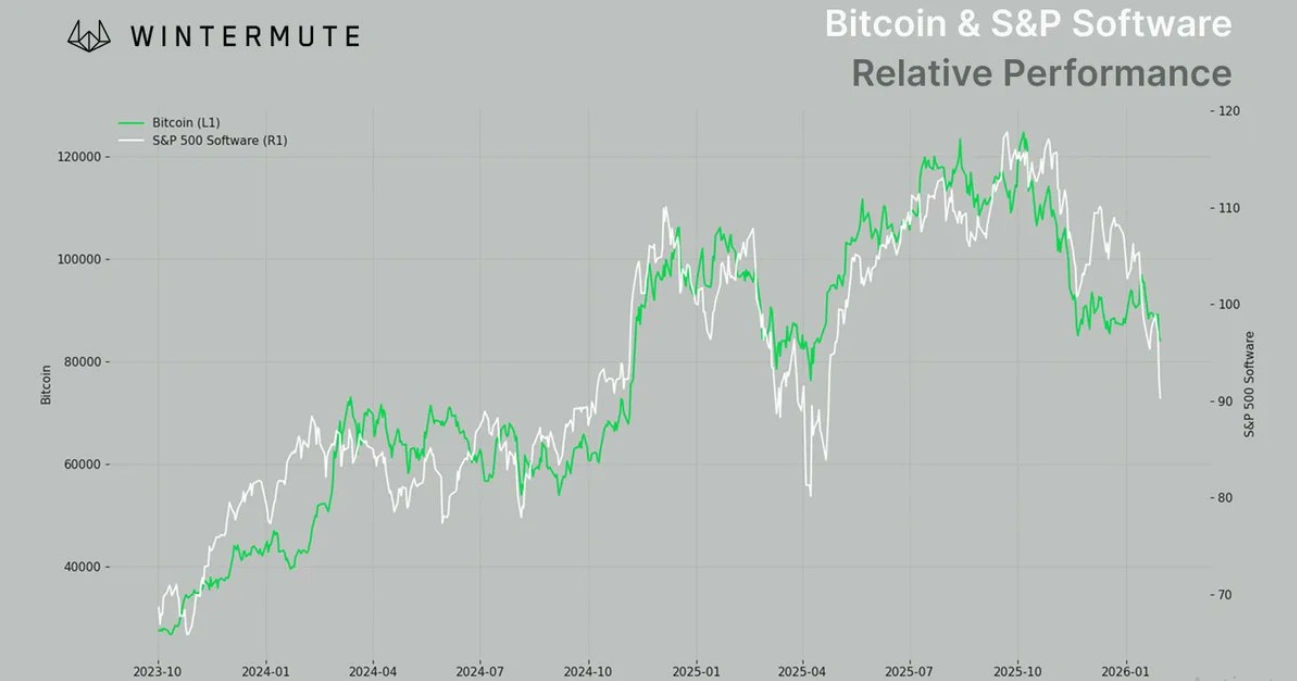
Bitcoin vs. S&P Software Index Performance
Source: Wintermute
The report also highlights that the spot demand needed to initiate a structural recovery remains weak. Digital Asset Treasuries (DATs), which were a major source of buying pressure over the past year, are now sitting on unrealized losses of up to $25 billion as prices have fallen below their average cost basis. The resulting contraction in Net Asset Value (NAV) premiums limits their ability to raise fresh capital to support demand.
Wintermute states: “It’s hard to see sustained upside until the Coinbase premium turns positive, ETF flows reverse, and basis rates stabilize.”
At the time of writing on Tuesday, Bitcoin is trading around $69,700, down 0.3% in the past 24 hours.
Bài viết này được lấy từ internet: AI Is “Draining” Bitcoin: The Capital Migration Behind $6.2 Billion in ETF Outflows
Related: When Big Money Gets Serious, RWA’s Liquidity Issues Come to the Fore
Compiled by | Odaily (@OdailyChina) Translator | DingDang (@XiaMiPP) Liquidity is the prerequisite for an asset to gain confidence. When the market has sufficient depth, large capital can be smoothly absorbed, whales can freely build positions, and assets can be used as reliable collateral. This is because lenders know they can exit at any time if needed. However, if the asset itself lacks liquidity, the situation is completely reversed. Shallow liquidity struggles to attract users, and insufficient users further compress trading depth, ultimately forming a self-reinforcing “liquidity depletion cycle.” Tokenization was initially held in high hopes: it was seen as a key tool for enhancing capital liquidity, unlocking DeFi’s financial utility, and bridging on-chain and off-chain assets. Ideally, trillions of dollars from traditional financial markets would be brought on-chain, allowing…
相关文章
































 Tiếng Việt
  English
  繁體中文
繁體中文  简体中文
简体中文  日本語
日本語  العربية
  한국어
한국어  Bahasa Indonesia
  हिन्दी
  اردو
اردو  Русский