






Original translation: Blockchain in Plain Language
The post-pandemic era has been bất chấpned by fiscal dominance—an economy driven by government deficits and short-term Treasury bond issuance, with liquidity remaining high even as the Federal Reserve maintains high interest rates.
Today, we are entering a phase dominated by the private sector, where the Treasury is withdrawing liquidity through tariffs and spending restrictions, unlike the previous administration.
That’s why interest rates need to fall.
We analyze the current cycle from the perspective of global liquidity to emphasize why the current round of “devaluation trading” has reached its final stage.
Is fiscal dominance coming to an end?
We always hope to “buy the dip” when everyone else is “chasing the rise”.
That’s why all the recent discussions about “devaluation trading” have caught our attention.
 Data: Google Trends
We believe the interest in “devaluation trading” arose a few years ago. At that time, Bitcoin was priced at $25,000 and gold at $2,000. Back then, nobody talked about it except mật mãcurrency and macro analysts.
In our view, this “deal” is essentially complete.
Therefore, our task is to understand the conditions that created it, and whether those conditions will continue to exist.
What drove this deal? In our view, there are mainly two factors.
1. Treasury spending. During the Biden administration, we implemented a large-scale fiscal deficit.
 Data: US Treasury
The fiscal year 2025 has just ended, and the deficit has narrowed slightly—primarily due to increased taxes (tariffs) rather than reduced spending. However, the Big Beautiful Bill is expected to achieve spending cuts by reducing benefits from Medicaid and the Supplemental Nutrition Assistance Program (SNAP).
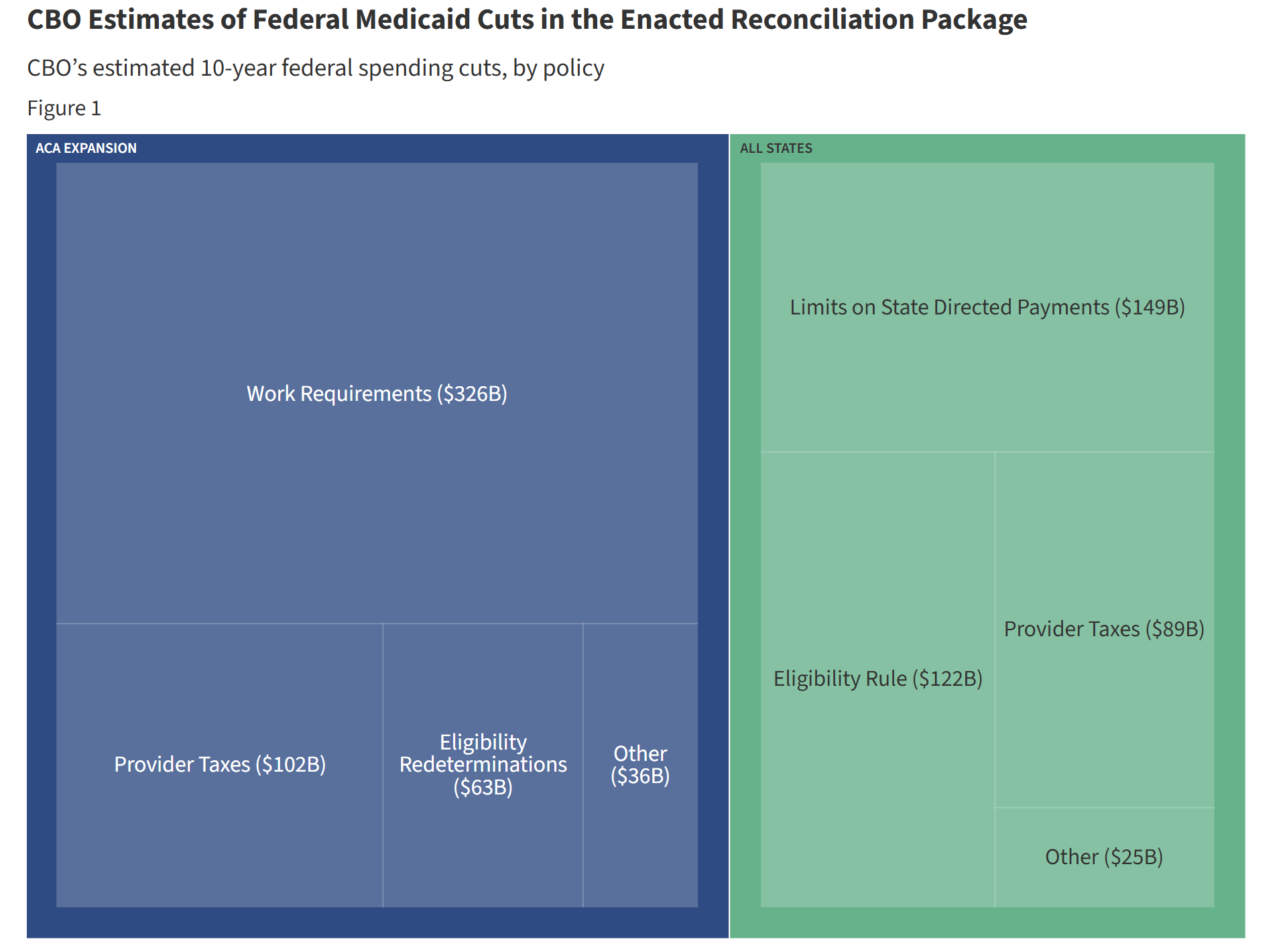 Data: Comparison of KFF (Kaiser Family Foundation) cuts with current spending trajectory
During Biden’s presidency, government spending and transfer payments continuously injected liquidity into the economy. However, under the Great America Act, spending growth slowed.
This means that the government is injecting less money into the economy.
In addition, the government is withdrawing funds from the economy through tariffs.
 Data: FRED (St. Louis Federal Reserve Economic Data)
The combination of spending restrictions (relative to the previous administration) and increased tariffs means that the Treasury is now absorbing liquidity rather than supplying it.
This is why we need to cut interest rates.
“We will privatize the economy, revitalize the private sector, and shrink the government.” – Scott Bessent
2. “Treasury QE”. To fund the excessive spending by the Treasury during the Biden administration, we also saw a new form of “quantitative easing” (QE). We can observe this below (black line). “Treasury QE” supported the market by funding government spending through short-term notes rather than long-term bonds.
 Data: Global Liquidity Index
We believe that fiscal spending and quantitative easing by the Treasury have fueled the “devaluation trade” and “everything bubble” that we have seen in the past few years.
But now we are transitioning to a “Trump economy,” with the private sector taking over the reins from the Treasury.
Similarly, this is why they need to lower interest rates. They need to use bank loans to stimulate the private sector.
As we enter this transition period, the global liquidity cycle appears to be peaking…
The global liquidity cycle is peaking and declining.
Current cycle and average cycle
Below, we can observe a comparison between the current cycle (red line) and the historical average cycle (gray line) since 1970.
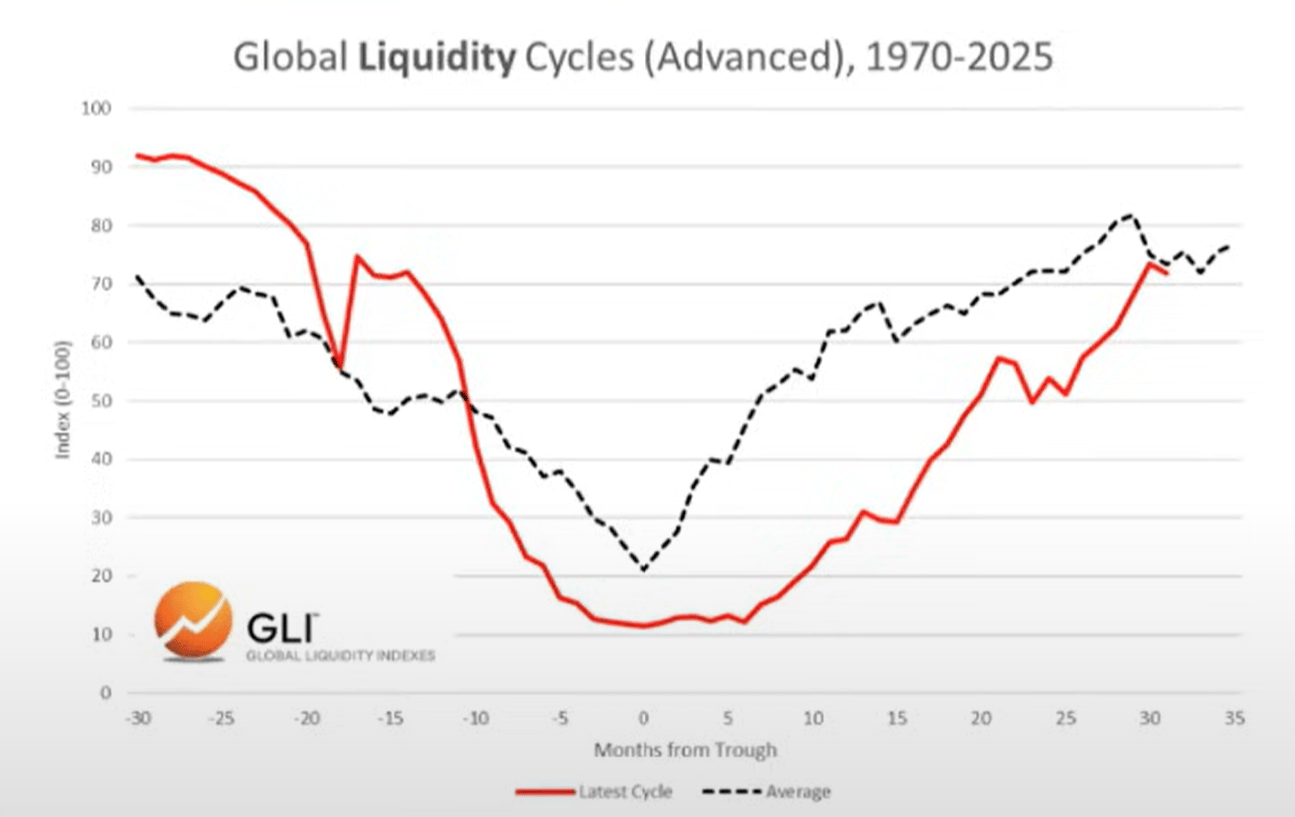 Data: Global Liquidity Index
Asset allocation
Based on Mr. Howell’s work on global liquidity indices, we can observe typical liquidity cycles and their alignment with asset allocation.
Commodities are often the last assets to fall, which is exactly what we are seeing today (gold, silver, copper, palladium).
From this perspective, the current cycle looks very typical.
 Data: Global Liquidity Index
So, if liquidity is indeed peaking, we expect investors to rotate into cash and bonds as the environment changes. To be clear, this process hasn’t even begun yet (the market remains “risk-averse”).
Debt and Liquidity
According to the Global Liquidity Index, the debt-to-liquidity ratio of major economies reached its lowest level since 1980 at the end of last year. It is now rising and is expected to continue rising until 2026.
 Data: Global Liquidity Index
The rising debt-to-liquidity ratio makes it more difficult to service trillions of dollars of outstanding debt that need to be refinanced.
 Data: Global Liquidity Index
Bitcoin and Global Liquidity
Of course, Bitcoin has “foreshadowed” peak global liquidity in the past two cycles. In other words, Bitcoin peaked months before liquidity peaked and began to decline, seemingly anticipating the subsequent drop.
 Data: Global Liquidity Index
We don’t know if this is happening right now. But we do know that cryptocurrency cycles always closely follow liquidity cycles.
Alignment with the cryptocurrency cycle
 Data: Global Liquidity Index
Bài viết này được lấy từ internet: Is global liquidity running out?Recommended Articles
The past few months have been a stellar period for the Asian digital asset ecosystem, culminating in the launch of two of its most influential events: WebX 2025 in Tokyo and Korea Blockchain Week 2025 in Seoul. Both conferences attracted a broad global audience of investors, developers, regulators, and innovators, signaling the growing maturity and influence of the Asian market in shaping the next wave of Web3. As a sponsor of WebX and host of our summit during KBW, DFG had the opportunity to engage in in-depth discussions with local founders, policy leaders, and ecosystem partners. These conversations revealed fascinating similarities and stark contrasts between Japan and South Korea, two of Asia’s most dynamic and forward-thinking crypto economies. Japan and South Korea: Comparison and Integration of Web3 AI and blockchain…
相关文章
































 Tiếng Việt
  English
  繁體中文
繁體中文  简体中文
简体中文  日本語
日本語  العربية
  한국어
한국어  Bahasa Indonesia
  हिन्दी
  اردو
اردو  Русский