







Weak Defense, Compute Rental, IPO Underpinning: Why Musk Must Acquire Cursor
He had ample reason for his silence. Three years prior, he had led an $8 million seed round investment in Anysphere, Cursor’s parent company, in the name of OpenAI. That was the company’s first institutional investment. Later, he tried to buy the company but was rejected. He then turned around and acquired Cursor’s competitor, Windsurf, for $3 billion. Then, on April 21, he watched as Musk locked down the asset he once most desired, at a price 20 times that of the former.
Six days later, he was scheduled to meet Musk in a courtroom in Oakland, California.
Almost everyone read this $60 billion deal at its surface level. But behind it lie five layers of systematically obscured truths: Musk is not the strong party, $10 billion is not a breakup fee, integration preceded the announcement, compute rental preceded the agreement, and the entire setup serves a much larger IPO bill.
Sky-High Defense
Let’s start with the layer that “Musk is not the strong party.”
xAI currently possesses the world’s largest AI compute cluster, the Colossus supercomputing center, with 100,000 NVIDIA H100 GPUs and plans to expand to 200,000. This is the number most frequently cited in mainstream reports about the company, and the one most likely to create the intuition that “Musk has already won the compute war.”
However, shortly after Colossus was built, an internal memo quietly made its way to the media. The author of this memo was Michael Nicolls, who had just been transferred from his position as Senior Vice President of SpaceX’s Starlink engineering to become President of xAI. In the memo, he used a harsh assessment, stating that xAI was “significantly behind” in the AI competition, and then provided specific numbers to support this judgment: xAI’s Model FLOPs Utilization (MFU) was about 11%, while the industry average was between 35% and 45%.
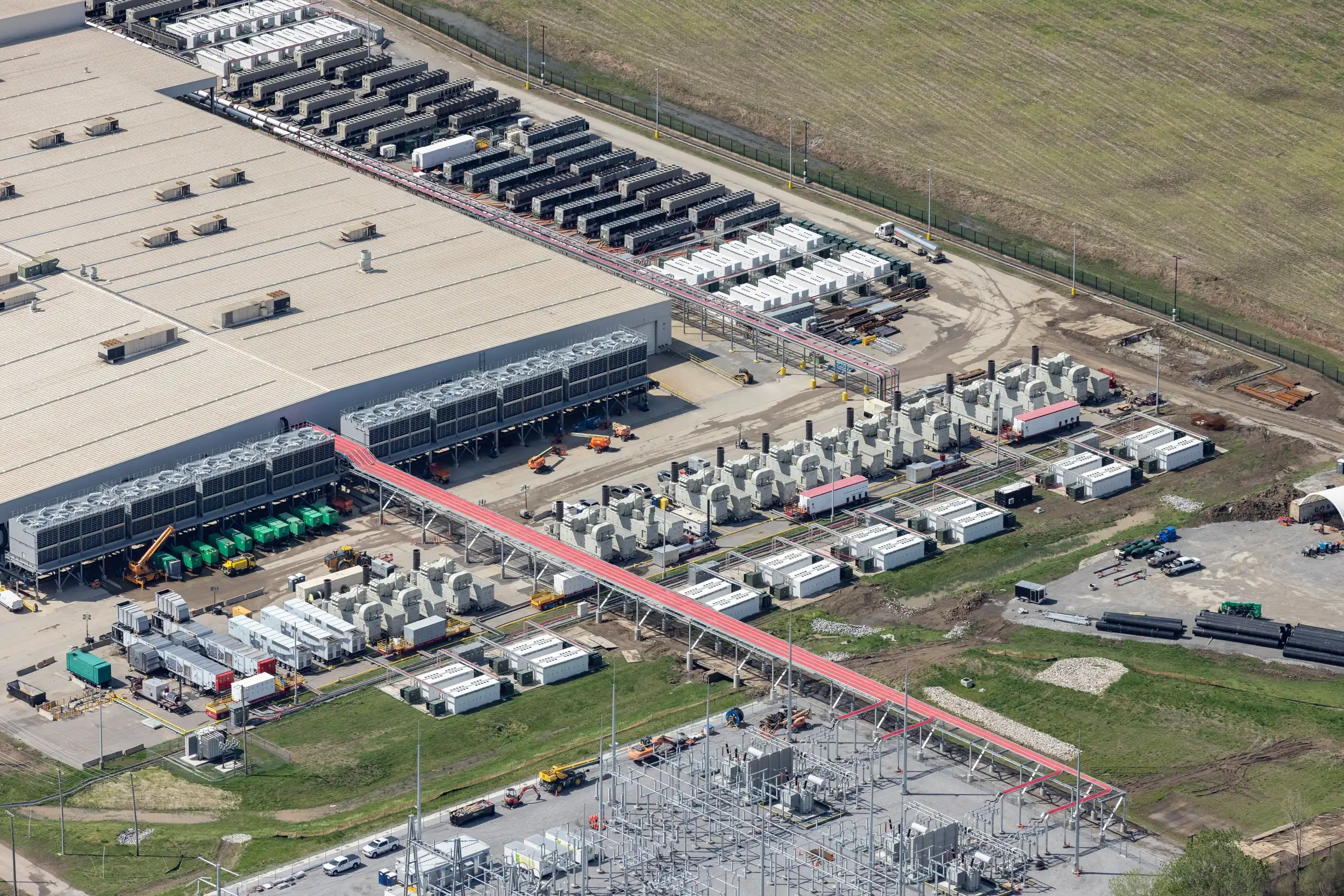
The Colossus Supercomputing Center in Memphis, Tennessee, USA
This meant that over sixty percent of those 100,000 H100s were idling. The world’s largest compute cluster was operating at less than one-third of the industry’s average efficiency.
The timing of this memo’s delivery had an even more embarrassing background. All 11 of xAI’s co-founders had departed, Musk himself publicly admitted that xAI “wasn’t built right the first time, we’re rebuilding from scratch,” and the company’s most ambitious project, the all-purpose AI agent “Macrohard,” was stalled due to the departure of its core lead. Nicolls was sent precisely to transplant SpaceX’s culture of extreme engineering efficiency and get that massive machine running at high speed again.
Locking down Cursor for $60 billion is not an acquisition made by a strong player casually expanding its territory. It is an AI company undergoing a technical rebuild with severely low compute efficiency, using money to buy time, while also seeking a sufficiently large commercial load for that idling machine. And the groundwork for all of this began 40 days before the official announcement.
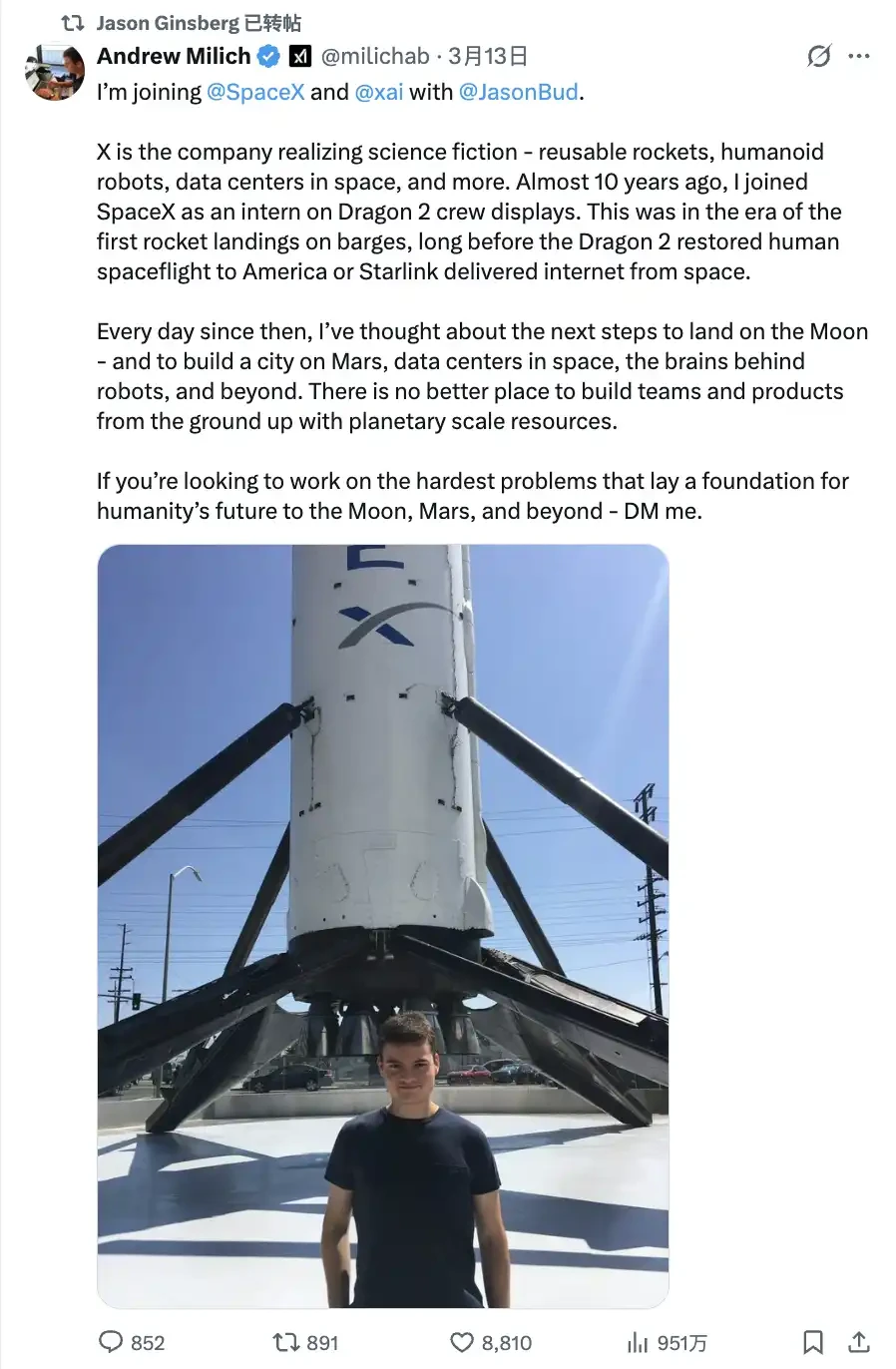
Ginsberg and his partner Andrew Milich are the co-heads of product engineering at Cursor, jointly responsible for the architecture and iteration of all Cursor’s core product features. In Cursor’s journey from zero to $2 billion in annual revenue, setting a SaaS growth record, they were the two most critical people on the product side. On March 12, they simultaneously announced they were joining xAI, reporting directly to Musk, with the assigned task of rebuilding the Grok model’s programming capabilities from the ground up.
Andrew Milich left a note when announcing his move to xAI: “Nearly 10 years ago, I interned at SpaceX, working on the cockpit display system for the Dragon 2 spacecraft.” The weight of Ginsberg’s return this time can only be understood by looking at his complete trajectory.
The cockpit display system for the Dragon 2 spacecraft was one of SpaceX’s most critical human-machine interface engineering projects at the time, and interns who could participate in it were few and far between. After leaving SpaceX, he and Milich co-founded Skiff, an end-to-end encrypted document collaboration platform, which was acquired by Notion in February 2024. Subsequently, both joined Cursor and together propelled it to the pinnacle of the AI programming market. Now, he returns to the starting point of this path, armed with years of product judgment and technical architecture experience accumulated at Cursor.
When you lay out this timeline: Ginsberg’s return to the nest, Milich’s joining, and the explicit task assigned to both to “rebuild Grok’s programming capabilities.” The substance of the acquisition was completed in its core part 40 days before the official announcement. The contract is the endpoint, not the starting point.
The Real $10 Billion Bill, and the Precision Strike Before the Court
The acquisition deal is structured as follows: at a certain point later this year, SpaceX must make a binary decision—either exercise the acquisition option for $60 billion or pay $10 billion as a “collaboration fee.” If it ultimately does not acquire, the $10 billion is a one-time settlement for terminating this partnership.
Media reports have widely labeled this $10 billion as a “breakup fee,” but this definition fundamentally obscures its true nature. To understand why Cursor would accept such a peculiar structure, one must first see the situation it faces.
Cursor’s rise relied on the underlying models provided by Anthropic. Claude was its core technical foundation. Then Anthropic launched Claude Code, a programming AI tool directly competing for the same user base as Cursor—the supplier became a competitor. And that wasn’t even the hardest part.
Internal analysis at Cursor showed that while Anthropic’s Claude Code had a maximum monthly subscription fee of $200, the actual compute cost Anthropic incurred per heavy user was as high as approximately $5,000. Last year, this figure was $2,000, having increased 1.5 times in a year. This meant Anthropic was delivering this service to the market at a loss of about $4,800 per user per month.
It was using venture capital ammunition to wage a pricing war designed to leave competitors economically unviable. Any tool company continuing to rely on Anthropic’s models to offer a comparable user experience simply could not cover the API costs with subscription fees.
Faced with this situation, Cursor’s CEO Michael Truell said, “Our strategy is to use the best technologies available from partners, combined with technologies we develop ourselves.” This is the most sober statement a founder can make publicly. The other side of this is that Cursor must train its own models, and therefore must find a source of compute that does not depend on a competitor.
xAI’s Colossus cluster is the largest independent source of compute currently available for Cursor to use. That $10 billion “collaboration fee” packages the prepaid value of this compute rental relationship. Cursor’s predicament also happened to make it the most suitable pawn in another, larger game.
The relationship between OpenAI and Cursor has a complete three-year arc that mainstream reporting has never pieced together.
The story begins in October 2023. OpenAI led an $8 million seed round investment in Anysphere, becoming Cursor’s first major institutional investor. At that time, Cursor was just a fledgling AI programming tool company; OpenAI’s money was both capital and endorsement.
Two years later, the situation completely reversed. In November 2025, Cursor completed a $2.3 billion Series D round at a $29.3 billion valuation. OpenAI began seriously discussing the possibility of acquiring Cursor; the former investor wanted to buy back that initial seed. Cursor refused. OpenAI then turned and acquired Cursor’s competitor, Windsurf (formerly Codeium), for $3 billion. The $30 billion unicorn said no, forcing a retreat to acquire the second-best choice at one-tenth the price.
Then came April 21. The day SpaceX announced the $60 billion deal was six days before Altman and Musk were scheduled to face off formally in Oakland federal court. That lawsuit stemmed from Musk’s accusation that Altman betrayed OpenAI’s original non-profit mission, the most public airing of years of accumulated grievances.
There is no evidence that April 21 was a deliberately chosen date. But the dramatic timing cannot be ignored: six days before going to court with Altman, Musk publicly locked down, at a $60 billion price, the company OpenAI once invested in and later was refused acquisition of. The seed planted with $8 million three years ago was now worth $60 billion. Altman surely calculated that account in his mind.
And the account Musk was calculating wasn’t just aimed at Altman.
The Ground-Level Trump Card for the IPO
On April 1, 2026, SpaceX confidentially filed its IPO application with the U.S. Securities and تبادلہ Commission, targeting a valuation of $1.75 trillion. The core narrative supporting this number is SpaceX’s grand plan to deploy up to 1 million data center satellites in space, using solar power and natural heat dissipation in space to replace the electricity and water cooling demands of terrestrial data centers, providing cheaper infrastructure for AI computation. Musk has claimed on multiple occasions that “space will be the cheapest place to run AI.”
However, according to S-1 filing contents disclosed by Reuters and other media, SpaceX admitted in its legal documents submitted to regulators that this plan involves “unproven technologies,” and its commercial viability is uncertain. The company’s official assessment of its biggest AI bet is a question mark.
This question mark explains the real logic behind the Cursor acquisition. Whether SpaceX’s space compute plan can succeed depends on an unverified physical and engineering hypothesis. Cursor generates 150 million lines of code daily for global enterprises—a real, ongoing, and quantifiably large demand. If the future of the space compute plan is uncertain, then the most important thing is to find a sufficiently large and stable commercial load for that idling Colossus cluster on the ground.
Cursor has $2 billion in annual revenue and is one of the fastest-growing SaaS products globally. Tying it into SpaceX’s ecosystem provides not just an outlet for compute monetization but also a real-world case to prove to capital markets that “AI infrastructure is already operational.” In an IPO roadshow, this is far more persuasive than any vision about space data centers.
Acquiring Cursor is SpaceX using a definitive software asset to underwrite an uncertain hardware vision.
یہ مضمون انٹرنیٹ سے لیا گیا ہے: Weak Defense, Compute Rental, IPO Underpinning: Why Musk Must Acquire Cursor
Related: Is Wall Street Moving the Entire Financial System onto the Blockchain?
Original Compilation: AididiaoJP, Foresight News Wall Street is no longer just dabbling in blockchain; it is migrating to it. After years of watching from the sidelines, the institutions that form the backbone of global capital markets—including exchanges, clearinghouses, and electronic trading platforms—are moving their operations on-chain. What is happening now is the largest infrastructure upgrade in capital markets since the shift to electronic trading three decades ago. Yet, most people won’t realize it’s happening until the transition is complete. Why Now: Speed Changes Everything Every institution moving in this direction shares the same conviction—that on-chain infrastructure will dramatically increase the velocity of money. History has shown clearly what that leads to. Recall the transformation brought by electronic exchanges in the 1990s: before Electronic Communication Networks and online brokers, a trade…
相关文章































 اردو
اردو  English
  繁體中文
繁體中文  简体中文
简体中文  日本語
日本語  Tiếng Việt
  العربية
  한국어
한국어  Bahasa Indonesia
  हिन्दी
  Русский