




BTC is on its last legs, so why is HYPE surging 20% against the trend?
Author | Golem (@web3_گولیم)
Hyperliquid is one of the few projects still worth paying attention to in the کرپٹو bear market.
In the first two months of 2026, the کرپٹو market cooled down, with Bitcoin falling from $95,000 to $60,000. بازار sentiment was low, and Hyperliquid’s activity and liquidity also declined accordingly. However, after entering March, the platform’s daily Open Interest (OI) showed signs of recovery. Although the increase was not huge, it released a positive signal that user activity is rebounding.
In terms of token price performance, HYPE has significantly outperformed the broader market. OKX data shows that over the past month, BTC rose only 0.6%, ETH rose 2.7%, while SOL and BNB fell 4% and 2.4% respectively. In contrast, HYPE rose 20% against the market’s volatility.
What is the logic behind this round of HYPE’s rise? Odaily will analyze it in this article for readers’ reference.
HIP-3— Hyperliquid’s RWA Trading بازارجگہ
On October 13, 2025, HIP-3 went live on the Hyperliquid mainnet. HIP-3 allows anyone to create new trading markets on Hyperliquid after staking 500,000 HYPE. One month later, HIP-3’s open interest exceeded $100 million. By January 29, 2026, HIP-3’s OI reached $1.06 billion, marking the first time its daily OI surpassed $1 billion, though it fell back below that level the next day.
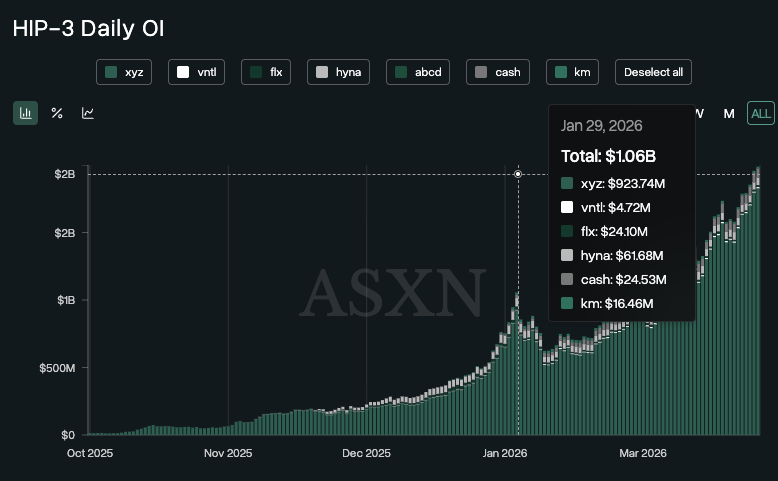
HIP-3 Daily OI
As shown in the chart above, HIP-3’s OI is primarily contributed by trade.xyz. Furthermore, whether measured by OI holdings or market trading volume, the top 10 markets on trade.xyz are all traditional assets. The first and second places are contracts tracking crude oil, and the third is a contract tracking the Nasdaq 100. Therefore, we can conclude that HIP-3 has become Hyperliquid’s RWA trading بازار.
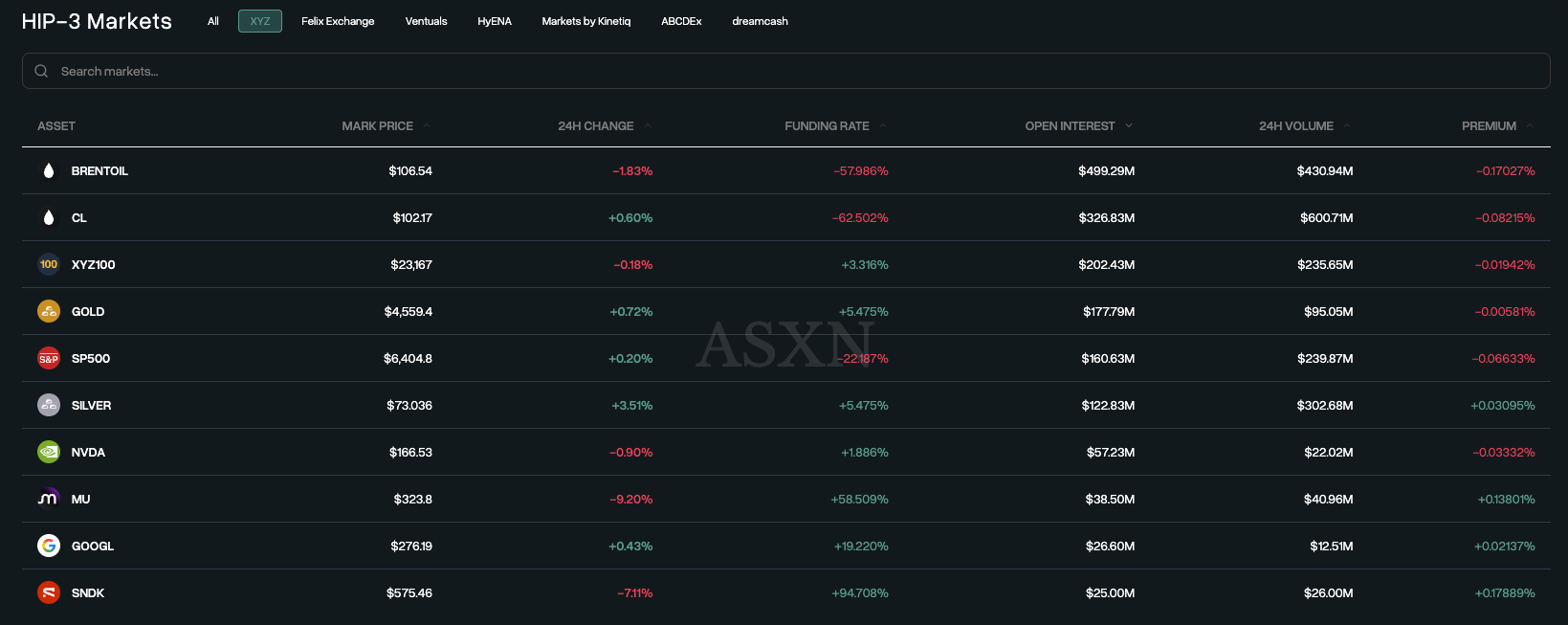
Top 10 Markets on trade.xyz
By January 2026, in just three months, HIP-3’s daily OI could stabilize at several hundred million dollars, which is enough to prove its rapid development and its growing attention from traditional commodity traders. However, for Hyperliquid, it was still not the main revenue and trading segment at that time. Taking January 29 as an example, HIP-3’s OI that day was $1.06 billion, while Hyperliquid’s total platform OI and trading volume for the day were $6.05 billion each. HIP-3 accounted for only 17%. In fact, the total OI of all markets on HIP-3 that day was even less than the OI of BTC contracts.
HIP-3 is destined not to remain a supporting role on Hyperliquid forever. It was ready, waiting for an opportunity.
The US-Iran Conflict Becomes a Major Catalyst for HIP-3’s Development
On February 28, the catalyst appeared. The US-Iran conflict broke out that day, causing shockwaves in global financial markets. Particularly, international oil prices were pushed higher by the war. However, the first day of the conflict fell on a weekend when traditional markets (like CME) were closed. Traders urgently needing to adjust positions and operations had to find new tradable markets, and HIP-3 on Hyperliquid became the first choice.
On January 6, trade.xyz had already launched a contract tracking WTI crude oil prices on the HIP-3 market, but trading volume was not significant in the first two months, averaging only a few million dollars, with a daily peak exceeding $2,000. After the US-Iran conflict erupted, the daily trading volume of the crude oil contract launched by trade.xyz quickly broke through $100 million. On March 5, trade.xyz promptly launched a contract tracking Brent crude oil prices. On March 23, the combined daily trading volume of these two crude oil contracts reached $2.38 billion, while the trading volume of ETH on Hyperliquid on the same day was only $1.51 billion.
Increasing crude oil contract trading volume is just the surface effect of this catalyst. Essentially, over a month of geopolitical tensions in the Middle East has propelled the RWA/commodity contract market led by HIP-3 to become Hyperliquid’s new core narrative.
After the US-Iran conflict broke out, HIP-3’s OI holdings continued to rise, breaking through $1 billion again on March 1 and subsequently reaching new highs. On March 31, HIP-3’s OI holdings reached $2 billion, a monthly increase of over 100%. HIP-3’s OI holdings have surpassed those of mainstream coins like BTC. On March 31, the OI for BTC contracts on Hyperliquid was $1.8 billion, and for ETH contracts, it was $1.19 billion. In terms of total OI share, HIP-3 now accounts for over 50%, meaning it contributes half of the platform’s activity.
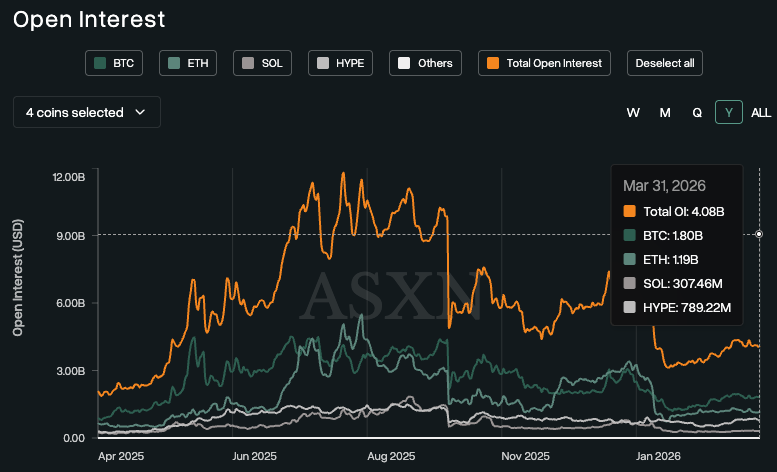
Hyperliquid’s New Value Support
Amid the downturn in the crypto market, HIP-3 has found new value support for Hyperliquid. Hyperliquid has completed a magnificent transformation, evolving from a single-function Perp DEX trading only crypto assets to an on-chain exchange that also trades RWA assets, extending its reach into traditional finance.
Compared to traditional trading markets, Hyperliquid has several obvious advantages, such as 24/7 trading and support for higher leverage. Although from a competitive perspective among similar products, these advantages are also possessed by many exchanges and DEXs, Hyperliquid’s market advantages still lead them.
Taking the silver contract as an example, as of now, the 24h trading volume of the XAG/USDT contract on Binance is $1.864 billion, while the 24h trading volume of the silver contract on the HIP-3 market is about $300 million, only 16% of Binance’s. Superficially, the gap seems huge, but considering user scale, the conclusion is different.
Binance is the world’s largest CEX with over 300 million users. Hyperliquid is the world’s most well-known DEX, but it has only 1.18 million users, which is 0.39% of Binance’s user base. Meanwhile, according to official data, HIP-3’s cumulative unique traders are only 2.42 million. With such a vast disparity in user numbers, Hyperliquid’s silver contract can still achieve over a hundred million in trading volume, proving that the RWA traders on Hyperliquid are primarily whales and professional traders/institutions.
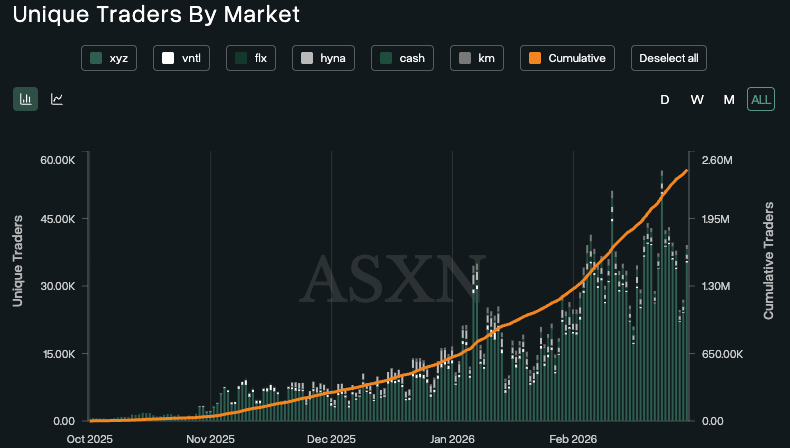
Otherwise, a user base of only a million could not create billions of dollars in trading volume (Odaily Note: On February 9, the silver contract on Hyperliquid reached a daily peak trading volume of $4 billion). These users are one of Hyperliquid’s most valuable moats. They are not general traffic users but a group of whales and professional traders with large capital, high trading frequency, and extreme sensitivity to volatility. The “output efficiency” per user is enough to compensate for the lack of total user numbers.
Moreover, compared to centralized exchanges, Hyperliquid is becoming increasingly attractive to traditional financial traders.
The core reason is that Hyperliquid is a DEX with strong privacy and no KYC. Excellent user experience, liquidity depth, and an established brand image also increase traders’ trust in Hyperliquid. This is a more direct temptation for traditional financial traders, especially those in commodities, macro, and event-driven trading.
These traders are not unable to trade on CME, brokerages, or CEXs; they are unwilling to expose their position intentions, trading rhythms, and fund flows to platforms, brokers, or regulatory interfaces. The KYC, risk control layers, and account review mechanisms of CEXs essentially increase visibility. What Hyperliquid provides is a faster, less scrutinized trading entry point—no cumbersome account opening, no waiting for approval, no risk of centralized platforms suddenly tightening permissions—while still offering sufficient liquidity and a mature trading experience.
On March 18, S&P Dow Jones Indices licensed the S&P 500 index to trade.xyz, allowing it to launch an S&P500/USDC contract market on Hyperliquid. S&P’s choice of Hyperliquid and trade.xyz undoubtedly recognizes their massive trading volume and user advantages, but the most important thing it brings to Hyperliquid is compliance recognition.
For traditional traders who were previously hesitant due to compliance concerns, this is a strong reassurance, dispelling worries like “can it be done, how big can it be, how long can it last?” If even S&P directly licenses it, what is there to worry about Hyperliquid or trade.xyz running away?
خلاصہ، the US-Iran conflict made the market see Hyperliquid’s potential in the RWA trading market. Simultaneously, with the growth in trading volume and the establishment of user trust, Hyperliquid will no longer be just a temporary substitute when traditional financial markets like CME are closed. Instead, it will become an important participant in traditional financial markets, helping traders achieve better price discovery for traditional assets and even seizing pricing power from traditional financial markets.
This is one of the core reasons behind investors’ long-term bullishness on HYPE over the past month and into the future.
It is also worth mentioning that the recently proposed HIP-4 (Odaily Note: Similar to Polymarket, allowing players to trade event outcomes on Hyperliquid) might also create a new growth flywheel for Hyperliquid. HIP-3 enables Hyperliquid to trade traditional assets, while HIP-4 might enable Hyperliquid to trade everything.
متعلقہ پڑھنا
یہ مضمون انٹرنیٹ سے لیا گیا ہے: BTC is on its last legs, so why is HYPE surging 20% against the trend?
Compiled by Odaily (@OdailyChina); Translated by Azuma (@azuma_eth) Editor’s Note: Last night, the leading venture capital firm Dragonfly Capital announced the closing of its $650 million Fund IV. On the same evening, Dragonfly Capital’s star partner Haseeb Qureshi published a lengthy post on X titled “Crypto was not made for humans.” The article proposes a novel perspective that “cryptocurrency was not made for humans, but should serve AI tokens,” suggesting that “in 10 years, we might be amazed that humans ever interacted directly with crypto.” Below is the full text by Haseeb Qureshi, compiled by Odaily. We are a crypto fund. If anyone should believe in cryptocurrency, it should be us. Yet, when we sign an agreement to invest in a startup, we sign a legal contract, not a smart…
相关文章































 اردو
اردو  English
  繁體中文
繁體中文  简体中文
简体中文  日本語
日本語  Tiếng Việt
  العربية
  한국어
한국어  Bahasa Indonesia
  हिन्दी
  Русский