







Therefore, our editorial team will select some worthwhile articles from the past 7 days every Saturday—pieces deserving of your time to savor and bookmark. From data analysis, industry insights, to opinion pieces, we aim to offer new inspiration for you in the کرپٹو دنیا
Now, let’s read together:

Macro Landscape
With 400 Million Barrels Released, Why is Oil Still Above $100?
After the joint US-Israel strike on Iran, Iran threatened to attack oil tankers passing through the Strait of Hormuz, nearly paralyzing the world’s most critical oil shipping chokepoint. Current actual traffic through the Strait is less than 10% of pre-war levels. Crude oil prices have been soaring.
On March 11, the International Energy Agency (IEA) announced the release of strategic petroleum reserves, the largest one-time release by its 32 member states in its 50-year history. However, with a daily release of 400 million barrels covering only 17% of the shortfall, the effect has been underwhelming. If all 400 million barrels were dumped into the market at once, it would last less than 4 days.
The oil price reaction is not determined by how many barrels are released, but by whether the source of the supply disruption is eliminated. Reserve releases are essentially not about “replenishing oil” but about “buying time,” using limited ammunition to gain negotiation windows and flexibility for alternative shipping routes. If time is bought but the disruption source isn’t resolved, oil prices will still rise. The mathematical reality is that the refill rate is clearly lagging behind the depletion rate.
Jiang Xueqin: A Viral Beijing High School Teacher Who Predicted America’s Defeat in Advance (Paired with Latest Interview with Jiang Xueqin)
The US military is essentially a Cold War-era “muscle-flexing” system—expensive, pursuing technological deterrence rather than resilience for protracted wars of attrition. This mismatch manifests as an absurd asymmetry in reality.
The modern global economy is built on a premise: energy is cheap and readily available. Now, that premise is unraveling.
Jiang Xueqin believes the Iran war will be highly similar to the Ukraine war: dragging on, turning into a war of attrition. The US cannot withdraw because once it does, the only regional power capable of filling the security vacuum is Iran. With about one-fifth of the world’s oil passing through the Strait of Hormuz daily, if Gulf states tilt towards Iran, the petrodollar system would collapse.
The current US economy is essentially a Ponzi scheme, kept running by foreigners continuously buying dollars.
Three Weeks into the US-Iran War: Who’s Profiting, Who’s Paying?
The Iran war has changed the discount on Urals crude. A significant portion of the economic wall the West built over three years of sanctions has been dismantled in three weeks of war.
Supply-side losses and beneficiary gains ultimately pass through to consumers. American consumers are the most direct bearers. This round of oil price increases has just swallowed up the tax refunds American families recently received.
Three weeks into the Iran war, the world loses 11 million barrels of oil per day, Russia earned nearly $800 million extra in 15 days, American consumers’ fuel costs rose by one-third, and this transmission chain will continue to extend after the sanctions waiver expires on April 11.
Stop Just Watching Oil Prices; The Bond Market is the Real Bellwether
As the war enters a stalemate, a more systemic variable is emerging: financial conditions themselves are tightening. What truly dominates the current market is no longer the war itself, but the disorder in the bond market.
Over the past month, the US 10-year Treasury yield has risen rapidly, directly reshaping interest rate expectations from a “rate cut path” to a “re-discussion of rate hikes,” suppressing stocks, commodities, and even policy space. In this process, the continued weakening of the labor market and the renewed rise in inflation expectations have amplified the Fed’s dilemma.
The bond market is not just reflecting risk; it’s determining the boundaries of risk.
Winning or Losing the War? Trump: Profiting
The market manipulation tactics of the “king of bluster” Trump, and the underlying purpose—making stock market prosperity the best “substitute” for economic prosperity to consolidate his voter base.
Investment & Entrepreneurship
Abandoning Token Issuance, Abolishing veBAL: Can Balancer’s ‘All-or-Nothing’ Gamble Bring Rebirth?
On November 3, 2025, a security incident causing over $120 million in losses largely shattered the growth illusion of the veteran DeFi protocol Balancer.
The entire system seemed like a continuously running “money printer,” but it was actually “leaking” on two fronts: on one hand, fee revenue was being split and lost layer by layer; on the other, the BAL token’s annual inflation releases about 3.78 million tokens, creating a continuous sell pressure of approximately $580,000 at current prices.
On March 23, the Balancer core team simultaneously released two important governance proposals: a comprehensive overhaul of BAL tokenomics and an operational structure reorganization. The core logic of both documents can be summarized in one sentence: abandoning the token-release-driven growth model and shifting towards revenue-driven sustainable operations.
اس کے علاوہ تجویز کردہ: Odaily Interview with Bitwise: BTC Could Reach the $95,000 Range by Year-End, SIREN, A Meticulously Designed Leverage Harvest, Bittensor (TAO) Bearish Thesis: A Revenue Desert Under the Computing Power Myth.
Web3 & AI
The ERC-8183 protocol is an on-chain standard for the decentralized AI agent economy. Its essence is not a traditional payment protocol but a business infrastructure specification centered around the full lifecycle of “task-delivery-settlement.”
ERC-8183 uses “Job” as its core primitive, defining a tripartite collaboration model involving the Client, Provider, and Evaluator. It implements a complete state machine process (Open, Funded, Submitted, Completed/Rejected/Expired) for task posting, fund escrow, result submission, and outcome adjudication through smart contracts.
Within this framework, payment is no longer a single action but a programmatic process tightly bound to task conditions, delivery verification, and evaluation mechanisms, enabling trustless on-chain business execution. Application scenarios include automated supply chains, marketing automation, decentralized computing power markets, and fully automated AI software outsourcing centers.
Skill scanning is almost useless against hacker attacks because static detection rules are easily bypassed, AI review has inherent blind spots, and the review process has fundamental design flaws.
Since AI can already write code, find vulnerabilities, and even dynamically generate tools, the cost of writing code approaches zero. Once Agents can craft various customized tools for enterprises anytime, anywhere, the moats painstakingly built by those monthly-rent software companies naturally vanish. Thus, from CrowdStrike to IBM, from Salesforce to ServiceNow, regardless of how bright their earnings reports are, they are experiencing brutal sell-offs.
Meanwhile, countless AI entrepreneurs are pitching VCs with business plans, claiming they will “build the middleware for the Agent era” or “start a business For Agents.”
They are all betting on one thing: building tools is the sexiest business of this era. But in reality, software was never sold for the code.
The most crucial things are actually these three: solidified business processes, customer data accumulated over years, and the resulting extremely high switching costs.
Scarcity has shifted from “the ability to build tools” to “possessing irreplaceable business context data.” AI is the engine, while exclusive data is the fuel—also the sedimentation of time and irreplicable history. Code approaches zero, data starts collecting rent. The real winners are those holding data assets that Agents cannot bypass.
Don’t stare at the Agent’s hands; strangle the Agent’s neck.
اس کے علاوہ تجویز کردہ: The Token Naming War: Who is Fighting for the ‘Minting Power’ of the AI Era?.
Prediction بازارs
The 4 Truths and Fee Traps Behind Polymarket’s LP Market Making Incentives
The original author analyzes Polymarket’s new taker fee mechanism, market maker incentive program, liquidity incentives, and sponsored LP incentives.
Polymarket doesn’t need volume-botting robots; it needs LPs that provide real value. Systematically earning market making incentives requires capital, risk management, and constant presence, which greatly diminishes the advantage of airdrop farmers and instead benefits genuine market participants.
Arbitrage trader and Polymarket/Kalshi bot player securezer0 believes being an LP is another form of “paying to lose money.” Rather than drinking poison to quench thirst, it’s better to make fundamental changes: target the vampires, not harvest users. Specific measures include: imposing only a 1% fixed fee on profits; building native liquidity pools with POLY tokens; charging on extended products, not core products.
Dissecting 40 Addresses from Polymarket’s Leaderboard: Only Three Ways to Make Money
First: Sports markets, directional, buy right and hold to the end;
Second: Crypto sector, structural, profit not from prediction but from market making;
Third: Cognitive, place few bets but each with judgment.
Understanding which game you’re playing is more important than optimizing any parameter.
2% of Users Contribute 90% of Trading Volume: The True Profile of Polymarket
The vast majority of Polymarket’s trading volume is contributed by a small group of algorithmic and high-frequency traders; the massive number of low-frequency retail traders have almost no overlap with these professional traders. Recognizing the differences between these two groups directly determines platform fee design, product priority planning, and market category strategy.
Master Polymarket with These 7 Tools (Complete Tutorial Included)
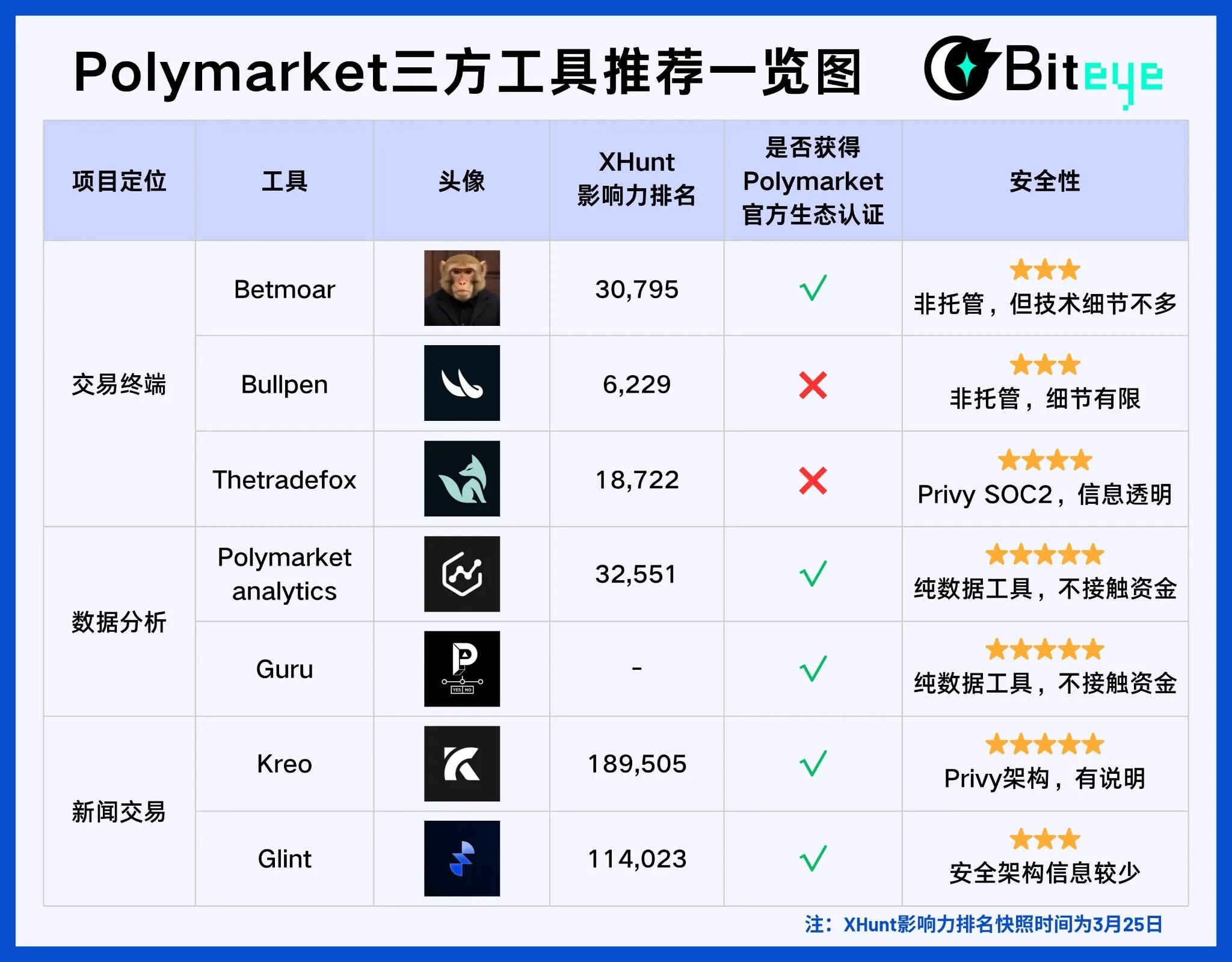
اس کے علاوہ تجویز کردہ: Interpreting Polymarket’s Major Update Last Night: Fee Expansion, Self-Regulation, New Incentives, Kalshi and Polymarket Jointly Invest in New Fund, A Major Step Towards Prediction Market ‘Ecosystemization’.
Policy & Stablecoins
CLARITY Act Rewrites DeFi’s Fate: Circle Feasts, DeFi Tokens Bleed
The latest CLARITY proposal essentially ends the narrative of stablecoins as savings products. Stablecoins are strictly defined as payment tools, not interest-bearing assets, which will be unfavorable for most DeFi. Assets most vulnerable are DeFi tokens and governance tokens tied to fee revenue, such as DEX tokens like UNI, SUSHI, DYDX, 1INCH, and CAKE.
Maker’s structure already positions it to benefit from this shift. Other beneficiaries include compliant infrastructure providers like Circle, exchanges, and custodians (BitGo).
10x Research sets a base target price of $120 for the next 12 months, potentially rising to $150 if USDC growth re-accelerates and margins improve significantly; but there is a risk of falling to $80 if growth stalls and the current economic situation persists.
اس کے علاوہ تجویز کردہ: Tether Signs with Big Four Auditor, Circle’s Compliance Moat Collapses, Stock Plunges 20%.
ایئر ڈراپ Opportunities & Interaction Guides
Popular Interaction Collection | xStocks Points Campaign Live; Tempo Mainnet Launch (March 25)
Interaction Tutorial | Startale Group, Which Raised $63 Million, Launches Points Campaign
Ethereum & Scaling
Ethereum Foundation Article: L1 and L2, From Division of Labor to Symbiosis
Weekly Hot Topics Recap
گزشتہ ہفتے میں، Iran presented 5 ceasefire demands to the US; Israel fears Trump may compromise to declare victory; Iran stated it will not allow Trump to decide the war’s end time;
Furthermore, regarding policy and macro markets, US lawmakers will introduce a bipartisan bill to ban the sports segment of prediction markets; UK plans to suspend crypto political donations, Prime Minister cites preventing illicit fund risks;
Regarding opinions and voices, Analysis: Bitcoin and S&P, Nasdaq under simultaneous pressure, Iran war
یہ مضمون انٹرنیٹ سے لیا گیا ہے: Weekly Editor’s Picks (0321-0327)
Related: What is Verse8 Changing as Vibe Coding Enters the Gaming World?
Author | Ding Dang (@XiaMiPP) The Epiphany That Started with a “Simple” Mini-Game After playing Mine8 for two days, I realized I had been hooked on a mini-game with extremely simple rules for so long. The gameplay isn’t complicated: dig for treasure with a shovel within a limited time; the shovel’s damage and speed determine efficiency, but whether you actually find treasure depends more on luck. Occasionally opening a lucky box allows you to upgrade your shovel, adding a bit more anticipation for the next round. The mechanics aren’t particularly novel, and the game interface isn’t exactly polished, but it genuinely captured my attention. However, what truly made me pause and think wasn’t the game itself, but the timing of its emergence. ‘Vibe coding’ is becoming one of the hottest…
相关文章































 اردو
اردو  English
  繁體中文
繁體中文  简体中文
简体中文  日本語
日本語  Tiếng Việt
  العربية
  한국어
한국어  Bahasa Indonesia
  हिन्दी
  Русский