







Why is oil price still above $100 after a 400 million barrel release?
The story begins on February 28. After the US and Israel launched a joint strike on Iran, Iran threatened to attack oil tankers passing through the Strait of Hormuz, nearly paralyzing the world’s most critical oil transport chokepoint. According to IEA data, the current actual traffic through the Strait is less than 10% of pre-war levels. Brent crude soared from around $65 before the conflict, touching $119.5 intraday on March 9, a near 80% increase within two weeks.
Against this backdrop, the IEA deployed its biggest weapon. The question is, why didn’t this weapon work?
The Mathematical Illusion of 400 Million Barrels
400 million barrels sounds like a massive number, but when placed against the gap created by the Strait of Hormuz, the proportion looks entirely different.
In its 50-year history, the IEA has tapped strategic reserves five times, with this being the sixth. The combined volume of the first four releases was approximately 352.7 million barrels (about 50 million barrels in the 1991 Gulf War, 60 million barrels after Hurricane Katrina in 2005, 60 million barrels during the 2011 Libyan civil war, and 182.7 million barrels during the 2022 Russia-Ukraine war). This release of 400 million barrels exceeds the sum of the previous four.
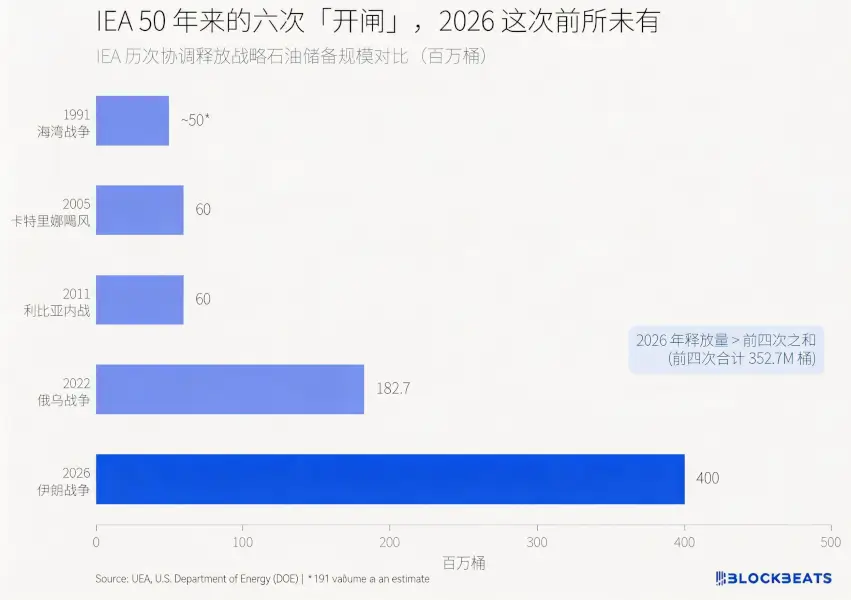
But scale does not equate to sufficiency.
Before the conflict, the Strait of Hormuz saw a daily passage of about 20 million barrels of crude oil and refined products, accounting for 25% of global seaborne oil trade. According to a US Department of Energy announcement, the US portion of 172 million barrels will be released over 120 days. Extrapolating at this pace, the IEA’s total 400 million barrels equates to a daily release of about 3.3 million barrels, covering only 17% of the shortfall. According to JPMorgan estimates cited by Al Jazeera, the maximum production increase capacity of IEA member countries is only 1.2 million barrels per day, far from enough to make up the difference.
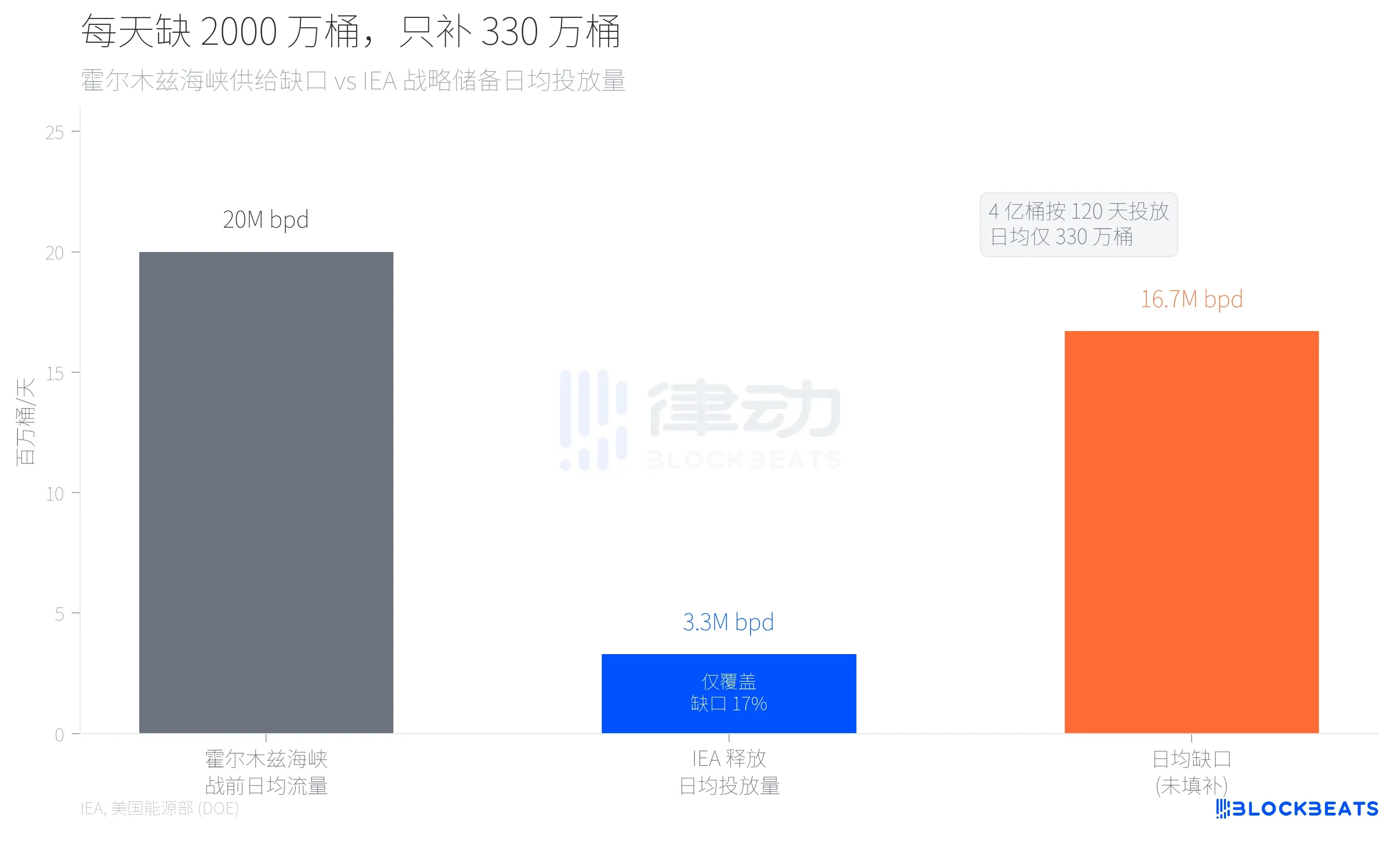
Another more intuitive calculation: According to the IEA’s March report, global daily oil consumption is approximately 103 million barrels. If all 400 million barrels were dumped into the market at once, it would last less than 4 days.
Which Historical “Tap Openings” Actually Worked?
The outcomes of the IEA’s five reserve releases over 50 years clearly fall into two categories.
During the 1991 Gulf War, oil prices plummeted about 20% on the day the IEA announced the release, and fell by one-third over the following week. After Hurricane Katrina in 2005, the market also stabilized quickly. These two instances share a common feature: the source of the supply disruption was being repaired. In the Gulf War, the start of airstrikes meant Kuwaiti oil fields had hope of recovery; Hurricane Katrina had passed, and refineries were gradually resuming operations.
The counterexample is 2022. After the Russia-Ukraine war broke out, the IEA released 182.7 million barrels, but Brent crude rose instead of falling after the announcement, first surging to $113, and then taking months to slowly decline. The reason is simple: there was no prospect of a quick fix for the supply disruption from Russia.
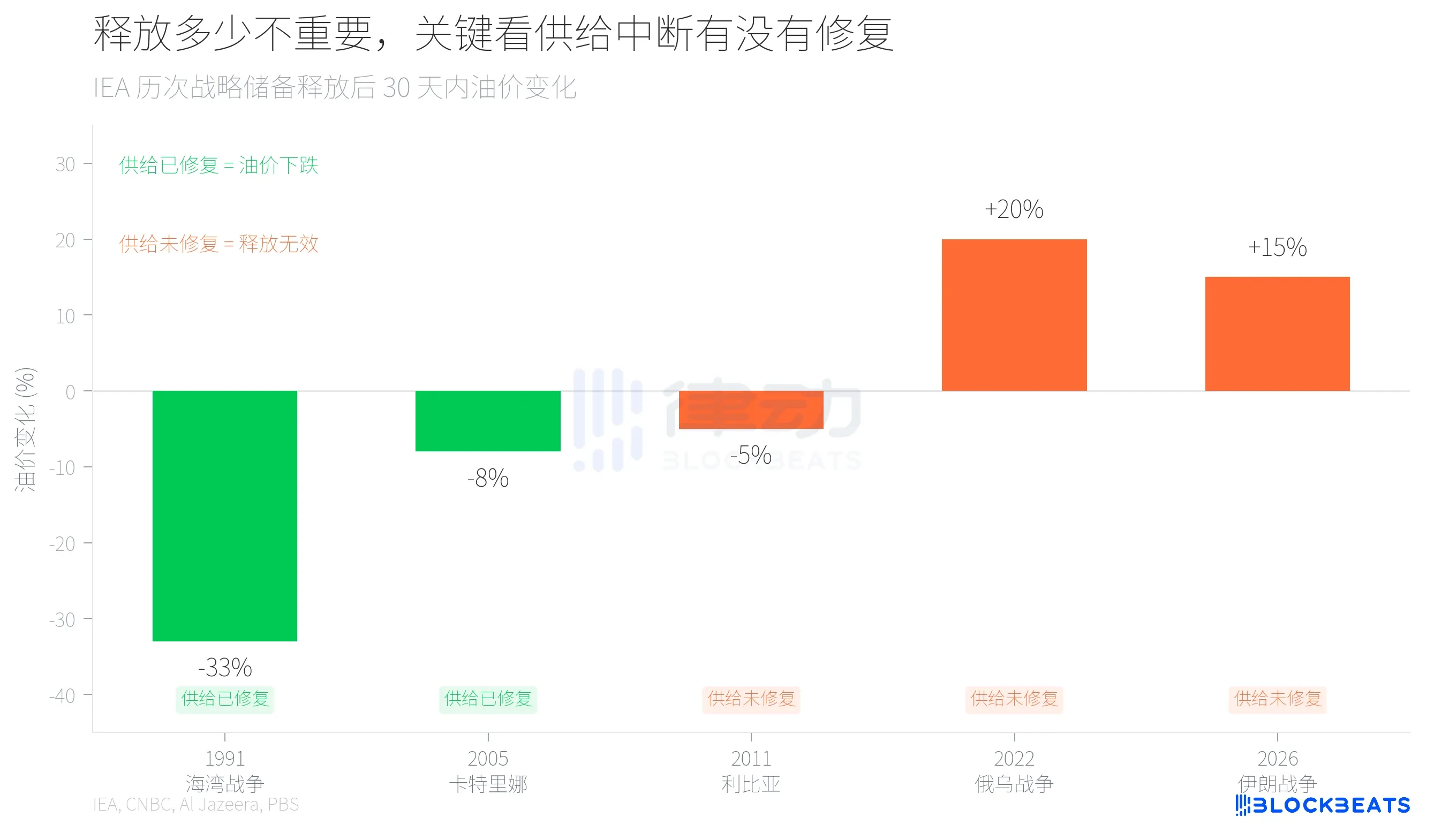
The situation in 2026 resembles 2022 more than 1991. The Strait of Hormuz remains semi-blockaded, with no signs of a ceasefire from Iran. According to analysis by Stanford University researcher Maksim Sonin cited by Al Jazeera, “This is not a panacea. The market trades on expectations, and current expectations lean towards worry.” University of Massachusetts Amherst economist Gregor Semieniuk put it more bluntly: “The release only buys temporary breathing room. Once it’s done, the firepower is spent.”
What determines the oil price reaction is not how many barrels are released, but whether the source of the supply disruption is eliminated. Reserve releases are essentially not about “replenishing oil” but about “buying time,” using limited ammunition to gain negotiation windows and flexibility for rerouting alternative shipping lanes. If time is bought but the disruption source isn’t resolved, oil prices will still rise.
How Much Ammunition is Left in the Arsenal?
This leads to a longer-term question: After repeatedly “buying time,” is the arsenal itself still sufficient?
The US Strategic Petroleum Reserve (SPR) is the world’s largest government emergency oil stockpile. According to US Energy Information Administration (EIA) data, the SPR peaked at 727 million barrels at the end of 2010. In 2022, the Biden administration released about 180 million barrels to combat soaring oil prices from the Russia-Ukraine war, causing the SPR to drop to 347 million barrels by June 2023, its lowest level since 1983. After more than two years of replenishment, it only recovered to about 415 million barrels by March 2026.
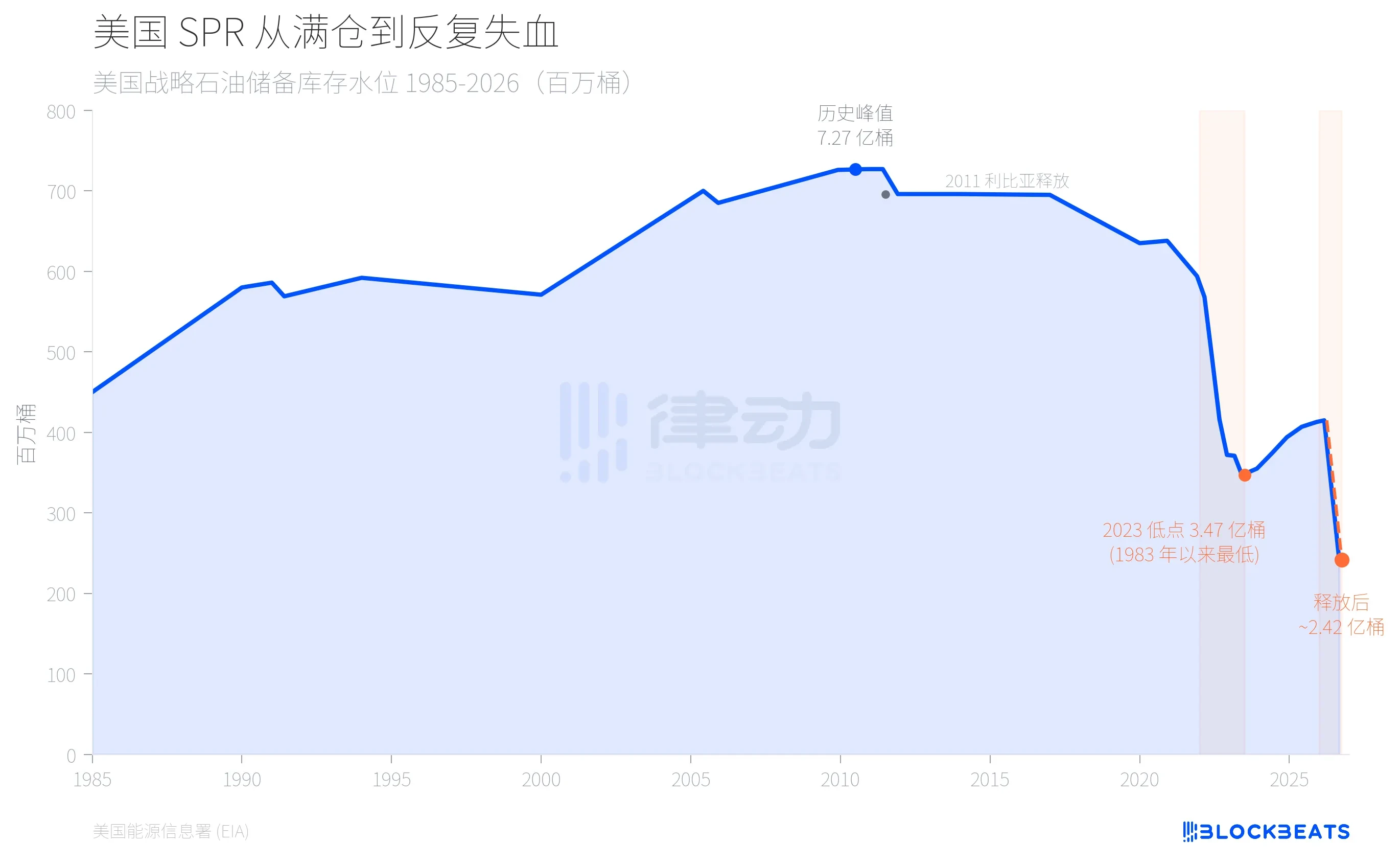
Now, 172 million barrels out of this 415 million are set to be released again. After the planned execution, the SPR will drop to about 242 million barrels, returning to levels seen in the mid-1980s when the reserve was first established. The US Department of Energy has pledged to replenish about 200 million barrels within a year after the release, but the previous replenishment cycle took over two years to climb from 347 million to 415 million barrels. The replenishment speed clearly cannot keep up with the depletion speed.
It’s not just the US. Before the release, the 32 IEA member countries collectively held about 1.2 billion barrels of public emergency reserves. This 400-million-barrel release directly cuts that by one-third.
If the next supply crisis arrives before the SPR is replenished, will the world’s “final ammunition depot” be sufficient? There is currently no answer to this question. And it is precisely because the market sees this problem that it is unwilling to let oil prices fall.
یہ مضمون انٹرنیٹ سے لیا گیا ہے: Why is oil price still above $100 after a 400 million barrel release?
Related: What’s Left for Optimism After Base Takes Everything?
Original compilation: Luffy, Foresight News There could have been a triumphant version of the Optimism story. In that version, the OP Stack becomes the default infrastructure for Ethereum scaling, dozens of well-funded chains join the Superchain, revenue flows back to the Collective, interoperability features launch smoothly, and the entire ecosystem compounds, looking from afar like a new form of the internet: it belongs to no one, is governed by all, and is self-sustaining. This version was not a fantasy. For a time, it genuinely seemed like it was about to happen. The problem is: everything Optimism did to achieve this vision also made protecting it impossible. The OP Stack was released under the MIT open-source license. The importance of this decision arguably surpasses any other choice Optimism made, so it’s…
相关文章
































 اردو
اردو  English
  繁體中文
繁體中文  简体中文
简体中文  日本語
日本語  Tiếng Việt
  العربية
  한국어
한국어  Bahasa Indonesia
  हिन्दी
  Русский