







Equity Swap for Tokens, Across Leads the “Rebellion”, DAO Model Faces Real-World Scrutiny
A DeFi project, Across Protocol, which has been operating for four years and raised tens of millions of dollars in funding, recently made a surprising decision to dissolve its DAO and transition into a private company.
This veteran protocol’s leading “defection” is not merely an adjustment in corporate structure but reflects deeper challenges within the existing DAO governance model and tokenomics.
Plans to Transition into a US Company, ٹوکن Holders Offered Equity or USDC Exit Options
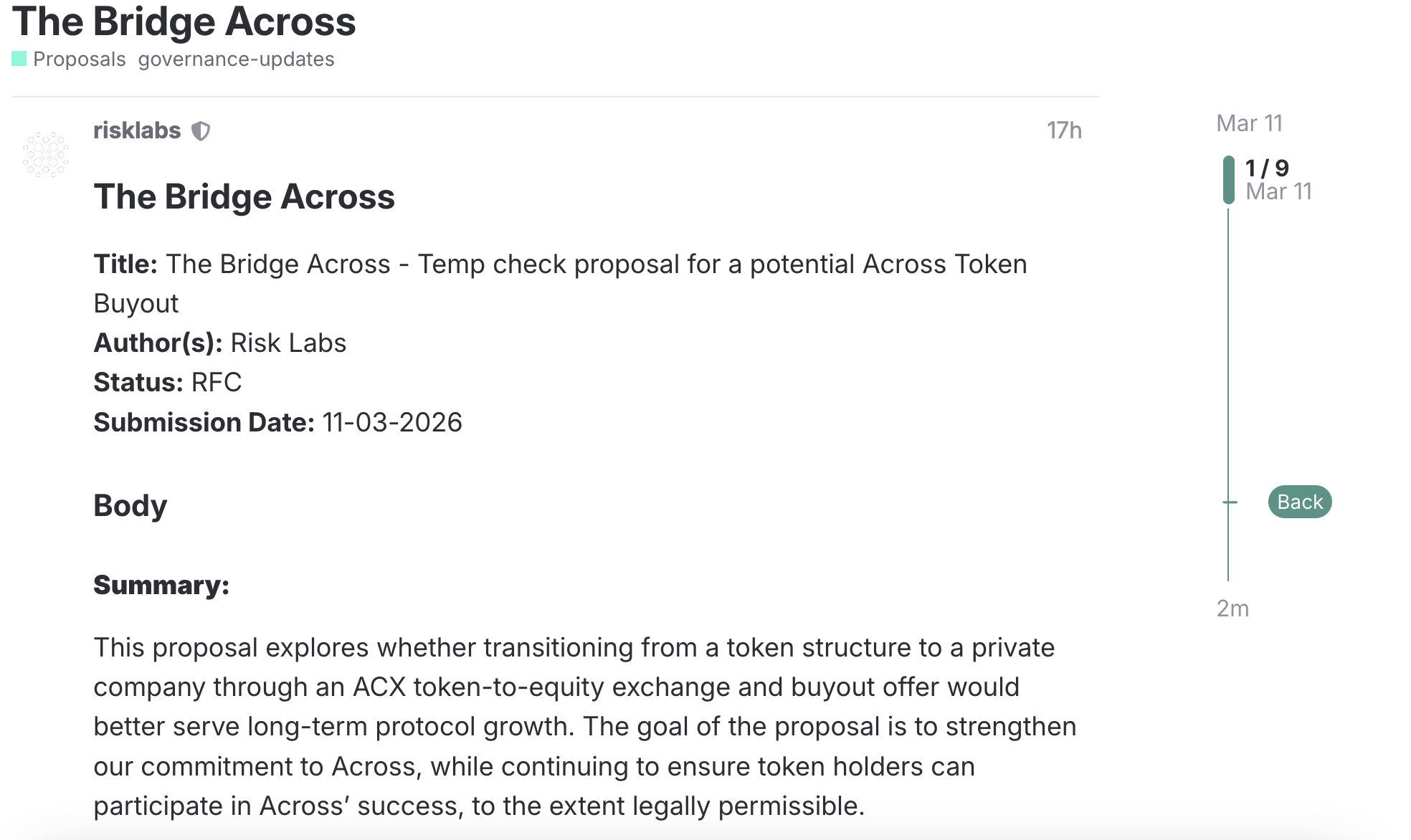
On March 11, Across published a temperature check proposal to transition from a DAO structure to a US C-Corporation. This marks a significant shift in the governance structure of the Across protocol, a first-of-its-kind move in the کرپٹو جگہ
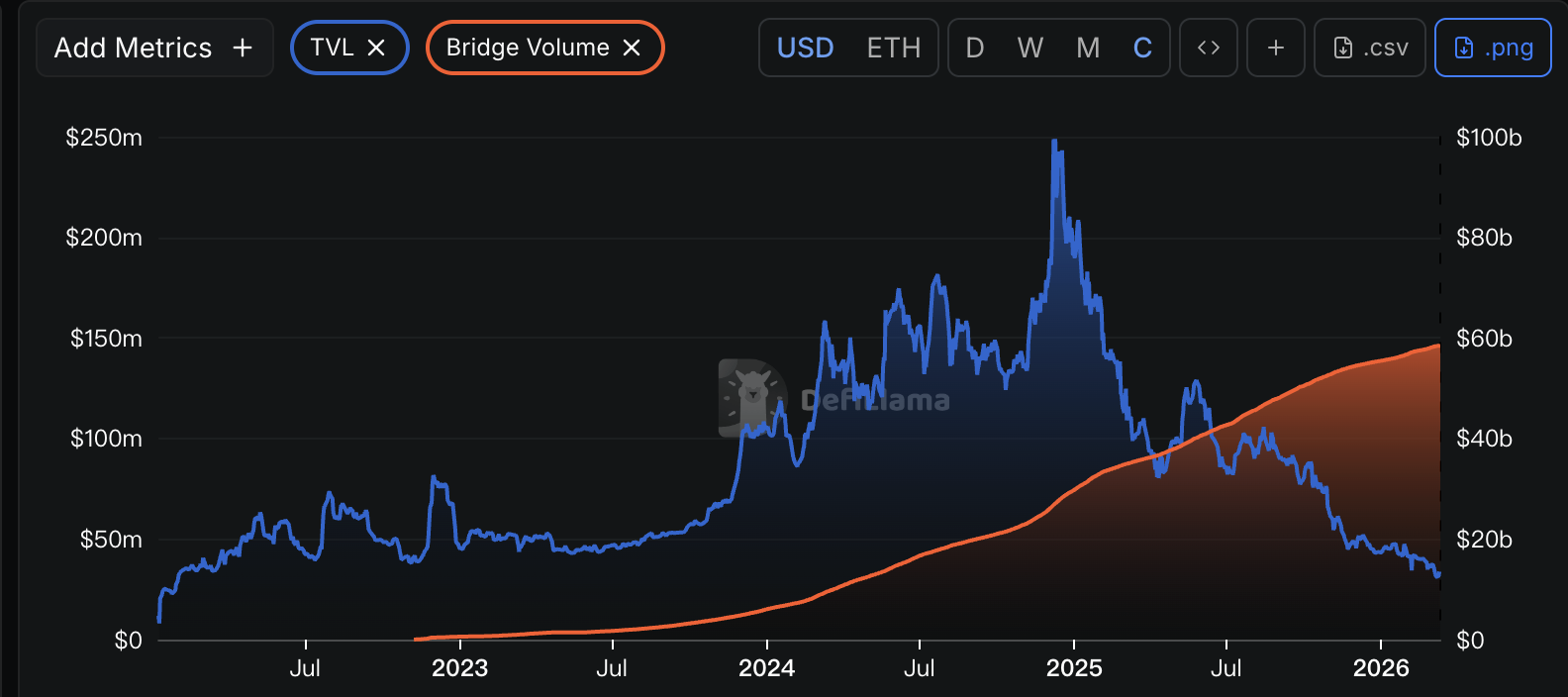
Following the proposal’s release, the price of the ACX token unexpectedly surged. According to CoinGecko data, ACX rose by 94.9% in the past 24 hours, though it remains down approximately 96.2% from its all-time high. However, based on on-chain analyst Ai Yi’s monitoring, the largest holder of ACX tokens is estimated to still need a 5.66x increase to break even.
As a leading player in the cross-chain sector, Across has been operational for four years. During this time, Across has raised approximately $51 million across two funding rounds, attracting prominent institutions such as Paradigm, Coinbase Ventures, Bain Capital Crypto, Multicoin Capital, and Hack VC. To date, the protocol has processed over $58 billion in cumulative cross-chain transaction volume.
Despite this, Across has decided to embark on this transformation path. According to the proposal, the new entity, AcrossCo, will become the operating company behind the Across Protocol, taking over all protocol intellectual property and being responsible for development, partnerships, and commercialization. Typically, registering as a C-Corp is the most mainstream choice for the vast majority of startups with financing plans, pursuing rapid growth, targeting VC/institutional investment, and considering future IPOs or acquisitions.
To complete this transition, Across plans to proceed through an exchange of ACX tokens for equity or via an acquisition.
The proposal offers ACX token holders two options: The first is equity conversion, where users holding ACX tokens can exchange them for equity in AcrossCo at a 1:1 ratio. Holders of over 5 million ACX tokens can convert directly, while those below this threshold can participate through a free Special Purpose Vehicle (SPV) structure. The second option is a token buyback, where ACX holders can exchange their tokens for USDC at a price of $0.04375 per ACX, representing a 25% premium over the average market price of the past 30 days. The redemption window will be open for 6 months, with exchanges expected to begin within 3 months after the proposal passes. This buyback plan may have revealed an arbitrage opportunity for crypto investors, leading to a buying frenzy and contributing to the short-term price surge of the ACX token.
According to the proposal timeline, the community will hold a conference call on March 18, release the final proposal on March 26, and conduct a vote via Snapshot on April 2.
If the proposal is formally approved, Hart Lambur also disclosed that Across will focus on developing two major business lines in the future: The first is stablecoin bridging. Across’s pioneering cross-chain intent architecture is currently the only viable solution to unify the numerous L2s, sidechains, and alt L1s in the crypto world. It is expected that by the end of 2026, free cross-chain transfers will become standard for all stablecoins. Currently, besides Hyperliquid, Across has two undisclosed partnerships that will enable free fund transfers for users. The second is AI agent payments, allowing users to declare their needs and have a competitive solver network automatically execute them, thereby achieving automated and personalized services.
A Self-Rescue Attempt Amid DAO Dilemmas and Token Crisis, Future Consideration of Equity Tokenization
The decision by Across to dissolve its DAO is not only a desperate survival move for the protocol itself but also reflects a predicament faced by the vast majority of DeFi protocols today.
It is evident from Across’s statements that the DAO model has evolved into an invisible shackle hindering protocol expansion in real-world business collaboration. Hart Lambur tweeted that as Across deepens its partnerships with institutions/enterprises, the token and DAO structure have substantively impacted its ability to secure deals and integrations.

He further stated that although Across has consumer-facing products, it is essentially a payment infrastructure. Over the years, Across has signed contracts with many top crypto projects, but due to the lack of a legal entity, Across cannot sign agreements directly and must go through the Risk Labs Foundation as an intermediary. When Across engages with more traditional financial institutions, this “intermediary” structure hinders collaboration, making it more difficult to push its infrastructure into traditional finance (TradFi) or crypto-related companies. Particularly, as more third parties begin to cover user transaction fees in the future, signing contracts outside the protocol becomes increasingly important. After Across transitions its DAO model to a traditional legal entity, it will significantly enhance its ability to sign enforceable contracts, build revenue agreements, and create value for stakeholders.
The Across transformation case further highlights the existing dilemmas of the DAO governance structure. After years of large-scale practice, issues with the DAO model such as power distribution, accountability, and sustainability have drawn criticism. Beyond projects like Across that struggle to expand due to legal and compliance uncertainties, DAOs internally face problems like concentrated voting power, inefficient decision-making, and low community participation rates. These issues, especially in business environments requiring swift decisions, have become significant factors hindering the further development of DeFi projects.
As Stani Kulechov, founder of Aave, which is experiencing governance turbulence, recently stated, the current way DAOs operate is extremely difficult. Decision-making is slowed down by forum discussions, temperature checks, and multiple rounds of voting, while DAOs easily become politicized, with participants forming political alliances, ultimately leading to “politicians” rather than builders winning. Kulechov argues that the DAO governance model needs reform, focusing on areas that truly require collective participation, such as major protocol changes and treasury strategy, while the rest should belong to the execution layer, requiring leaders to drive progress.
Beyond governance issues, Across also faces the challenge of low token valuation. Hart Lambur stated that although he is a firm supporter of tokens, opposes the “high FDV, low float” token issuance strategy, and issued the Across token at a very low valuation early on, the macro environment has changed. The Across token is currently severely undervalued and lacks sufficient attention. For Across, the reality is that the drawbacks of having a token often outweigh its benefits.
Compared to the volatility and uncertainty of tokens, after transitioning to a private company, adopting traditional equity incentive mechanisms may provide the protocol with more stable financing channels and market valuation.
However, Across’s approach has also sparked controversy in the crypto market. Some view it as a betrayal of decentralization principles, potentially marginalizing crypto retail investors, while others see it as a realist return for DeFi.
It is worth mentioning that Across co-founder Hart Lambur revealed that they are considering tokenizing equity in the future. However, these plans will be implemented in phases, first focusing on traditional equity, followed by exploring tokenization options.
As for the future direction of this pioneering DeFi experiment by Across, perhaps only time will tell.
یہ مضمون انٹرنیٹ سے لیا گیا ہے: Equity Swap for Tokens, Across Leads the “Rebellion”, DAO Model Faces Real-World Scrutiny
Related: When we say “crypto is failing,” what do we really mean?
I wrote my first line of smart contract code during the ICO frenzy of 2017. As an old Builder who has survived until 2026, having weathered the “September 4th” crackdown, DeFi Summer, NFT mania, the FTX collapse, and countless pronouncements that “crypto is dead,” I’ve witnessed ten thousand ways projects manage to self-destruct. I’ve discovered that throughout this long Crypto journey, the definition of “winning” has never been about how many billions your FDV reached on TGE day, or whether you achieved a grand slam. It’s about whether you are still fighting for your own sovereignty against the entire world. Every team with a bit of technical background or resources can launch a token at least once. Even if the code is forked, even if the whitepaper is written by…
相关文章































 اردو
اردو  English
  繁體中文
繁體中文  简体中文
简体中文  日本語
日本語  Tiếng Việt
  العربية
  한국어
한국어  Bahasa Indonesia
  हिन्दी
  Русский