







Original Author: Arthur Hayes, Co-founder of BitMEX
Original Compilation: Saoirse, Foresight News
We walk into the frozen forest and climb the steep volcano. It’s just another day of ski touring and meditation. Amidst the silent snowy woods, my thoughts roam freely. The creativity you can unleash when you’re fully focused, slowly ascending the volcano step by step, placing one ski in front of the other thousands of times, is astonishing. I cherish these three months of tranquility.
Both body and mind crave rest and recovery. During the ski season, this means going to a real ski resort. On resort days, I remove my climbing skins, take the mechanical lift, and within minutes, I’m transported hundreds of meters into the air. Chairlifts and gondolas are great, but sometimes I have to share this peace with others.
I’m not much of a talker in the gondola, preferring to sit quietly in the corner. But there are always sociable people at the resort who like to pass the time by striking up conversations with strangers.
The questions are harmless but allow the other person to mentally categorize me. The conversation inevitably turns to profession—it’s odd for someone who skis every day to be neither a گائیڈ nor an instructor. I respond politely, simply saying, “I work with computers.” The beauty of the tech industry is that people assume you’ve made some money but can’t delve deeper because they don’t even understand electricity, let alone the strange things you can do with a “computer.” The conversation naturally dies there, thank goodness, and I can finally get off and ski.
What exactly do I, or we at Maelstrom, do?
We are flow traders, making money by monetizing attention. The primary monetization method is going long on Bitcoin and various altcoins, rarely shorting. By drawing market attention to our views, we believe the market will validate our judgments in the long run.
Now, please focus your attention on Hyperliquid (HYPE).
I dislike shorting because without leverage, your maximum profit is only 100%, while your maximum loss is infinite. I always seek long convexity, not short, so I am perpetually net long in the market.
In this difficult phase where Bitcoin has decisively broken its previous high, are there truly high-quality altcoins that can achieve absolute gains?
The answer is: Yes. Because in every کرپٹو consolidation or bear market, the best-performing altcoins are exchange tokens. Even when prices fall, exchanges can continue to earn fees, sometimes even more than during rallies, especially when they benefit from the long-term growth in decentralized exchange (DEX) trading volume.
During the market consolidation to decline in early 2023, the most sought-after exchange token was GMX. In April 2023, GMX hit its all-time high of $90. Why? Because at that time, it was the undisputed leader in perpetual DEX trading volume, with open interest and trading volume surging, driving protocol revenue sharply higher. More importantly, the vast majority of that revenue was distributed to GMX holders.
When the consensus on fiat credit expansion shifts from growth to contraction, which exchange token can still surge?

Data taken from DefiLlama on March 7, 2026
Hyperliquid is the current leading perpetual DEX and the highest-earning project excluding stablecoins. 97% of its revenue is used to buy back HYPE from the market. Across the entire crypto industry, no other project returns such a high percentage of money to token holders like Hyperliquid does.
The unfortunate part is that holding stablecoins like USDT or USDC doesn’t give you their net interest spread. Therefore, if the market believes HYPE can achieve absolute gains. My target price for HYPE in August 2026 is $150, roughly 5 times the price of about $30 when I’m writing this.
To go from “hell” to “Valhalla,” Hyperliquid needs to restore its 30-day revenue to an annualized $1.4 billion level—a level it reached last August. To make the following easier to understand, I’ll present the financial model upfront.
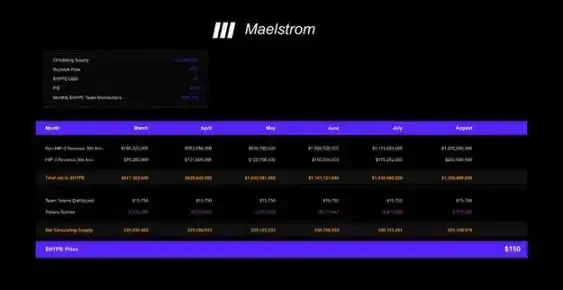
The key assumptions I must verify are: the Price-to-Earnings (P/E) ratio and the amount of HYPE tokens unlocked and released by the team each month. P/E Ratio Formula:
P/E = (Circulating Supply × Price) ÷ (30-day Annualized Revenue × Buyback Ratio)
My model predicts: Total revenue from HIP-3 and non-HIP-3 will grow from $843 million in March to $1.4 billion in August.
I will explain how, amidst intensifying competition among perpetual DEXs, Hyperliquid can reclaim its historically high 30-day annualized revenue level.
The final part estimates how many HYPE tokens the team receives monthly based on data from the past three months.
Stress-testing the model under different scenarios effectively increases the credibility of the assumptions. I will examine some assumptions from a pessimistic angle to see how “high” one needs to be to believe my $150 target price.
CEX vs DEX
The best thing about Hyperliquid is: Its volume growth doesn’t require an increase in global crypto perpetual total volume. If just a few percentage points of perpetual volume from centralized exchanges shift to Hyperliquid, it could easily double its 30-day annualized revenue within months. A mere 3.97% increase in market share would allow Hyperliquid to reach its $1.4 billion annualized revenue target. Considering Hyperliquid didn’t even exist less than three years ago, this is entirely feasible.

It’s great that Hyperliquid can take volume from CEXs, but which crypto derivatives specifically attract users? People come for stock perps and binary options, and stay for Bitcoin, Ethereum, and Solana trading.

HIP-3 allows anyone to permissionlessly list perpetual contracts. By staking 500,000 HYPE, you can use Hyperliquid’s matching and margin engine to create any market you want. TradeXYZ did exactly this, with its flagship products being perpetuals for Silver, Gold, Nasdaq 100, and S&P 500.
By the way, the Silver and Gold markets, launched less than three months ago, already see daily trading volume in the tens of billions. As the dirty fiat financial system arbitrarily changes rules to suppress people’s desire to escape centralized money, this will become the new venue for price discovery.
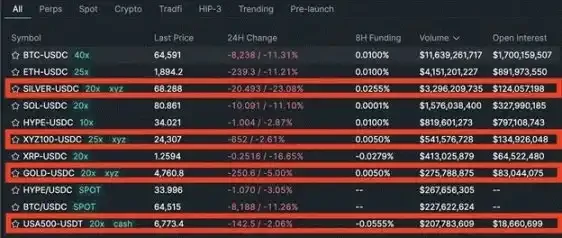
Screenshot taken on February 5, 2026, at 11:20:00 UTC
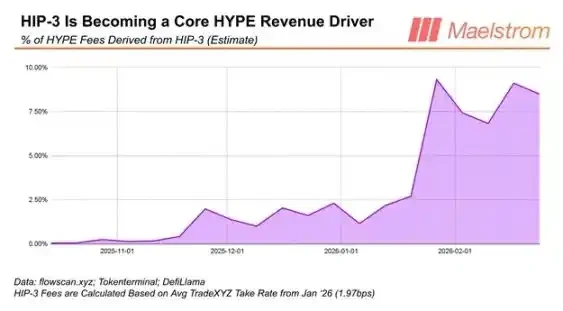
In just four months, HIP-3 volume contributes nearly 10% of Hyperliquid’s total revenue. Permissionless listing has always been the holy grail for DEXs, and the rapid growth in volume proves this is Hyperliquid’s key to pulling away from competitors.
For Hyperliquid’s revenue to grow 66% from March to August, HIP-3 must carry the banner. Especially if the total crypto market cap remains at its current depressed level. Hyperliquid must offer traders fresh, exciting on-chain trading instruments. Precious metals, AI stocks, crude oil—these are exactly what retail wants to trade. Now, via perpetuals, anyone globally can trade 24/7 with higher leverage than traditional financial exchanges.
For these reasons, my model predicts HIP-3 revenue will increase by 160% over 6 months.
The cherry on top is prediction markets. Hyperliquid recently announced that HIP-4 will support permissionless listing of prediction markets. I expect HIP-4 to launch within the next three months. Degens will flock to Hyperliquid’s prediction markets to trade binary options and 0DTE options. It’s hard to predict revenue growth before launch, so I haven’t included it in the model. If the Hyperliquid team delivers high-quality code as usual, almost immediately driving significant revenue, that’s just an extra bonus.
Unfortunately, Hyperliquid is not the only perpetual DEX. Competition is fierce because this is the next major battleground for trading. Late last year, the emergence of many low-fee, zero-fee DEXs pressured Hyperliquid’s expected valuation.
So what has happened since then that makes me believe again that Hyperliquid’s dominance is hard to shake?
Is It Real?
For crypto CEXs or DEXs, faking volume is as easy as pie.
At BitMEX, we used to joke about having a “volume bot”—a program run by the exchange to generate fake trades and boost activity.
Nowadays, many top exchanges routinely use volume bots to claim they are the “largest,” misleading traders into thinking there’s real liquidity. For DEXs, creating wallets to wash trade is even simpler, being the primary source of fake volume.
Liquidity mining is also a common tactic to boost activity: DEXs distribute points or platform tokens based on trading volume, so traders wash trade between wallets.
Wash trading and liquidity mining do not deepen real liquidity. We cannot precisely judge what percentage of volume these activities constitute. The only objective metric to measure exchange quality is calculating the ADV/OI Ratio (Average Daily Volume / Open Interest).
Because traders must post real funds as margin to open positions, Open Interest (OI) reflects the extent of real user engagement with the platform. Average Daily Volume (ADV) can easily be inflated by wash trading and mining, but when adjusted by OI, we get organic volume driven by real, risk-seeking traders. Therefore: A lower ADV/OI Ratio is better.
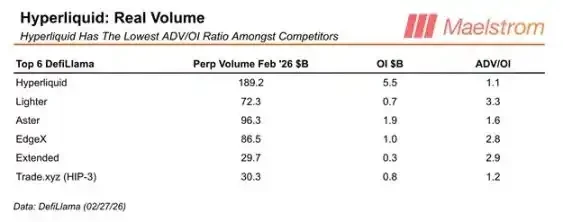
Among the top 5 perpetual DEXs, Hyperliquid’s volume is the most real because it has the lowest ADV/OI ratio. When traders realize that much of the liquidity on competitor platforms is fake, or that point/token mining incentives have ended, they will flow back to Hyperliquid.
Long-term, Hyperliquid’s share of real volume will continue to increase. This will solidify the “competition-proof” narrative for HYPE.
Many remember my tactical short-term bearishness on HYPE, with a key reason being competition from low-fee DEXs. Now I believe Hyperliquid is #1 in “real volume” in the industry, and for at least the next six months, I’m no longer worried about competition.
Regarding competition, the next consideration is: Considering slippage, which DEX truly has the best liquidity?
I took order book snapshots of the Bitcoin/USD perpetual on five platforms and calculated the slippage for market buy/sell orders of $100k, $1M, and $10M notional.
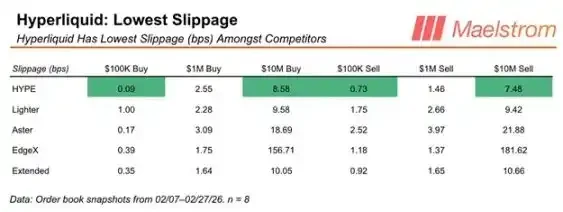
You can see that for large trades on Hyperliquid, the cost is lowest most of the time. Therefore, even if a competitor’s explicit fee is 1–2 basis points lower, serious large-volume traders will still flock to Hyperliquid because they can trade larger sizes with minimal market impact.
I’m Rich
The Hyperliquid team of just 11 people has built the best DEX product in history. Wealth should flow to them through their locked HYPE tokens.
When Maelstrom was bearish on HYPE late last year, one concern mentioned was the uncertainty around how many tokens the team would actually sell into the market each month. Since Hyperliquid didn’t take VC funding, whether the team voluntarily refrains from selling newly unlocked tokens is essentially an internal political decision for Jeff and the team. They have already limited token sales.
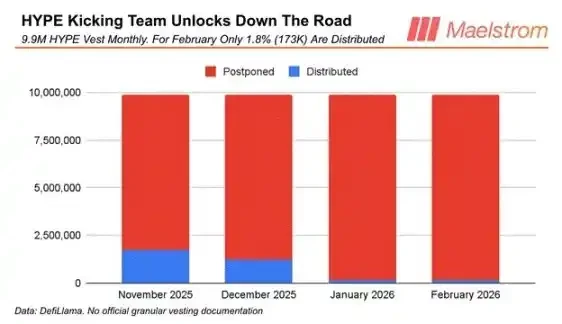
After distributing nearly 20% of reward tokens in November and December last year, the team distributed only about 1% of reward tokens in January and February. I speculate that the initial high distribution was for tax payments and lifestyle improvements. Once those needs were met, the team drastically reduced releases to help HYPE rebound. This is just my speculation.
History doesn’t repeat exactly, but it rhymes. Based on this, I assume the monthly release amount is the average of these four months: 815,750 tokens.
Looking Forward
The market is forward-looking. How much are players willing to pay for Hyperliquid’s future earnings? Currently, HYPE’s P/E ratio is about 12x. How does that compare to traditional financial exchanges?
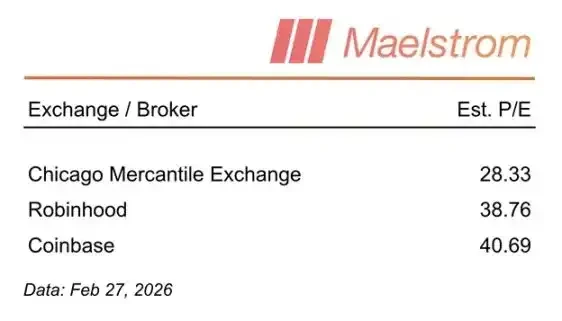
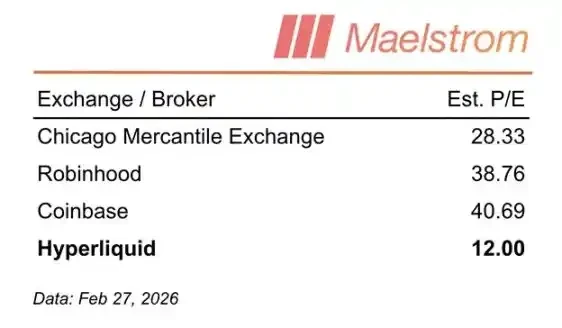
To determine a reasonable valuation level, I referenced the current P/E ratios of top global exchanges like CME, new-age brokerages like Robinhood catering to young, aggressive investors, and crypto exchanges heavily influenced by US regulation like Coinbase. Their P/E ranges are wide, roughly between 26x and 40x. In comparison, $HYPE at only 12x P/E is clearly severely undervalued.
Part of the low valuation is because Hyperliquid is not a public company, carries smart contract and counterparty risks, so its valuation multiple is naturally lower. Additionally, most mainstream centralized spot exchanges don’t support $HYPE trading, making it difficult for ordinary investors to buy, so it can’t be pumped to extremely high valuations like many altcoins. But even so, a 12x P/E is ridiculously low.
Within just a few months, Hyperliquid’s HIP-3 stock index and precious metals markets have become key price discovery venues when traditional financial exchanges like CME are closed on weekends. I didn’t know computers needed to play golf on weekends.
At the very least, from an industry trend perspective, HYPE deserves a higher valuation premium.
A note on بازار Cap vs Fully Diluted Valuation (FDV):
I use Market Cap, not FDV, which differ due to circulating supply. Market Cap only counts currently circulating tokens, not all future tokens represented by FDV. Given this is a 6-month horizon trade, using current market cap is reasonable. Admittedly, Hyperliquid may conduct another airdrop in the future, expanding the circulating supply. But as of now, the team has not hinted at an imminent airdrop, so I’m not considering this risk and the resulting supply shock for now.
Stress Test
What if the team unlocks 9.91 million HYPE monthly, the market only assigns a 12x forward P/E, but Hyperliquid’s 30-day annualized revenue still recovers to its historical high of $1.4 billion?
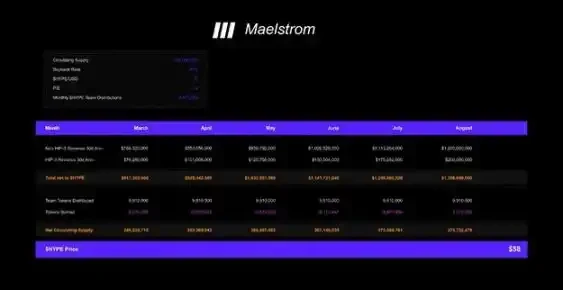
The target price would drop to $58, still about 75% higher than the current $30. That’s not a bad outcome.
I haven’t made pessimistic assumptions about revenue for a simple reason: If Hyperliquid’s revenue cannot grow from current levels, the token won’t rise. If that’s your view, don’t buy HYPE under any circumstances.
HYPE Man

Source: CoinGecko
I charted HYPE/BTC to illustrate that the market has already recognized this token’s value.
We all painfully know that unless you were short, Bitcoin has fallen from its September highs last year when HYPE hit a local low around $20. I believe the catalyst for HYPE’s renewed rise was the team’s token release plummeting from 9.91 million in January to a mere 140,000.
Furthermore, competitor DEXs’ point and token incentives are expiring one after another, rapidly losing their appeal to traders. Their remaining volume might be fake, but as I showed earlier, Hyperliquid is the place with the lowest trading cost based on order book liquidity.
Our Maelstrom team started dipping our toes with small positions in the low $20s. While ski touring, I kept thinking: If macroeconomics
یہ مضمون انٹرنیٹ سے لیا گیا ہے: Arthur Hayes: HYPE’s Next Stop is $150
1. Hot ٹوکنs on CEXs Top 10 CEX Trading Volume and 24-hour Price Changes: BTC: +1.96% ETH: +0.07% BNB: -1.46% WLFI: +1.69% SOL: -0.56% PSG: -0.75% DOGE: -1.65% ATM: +2.22% CITY: +0.19% JUV: -2.76% 24-hour Top Gainers (Data Source: OKX): ICX: +14.12% BERA: +11.78% TOSHI: +7.02% SWFTC: +4.41% SONIC: +4.29% HYPE: +4.19% LQTY: +3.53% SPK: +3.36% MAGIC: +3.14% BABY: +2.59% 24-hour Top Gainers in Crypto Stocks (Data Source: msx.com): PSTG: +10.44% RMBS: +9.17% GLW: +8.31% BTCS: +6.94% BTOG: +6.07% NVO: +4.76% VERB: +4.18% ICG: +4.17% NTAP: +3.77% SUIG: +3.65% 2. Trending On-chain Memes (Data Source: GMGN): WhiteWhale USELESS Buttcoin PENGUIN WAR Headlines US Treasury Secretary Besant: Fed Not Expected to Take Swift Action on Balance Sheet US Treasury Secretary Besant stated that gold appears to be in a typical speculative…
相关文章
































 اردو
اردو  English
  繁體中文
繁體中文  简体中文
简体中文  日本語
日本語  Tiếng Việt
  العربية
  한국어
한국어  Bahasa Indonesia
  हिन्दी
  Русский