







After the OpenClaw Craze: How Did an Open-Source “Crayfish” Move the Needle on U.S. Stocks?
In November 2025, an independent Austrian developer, Peter Steinberger, quietly submitted a project on GitHub – Clawdbot (later renamed to OpenClaw).
No one paid attention at the time, and everything spiraled out of control by the end of January 2026.
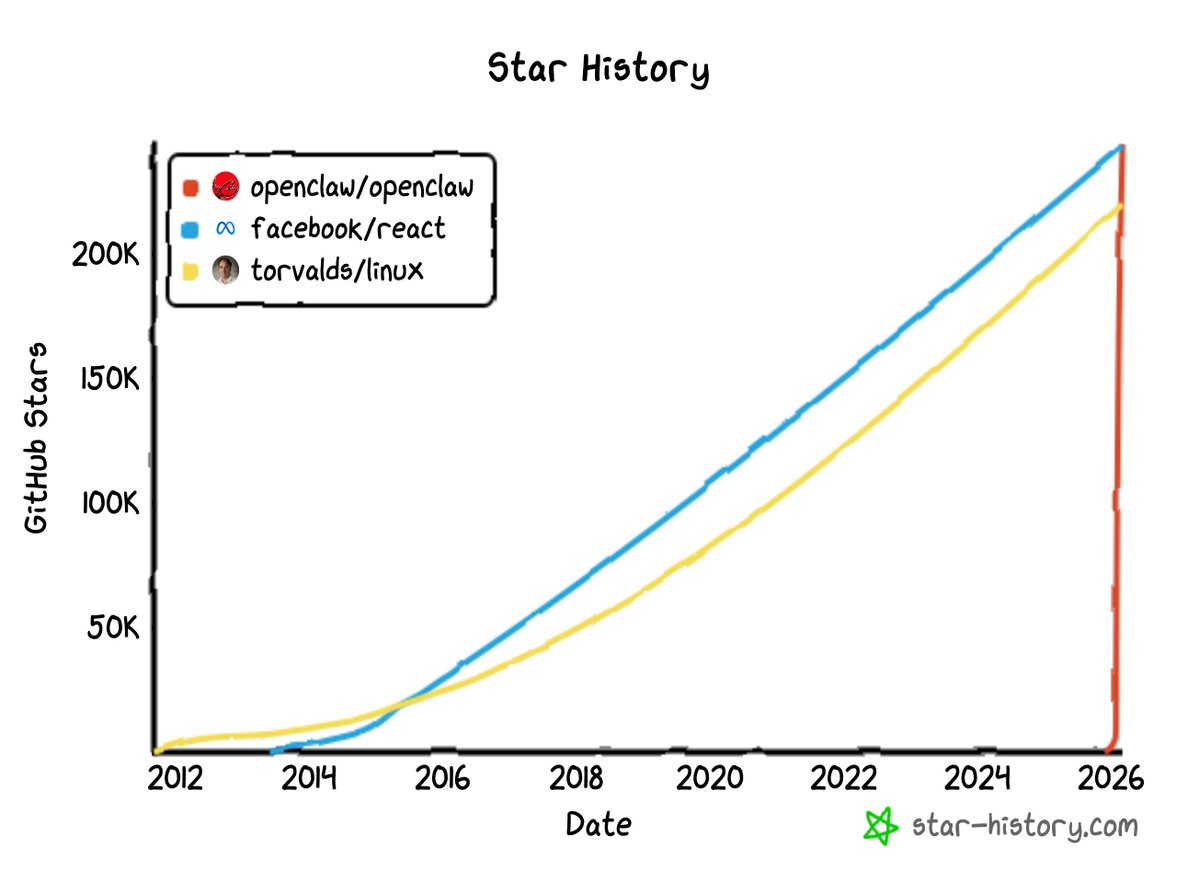
Between January 29th and 30th, the project gained tens of thousands of GitHub Stars in an extremely short period, quickly surpassing 100,000. As of March 3rd, this number has ballooned to nearly 250,000, topping the star chart and surpassing Linux. For reference, star open-source projects like React (one of the world’s most popular front-end development frameworks) and Linux (the operating system kernel that powers internet servers) often take over a decade to accumulate 200,000 Stars. OpenClaw’s growth curve, however, is almost a vertical line.
OpenClaw’s original name, Clawdbot, was a homophone for Claude. On January 27th, Anthropic sent a cease-and-desist letter forcing a name change. The project went through Moltbot before finally settling on OpenClaw. However, the name changes did nothing to slow its spread; instead, they generated more buzz. On February 16th, Sam Altman announced that Steinberger had joined OpenAI and that OpenClaw would be transferred to an independent open-source foundation supported by OpenAI.
From an independent developer’s project to a strategic chess piece for a tech giant, this little crawfish took less than three months.
The tech world has witnessed firsthand how hot OpenClaw itself is. So, where is this fire spreading now? This article attempts to sort out the beneficiary industry chain behind OpenClaw’s explosive popularity and the U.S. listed companies that may be revalued from a capital market perspective.
1. What is OpenClaw? Why Does It Impact U.S. Stocks?
First, the essence. OpenClaw is not another chatbot; it’s an open-source AI Agent framework.
What’s the difference? A chatbot receives your question and returns a block of text. OpenClaw receives your instruction and then takes action. It can operate browsers, execute code, call APIs, manage file systems, and connect to over 12 messaging platforms.
The difference in their operational modes can be summarized in a table:
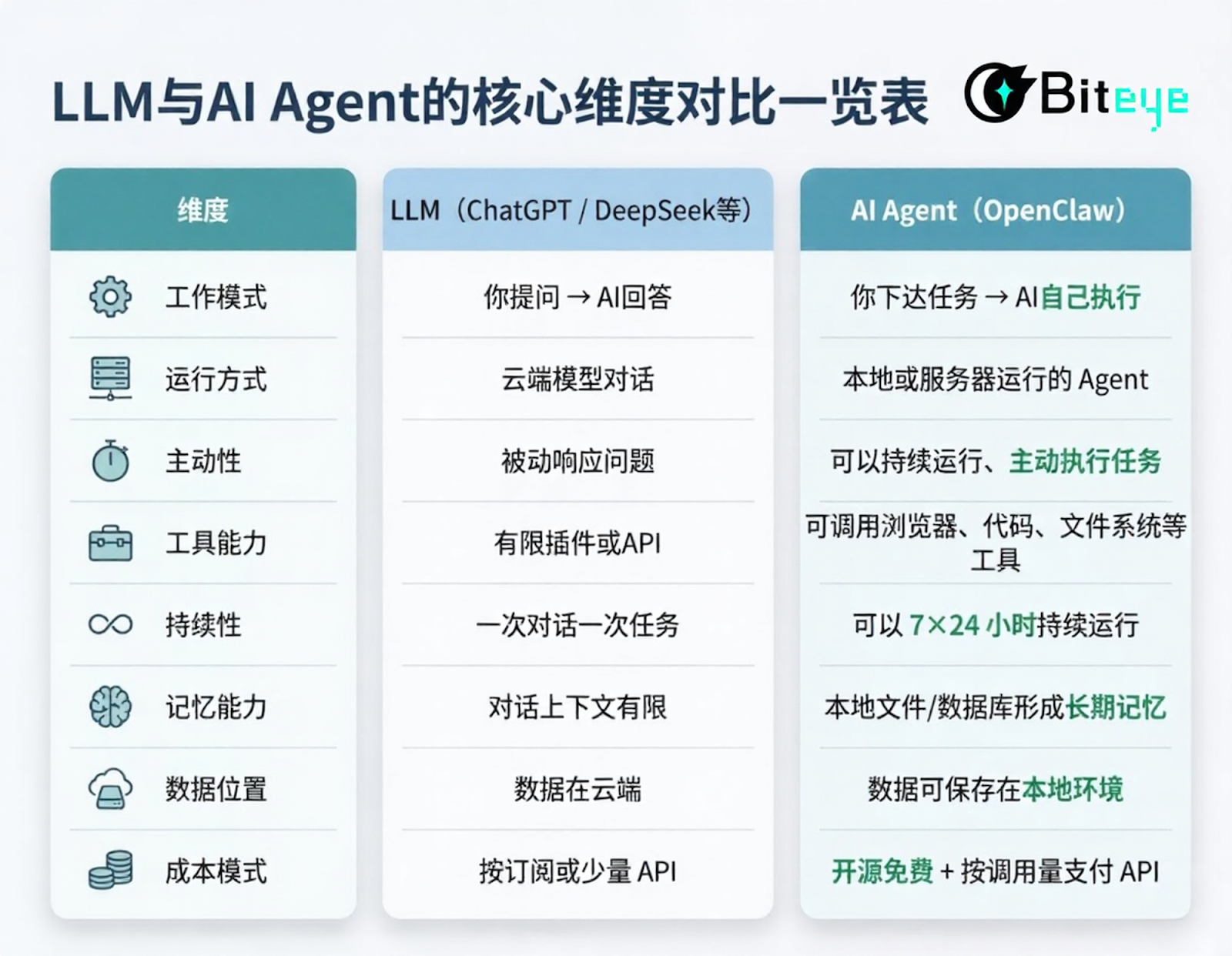
In simpler terms, it has evolved from a chatbot into a true digital employee. This also signifies a qualitative shift in the commercial paradigm of AI. In the conversational era, a user asks a large language model (LLM) a question, the model returns an answer, consuming a few hundred tokens, and the interaction ends. But in the Agent era, a single OpenClaw might initiate hundreds or even thousands of model calls per day. The token consumption generated by a single Agent user could be dozens or even hundreds of times that of a traditional chat user.
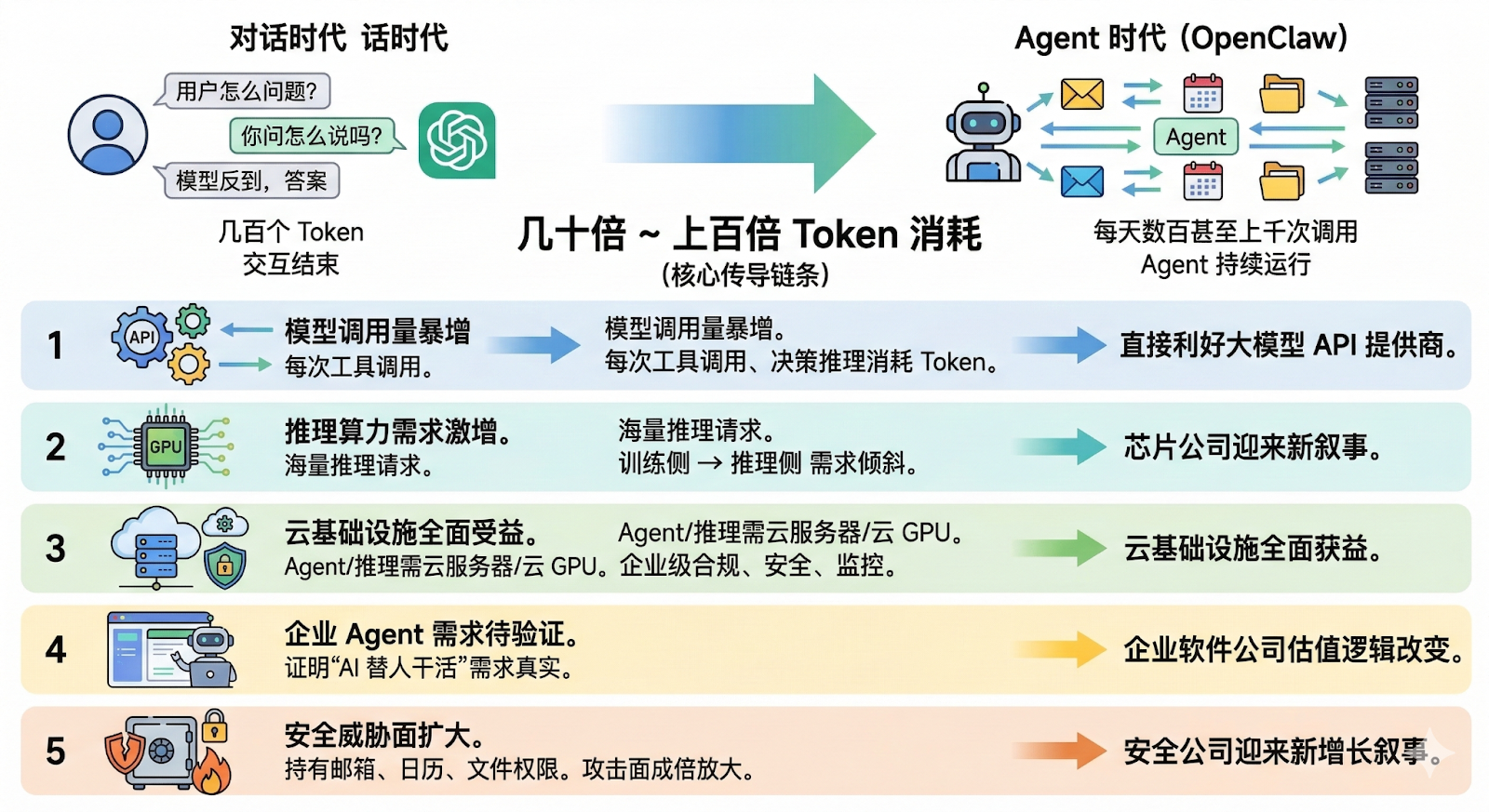
This consumption multiplier is the core transmission chain through which OpenClaw impacts U.S. stocks:
- First Layer: Surge in Model Calls. Every tool call, every decision-making inference by an Agent consumes tokens, directly benefiting major LLM API providers.
- Second Layer: Spike in Inference Compute Demand. Massive Agent calls mean massive inference requests. The demand logic for GPUs shifts from the “training side” towards the “inference side,” creating a new narrative for chip companies.
- Third Layer: Comprehensive Benefit for Cloud Infrastructure. Agents need cloud servers to run, model inference requires cloud GPUs to compute, and enterprise-grade Agents demand compliant, secure, and monitorable cloud infrastructure.
- Fourth Layer: Enterprise Agent Demand Awaits Validation. OpenClaw, in its open-source form, proves the real demand for “AI doing human work.” Enterprise software companies commercializing Agent capabilities may see their valuation logic change.
- Fifth Layer: Expanded Attack Surface. When Agents hold long-term access to email, calendars, and file system permissions, the attack surface multiplies, creating a new growth narrative for security companies.
- Below, we follow this chain to sort out the beneficiary U.S. stock targets one by one.
2. ٹوکن Killer: The Super Flywheel for LLM Service Providers
If Agents become the mainstream paradigm for AI interaction, API revenue for major LLM vendors will experience exponential growth.
However, the two largest Agent model suppliers currently, OpenAI and Anthropic, are not yet publicly traded. Therefore, the most direct corresponding listed targets for this logic in the capital markets are MSFT and GOOGL.
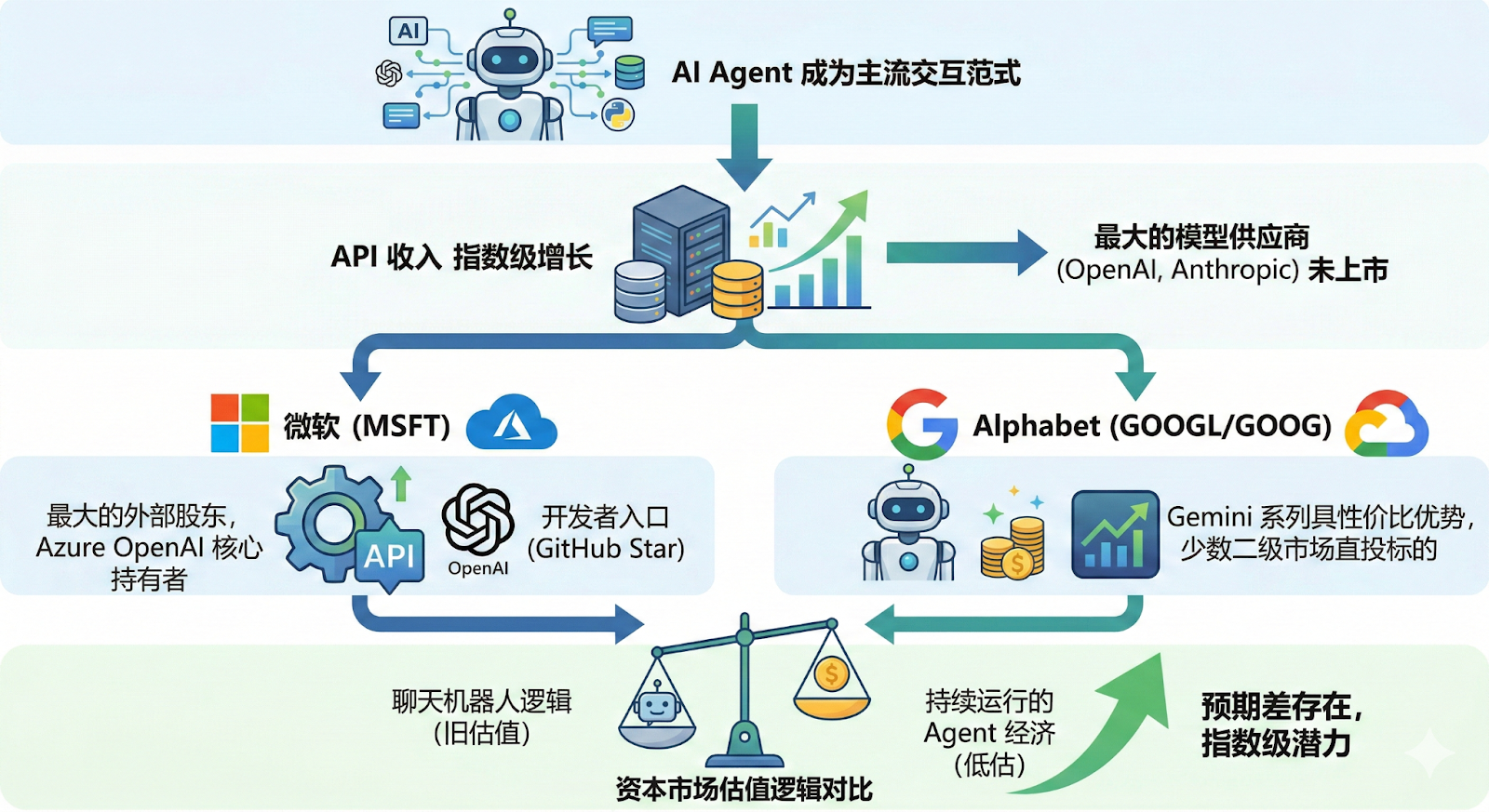
First, Microsoft, as OpenAI’s largest external shareholder, benefits from every API request for GPT-4o or o1 made through Azure OpenAI Service, as it essentially contributes revenue to Microsoft’s cloud business. The OpenClaw founder joining OpenAI and transferring the project to an OpenAI-supported foundation suggests the OpenClaw ecosystem will likely bind more closely with OpenAI models in the future. If OpenAI models top the default model recommendation list for OpenClaw, Microsoft would, in effect, gain a developer entry point with 240,000 GitHub stars.
Alphabet (Google’s parent company, tickers GOOGL/GOOG) is a beneficiary in another dimension. Google’s Gemini series is one of the mainstream models supported by OpenClaw, with Gemini 2.0 Flash offering highly competitive inference cost-performance. More crucially, among the leading model vendors, Alphabet is one of the few AI model providers directly investable via the public markets.
More noteworthy is that the market currently doesn’t seem to have fully priced in the Agent-driven API consumption logic. GOOGL hasn’t shown a significant rally since February due to OpenClaw, while MSFT is undergoing a valuation correction. In other words, an expectation gap exists—the capital market is still valuing model companies based on the “chatbot” logic, not the continuously running Agent economy.
3. Never Enough Inference: The New Narrative for Chip Companies
If token consumption is the gasoline of the Agent era, then GPUs are the engines powering this machine. The most direct beneficiaries remain GPU manufacturers NVIDIA and AMD.
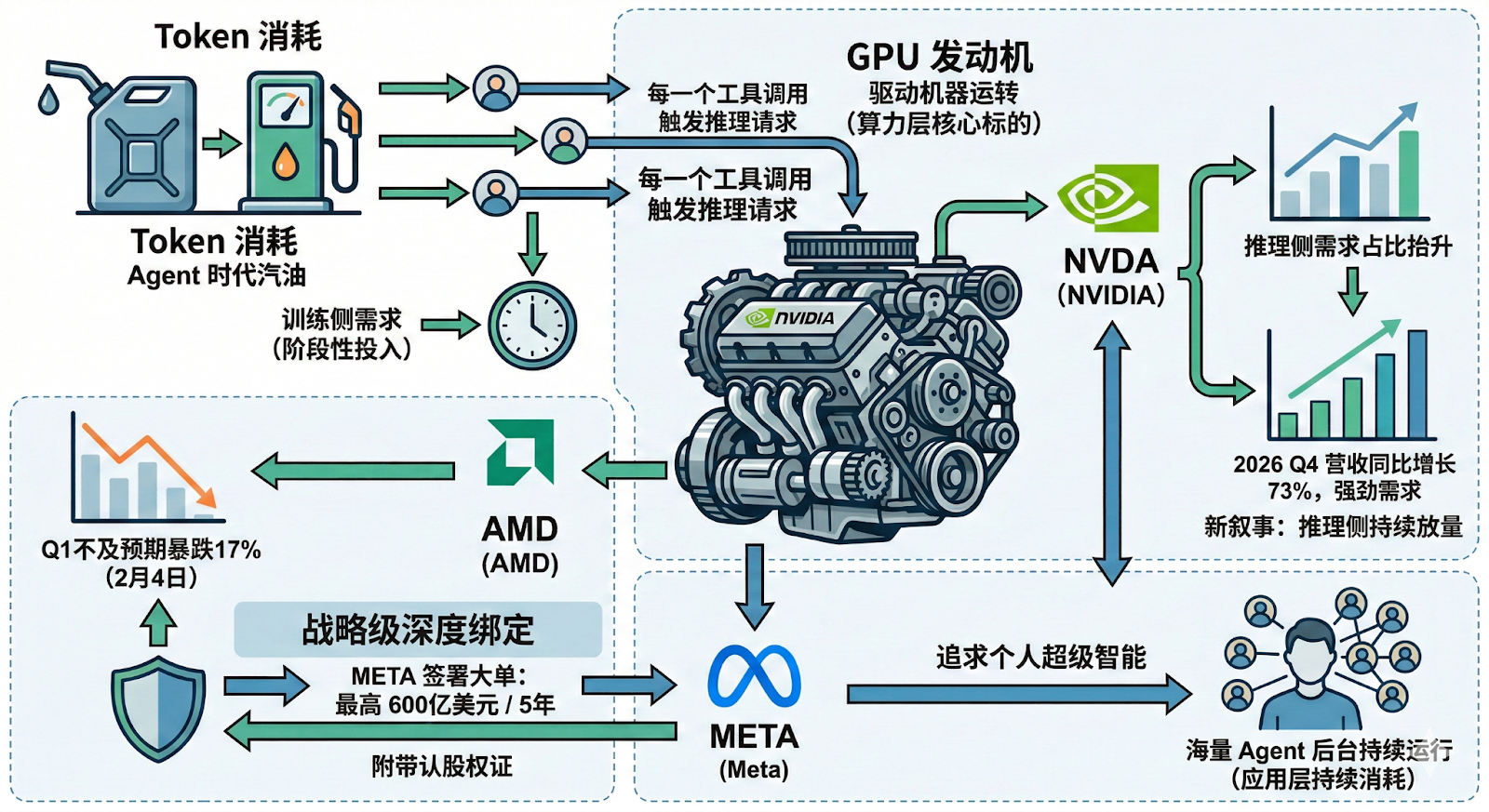
Over the past three years, the market’s valuation logic for chip companies was primarily based on the training side, with major players racing to purchase GPUs to train ever-larger foundational models. However, training is more like a phased investment, while inference is a continuous consumption. For example, every tool call by every Agent constantly triggers new inference requests. As Agents move from labs to millions of users, the proportion of inference-side demand is expected to rise significantly.
This also explains NVIDIA’s new narrative. If large training-side orders slow marginally, what can sustain GPU demand? Agents provide the answer: continuous scaling on the inference side. NVIDIA’s latest earnings report shows Q4 2026 revenue grew 73% year-over-year, with demand remaining strong. The rise of the Agent paradigm offers a more sustainable underlying explanation for this strength.
Let’s look at AMD. On February 4th, AMD plunged 17% due to weaker-than-expected Q1 earnings, spreading market panic. Yet, just 20 days later, Meta announced signing a potential $600 billion (over 5 years) AI chip supply agreement with AMD, accompanied by warrants for up to 160 million shares (about 10%), resembling a strategic deep binding.
Why does Meta need so much inference compute? Because it is pursuing so-called personal superintelligence, and achieving this vision relies on massive numbers of Agents running continuously in the background. OpenClaw validates not just a product direction but the entire logic that Agents require massive compute power.
Therefore, the inference demand growth driven by Agents will first transmit to the compute layer, with core targets being NVDA and AMD. Among application-layer companies continuously consuming compute, META could also become a significant demand driver.
4. The True Vessel for Agent Scale: Cloud Computing
As mentioned earlier, GPUs are the engines of the Agent era. Cloud computing platforms are the infrastructure where these Agents run long-term. From a capital market perspective, the core targets in this chain are the three major cloud platforms: AMZN, MSFT, and GOOGL. Further upstream in the data center infrastructure layer, EQIX and DLR could also become indirect beneficiaries.
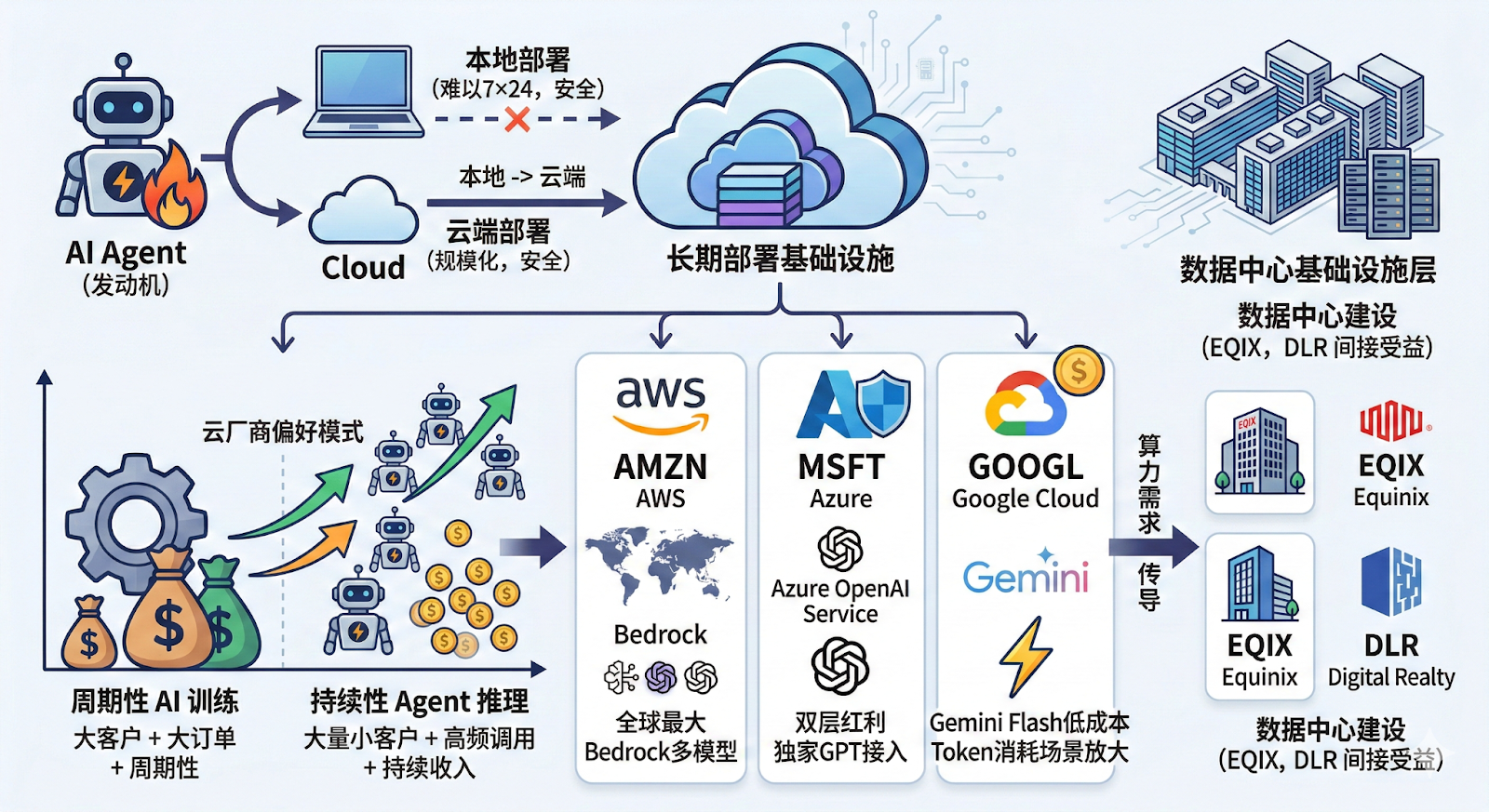
Although OpenClaw touts local deployment, the reality is that due to security and permission concerns, most users won’t run an AI Agent 24/7 on their personal laptops. Whether for individuals or enterprises, the endpoint for scaled deployment is likely the cloud. Alibaba Cloud and Tencent Cloud have already launched one-click deployment services in the Chinese market, validating the real demand from the side.
Furthermore, there’s an easily overlooked detail: the value of Agents to the cloud isn’t just compute power but long-tail inference traffic. AI training orders are “large customer + large order + cyclical,” while Agent inference is “numerous small customers + high-frequency calls + recurring revenue”—a business model cloud providers prefer.
In the global market, the three major cloud providers each hold unique advantages. AWS, as the world’s largest cloud platform, has its Bedrock platform supporting multiple model APIs and is a common deployment environment for developers. Azure benefits from both model API and cloud infrastructure layers; the exclusive GPT access capability of Azure OpenAI Service is further amplified in Agent scenarios. Google Cloud’s differentiation lies in its cost structure. The inference pricing of models like Gemini Flash is significantly lower than many flagship models. In scenarios requiring long-running Agents consuming tokens, this price difference is rapidly magnified.
Another point to watch: if Agents run at scale, cloud providers’ compute demand will eventually transmit to data center construction, potentially benefiting Equinix and Digital Realty indirectly.
5. Enterprise Agent Logic Awaits Validation, Benefiting AI-Native Companies
OpenClaw’s popularity validates a trend: people are willing to let AI do work for them, not just chat with them. However, for the traditional enterprise software sector, this is seen by the market as the prelude to a “SaaSpocalypse” (SaaS apocalypse).
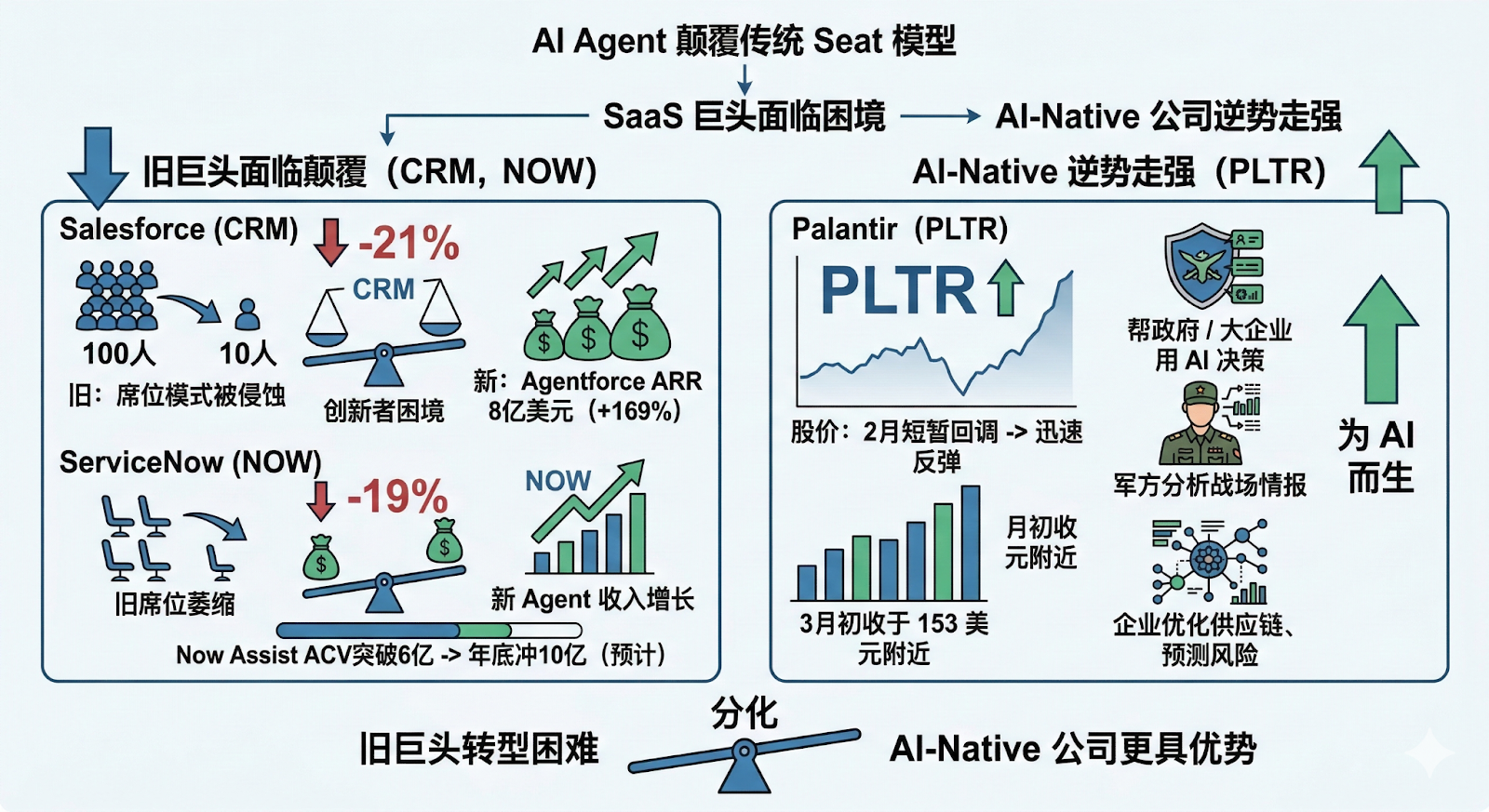
At the start of 2026, SaaS giants faced collective pressure: Salesforce down 21% year-to-date, ServiceNow down 19%. The root of the panic stems from a structural contest between Agents and software. In the past, we needed a software interface to command systems; now, Agents can directly call systems to complete tasks, stripping away the very presence of the software itself. This change raises two fundamental questions.
First, AI’s impact isn’t limited to the “per-seat” pricing model; it affects the entire software value chain. Take Adobe, for example: its stock fell from a high of $699.54 to $264.04, a drop of 62%. Education software company Chegg plummeted from $115.21 to $0.44, nearly zeroing out. Tax and accounting software giant Intuit also plunged 16% in a week in January 2026. The market’s fear isn’t the disruption of one pricing model but that generative AI tools (like those from Anthropic, etc.) are automating core enterprise workflows, reducing reliance on traditional software functions, thereby permanently compressing the revenue potential of entire SaaS platforms.
Second, the more powerful Agents become, the more fragile traditional business models are. Take ServiceNow: Microsoft is eroding its pricing power and slowing new customer acquisition through its “Agent 365” bundling strategy. A simple extrapolation is enough to chill investors: if one AI Agent can do the work of 100 employees, does a company still need to buy 100 software seats? OpenClaw’s breakout essentially accelerates the realization of this logic.
Of course, the giants aren’t sitting idle. Salesforce’s AgentForce has reached $800 million in Annual Recurring Revenue (ARR), growing 169% year-over-year. ServiceNow’s Now Assist has surpassed $600 million in Annual Contract Value (ACV), aiming for $1 billion by year-end. But it’s never easy for elephants to dance; they face the classic innovator’s dilemma: new Agent revenue is growing, while old seat-based revenue is shrinking. The outcome of this race between the two curves remains unclear. For CRM and NOW, the core contradiction is: can the Agent-driven increment offset the gap left by the seat model? The market has already voted with its feet.
Meanwhile, Palantir tells a completely different story. This company focuses on helping governments and large enterprises use AI for critical decision-making: the military uses it for battlefield intelligence analysis, companies use it for supply chain optimization and risk prediction, deploying AI into the most complex and sensitive business scenarios. After a brief pullback in February, PLTR quickly rebounded, stabilizing around $153 in early March.
While the SaaS sector was cratered by the “SaaS apocalypse,” Palantir bucked the trend. This divergence might indicate that the winners of the Agent era may not be the fastest-transforming old giants but companies born for AI from the start.
6. The Hidden Benefit for Security Companies
This is currently the most underestimated thread in the market.
Imagine you configure OpenClaw with access to your email, calendar, Slack, Google Drive, and GitHub. It needs these keys to work for you. But what if this Agent is compromised? The OpenClaw community has repeatedly discussed related security risks, such as credential leakage, permission abuse, and even data theft.
This is precisely why security companies are starting to position themselves early. In the current security industry, CrowdStrike (CRWD) and Palo Alto Networks (PANW) are two of the most capable leading players.
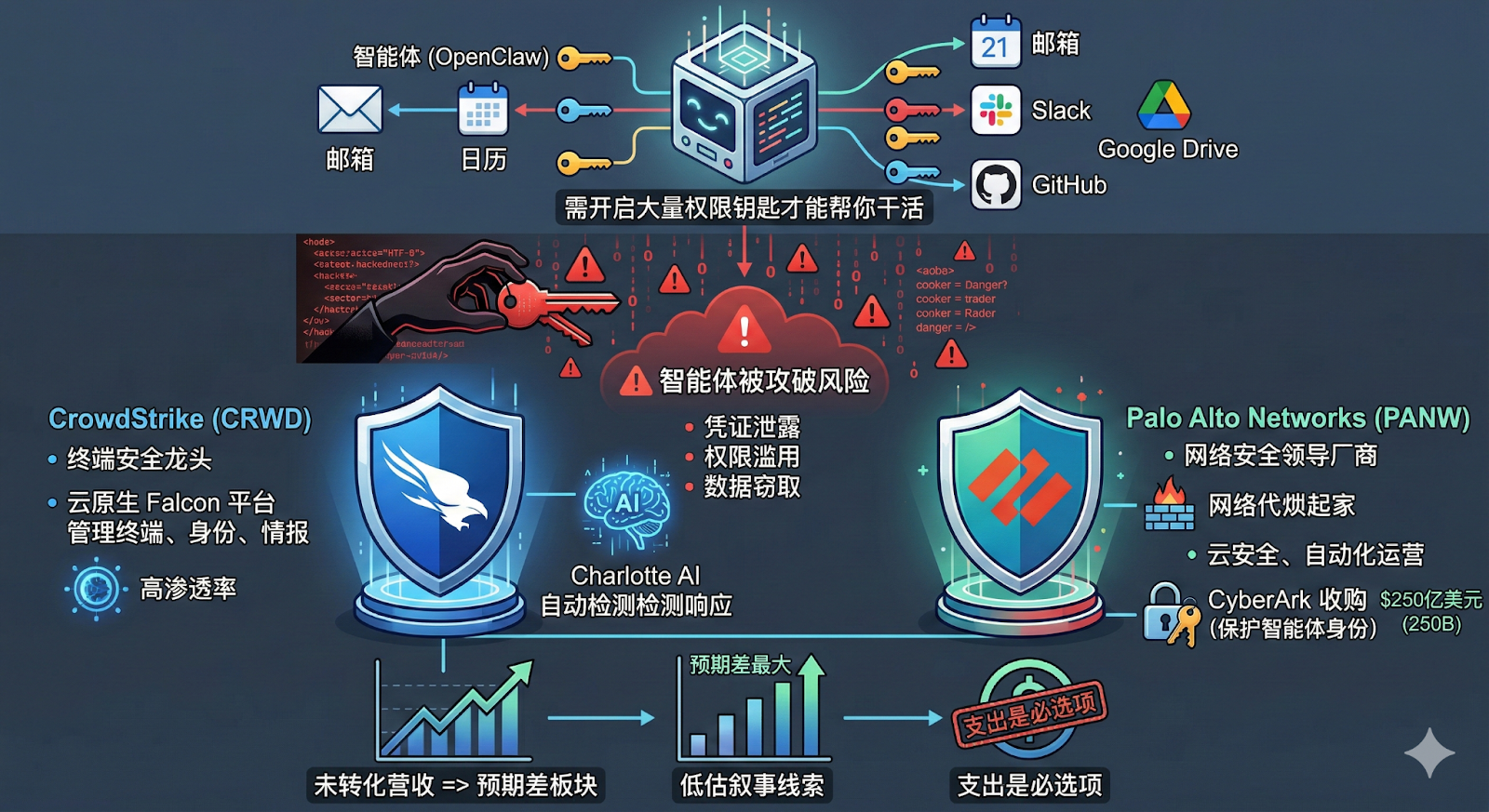
CrowdStrike is considered a leader in endpoint security. Its Falcon platform unifies endpoint, identity, and threat intelligence management through a cloud-native architecture, with high penetration among large global enterprises. The company has consistently integrated AI into security operations in recent years, such as Charlotte AI, which automates threat detection and response.
Palo Alto Networks is a leader in the global cybersecurity industry. Starting with next-generation firewalls, it has expanded into cloud security, identity security, and automated security operations. In 2025, it acquired CyberArk for $25 billion, focusing on protecting intelligent agent identity security.
At the moment of OpenClaw’s explosive popularity, security issues haven’t yet translated into significant revenue growth. But this precisely means security companies might be the sector with the largest “expectation gap” within the entire Agent narrative. Moreover, security spending is non-optional.
7. Conclusion: Short-Term Sentiment, Mid-Term Inference, Long-Term Ecosystem
Returning to the initial question: which U.S. stocks has OpenClaw actually moved? We can reason along different timelines.
Currently (past month), judging by stock performance, OpenClaw’s direct impact on individual stocks has been quite limited. GOOGL and MSFT haven’t shown abnormal volatility driven by the Agent narrative since February. The only clear event-driven move came from AMD, with Meta’s massive chip order triggering a single-day surge. Overall, the AI sector might be undergoing a round of valuation calibration; OpenClaw’s popularity hasn’t translated into immediate stock price catalysts.
Short-term (3 months), the market may continue digesting the squeeze in AI valuation bubbles, but the cognitive impact brought by OpenClaw could change buy-side perceptions of the Agent sector. This cognitive shift won’t immediately reflect in stock prices but could reshape analysts’ expectation models.
Mid-term (6-12 months), the key catalyst is whether Agent inference compute demand can be validated in earnings reports. If OpenClaw and subsequent projects like Kimi Claw, MaxClaw, and enterprise Agent solutions can bring observable growth in API call volumes and cloud resource consumption, the inference-side narrative for NVDA, AMD, and the three major cloud providers could be confirmed.
Long-term (1-3 years), the true winners will be companies that secure key positions within the Agent ecosystem, such as those establishing standards in Agent security like CrowdStrike and Palo Alto Networks.
We must also recognize that OpenClaw may not be the ultimate product. It has security vulnerabilities, high token costs, and an uncertain business model. But it has achieved one crucial thing: letting the world see the potential of AI Agents firsthand. This is no longer just product iteration; it’s a profound paradigm shift.
And once a paradigm shift occurs, it doesn’t stop. We can only be fully prepared and wait for that day to arrive.
یہ مضمون انٹرنیٹ سے لیا گیا ہے: After the OpenClaw Craze: How Did an Open-Source “Crayfish” Move the Needle on U.S. Stocks?
Author | Ding Dang (@XiaMiPP) “Altcoins are dead” has become a consensus that crypto users were reluctant to admit but had to face over the past year. Even former blue-chip tokens have fallen into prolonged sideways movement or gradual declines amidst the broader market’s sustained weakness, showing little sign of recovery. However, amidst this overall downturn, the MORPHO token has rebounded from its early February low of $0.96 to the $1.8-$1.9 range, doubling against the trend. Looking at the daily chart, this rebound has essentially formed a rounded bottom pattern, which could be a signal of a bottom reversal. Is this surge merely a short-term push driven by market sentiment, or the start of a trend fueled by the resonance of fundamental and structural variables? When the Old Regime Begins…
相关文章






























 اردو
اردو  English
  繁體中文
繁體中文  简体中文
简体中文  日本語
日本語  Tiếng Việt
  العربية
  한국어
한국어  Bahasa Indonesia
  हिन्दी
  Русский