







Author|Wenser (@wenser 2010 )

“The first DAT stock,” “BTC’s biggest diamond hands”—Strategy has started selling! According to Strategy’s disclosure, it sold 32 Bitcoins at an average price of $77,135 last week, generating $2.5 million.
Perhaps influenced by this news, BTC fell below $71,000 last night and is currently trading around $70,560; U.S. криптовалюта-themed stocks declined broadly at market close, with Bullish down 7.99%, DeFi Development down 7.97%, Circle down 7.11%, Strategy down 5.85%, and Upexi down 5.04%.
Strategy’s move to stop buying BTC and sell a small amount has exacerbated an already liquidity-constrained криптовалюта market. As major CEXs race to list U.S. stocks for trading, the crypto market continues to bleed capital.
Strategy Selling Bitcoin: Not the First Time, But Different This Time
This sale of BTC is not the first in Strategy’s history.
In 2022, when the second-largest crypto exchange FTX collapsed, the crypto industry entered a crypto winter, with BTC briefly falling below $20,000. On December 22, 2022, Strategy sold 704 BTC at a price of $16,776, and quickly bought back 810 BTC at $16,845 on December 24, 2022.
Strategy’s current sale is primarily to service dividends on its STRC financing.
As a fixed-income digital credit product launched by Strategy, STRC can be considered its flagship offering. However, after repurchasing $1.5 billion in convertible debt last month, Strategy’s cash reserves have fallen to approximately $871 million, enough to cover its estimated $1.7 billion annual preferred dividend obligation for only about six months. On May 29, STRC briefly dropped to $97.11 before recovering to close at $98.57.
Strategy stated in its Q1 earnings report released in early May: “If convertible notes mature or are redeemed without conversion into common stock, the company may need to sell common stock or Bitcoin to generate sufficient cash to meet these obligations.” At that time, Strategy reported a net loss of $12.54 billion for Q1, almost entirely from unrealized losses on its BTC holdings ($14.46 billion). As of the end of Q1, the total cost basis for its 818,334 BTC was $61.81 billion, corresponding to an average purchase price of approximately $75,537 per coin. Recommended reading: 《Strategy Q1 Earnings Report: Book Loss of $14.4 Billion, Selling Bitcoin to Pay Interest Not Ruled Out》
Of course, from a corporate operations perspective, Strategy’s move is understandable, and Michael Saylor has previously stated: “Even if we sell 1 BTC, we will buy 10 to 20 times more.” Selling is to buy better later. However, from an industry confidence perspective, this move not only signals a temporary dead end for the “DAT treasury model” but also significantly dampens the enthusiasm for accumulating and buying coins within the crypto industry, having a substantial short-term impact on market trading.
After this sale of 32 BTC, Strategy still holds 843,706 BTC, valued at $60.936 billion, with an average cost of $75,699 per coin, representing an unrealized loss of $2.932 billion. Just last month, thanks to a broader market rebound, Strategy’s holdings briefly showed an unrealized gain of $8.2 billion.
Notably, on May 28, Strategy founder Michael Saylor published an article with the theme “HODL” (Hold On for Dear Life), urging the market to steadfastly hold Bitcoin amidst the current downturn.
The “Muddled Accounts” Behind Strategy’s Bitcoin Sale: Polymarket’s “If Not Officially Stated, It Didn’t Happen” Farce
Beyond the sale itself, the “event determination farce” playing out on the prediction market Polymarket has also been quite amusing.
As we previously mentioned in the article 《Strategy Q1 Earnings Report: Book Loss of $14.4 Billion, Selling Bitcoin to Pay Interest Not Ruled Out》, the probability of “Strategy selling BTC before May 31” was only around 40% at that time.
As May ended, on June 1, Polymarket data showed that the probability of Strategy selling Bitcoin in May surged from a low of 12% to as high as 80%, before retreating to 58%, with cumulative market trading volume exceeding $16.4 million.
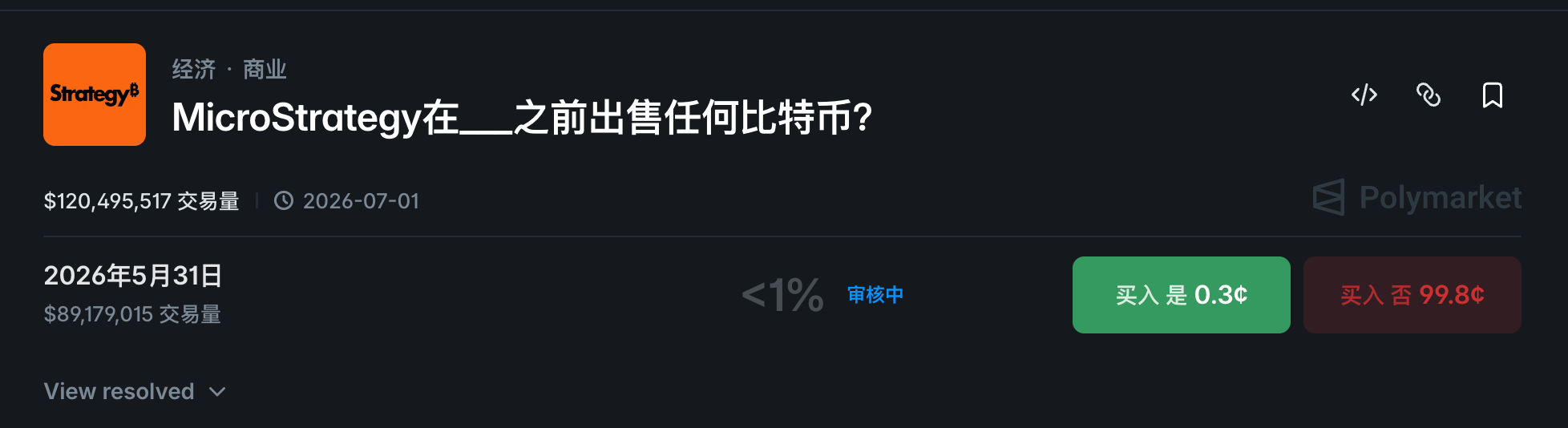
Ultimately, the matter was settled with a “No” outcome following a ruling by Polymarket officials. Polymarket stated officially, “We are aware of disputes regarding this prediction market. If a clarifying announcement is to be released, it will be published by 1:00 PM Eastern Time on June 1. If no statement is issued by then, it means the Polymarket team will not provide further clarification. Regardless of whether clarification is issued, the order book will be liquidated at 1:00 PM Eastern Time that day.”
Because Strategy did not issue an official statement regarding the Bitcoin sale, the event was ultimately settled as “Strategy did not sell BTC in May.” This once again confirms that prediction markets trade not on “the truth of the facts themselves,” but on “events within the defined rules.”
BTC’s “Digital Gold” Narrative Wavers, “Safe Haven” Status Takes a Hit
Following the news of Strategy’s Bitcoin sale, economist, gold advocate, and crypto critic Peter Schiff commented, stating that “Strategy selling 32 Bitcoin last week” signals the transition of Strategy, the “largest Bitcoin buyer,” into a seller, and questioned the source of future demand.
Billionaire investor Mark Cuban, who previously regarded BTC as a “superior version of gold,” recently also stated that he has sold most of his Bitcoin holdings, citing waning confidence in Bitcoin as a hedge against fiat currency devaluation and geopolitical risks, and expressing clear disappointment in the “digital gold” narrative.
JPMorgan also stated in a previous analysis that the “devaluation trade” involving gold and BTC is heating up, with investors exiting safe-haven assets.
Amidst successive price declines, perhaps BTC and the crypto market can only wait for the Trump administration to “love crypto once more.”
Эта статья взята из интернета: “HODL Myth” Ends: Strategy Sells BTC for First Time in 3 Years
Related: Token Transfer Station Chaos Collection: After Researching, I Don’t Dare to Use It at All
A couple of days ago, I was lurking in a developer group chat, watching everyone passionately discuss buying cheap API Keys—you know, those relay stations on Xianyu where a few bucks can get you billions of tokens. Everyone was complaining, saying they felt the models they were using had been swapped out, suspecting the station admins were secretly diluting them with smaller models to scam money. Looking at these chat logs, I only had one thought… Seriously, folks, you’re way too trusting. While you’re all worried about saving a few bucks, those relay stations might already be rifling through your computer’s drawers. How Bad Is the Situation? Frankly speaking, when it comes to topping up at sketchy relay stations, model dilution is probably the most ethical practice among these gray-market…
Related articles
































 Русский
  English
  繁體中文
繁體中文  简体中文
简体中文  日本語
日本語  Tiếng Việt
  العربية
  한국어
한국어  Bahasa Indonesia
  हिन्दी
  اردو
اردو