







Kalshi’s Eight-Year Startup Journey: A Boxer in a Suit Steps into the Ring
One afternoon sixteen years ago, in a dance studio at the Ballet School of the Teatro Municipal do Rio de Janeiro, 14-year-old Luana Lopes Lara was training her flexibility by lifting her leg to her ear. Her dance teacher lit a cigarette beneath the raised thigh. If she couldn’t hold the position, the cigarette tip, with a core temperature exceeding 700 degrees, would instantly burn through her leotard and leave a permanent scar on her leg.
At the same time, Lebanon was experiencing its most severe border conflict since the 2006 Lebanon War. Tarek Mansour, around the same age as Lara, was attending middle school in Lebanon. Years of warfare hadn’t instilled a fear of war in Tarek Mansour; instead, he personally experienced the anxiety brought by “uncertainty.”
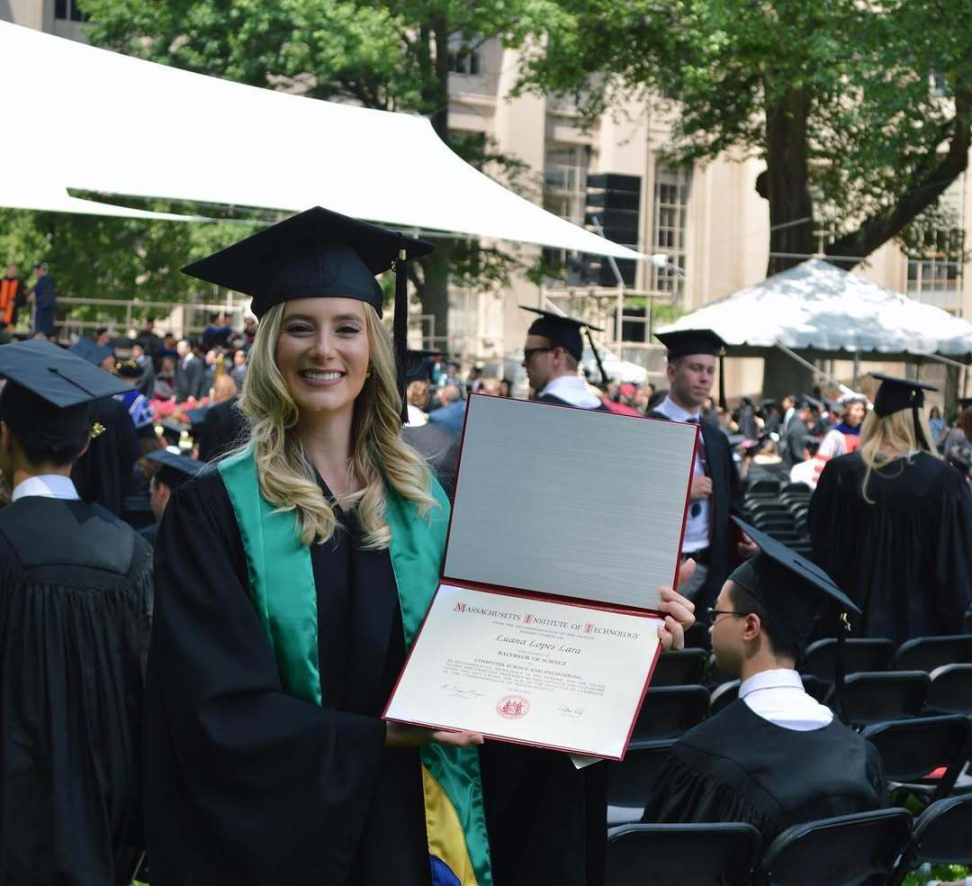
Three years later, fate brought the two, originally separated by over 10,000 kilometers, together at the Massachusetts Institute of Technology in the United States. After five years of study and work experience, one evening in 2018, while interning together at Five Rings Capital, the two conceived the idea of starting a company offering “event contracts” on their way home from work.

Kalshi’s two founders, Luana Lopes Lara (left) and Tarek Mansour (right)
In late March of this year, this prediction market company named Kalshi completed a $1 billion financing round led by Coatue Management at a valuation of $22 billion, becoming the world’s highest-valued prediction market company (contemporaneous media reports stated Polymarket was raising funds at a valuation of approximately $20 billion, but no official confirmation exists).
As early as December 2025, when Kalshi completed a $1 billion financing round at an $11 billion valuation, Lara surpassed Scale AI co-founder Lucy Guo and Taylor Swift to become the world’s youngest self-made female billionaire.
Before Kalshi’s founding, internet companies, including Uber, believed in expanding scale through aggressive growth and then using that scale to negotiate with regulators. In 2017, at a dinner in Tokyo, SoftBank’s Masayoshi Son pointed to Didi’s founder Cheng Wei beside him and told WeWork co-founder Adam Neumann that Didi defeated Uber not because he was smarter, but because he was crazier.
When this “craziness” became the standard for internet entrepreneurs of that era, Kalshi’s two founders went to the other extreme. For two years after the company’s founding, Kalshi had no product, no users, and no revenue. They bet the fate of this startup on one thing: obtaining a license.
“We Saw a Huge Рынок Gap”
A person’s decisions often reflect their life experiences. What one sees and thinks influences their different perspectives on the same matter.
You could view Kalshi’s near-fanatical obsession with compliance as a form of paranoia, but in hindsight, it appears more as “strategic resolve” forged by the founders’ past experiences.
Mansour, seeking “certainty” due to the shadow of war, and Lara, who studied diligently after dance school to win Brazil’s National Astronomy Olympiad gold medal, both independently chose to major in Computer Science at MIT.
At MIT, Lara sat in the front row for every class, a detail noticed by the introverted Mansour, who always sat in the back. He began boldly sitting next to Lara, and they gradually became friends. This friendship was partly due to their similar backgrounds: both were international students, both majored in Computer Science and Mathematics, and both were deeply interested in quantitative finance. Lara interned at Bridgewater Associates and Citadel during summers, while Mansour interned at Goldman Sachs and Citadel. In 2018, both received internship offers from Five Rings Capital and worked together in New York’s financial district.
Two major events occurred in 2016: Brexit and Donald Trump’s election as US President.
Mansour later stated that he saw institutional investors scrambling to adjust their positions, trying to hedge against the risks brought by these political events, but all hedging tools were indirect—such as shorting the pound, buying gold, or adjusting stock portfolios. No one could directly bet on whether “Brexit would happen” or “Trump would win.” “We saw a fundamental problem,” Mansour said, “People want to hedge the event itself, not the event’s impact on an asset’s price.”
After work each day, the two would walk back together to their intern apartments in the financial district. On these walks, they repeatedly discussed a core question: Why are all transactions in financial markets indirect? If you think Brexit will happen, you can only short the pound; if you think Trump will win, you can only buy certain stocks or sell others. Why can’t you directly trade on the event itself?
“We saw a huge gap,” Lara said, “All trading in financial markets is essentially people’s views on the future, but there’s no market to directly trade the future.” After countless discussions, the two decided to fill this long-standing gap.
Being the First to Eat the Crab
This insight itself wasn’t new. The concept of prediction markets has existed in academia for decades, with attempts dating back to the 1990s. But these platforms were either too small or operated in gray areas, ultimately failing to become mainstream.
In 1988, University of Iowa professors launched the Iowa Electronic Markets (IEM). As an academic research project, it allowed real-money trading on outcomes like US presidential elections, proving the effectiveness of “wisdom of the crowd” in prediction (its accuracy often outperformed polls). IEM obtained a “no-action letter” exemption from the CFTC (meaning the CFTC would not take enforcement action if conducted within limited scope), establishing an early legal framework.
The emergence of IEM was a landmark starting point for modern prediction markets. In the early 2000s, the US Defense Advanced Research Projects Agency (DARPA) proposed the Policy Analysis Market (PAM/FutureMAP) project, attempting to use prediction markets to analyze geopolitical events (like the Middle East situation). The plan was quickly canceled due to public controversy (labeled “terrorism futures”), but sparked widespread discussion on prediction markets’ application in intelligence and decision-making.
The earliest commercial prediction markets, Tradesports and Intrade, were founded around 2001. The former focused on sports-related event contract trading, while the latter focused more on economic and political events. In 2003, Tradesports acquired Intrade, reorganizing as Trade Обмен Network Limited (TEN) the following year. TEN gained attention during the 2008 and 2012 US presidential elections but chose to shut down in 2013 due to CFTC allegations of “offering contract trading to US users without approval.”
In 2010, Cantor Exchange received full CFTC approval to launch a movie box office futures market, an early attempt at formally regulated prediction-like contracts by the CFTC. In 2014, PredictIt, operated by Victoria University of Wellington in New Zealand, launched. This platform followed IEM’s academic-oriented model, obtaining a CFTC “no-action letter” exemption with a per-person trading limit of only $850.
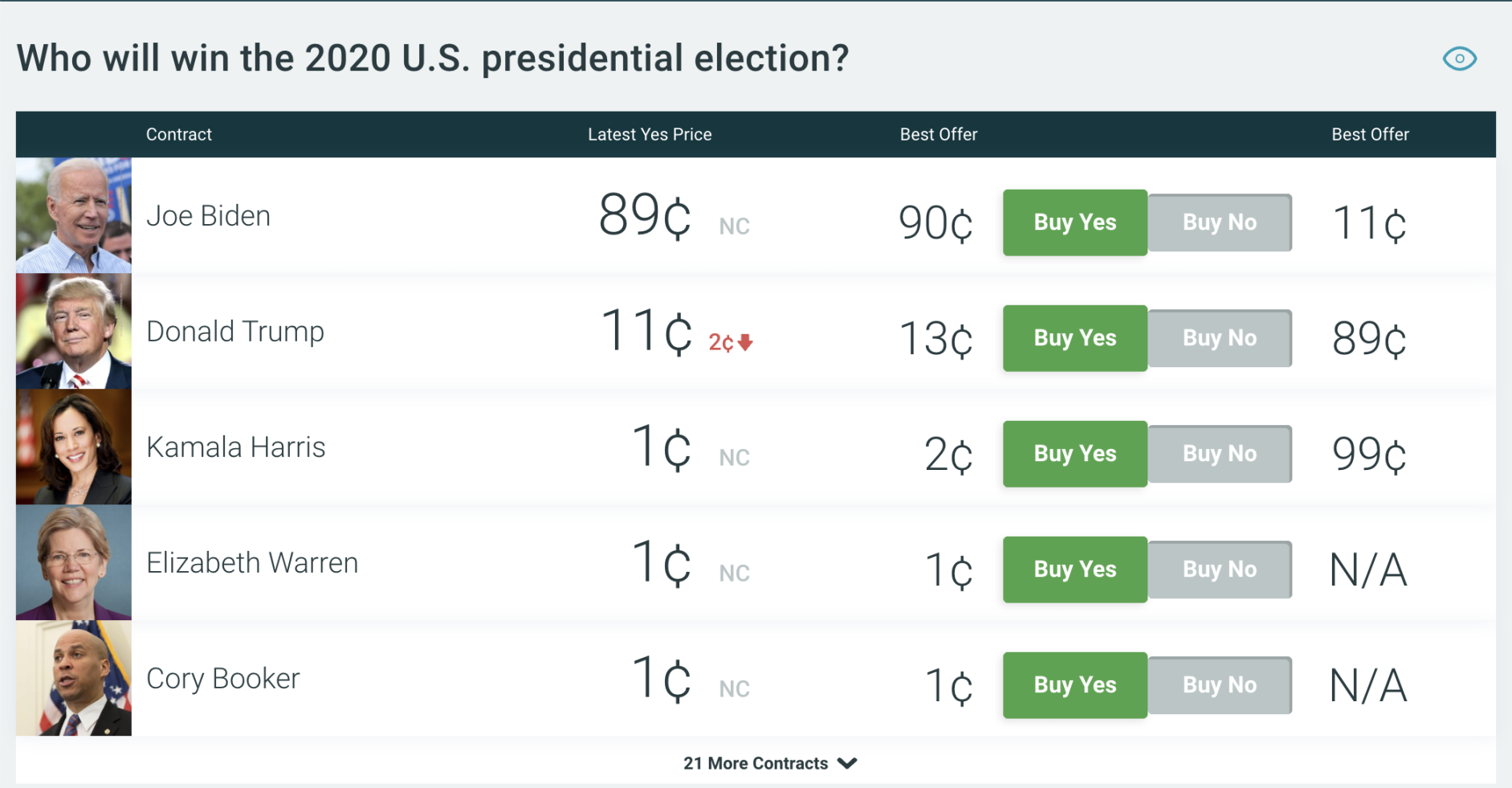
PredictIt’s 2020 US Presidential Election prediction market
Four years later, Kalshi was officially founded. Following the footsteps of their predecessors, Kalshi faced only two paths: either challenge the CFTC to obtain the highest-level Designated Contract Market (DCM) license, the same level as the Chicago Mercantile Exchange (CME) founded in 1898; or operate in a gray area with an offshore identity like later Polymarket.
At that time, only 14 companies in the US held DCM licenses, almost all being long-established commodity futures exchanges, including the Chicago Board of Trade (CBOT) founded in 1848, ICE Futures U.S. under the NYSE parent company, besides CME.
“When we were at Citadel, we saw how clients hedged risks,” Lara recalled, “As the Brexit referendum approached, clients wanted to hedge this risk, but they could only do so indirectly through complex currency and stock combinations. We asked them: If there was a platform where you could directly bet on ‘whether Brexit will happen,’ would you use it? The answer was yes, but only if the platform was compliant and regulated.”
This feedback was crucial. It revealed a fact overlooked by many prediction market entrepreneurs: the true value of prediction markets lies not in retail speculation but in institutional risk management needs, and institutional funds only flow to regulated platforms.
“Our goal was never just to create a platform for consumers to ‘place bets,'” Mansour emphasized, “Our goal is to create a new asset class, making prediction markets a mainstream financial instrument like stocks, bonds, and futures. To achieve this, compliance is not optional; it’s mandatory.”
In the founders’ minds, Kalshi was no different from Nasdaq, NYSE, or CME. The absence of such a platform wasn’t because event contracts themselves were illegal, but because no one was willing to attempt the seemingly impossible task of persuading regulators. Lara stated in an interview, “When we decided to get the license first before launching, many investors didn’t understand. They said: You could operate in overseas markets first, or use криптовалютаcurrency to bypass regulation. But we firmly believe that only growth built on a foundation of compliance is sustainable.”
Determination, patience, discipline—these identical qualities forged by vastly different experiences, and the aspiration to be “the first to eat the crab,” led the two young people to choose an untrodden path. This choice, absolutely correct in hindsight, was not a smooth one.
Two Years of Zero Progress, “Gnawing Through” to a CME-Level Contract License
In 2019, Kalshi was accepted into Y Combinator. Unlike other YC startups, their roadmap wasn’t “launch MVP within three months, acquire 1 million users within six months,” but “obtain CFTC license within two years.” But soon they faced their first challenge: they couldn’t find a law firm willing to take their case.
“We contacted over 40 law firms, all of which refused,” Lara recalled, “The reasons were similar: founders too young, company too small, legal status of prediction markets unclear, risk too high.”
This dilemma reflected the awkward position of prediction markets at the time. Legally, prediction markets were neither clearly regulated by securities laws like stocks nor constrained by state gambling laws like traditional gambling. They existed in a gray area between the two, with an ambiguous legal status. For conservative law firms, taking such a case meant immense uncertainty and potential reputational risk.
A turning point came when they met former CFTC official Jeff Bandman. Bandman, with years of experience at the CFTC, had a deep understanding of the regulatory framework. He saw Kalshi’s potential and believed prediction markets could operate within a compliant framework. More importantly, he was willing to bet on these two young people.

Jeff Bandman (second from left) with Luana Lopes Lara (second from right)
“People will eventually see how deep their commitment to prediction markets is, how firm their commitment to doing the right thing is. They are leaders with unwavering moral principles…” Bandman wrote in his memoir published on LinkedIn this year. Perhaps it was this rare persistence in young people that moved the veteran, a stranger who had dedicated half his life to regulation.
“Bandman was the first person we met who said ‘yes,'” Mansour said, “He understood what we were doing and believed it was achievable. Without him, we might have given up long ago.”
With Bandman’s guidance, Kalshi began the long and complex application process. To obtain a DCM license, Kalshi had to prove it possessed all the capabilities required to operate a compliant financial exchange: a trade matching system, clearing and settlement systems, market surveillance systems, AML and KYC procedures, a risk management framework, capital adequacy…
“We had to build a complete financial exchange from scratch,” Lara explained, “This includes the matching engine, clearing system, monitoring tools, compliance processes… All these things had to be built before launch and meet CFTC standards.”
This process took nearly two years. During this period, the two founders faced countless setbacks. CFTC officials remained cautious, a stance maintained for decades: Are event contracts disguised gambling? Could prediction markets be used to manipulate political events? What if someone engages in insider trading on the platform?
“Every meeting was a battle,” Mansour recalled, “We had to explain over and over: Event contracts are not gambling but risk management tools; prediction markets don’t manipulate politics but provide transparent information; Insider trading is harder on our platform than in the stock market because we have real-time monitoring.”
The biggest controversy centered on the CFTC’s “public interest” clause. Under the Commodity Exchange Act, the CFTC has the authority to prohibit any contract it deems “contrary to the public interest.” This clause gave the CFTC significant discretionary power and became the biggest obstacle in Kalshi’s application process.
“CFTC officials were concerned: if we allowed betting on political events, would it affect the democratic process?” Lara explained, “Our response was: Prediction markets don’t undermine democracy; they enhance it. When people have real money invested in political outcomes, they take information more seriously and spread misinformation less. The market becomes an aggregator of truth.”
This debate lasted for months. Finally, in November 2020, the CFTC approved Kalshi’s DCM application by a 3-2 vote. This was a milestone in prediction market history: for the first time, a regulatory agency formally recognized that event contracts are a legitimate financial derivative, not gambling. Simultaneously, this made Kalshi the world’s first prediction market to successfully obtain a formal financial market license.

Screenshot of the official document approving Kalshi’s DCM license
In an interview with Forbes, Lara stated that after the pandemic outbreak in 2020, she went to London, UK, to continue advancing the compliance process, while Mansour returned to his hometown. During the August 2020 Beirut port explosion, he spent his days helping with cleanup and search and rescue, and his nights continuing to work on Kalshi.
Kalshi successfully broke regulatory bias with two years of persistence, but the struggle was far from over.
Crossing the Final Compliance Hurdle
When Kalshi officially launched in July 2021, the competitive landscape it faced was completely different from two years prior.
Polymarket rose rapidly in 2020, attracting a large user base with the convenience of cryptocurrency and global coverage. But in January 2022, the CFTC fined Polymarket $1.4 million for “operating an unregistered binary options trading platform.” As part of the settlement, Polymarket agreed to block all US users, leaving a huge gap. Meanwhile, PredictIt, as another compliant prediction market, operated in the US, but the CFTC’s “no-action letter” limited the number of participants per market and trading size, preventing large-scale expansion.
Kalshi became the only prediction market platform in the US that could legally operate at scale. Kalshi user funds are held in FDIC-insured bank accounts, not directly custodied by Kalshi, meaning user funds are safe even if Kalshi goes bankrupt. Even when the option to use USDC was added in November 2025, it was custodied with Coinbase Custody.
“Many users don’t understand what FDIC insurance means,” Lara admitted, “But for those who do, it’s a strong signal of trust. It tells users: We are a real financial institution, not a cryptocurrency experiment.”
Kalshi’s compliant status made it the only prediction market platform institutional investors could legally use. Lara’s former employer, Bridgewater Associates, began using Kalshi data as input for macroeconomic analysis; Tradeweb, one of the world’s largest institutional bond trading platforms, partnered with Kalshi to provide prediction market data to its institutional clients. Furthermore, in December 2025, both CNN and CNBC partnered with Kalshi to integrate Kalshi data for analysis and other commercial purposes.
“From day one, we wanted to serve institutional investors,” Mansour said, “Not because we dislike retail, but because institutional capital is key to making this market truly liquid. And institutions only go to compliant platforms.” From its 2021 launch to year-end, Kalshi’s total trading volume was only about $10.4 million, growing to about $76.4 million the following year, and reaching $183 million in 2023.
Although the growth rate wasn’t slow, the expected explosion wasn’t seen. The reason was that despite obtaining a fully compliant license, the types of contracts Kalshi was allowed to list were still limited, mostly revolving around US macroeconomic data, climate, entertainment, etc., and mostly binary options (yes/no). This was far from the original goal of providing institutions with direct hedging for high-impact events.
The reason for this “bleak” situation was that the CFTC did not allow politics to be a tradable event. In June 2023,
Эта статья взята из интернета: Kalshi’s Eight-Year Startup Journey: A Boxer in a Suit Steps into the Ring
Compiled by | Odaily (@OdailyChina); Translator | Ethan (@ethanzhang_веб3) At first glance, the event title might easily be mistaken for an exploit. The core of the incident is: Someone exchanged $50.4 million worth of USDT for only $35.9k worth of AAVE. When I first heard about this, I was genuinely shocked. Therefore, I thoroughly dissected the entire event: transaction tracing, solver path, contract calls, historical reserves, settlement data, adapter flow, Aave interface code, CoW flash loan SDK, and the routing code that determines whether a quote is “reasonable.” This was not a hack. The Aave core protocol did not malfunction. The CoW settlement did not malfunction. Uniswap did not malfunction. SushiSwap did not malfunction. The transaction was valid, the signature was valid, all contracts executed strictly according to their code.…
Related articles































 Русский
  English
  繁體中文
繁體中文  简体中文
简体中文  日本語
日本語  Tiếng Việt
  العربية
  한국어
한국어  Bahasa Indonesia
  हिन्दी
  اردو
اردو