







Huobi Growth Academy | In-Depth Research Report on the Web3 Robots Sector: When Machines Become On-Chain Economic Entities
1. Track Definition and Evolution Logic: From Automation Инструментs to On-Chain Economic Entities
The core driving force behind this transformation stems from the maturation of technology across three levels. First, breakthroughs in Embodied AI. Large language models and multimodal models have endowed robots with capabilities for natural language understanding, environmental perception, and task planning. For example, OpenMind’s OM1 operating system integrates perception, memory, reasoning, and action into a unified framework, evolving robots from “capable of movement” to “capable of understanding and thinking.” Second, the rise of Decentralized Physical Infrastructure Networks (DePIN). Blockchain provides physical devices with identity authentication (DID), trusted data recording, and automated settlement capabilities, enabling machines to participate in market transactions as economic entities. Third, the maturation of stablecoins and Layer 2. Efficient micropayment infrastructure makes high-frequency, small-amount settlements between machines possible, laying the financial foundation for the Machine Economy.
Forbes predicted in 2026 that blockchain will become the trust network for AI, with every significant agent action recorded on a lightweight ledger to achieve compliance, governance, and accountability. This means that the Web3 Robots track is essentially building a new economic system that enables machines to prove themselves, trust others, create value, and participate in distribution. This system consists of a three-layer architecture: the bottom layer is the operating system that grants intelligence to machines (e.g., OpenMind OM1), the middle layer is the protocol layer providing identity and collaboration networks (e.g., OpenMind FABRIC, peaq), and the top layer is the labor market and tokenization platforms for application scenarios (e.g., Konnex, Virtuals). The synergy of this three-layer architecture is reshaping robots from “tools” into “digital citizens.”
2. Infrastructure Layer: The Co-evolution of Operating Systems, Data, and Networks
The underlying infrastructure construction for the Web3 Robots track is advancing simultaneously across multiple dimensions. The most representative examples include OpenMind’s layout in the operating system layer, PrismaX’s exploration in the data layer, and peaq’s construction in the network layer. These three projects together form a complete infrastructure closed loop of “system-data-network,” providing the operational foundation for upper-layer applications.
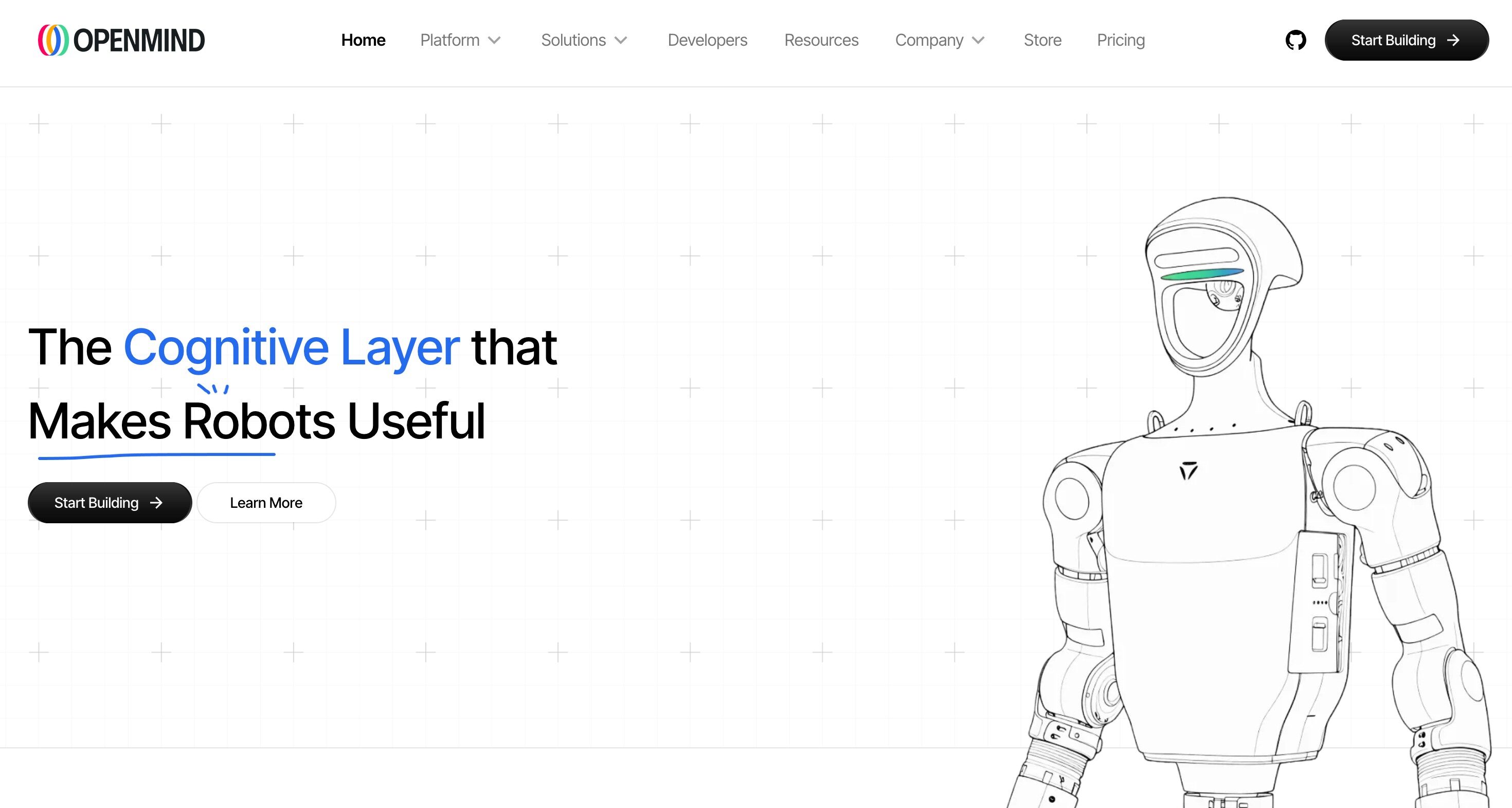
OpenMind is hailed as the “Android of the robotics field.” Its core products include the open-source AI-native robot operating system OM1 and the decentralized collaboration network FABRIC. OM1 uses the MIT license, has garnered over 2500 stars on GitHub, attracted more than 500 global contributors, and seen over 7500 independent developer visits. Unlike traditional robot operating systems (ROS) that focus solely on motion control and navigation, OM1 integrates four major modules: perception, memory, reasoning, and action, supporting advanced functions such as natural language interaction, environmental mapping, and object recognition. Currently, OM1 has been adapted for over 10 leading hardware manufacturers including Unitree, Fourier, UBTECH, and Deep Robotics, covering various forms such as humanoid robots, quadruped robots, and robotic arms. The FABRIC protocol builds a decentralized machine collaboration network, assigning an on-chain identity (peaq ID) to each robot, supporting skill sharing, task coordination, and USDC micropayment settlements between machines. In February 2026, the FABRIC Protocol (ROBO) was listed on Binance Alpha and Binance Futures, with a 24-hour trading volume exceeding $140 million, and subsequently listed on mainstream exchanges like OKX, Coinbase, and Kraken. The project completed approximately $20 million in financing in August 2025, led by Pantera Capital with participation from top institutions such as Coinbase Ventures, DCG, and Sequoia China. Its latest round valuation is around $200 million, with a Kaito Launchpad presale FDV reaching $400 million. Current participation points include the Season 1 points program, NFT minting for the FABRIC Identity Network, and GitHub code contributions, with strong airdrop expectations.
PrismaX is hailed as the “gold mine” of physical world training data. If algorithms are the “brain” of a robot, data is the “nutrient” for that brain. PrismaX positions itself at the AI robot data layer, solving the scarcest problem in robot training—”physical world interaction data”—through a human-machine collaboration (RLHF) model. Its platform allows users to remotely control real robotic arms via a webpage to complete actions. The system records operational data and sells it to robotics companies for AI training, while users earn points redeemable for future tokens. This “Play-to-Train” model creates a data flywheel: more user participation brings more data, more data trains better models, and better models attract more users. PrismaX recently completed an $11 million seed round led by top venture capital firm a16z, with participation from Virtuals Protocol. The current ecosystem has over 500 participants who have completed remote robotic arm operations, with two complete operable robotic arm systems (Unitech Walker “Tommy” and “Bill”) launched. Users can earn points through daily check-ins, whitepaper quizzes, or even paid training ($99), with market expectations for future airdrop distributions. Risks include the influx of many “farming studios” potentially diluting point value, and industry debate over whether remote operation data can truly train commercial-grade robots.
peaq is the Layer-1 network for the machine economy. peaq is a Layer-1 blockchain specifically designed for the machine economy. Its core functions include machine identity (peaq IDs), on-chain wallets, access control, and nanosecond-level time synchronization, supporting millions of robots and devices for autonomous transactions. Unlike many DePIN projects that remain conceptual, peaq has already validated a real commercial closed loop. Its ecosystem includes a Hong Kong robot farm (Robo-farm) that uses automated robots to grow hydroponic vegetables. Users purchase NFTs representing farm shares, and revenue generated from vegetable sales is converted into stablecoins and directly distributed on-chain to NFT holders. The first revenue distribution at the end of January 2026 showed a single payout of 3820 USDT, with an annualized return of approximately 18%. This model of “earning not from token inflation, but from selling vegetables” makes peaq a typical case of Real World Asset (RWA) implementation. In terms of partnerships, peaq has conducted technical validation collaborations with industrial giants like Bosch, Mastercard, and Airbus, covering areas such as IoT sensors, payment gateway integration, and supply chain tracking. The mainnet launched in 2024, with a current circulating market cap of approximately $34.25 million and an FDV of about $78 million. The ecosystem hosts 50-60 running DePIN applications, connecting over 2 million physical devices. The $PEAQ token is primarily used for Gas and staking. The “Get Real” campaign is ongoing, with a reward pool of 210 million $PEAQ (worth over $100 million). Users can earn XP/NP by completing real-world DePIN tasks and claim tokens.
The relationship between these three is akin to a complete production system: PrismaX provides the data “raw materials” to train robots, OpenMind’s OM1 provides the “operating system” for robots to run intelligently, and peaq provides the “network and incentive layer” for robots to complete economic settlements. Their synergy constitutes the complete infrastructure stack for decentralized embodied intelligence.
3. Financial Layer of the Machine Economy: Токенization Platforms and Positioning Networks
When the infrastructure layer solves the problems of “how machines become intelligent” and “how machines collaborate,” the financial layer of the machine economy begins to emerge. The core question this layer addresses is: How can the value of machines be priced, traded, and circulated? Virtuals Protocol and Geodnet provide answers from different perspectives.
Virtuals Protocol is a tokenization platform for AI agents/robots, allowing communities to participate in agent issuance, staking, and governance. Its core mechanisms include the Pegasus/Unicorn ecosystem, the ACP (Agent Commerce Protocol) marketplace, and the Butler tool. The ACP marketplace enables trustless commercial transactions between AI agents, supporting the entire process of task publishing, verification, and settlement on-chain. In March 2026, Virtuals co-developed the ERC-8183 standard (Agentic Commerce) with the Ethereum Foundation’s dAI team, introducing work primitives with on-chain escrow, evaluator certification, and modular hooks, enabling trustless commercial transactions between agents. Data shows that on-chain revenue between agents on Virtuals has exceeded $3 million (excluding transaction fees), indicating that verifiable economic output entirely created by AI agents has reached scale. The $VIRTUAL token launched in late 2023, with a current market cap in the $500 million range, and is listed on mainstream CEXs like Gate.io. The weekly Epoch airdrop system is active, distributing rewards based on veVIRTUAL staking and Butler usage—2% to stakers and 3% to ecosystem participants. In early 2026, Virtuals also partnered with OpenMind’s FABRIC protocol. After robots obtain economic identities through FABRIC, they can receive tasks from agents via ACP and perform on-chain settlements, achieving deep integration between the machine economy layer and the infrastructure layer.
Geodnet is known as the centimeter-level navigation infrastructure for robots. Geodnet is a decentralized high-precision positioning network built on Solana, providing RTK (Real-Time Kinematic) centimeter-level navigation services for robots, drones, and autonomous vehicles. Its network consists of globally distributed reference stations. Node operators earn $GEOD tokens by deploying hardware, while users subscribe to services to access positioning data. Geodnet’s business model features a typical “real yield” characteristic: 80% of data revenue is used for $GEOD buybacks and burns, creating a deflationary mechanism. At the CES exhibition in January 2026, Geodnet showcased the Geoswarm home security drone. This drone can automatically take off from a compact rooftop dock, complete patrols using GEODNET’s high-precision positioning data, and automatically return and land, all without human intervention. Additionally, Geodnet launched consumer-facing in-vehicle RTK hardware ($150) and an RTK survey receiver ($695), the latter of which won a CES Innovation Award. Geodnet has completed total financing exceeding $15 million, including a round led by Multicoin Capital. The token has migrated from Polygon to Solana and is currently tradable on Coinbase. For investors, Geodnet’s buyback-and-burn mechanism and real hardware sales constitute value support. It’s worth noting that its node deployment rewards and staking reward mechanisms are still actively running.
From the perspective of the financial layer, Virtuals Protocol solves the “liquidity” problem for AI agents—making agent capabilities tokenizable, tradable, and priced. Geodnet solves the “spatial perception” problem for robots—enabling machines to precisely locate and navigate in the physical world. Together, they expand the boundaries of the machine economy: the former allows the value of machines in the digital world to circulate, while the latter makes the activities of machines in the physical world more precise and reliable.
4. Application Layer: From DePIN Investment to Real World Assets
The infrastructure and financial layers form the “skeleton” and “blood” of the Web3 Robots track, but what truly determines its vitality is whether the application layer can create value in the real world. XMAQUINA and Robonomics explore this proposition from different dimensions.
XMAQUINA is a DAO-governed robot investment bank. XMAQUINA is a DePIN project that invests in and tokenizes real humanoid robot companies through DAO governance, allowing token holders to share in the profits of these companies. Its core mechanisms include the “Robotics Bank” and the Machine Economy Launchpad. The DAO allocates capital to promising robotics companies (e.g., Apptronik, Figure AI) and manages them professionally through SubDAO mechanisms. In January 2026, XMAQUINA completed its final public auction, with the community contributing over $3.25 million in less than 30 minutes, bringing cumulative financing to $10 million. The TGE for the $DEUS token is expected to be activated in January-February 2026, with 33% unlocked at TGE and 67% released linearly. Current participation points include holding $DEUS for governance voting and profit sharing, monitoring DAO proposals and staking mechanisms, and upcoming Launchpad projects. XMAQUINA’s model is essentially a “robotics version of an investment fund.” It lowers the barrier for ordinary investors to participate in early-stage investments in robotics companies while achieving decentralized investment decision-making through DAO governance.
Robonomics is the earliest Web3 robot coordination platform. Robonomics is a pioneer in the Web3 robotics field, launching a testnet as early as 2018, providing robot cloud services and smart contract-based task allocation functions. Its core capabilities include IoT device integration, sensor data on-chain, and automated task execution. The Robonomics token $XRT was issued in 2019 and is listed on exchanges like Kraken, but its market cap is relatively small, making it a “veteran” project in the track. Compared to newer projects, Robonomics’ ecosystem is relatively mature but lacks growth momentum, with no recent large-scale airdrops or incentive activities. It is more suitable for long-term investors focused on IoT and robotics integration to hold and observe.
It is worth noting that more innovative models are emerging in the application layer. The “Universal Basic Ownership Pilot” project within the peaq ecosystem explores universal ownership of machine assets, while the tokenized machine deployment mechanism allows ordinary users to invest in and share the operational profits of robots. Furthermore, agents like ArAIstotle ($FACY) have emerged in the Virtuals ecosystem, achieving 382,000 queries, 8,000 users, and $760,000 in tax revenue, with a month-over-month ACP growth of 413x, demonstrating the immense potential of the AI agent economy.
5. Challenges, Risks, and Future Outlook
Although the Web3 Robots track shows immense potential, it is still in its early stages of development, facing multiple challenges and risks.
On the technical level, hardware reliability and environmental adaptability of robots remain bottlenecks. As OpenMind founder Jan Liphardt stated, the reliability of key components like dexterous hands is still a challenge. If a robotic hand with five fingers and 12 degrees of freedom fails after a hundred hours of operation, its practical value is greatly diminished. Additionally, the gap between simulation tools and real environments, and the simulation of human voice interaction required for social robots, all require continuous technological breakthroughs.
On the valuation level, some projects carry the risk of high valuation and low circulation. Taking OpenMind as an example, the Kaito Launchpad presale FDV reached $400 million, doubling the valuation from the previous financing round ($200 million). This may overextend secondary market expectations and face selling pressure from early VC unlocks. Investors need to be wary of projects with excessively high “narrative premiums” but slower-than-expected actual implementation progress.
On the data quality level, data layer projects like PrismaX face the risk of “farming studio” influx. If project teams cannot effectively filter high-quality training data, points will lose value, ultimately leading to severe selling pressure during airdrops. How to incentivize user participation while ensuring data quality is a challenge all data layer projects must solve.
On the competitive landscape level, traditional robotics manufacturers tend to adopt closed systems (like Tesla’s Optimus), similar to Apple’s iOS model. Whether open-source “Android models” like OpenMind can survive amidst industry giants depends on their ability to attract enough mid-tier hardware manufacturers to form a synergistic ecosystem.
Looking ahead, the development of the Web3 Robots track will evolve along three main lines: First, standardization. A2A (Agent-to-Agent) communication protocols are becoming the universal language for robots and agents. Similar to how HTTP unified the early internet, A2A will become the communication foundation of the autonomous world. Second, real yield. The case of the peaq robot farm proves that Web3 robot projects can generate real cash flow independent of token inflation. More projects will explore business models like “Device-as-a-Service” and “Robot-as-an-Asset.” Third, compliance and governance. As robots deeply participate in economic activities, regulators will require AI decisions to be explainable and traceable. The immutable ledger of blockchain will become key infrastructure for meeting compliance requirements.
6. Conclusion: Participation Strategies and Investment Logic
The Web3 Robots track is at a critical stage transitioning from proof-of-concept to scaled application. For investors and ecosystem participants, the core strategy should be: focus on underlying capability building, track real deployment scale, and seize early participation opportunities.
From an ecological niche perspective, infrastructure layer projects (OpenMind, peaq) have higher certainty and moats, but their valuations may already partially reflect expectations; data layer projects (PrismaX) have high elasticity but come with data quality risks; financial layer projects (Virtuals) and application layer projects (XMAQUINA) rely more on ecosystem prosperity and community activity.
Reflecting on the evolution of the mobile phone industry from the “shanzhai phone era” to the “Android/iOS duopoly,” the Web3 robotics track might be experiencing a similar early stage. As the OpenMind founder stated, the future will not have just one winner but will see many powerful participants emerge. For investors watching this track, now is a window period for observation, learning, and selective participation. The future where machines become on-chain economic entities is moving from science fiction into reality.
Эта статья взята из интернета: Huobi Growth Academy | In-Depth Research Report on the Web3 Robots Sector: When Machines Become On-Chain Economic Entities
Related: Etherean Foundation Releases Article: L1 and L2, From Division of Labor to Symbiosis
Original Compilation: Chopper, Foresight News The ultimate goal of the Ethereum Foundation’s Platform team is to drive the scaling of Ethereum as a unified, synergistic system, ensuring all users can use it with confidence. This article aims to share our perspective on the relationship between L1 and L2, explain the role of each layer, and how we (as an ecosystem) can leverage the strengths of both L1 and L2 to build the most compelling platform for all users. Some of this is already clear, while other aspects require validation through ongoing experimentation and iteration with the community and users. TL;DR: Goal: All individual and institutional users should have clear pathways to utilize, extend, and benefit from the core properties offered by Ethereum. The best way to achieve this is by…
Related articles































 Русский
  English
  繁體中文
繁體中文  简体中文
简体中文  日本語
日本語  Tiếng Việt
  العربية
  한국어
한국어  Bahasa Indonesia
  हिन्दी
  اردو
اردو